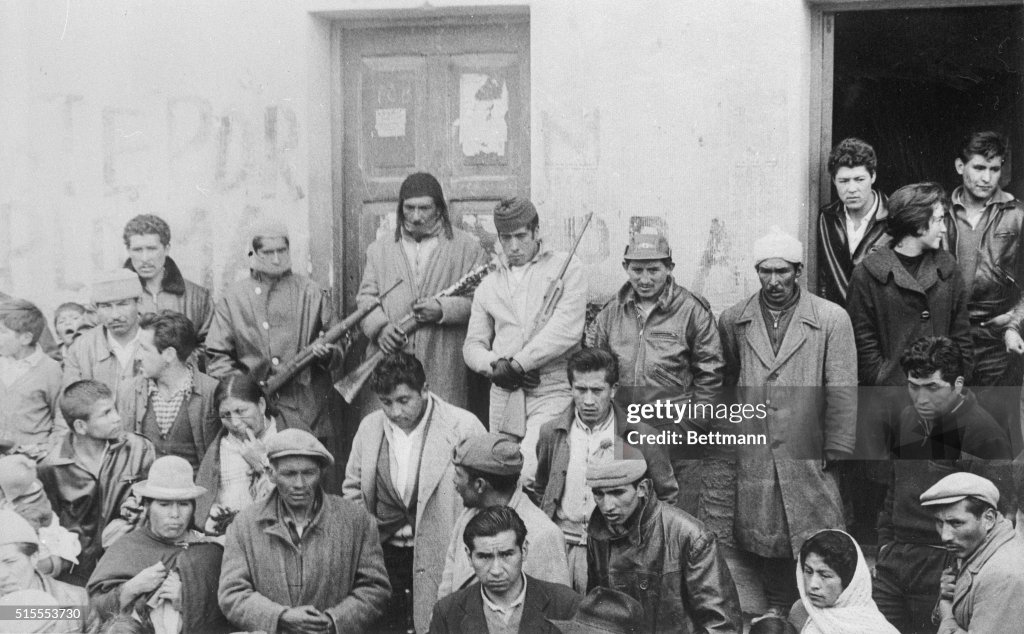
Three American officials and a peace corpsman arrived safely in Oruro tonight from Catavi, where rebellious tin miners had held them hostage with 15 other persons for 10 days in a vain effort to force the government to release two communist union leaders. The Americans will stay here overnight and go on to La Paz in the morning. President Johnson has instructed the United States air force to get them home in time for Christmas. Two other foreign hostages, a German and a Dutchman, were released with the other hostage. They remained in Catavi to continue to work as executives of the mines there.
Some of the hostages wept with joy when released. The Americans were brought to Oruro from Catavi by automobile. They were met by federal troops and United States Ambassador Douglas Henderson. Henderson gave them the news that President Johnson has ordered the air force to fly them to their homes to join their families for Christmas. The President said the Americans had “borne the long, distressing ordeal with great courage,” and added he was deeply gratified by their release. The Americans are United States information service officers Thomas M. Martin of New York, and Michael Kristula of Cadillac, Michigan; Bernard Rifkin of Montclair, New Jersey, labor specialist for the agency for international development; and Robert Fergerstrom of Honolulu, a peace corps volunteer.
Searchers recover the bodies of three American airmen, missing since their helicopter crashed into the sea off the South Vietnam coast. The bodies are recovered on the beach and flown to Saigon for an autopsy to determine the cause and manner of their deaths — from bullets or by drowning.
Secretary of State Dean Rusk urged the NATO allies meeting in Paris to support the Soviet Union in its continuing ideological quarrel with the Communist Chinese. Secretary of State Dean Rusk urges the NATO council of ministers to support Russia in its ideological quarrel with Red China as the lesser of two evils. “Peaceful cooperation” is preferable to Peking’s “militant belligerency.” Rusk tells a NATO meeting in Paris. President Johnson tells the parley that six United States army divisions will remain in Europe as long as they are needed.
The Soviet government announced a $660 million cut in the military budget for next year amid new indications Premier Nikita S. Khrushchev is serious about putting heavy emphasis on production of food and consumer goods.
President Gamel Abdel Nasser publicly saluted Communist China’s Premier Chou En-lai as “our distinguished guest and a symbol of the struggle of the Chinese people…”
Ignoring appeals for delay from both the Soviet Union and the United States,” the U.N. General Assembly’s special political committee voted to enlarge both the Security Council and the Economic and Social Council.
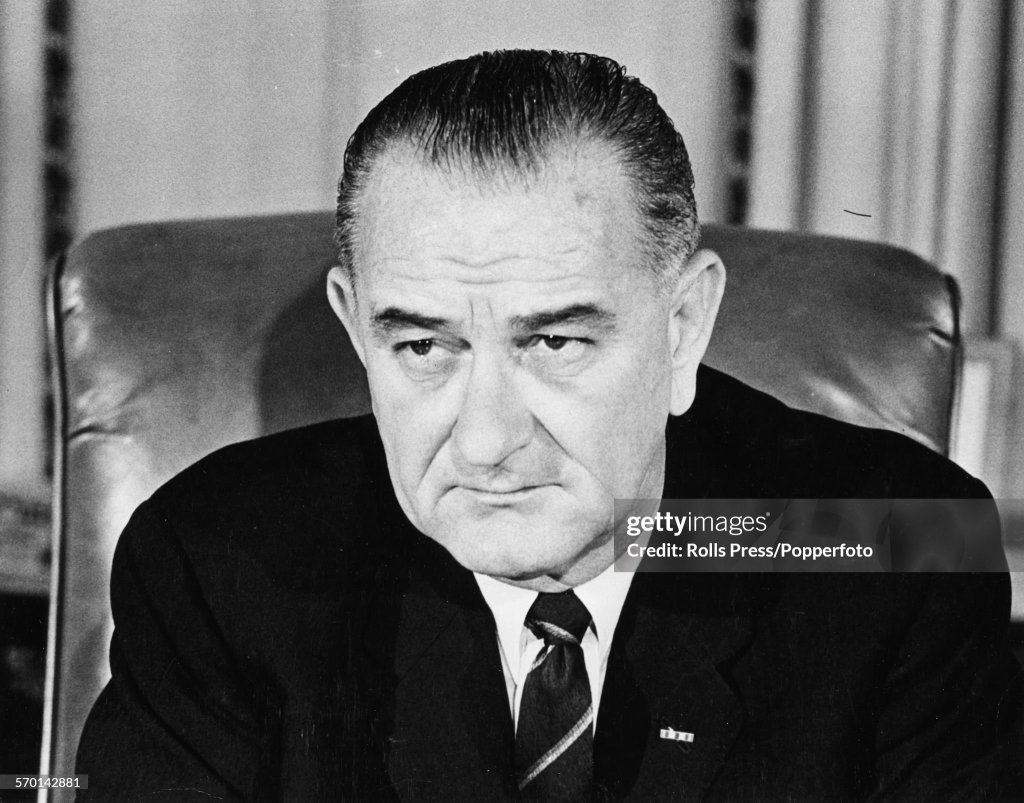
President Johnson is to address the United Nations General Assembly tomorrow in his first public speech, outside Washington, since taking office.
The United States moved to reduce shipping to Communist Cuba and thus further isolate Havana’s faltering economy from the rest of the free world.
A top congressional spokesman indicated President Johnson intends to upgrade the State Department’s top Latin American post as part of a wider administration shakeup now under way.
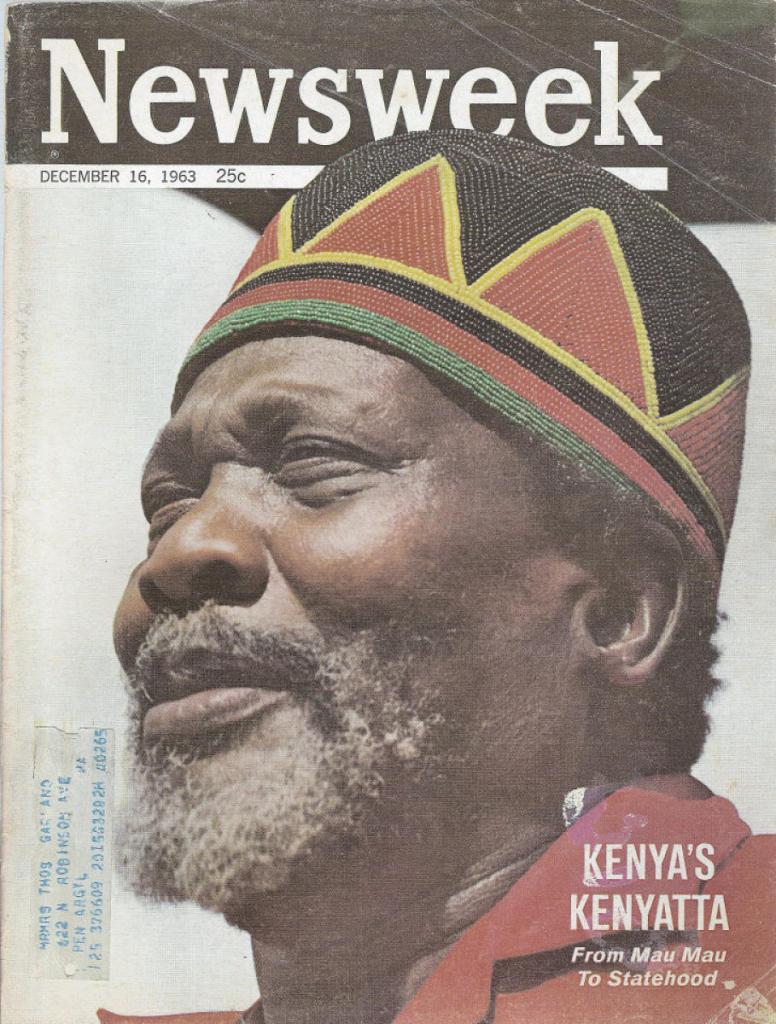
Zanzibar and Kenya entered the United Nations as its 112th and 113th members, upon unanimous recommendation of the 11 members of the U.N. Security Council and approval by the 111-member General Assembly.
Yen Chia-kan, also referred to in the U.S. press as “C. K. Yen”, was sworn in as Prime Minister of the Republic of China on the island of Taiwan, after being appointed by President Chiang Kai-shek. Yen would succeed Chiang as president on April 5, 1975.
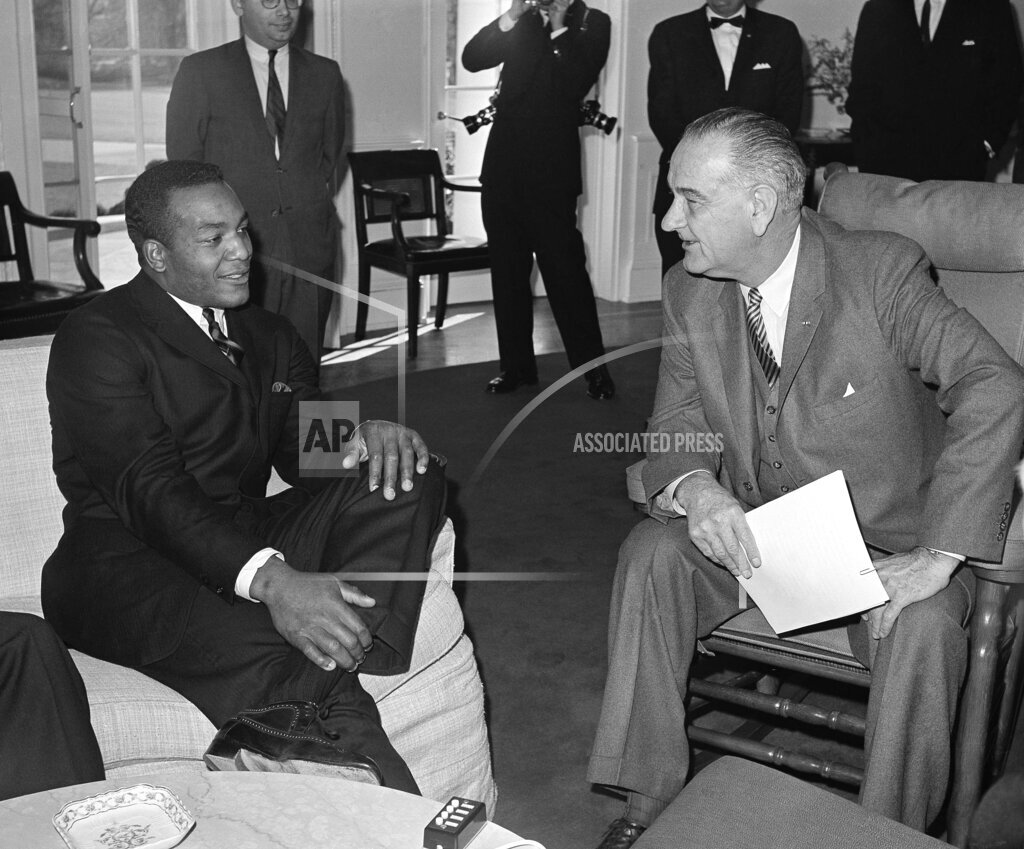
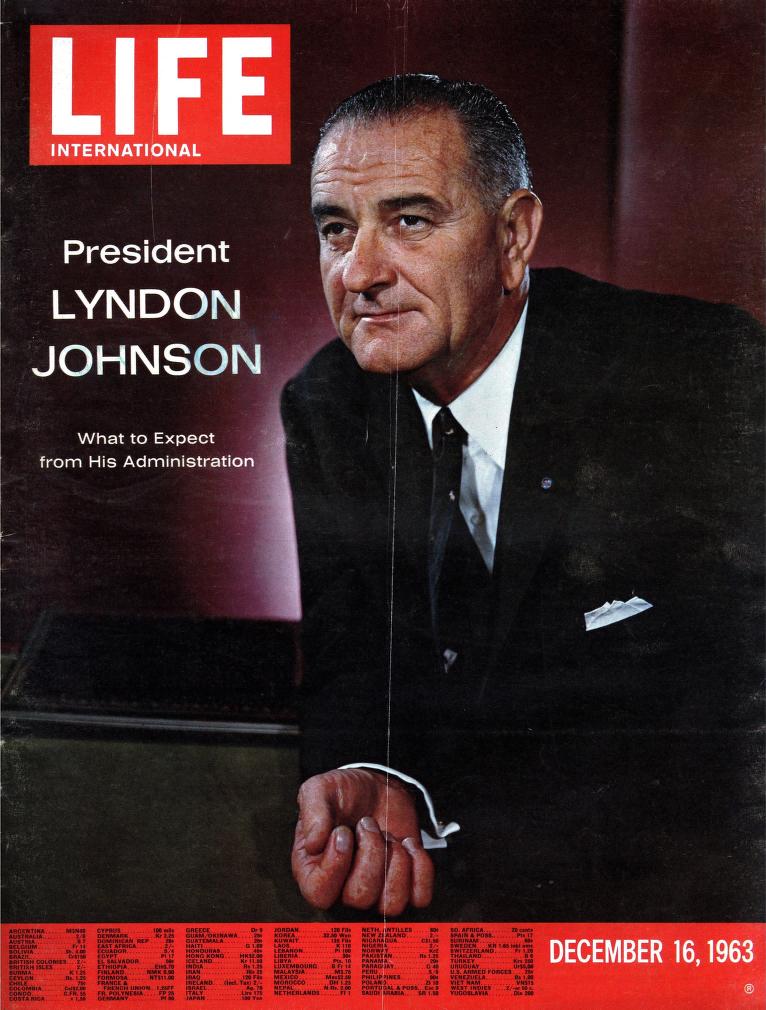
The first of the “Great Society” programs was enacted into law, as U.S. President Lyndon Johnson signed the Higher Education Facilities Act of 1963 The “Morse-Green Bill”, sponsored by U.S. Senator Wayne Morse and U.S. Representative Edith Green, both of Oregon, authorized the unprecedented spending of 1.2 billion dollars in loans and grants to public and private colleges and universities for construction, creation of new community colleges and graduate schools, and aid to students. The signing ceremony was the first where Johnson would introduce a tradition that would be followed by his successors— the use of more than one pen in order that multiple souvenirs could be presented to favored senators, Congressmen and supporters as a reward for their work. “There are only 14 letters in ‘Lyndon B. Johnson’,” reporter Philip Dodd would note on the occasion of a signing ceremony three days later, “but the President was able to use 34 pens to write his signature.” He would note that as of “the fourth bill signing ceremony in the White House since Monday. The President has used— and given away— 169 pens in the process.”
The House today gave President Johnson a one-two legislative punch, approving the biggest foreign aid cut in 10 years and imposing restrictions on the pending wheat sale to Russia. These two setbacks came on Johnson’s 25th day in office, signifying an end to a period in which the new President had been granted all he demanded in the name of his assassinated predecessor. Appeals were made to give the President “a vote of confidence” on the eve of his appearance tomorrow before the United Nations. They proved futile. His strictures on the dangers of reduced foreign aid were quoted and ignored.
On roll call votes, the House took these actions:
- Passed and sent to the Senate, by a vote of 249 to 135, an appropriation bill providing 2 billion, 801 million dollars for military and economic aid to foreign nations. This was 800 million less than the 3.6 billion which could have been appropriated under an authorization bill, and more than 2 billion less than President Kennedy had suggested as essential last January.
- Adopted an amendment to the bill, by a vote of 218 to 169, which prohibits the Export-Import bank from guaranteeing credits in the current wheat deal with Russia or in any other transaction involving the sale of commodities to communist countries. This issue had been deemed dead when the Senate on November 26 defeated, by a vote of 57 to 35, a similar proposal by Senator Karl Mundt (R-South Dakota). Now it is revived as a subject for controversy in the last days of the 1963 session.
Events moved so fast that the President was issuing a statement on the “dangerous reduction of funds” involved in authorizing only 3.6 billion dollars in foreign aid as the House was voting to appropriate 2.8 billion.
The Senate committee revising the 11-billion-dollar tax cutting measure makes campaign contributions deductible for the first time in the history of the United States income tax. A maximum of $50 would be deductible, under the amendment proposed by Rep. Carl Curtis (R-Nebraska). By a vote of 11 to 5, the committee rejects a proposed $20 credit, in favor of the Curtis amendment.
Chief Justice Earl Warren said it “would serve no useful purpose at this time to make public the findings of an FBI report on the assassination of President Kennedy and the murder of Lee Harvey Oswald.
First public session of the Robert G. Baker investigation will be today when the Senate Rules Committee questions the widow of one of Baker’s business partners.
The U.S. Supreme Court overturned the contempt convictions of two officials of the National States Rights Party, an Alabama segregationist group.
Two Michigan Republicans, Rep. Victor A. Knox and John B. Bennett, offer a House bill authorizing the federal government to pay about 66 million dollars for the Mackinac bridge linking the upper and lower peninsulas. If approved, the five-mile toll bridge will be opened to free travel. The bill’s backers say high tolls, necessary to retire the bonds that financed the bridge construction, have choked traffic over the bridge, and the state is unable to meet its obligations to the bond holders.
The Ford Motor company’s experimental garage in Dearborn, Michigan, is doing preliminary work on the bubble top limousine in which President Kennedy was riding when assassinated to make it bullet proof. The final job of adding armor will be done in Cincinnati before the Continental is turned over to the secret service for use by President Johnson.
A coal mine in central Utah was wracked by a violent, searing blast today, killing nine of 19 miners working a half mile underground. One of the survivors was injured seriously but was in fair condition. The other survivors, unaware of the explosion until notified by company officials, joined rescue teams in searching through the gas filled, debris cluttered section of the mine where the victims later were found. They came to the surface after the bodies were hauled out on ore cars. Martin, the scene of the blast, is located 2 miles from Helper, Utah.
The engine and 10 cars of the Santa Fe railroad’s Chicago bound San Francisco Chief are derailed when the train hits a truck at a crossing four miles west of Clovis, New Mexico. Eight persons, including the truck driver, are treated for minor injuries in a hospital.
Sybil Burton, the wife of Richard Burton, actor, was granted a Mexican divorce today on charges that he abandoned his home and subjected her to cruel and inhuman treatment. A friend of Burton said the divorce means the British actor will marry Elizabeth Taylor. In Beverly Hills, California, Eddie Fisher, estranged fourth husband of Miss Taylor, exclaimed, “Marvelous! Bravo!” Then he broke into song.
Martin Gang, Miss Taylor’s lawyer, said his partner, Mickey Rudin, was in New York conferring with Fisher’s lawyer about a settlement to clear the way for a divorce between the actress and the singer. Fisher said, “I will do anything to make Elizabeth happy. I wish her only the best.” The Burton divorce was obtained in Puerto Vallarta, a Pacific coast resort where Mr. Burton and Miss Taylor have been staying during shooting of a movie in which Mr. Burton is a star.
The Saturday Evening Post issued its Kennedy memorial edition with cover by Norman Rockwell.
Dow Jones Industrial Average: 761.64 (+1.47).
Born:
Benjamin Bratt, American actor (Detective Reynaldo Curtis-“Law & Order”), in San Francisco, California.
James Mangold, American filmmaker (“Girl, Interrupted”; “Kate & Leopold”; “Walk the Line”; “Logan”), in New York, New York.
Tim Green, NFL linebacker and defensive end (Atlanta Falcons), in Liverpool, New York.
Arnold Franklin, NFL tight end (New England Patriots), in Cincinnati, Ohio.
Chris Jelic, MLB leftfielder (New York Mets), in Bethlehem, Pennsylvania.
 History Diaries