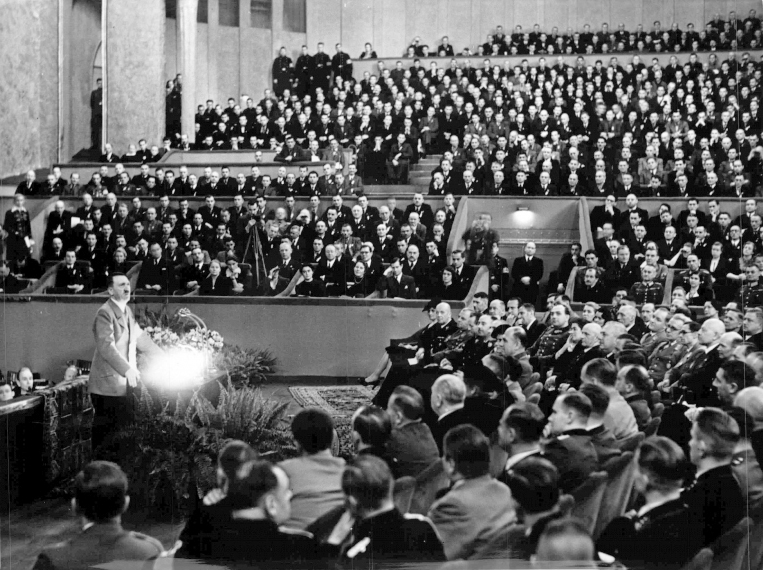
At the opening ceremony of a new section of the Autobahn in Rangsdorf, Joseph Goebbels told the German people that the territories occupied by the Reich were “still too small to meet our vital needs.” Referring to the incorporation of Austria and Sudetenland into Germany, he said: “We have enlarged our living space, but it is still too small to satisfy our vital needs. If we have managed to pull through so far, we owe this to our industry and our intelligence.” The propaganda minister spoke at Rangsdorf, near Berlin, at the opening of the 3,000th kilometer [1,864th mile] of the nation’s new superhighways.
The net of two-lane automobile roads will be extended to total about 9,000 miles at an estimated cost of 2 billion 500 million dollars. When the roads are completed Germany’s mechanized divisions will be able to speed from the fortifications on the western frontier facing France to the Hungarian, Jugo-Slav, or Polish borders, or from the Baltic to the Italian frontier. Goebbels in his speech sarcastically referred to critics of the methods employed by the Nazi régime. He illustrated this with a story. Two Viennese workers, he said, were trying to remove a cobblestone in a lackadaisical fashion, but failed. A Berlin worker, who happened to be passing, dislodged the stone with one. forceful blow of his pickaxe, whereupon the Viennese exclaimed: “Why, of course, if you use force!” “It does not matter whether or not you use force, the main thing is that you accomplish your task,” Goebbels commented.
Reichsführer Hitler in an address to 3,000 road workers said Germany had about reached the limit of her food production. He said the country’s consumption would have to be adjusted accordingly. Germany’s declared lack of land and how this shortcoming can be remedied not only is occupying the attention of leaders of the nation. For the first time German hopes for the creation of an independent nation of 45,000,000 Ukrainians now living in Soviet Russia, Poland, Rumania, and Czecho-Slovakia were openly discussed in the German press. One of East Germany’s leading newspapers, more remote from censorship than the metropolitan press, said: “It would be wise for Europe to watch developments in the Ukraine very carefully lest it be surprised some day by events, the extent of which we cannot estimate today.”
Reichsbank president Dr. Schacht meets with Refugee Committee members to present a plan for Jewish emigration. The German plan demands a ransom for each Jew released. While unsavory, the plan opens the door to negotiations with Germany.
In Germany, the first installment of the one-billion-mark fine is due from Jews. Those with over 5,000 marks must pay 5 percent of their owned wealth.
Prime Minister Chamberlain reminds the leaders of Germany that Britain has greater cash resources and might outlast other nations in a war.
By decree, General Franco of the Spanish insurgency restores citizenship to deposed King Alfonso. The Nationalists announced the restoration of the citizenship and property of Alfonso XIII. The law not only restores Alfonso’s full legal rights, but also restores all his personal estates and properties in Spain. Included is the famous summer palace, Magdalena, in Santander. Of course, the rebels’ ruling actually could apply only in that part of Spain controlled by them. It had been reported last year that Franco might agree to put Alfonso’s youngest son, Prince Juan, on the Spanish throne and that Alfonso would not object. Alfonso left the throne and went to France on April 14, 1931, the day the Spanish republic was proclaimed. He has lived in Italy most of the time since then. There are two factions of monarchists who have backed Franco. They are the Carlists, followers of an old line of rival Spanish kings who had maintained claims to the Spanish throne for a century, and the Rennovacion Espanolists, who backed Alfonso. Both have agreed to a possible return of Prince Juan. Juan, like his father, is in Rome.
The Spanish government reveals that members of a spy ring have been tried, with 200 death sentences and 200 prison terms meted out. The Juan Negrín government in Spain claimed to have uncovered a Nationalist espionage ring and put 200 people on trial. The ring was said to have tried to foment an uprising in government Spain last August and to spread sedition among government offices. Its leader, the communique said, was a major on the government general staff, who later was identified as Major Antonio Aimat Marec, a friend of General Francisco Franco, rebel chief. He was accused of signaling directions to rebel bombing planes. The communique said members of the ring included army officers, physicians, lawyers, and priests. One group was said to have organized detachments of the Spanish Fascist Falange in Barcelona. Another was accused of dealing with police agents to spread sedition among government employees. The spies were said to have been organized not only in Barcelona but in mountain towns around the government capital. Because of a truce between the combatants against executing prisoners, none of the condemned men have been executed, it was said.
Two rebel attacks were launched today on widely separated fronts in Spain. Reports tonight indicated the fighting had been suspended, but the assaults were considered as developments in the planned insurgent general offensive. In northeastern Spain the forces of General Francisco Franco attacked government lines defending Catalonia. There the fighting was near the town of Tremp, southwest of the village of Puigcerda, railroad gateway from loyalist Spain into France. The other insurgent assault was in Estremadura, in the far southwest. Rebel infantrymen, attacking after a tank charge, assaulted government lines near Valsequillo, about forty miles southwest of the rich Almaden mercury mines which the loyalists hold. Loyalist dispatches said the rebels made no gains and that government troops made a counterattack on the Estremadura front.
The French Chamber of Deputies plunged into the 1939 budget tonight to rush its passage and keep the wheels of rearmament running. It put aside temporarily any debate on foreign dangers and, at the request of Premier Édouard Daladier’s government, chairmen of chamber party groups agreed to limit the budget debate to sixty-two hours. Finance Minister Paul Reynaud rejected protests that the proposed limited discussion of the budget was “ridiculous” and “discredits the parliamentary régime.” Speedy action is necessary, he said, for the success of his recovery plan. It is designed to help France bear her arms burden. The budget allotted more money for armaments than any since the world war. Nearly 40,000,000,000 francs [about $1,052,000,000] for the nation’s armed forces was distributed in various parts of ordinary and extraordinary budgets.
In two separate incidents in Palestine, a British soldier and a prominent Arab are shot to death. The Arab was an enemy of the Mufti of Jerusalem.
The United States sends a fourth note to Germany, demanding that American citizens not be subject to anti-Semitic laws.
The United States extends a $25 million credit to China through the Export-Import Bank.
Commerce Department Secretary Daniel C. Roper resigns.
At the Dies Committee’s last public hearing, Bishop Leonard of the Methodist Episcopal Church testifies. He says Labor Secretary Frances Perkins should be replaced by a man and that aliens on relief rolls should be deported. He also suggests that publications of the government printing office be closely examined.
Fingerprints reveal that McKesson and Robbins head F. Donald Coster is actually felon Philip Musica, a lifelong swindler.
The combination of the T10 gun and T5 carriage was officially adopted by the U.S. Army as the 37 mm Gun M3 and Carriage M4.
Ground is broken in Washington, D.C., for the new Jefferson Memorial.
Torrential rain in Los Angeles cause flooding. Entire residential blocks are flooded. At sea, the vicious storm kills two fishermen.
The Red Sox send Pinky Higgins and pitcher Archie McKain to the Tigers for pitchers Eldon Auker and Jake Wade, and outfielder Chet Morgan. The Sox also ship outfielder Ben Chapman to the Indians in exchange for pitcher Denny Galehouse and shortstop Tom Irwin.
Ecuador’s President is forced to accept a compromise by the army, which supports Congress. Elections will be held January 15, and Congress will meet February 1 to elect a new President. President Mosquera Narvaez will step down at that point.
General Chiang Kai-shek flies to Sian in Shensi province to inspect defenses. Japanese artillery is active daily in Shensi.
Japanese troops report limited success against guerilla bands near Shanghai, Chekiang province, and north of Nanking. They claim to inflict casualties and drive the bands away.
Nobutake Kondo was named the commanding officer of the Japanese 5th Fleet.
Raizo Tanaka stepped down as the commanding officer of light cruiser Jintsu and was named the Chief of Staff of the Mako naval port at Pescadores islands, Taiwan.
Former governor James Fugate is killed on the Philippine island of Mindanao. An American educator, Fugate lived in the Philippines for over 35 years.
Military hero Pibul Songgram becomes Prime Minister of Siam. There have been two attempts on his life — by gunshots, and poison — in the past six weeks.
Dow Jones Industrial Average: 151.82 (-0.01).
Born:
Bob Foster, American boxer (world light-heavyweight champion 1968-74), in Lubbock, Texas (d. 2015).
Fred Anton Maier, Norwegian speed skater (Olympic gold 5,000m, 1968, bronze 1964, silver 10,000m, 1964, 1968; 11 world records), in Nøtterøy, Norway (d. 2015).
Billy Shaw, AFL guard (Pro Football Hall of Fame, inducted 1999; AFL Pro Bowl, 1962-1969; Buffalo Bills), in Vicksburg, Mississippi.
Doug Elmore, NFL punter (Washington Redskins), in Reform, Alabama (d. 2002).
Naval Construction:
The Regia Marina (Royal Italian Navy) Liuzzi-class submarine Alpino Bagnolini is laid down by Cantieri Navale Tosi di Taranto in Taranto, Italy.
The Kriegsmarine (German Navy) Type IXB U-boat U-64 is laid down by AG Weser, Bremen (werk 952).
The Koninklijke Marine (Royal Netherlands Navy) minelayer HrMs (HNMS) Willem van der Zaan (M 08), sole ship of her class, is launched by Nederlandse Droogdok Maatschappij (Amsterdam, Holland).
The Nihon Kaigun (Imperial Japanese Navy) Chitose-class seaplane tender Chiyoda (千代田, “Thousandth-Generation Field”) is commissioned. Her commanding officer on commissioning is Captain Kaku Tomeo.
[After the IJN suffered the debacle at Midway, Chiyoda was converted from a seaplane tender to a light aircraft carrier at the Yokosuka Naval Arsenal beginning 16 January 1943, with the work completed on 21 December 1943.]
 History Diaries