Neville Chamberlain spoke to 600 journalists and diplomats at the Foreign Press Association jubilee dinner in London, saying there would be no letup in British rearmament even though he was convinced that the wish of the British and German people remained “still what it was recorded to me in the Munich Agreement — namely, never to go to war with one another again, and to settle any difference that might arise between us by the method of consultation.” There were a number of empty seats at the function because the Germans boycotted after seeing an advance copy of the speech, which included a passage criticizing the German press for its tone and for rarely showing “any sign of a desire to understand our point of view.”
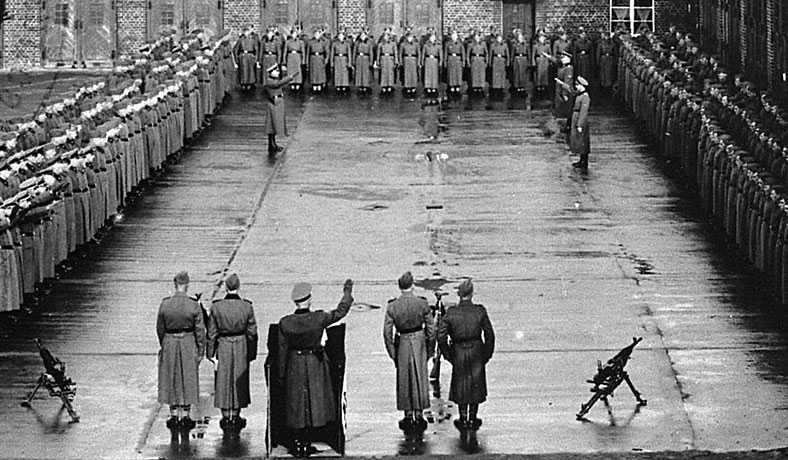
The Neuengamme concentration camp opened. Near Hamburg, Germany, 100 prisoners from the Sachsenhausen detention facility begin work on the Neuengamme concentration camp. The SS established a sub camp of the Sachsenhausen concentration camp in an abandoned brick factory in the Neuengamme suburb of Hamburg. In the early summer of 1940, Neuengamme became an independent camp and remained the main concentration camp in North-West Germany until 1945. The Gestapo and the SS security service sent tens of thousands of people from across occupied Europe to Neuengamme concentration camp. Later the camp was expanded.
Overall, 80,000 men and more than 13,000 women were registered and issued a prisoner number at Neuengamme concentration camp. Another 5,900 people were either not listed in the camp registry, or they were filed separately. It has been verified that at least 42,900 people lost their lives due to deliberately poor living and working conditions. Another several thousand prisoners died after they were sent to other concentration camps, or they perished from the results of incarceration after their liberation. We must therefore assume that more than half of the approximate 100,400 prisoners in the Neuengamme concentration camp did not survive Nazi persecution.
Germany enacted a law to exclude Jewish doctors.
On 13 December 1938, Helene Gumpert received a piece of mail from the tax office in her home city of Parchim. It tersely informed her that she was obligated to pay 2,800 Reichsmarks, which were to be remitted to the tax office in four installments under the Judenvermögensabgabe (Jewish Property Levy). The first installment was due just two days later—on 15 December. At that point, Helene was 84 years old. She had raised four children with her deceased husband Gustav. Her family had lived in Parchim since at least 1804 and had contributed to the city’s success with a flourishing cloth trade and manufacturing business, carrying its name far beyond the borders of the state of Mecklenburg. After Gustav’s death in 1930, their sons Leo and Rudolph expanded the business to Hamburg. But this glory has long since faded. The cloth factory was “Aryanized” and the Gumpert brothers became ensnared in an agonizing legal battle with the buyers. During the particularly severe riots of Kristallnacht in Parchim, Rudolph was arrested and imprisoned in the Alt-Strelitz prison, while his brother Leo was sent to the Sachsenhausen concentration camp. Helene stood before the ruins of her life.
After the war, Jews in the Federal Republic of Germany could petition for financial compensation, including for loss of assets due to the “Jewish Property Levy.” It was important to provide documentation as proof for the compensation authorities. The 1938/39 statements from the tax offices suddenly took on a new significance: they were evidence of state-organized plundering. But for Helene Gumpert there would be no compensation. She died in Parchim in 1941, completely impoverished. Before she died, she had to witness her family home turned into a so-called Judenhaus, from which the last Jews in Parchim were gradually deported to their deaths.
Rumanian Premier Miron Cristea early this morning called a cabinet session for late today to devise new regulations for the control of Jews. Rumania apparently was seeking measures halfway between the pronounced anti-Semitism of the recent government of Octavian Goga and the present comparative lack of restraint on Jews.
Foes of President Smetona of Lithuania are arrested.
An urgent demand for greater discipline among Soviet workers was voiced today by Pravda, communist party newspaper, which attacked younger executives for their “intolerable liberalism.” Some of these executives, themselves workers who recently were promoted to leading jobs, hesitate to proceed energetically against “idlers, floaters, and disorganizers” of production, the paper said. Many workers seem to forget, it added, that the “seven-hour day established in our country is the shortest working day in the world and should consist of 420 highly productive minutes.”
The ambition of such persons seems to be ” to work less and receive more pay,” Pravda asserted. In a Moscow ball bearing factory, for instance, 10,661 days were lost through the inexcusable absences of workers during the second quarter of 1938. During the third quarter, Pravda continued, 19,380 days were lost through such absences. “These idle workers, these lazy fellows, these violators of labor discipline are taking advantage of the carelessness of some executives and are disorganizing production,” Pravda declared. It added that “the sooner they (executives) get rid of their intolerable liberalism the better it will be for industry.”
For forty-five minutes today President Roosevelt and Anthony Eden, widely regarded as the next prime minister of Great Britain, bared their minds to each other on the state of the world. Although neither would comment afterward, the information gleaned from their intimates was that the American President and the former British foreign secretary had found much in common in their views of the aggressions of the dictators in Europe and Asia and the possible effect thereof upon Great Britain and the United States.
The President and Mr. Eden were of one mind before the young foreign minister was compelled to resign from the cabinet by Prime Minister Neville Chamberlain’s decision to make terms with the dictators. Their conversation today took on an extraordinary significance because of the possibility of Mr. Eden’s being called to head the British cabinet during Mr. Roosevelt’s tenure in the White House. Mr. Eden could hardly have evoked a greater measure of official interest and deference had he been the British prime minister instead of merely a member of the House of Commons no longer connected with the government. He was received at the State Department by the acting secretary of state, Sumner Welles, who escorted him to the White House and presented him to the President.
Chairman Martin Dies (D-Texas) of the House committee investigating un-American activities declared in a radio address tonight that the failure of the Labor Department to deport alien agitators “is becoming a national scandal.” Chairman Dies and other members of the committee have suggested impeachment of Madame Secretary of Labor Frances Perkins because of her refusal to deport Harry Bridges, west coast CIO leader, and other alien communist revolutionaries. In his radio address tonight Dies expressed gratitude for the support of “millions of patriotic Americans,” who, he said, have not been deceived by propaganda against his committee.
Earlier today he predicted that the Roosevelt administration would exert “its full pressure” to prevent continuation of the committee’s investigation. The committee’s present authority expires January 2 and its $25,000 appropriation is about exhausted. Dies said he would seek another $150,000, which would enable his committee to employ counsel and expert investigators for a thoroughgoing investigation of communist, Nazi, and Fascist activities. He predicted that not more than 40 members of the House would vote against a resolution to continue the investigation, despite the opposition of the Roosevelt administration. President Roosevelt, Interior Secretary Harold L. Ickes, Secretary Perkins and other administration spokesmen whom Dies calls “purveyors of hatred” have denounced the committee because of its delving into the communist influences within the New Deal.
The President increases funding for the Federal Housing Authority from $2 billion to $3 billion, to insure home mortgages.
Los Angeles, California freezes at 28°F.
Clark Gable announced he was seeking a divorce from his estranged second wife Rhea. Friends of the actor disclosed that he planned to marry the actress Carole Lombard when the divorce was finalized.
Fred Frankhouse returns to the Boston Bees, and Joe Stripp goes to Brooklyn in a player swap. In a separate transaction, the Dodgers send Buddy Hassett and Jimmy Outlaw to the Bees for Gene Moore and Ira Hutchinson.
After several clashes, Ecuador’s President Mosquera Narvaez dissolves the Assembly and orders elections. Several Socialist Assembly members are arrested.
Chinese authorities claim more gains in several provinces, by both guerilla troops and regular army forces, including the capture of Waichow.
Chinese troops reported today that they had recovered virtually all the territory they had lost in Hunan province since the Japanese occupation of Yochow on November 12. Their latest asserted victories in the month-long counteroffensive included capture of three villages east of Yochow and took them across the Hupeh province border to within three miles of Tungcheng. They reported on Sunday that their forces farther to the west had advanced up the shore of the Tungting Lake to within five miles of Yochow. Tungcheng is about forty miles east of that salient.
Chinese dispatches also told of gains north of Hankow, former provisional capital, which is the base for operations on the Yochow front as well as those in Hupeh province to the west and north. As a result of the recapture of three important towns east of the Peking-Hankow railway, these reports said, most of the Japanese troops in that sector have withdrawn to Anlu, 100 miles northwest of Hankow. The three towns said to be held by the Chinese were Loshan, twenty-five miles east of Sinyang; Hwangchwan, sixty miles east of Sinyang, and Kushih, ninety miles east of Sinyang. Sinyang is a Japanese base on the Peking-Hankow railway 110 miles north of Hankow.
Chinese troops were reported moving closer to Canton in a big semicircle today causing the Japanese to withdraw into the city from previously conquered territory in South China. Japanese sources said Kwangtung province authorities were recruiting additional troops under a new order from Generalissimo Chiang Kai-shek to launch a counterattack on the invaders.
Dow Jones Industrial Average: 149.59 (+0.94).
Born:
Tony Gomez, British rock keyboardist (The Foundations – “Baby Now That I’ve Found You”; “Build Me Up Buttercup”), in Colombo, Ceylon (now Sri Lanka) (d. 2015).
Heino, singer, in Düsseldorf-Oberbilk, Germany.
Gus Johnson, NBA power forward and small forward (ABA Champions-Pacers, 1973; NBA All-Star, 1965, 1968-1971; NBA: Baltimore Bullets, Phoenix Suns, ABA: Indiana Pacers), in Akron, Ohio (d. 1987).
Roger Shoals, NFL tackle (Cleveland Browns, Detroit Lions), in Baltimore, Maryland.
Died:
Leandro Verì, Italian carabiniere, shot in line of duty (b. 1903).

 History Diaries