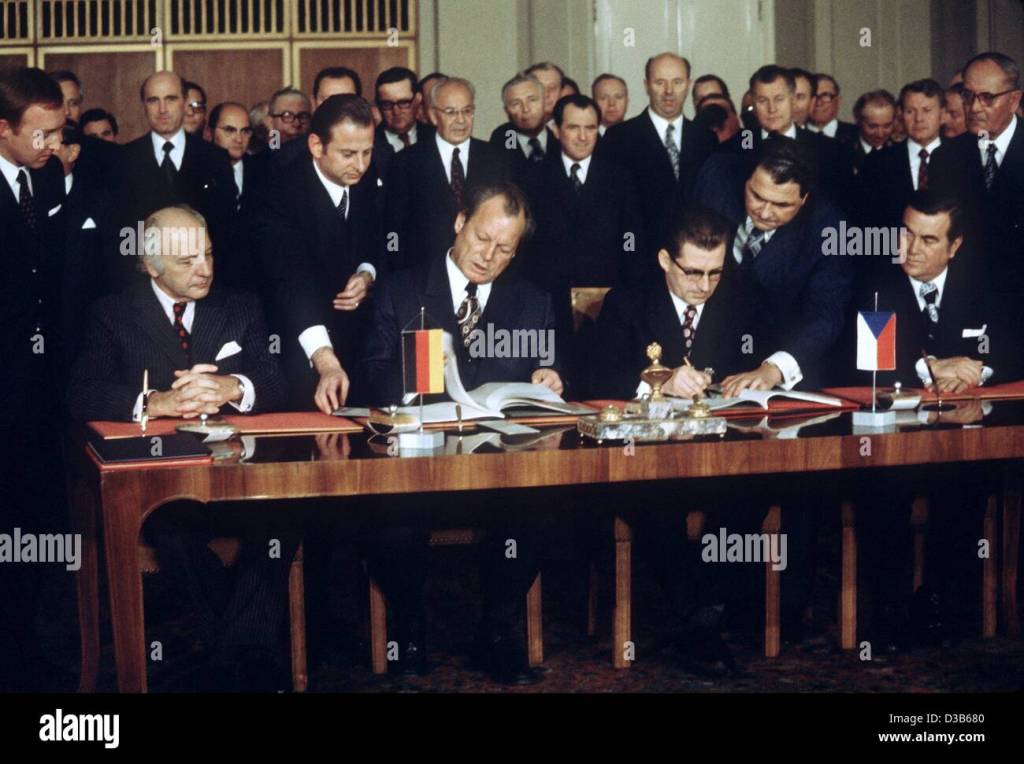
The Treaty of Prague was signed by the West Germany and Czechoslovakia. The two states established diplomatic relations, and declared the 1938 Munich Agreements to be null and void, acknowledging the inviolability of their common borders and abandoning all territorial claims. West Germany and Czechoslovakia put 35 years of bitterness behind them today as Chancellor Willy Brandt flew here and signed a treaty establishing relations between them. Mr. Brandt, in a television speech to the German people from Prague afterward, said: “No one could simply pretend that the Munich Treaty of 1938, which was carried out to such absurd lengths, never happened. But we would like to build bridge over the gap.”
Security precautions have been increased for Secretary of State Henry Kissinger. In London, Kissinger will meet with British Prime Minister Heath and Foreign Secretary Douglas-Home. The U.S. State Department confirmed that assassination threats were made against Kissinger, reportedly by Palestinian terrorists. Earlier, Kissinger had been in Brussels for a meeting with NATO foreign ministers.
Secretary of State Kissinger arrived here from Brussels tonight after three days of talks with allied officials that apparently succeeded in easing recent strains within the Atlantic alliance. In statements issued at the close of the winter meeting of the North Atlantic Treaty Organization, Mr. Kissinger and the European foreign ministers seemed to agree that their discussions had significantly improved the atmosphere in the alliance. Just yesterday, Mr. Kissinger and the French Foreign Minister, Michel Jobert, had a sharp exchange during a NATO session. But today Mr. Kissinger joked about “the dramatic accounts of the great confrontation” in the press, and Mr. Jobert said that the talks were important “from a psychological point of view.”
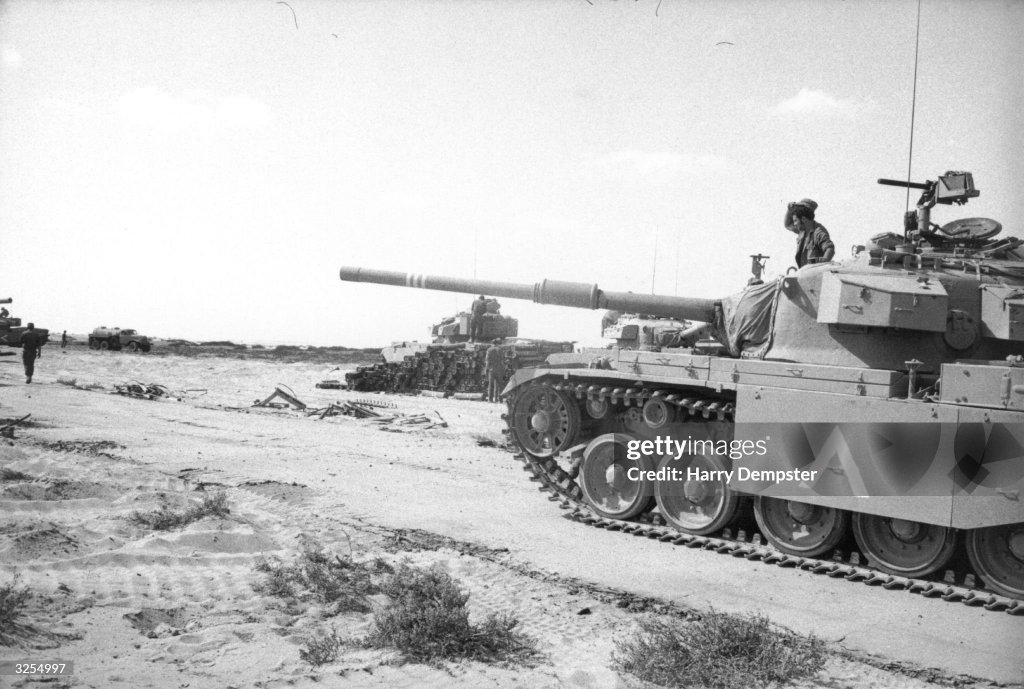
Israeli Defense Minister Moshe Dayan warned that Israel won’t participate in the Mideast peace talks in Geneva unless Syria releases a list of Israeli POWs it is holding.
The relative unity with which the Arabs waged war against Israel in October is showing signs of fragility as the opening of a Middle East peace conference draws near. With Secretary of State Kissinger about to arrive for his second trip to the region since the war, the Arabs now seem to be in agreement only on their demand for a prompt Israeli withdrawal from Arab lands occupied since 1967. Beyond that, the Arabs do not appear to have worked out a unified bargaining position, and issues such as recognition of Israel, the future of Jerusalem and the “rights of the Palestinian people” are clouded by contradictory statements and, in some cases, violent disagreements.
In Baghdad, Iraq, yesterday, Mr. Arafat reportedly told an assembly of Palestinians that the resistance movement he heads would never “recognize Israel nor sign a peace treaty” and would oppose any Arab government that did so. This stand appeared to be shared by Colonel Muammar el-Qaddafi, the Libyan revolutionary leader, who sent a telegram to President Suleiman Franjieh of Lebanon opposing the prospective peace conference. Colonel Qaddafi said that peace talks would lead to “recognizing the existence of Israel” and might introduce international peace‐keeping forces in the area “that would block the frontier in the face of Palestinians who will find themselves compelled to fight for return to their homelands.”
The U.S. House of Representatives, voting 362 to 54, approved $2.2‐billion in emergency military assistance to Israel while the Senate Appropriations Committee voted a 50 per cent reduction in military aid for South Vietnam and Laos. Most of the aid to Israel will be given in the form of grants to offset the cost of weapons she has received from the United States.
The House passed a trade reform bill to forbid loan credits to the Soviet Union unless that nation’s emigration restrictions are eased. The House cast a resounding vote against the Soviet Union’s emigration policies and then approved and sent to the Senate the most comprehensive foreign trade bill in at least 40 years. In two separate votes, the House decided by overwhelming margins to deny lower tariffs or export credits to the Soviet Union unless the President can certify that the Russians do not restrict emigration, by high taxes or other means. The chief motive behind the two votes‐319 to 80 and 298 to 106—was opposition to the Soviet restrictions on the emigration of Jews.
A campaign is under way in the Soviet Union to modernize economic management, automate the planning system and upgrade industry to stimulate lagging technological growth and keep up with the West. The first of three articles on the Soviet Union’s efforts to make its planned economy more productive and efficient appears today.
The Iranian Government announced that it sold oil at an auction for as high as $17.40 a barrel, which represents a quadrupling in price, the Associated Press reported from Teheran. The new price could play havoc with the economies of nations, particularly those already facing serious inflation threats, oil industry sources said.
President Habib Bourguiba of Tunisia arrived today to confer with President Pompidou on the repercussions of the Arab oil embargo on Arab‐European relations According to the Tunisian press agency, Mr. Bourguiba said before leaving Tunis that Col. Muammar el‐Qaddafi, the Libyan leader, and President Houari Boumediene of Algeria had assured him that France, Germany, Austria and Britain would continue to receive the gasoline they needed. Mr. Bourguiba’s visit came three days before Mr. Pompidou and other chiefs of government in the European Economic Community were to meet in Copenhagen to discuss the energy crises among other issues.
Less than two weeks after Leonid I. Brezhnev’s visit to New Delhi, Indian officials as well as foreign diplomats are sharply divided over its impact. Some diplomats, especially Europeans, are convinced that the Soviet party leader gained major economic and political leverage here and tacitly advanced the doctrine of Asian security. Other diplomats, and most Indians, maintain that the agreements strengthened the economic friendship between the two nations but that Prime Minister Indira Gandhi had to pay no political price. “We were not bullied and we are not toeing their line,” said one Government official. “We are too big and too independent to be told what we do.”
But one diplomat said: “I can’t help feeling that the Indians, in relation to the Soviet Union, take short‐term steps to satisfy immediate needs, The Soviet Union pursues a long‐range policy and uses these commitments to tie more strings around India. The Indians think that they can handle the Soviets and keep their independence entirely. But I think they are deluding themselves.” Details of the 15‐year economic agreement have not been disclosed, but it is known that Soviet assistance will focus on Indian needs in steel, coal mining, oil exploration and power generation. Trade between the countries may increase as much as 200 per cent by 1980.
Carlos Andres Perez, the apparent winner of Venezuela’s presidential election this past Sunday, campaigned on a platform of using his nation’s oil as a political weapon against industrialized countries.
The question of whether long space flights can be depressing, cause lethargy and mistakes by astronauts, is under study by doctors in view of the Skylab 3 crew’s performance. Doctors are privately concerned about the crew’s slow response in adapting to space flight, particularly in comparison with the two previous crews. Dr. Charles Berry, director of life sciences for the National Aeronautics and Space Administration, said, “We are trying to do some evaluation of their attitude, an evaluation of the crew load and their response.” But he added: “I think we get into trouble trying to compare crews. I don’t know what is causing their slowness. They seem to be more fatigued and seem to need more sleep. It may be an individual variation They may have a feeling of being pushed.”
In regard to whether the crew — Lieutenant Colonel Gerald P. Carr of the Marines, Dr. Edward G. Gibson, a scientist, and Lieutenant Colonel William R. Pogue of the Air Force — has been pushed too hard by flight controllers in attempts to get the most out of a mission, one flight controller, Don Puddy, said last night: “There have been cases where the crew pushed us, and cases where we pushed the crew. Initially we started out with a heavy schedule because we had just ended a mission where the schedule was very heavy. We were in the process of trying to find a happy medium.” Mr. Puddy said the average work day now is about nine hours per man and that it could be decreased or extended, depending on how the controllers and crew decide is the best way of running the mission.
President Nixon’s top economic adviser Herbert Stein reported that the oil shortage may not be as critical as expected, although the energy crisis is dire. Stein outlined a grave economic outlook for 1974 because of the energy crisis, with increased fuel costs, unemployment, and a higher cost of living.
President Nixon, in a reversal of policy, has shifted the Environmental Protection Agency’s authority to set radiation standards for individual nuclear power plants to the Atomic Energy Commission.
Frank Ikard, president of the American Petroleum Institute, stated that the energy crisis is real, and Americans must learn to conserve. The federal government announced plans to set up car pools in metropolitan areas.
The Nixon Administration reportedly plans to require a reduction of gasoline production by as much as 20 per cent as part of proposed regulations on the distribution of crude oil and all petroleum products.
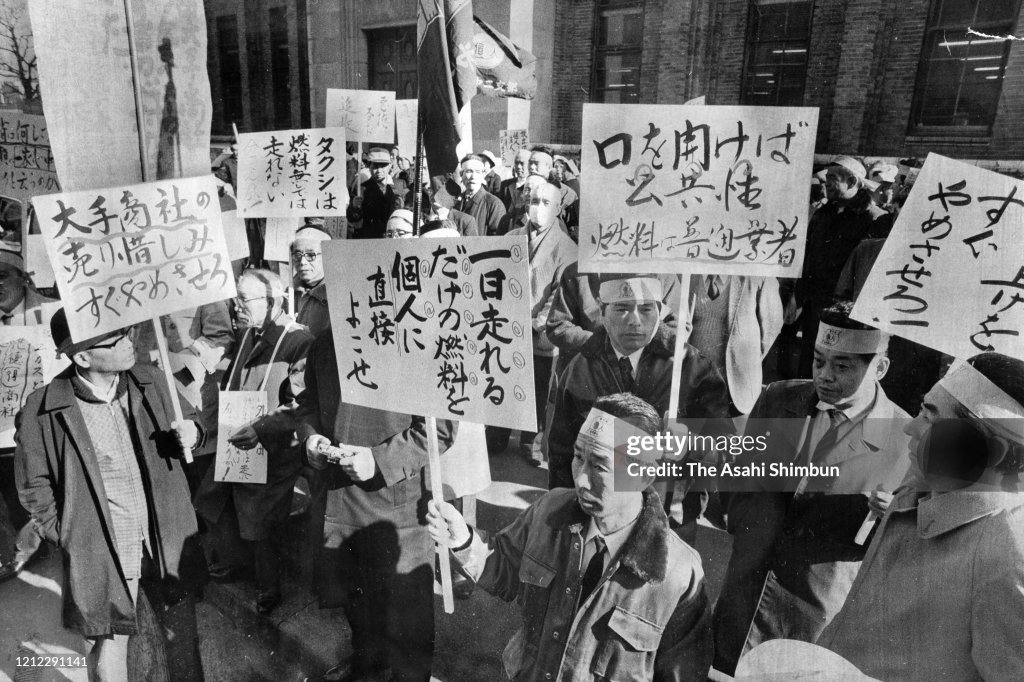
Truck drivers remain upset over high fuel costs and low speed limits. Truckers are threatening work stoppages unless their demands are met. No more road blocks will be put up; truckers will simply stop working. Teamsters president Frank Fitzsimmons said he doesn’t think a work stoppage is likely, however. Truckstop operators today attended a meeting called by Transportation Secretary Claude Brinegar. Unless more fuel is allocated, airlines will be affected severely, just as the trucking industry has been.
Administration energy czar William Simon approved indoor Christmas tree lights, but all outdoor holiday lighting is likely to be banned soon. Eli Reich, who was in charge of the Petroleum Allocation Office, resigned today following conflicts with Simon.
President Nixon and Republican leaders in Congress held a strategy meeting for the 1974 congressional elections. Watergate was not mentioned. National party chairman George H.W. Bush declared that not only was Watergate never mentioned at the meeting today, Watergate won’t be the main issue in the elections. Senator William Brock, however, acknowledged Watergate’s effect on the Republican party but agreed with Bush that the main issues in ’74 won’t include Watergate.
In President Nixon’s recently-released financial statement, the subject of California taxes was skirted. But that topic became a hot issue at a meeting of the Franchise Tax Board in Sacramento.
State controller Houston Flournoy insisted that the President will be accorded the same privacy as any other citizen. Democrat William Bennett demanded that the President be charged with tax evasion and that he be sent a bill for back taxes. The two Republicans on the board disagreed with Bennett. Bennett then accused the board of giving President Nixon preferential treatment; accusations and angry words flowed freely between Flournoy and Bennett until the meeting was adjourned.
Judge Charles Richie ruled that the organization formed by consumer advocate Ralph Nader is eligible for tax-deductible donations, but White House pressure kept Nader’s organization from getting the deductions.
New York Governor Nelson Rockefeller announced his resignation. Rockefeller insisted he does not plan to be a candidate for president in 1976, but was unsure about future plans regarding the presidency. Rockefeller stated that he will now devote full time to two national commissions which are attempting to deal with America’s problems. Rockefeller claimed that his resignation isn’t a “trick”, but all of his actions point directly to him having an eye on the White House.
The resignation of Governor Rockefeller, the most powerful New York politician in the last 15 years, weakened the state Republican party and gave Democrats their best hope of victory in more than a decade, politicians in all parties agreed.
Republican handicappers in Washington and around the country said that Nelson Rockefeller had finally learned some of the basic rules of Presidential politics. The big question among Republicans is whether he has learned those lessons too late.
The Supreme Court ruled that police may fully search any person who has lawfully been arrested, and any evidence found during a search may be used against that person. In a 6‐to‐3 decision, the court said that such personal searches need not be confined to cases in which a police officer was frisking a suspect for dangerous weapons or looking for evidence of the crime for which the suspect had been arrested.
A Federal judge ordered the Internal Revenue Service to grant tax‐exempt status to a public interest research group on the ground that the refusal of the White House to give the judge some documents in the case constituted an admission that the White House had exercised improper pressure on the IRS.
Elite Army airborne units, synonymous with masculinity, are facing changes. At Fort Benning, Georgia, Pvts. Joyce Kooch and Rita Johnson have become the first females in the paratrooper unit. Veteran jumpers were resentful of the allegedly watered-down training received by Kooch and Johnson. Sgt. Larry Taylor said he believes that the public will resent female paratroopers.
Ford, Chrysler and American Motors announced immediate price increases after the Cost of Living Council lifted price controls.
Tonight’s CBS news broadcast was interrupted earlier in the program by a disturbance caused by a member of the “Gay Raiders” who was protesting the defamation of homosexuals on entertainment programs.
The U.S. aircraft carrier Kitty Hawk (CVA-63) caught on fire. A flange gasket failed in one of the fuel transfer tubes of JP5 that pass through Number 1 engine room. Jet fuel was sprayed, atomized, and ignited and the ship went to General Quarters for nearly 38 hours. Due to the massive amounts of thick black smoke the crew was ordered topside to flight deck until the fire could be controlled and smoke cleared. Because two and then three of the ship’s four propulsion systems had to be shut down during the fire, Kitty Hawk began list to about 7 degrees portside and as a result many of the aircraft were moved starboard in an attempt to balance the ship until the fire was finally brought under control and two propulsion systems restored. Kitty Hawk was forced off her course and maneuvers and then headed toward the Philippines where she ported in Subic Bay until the ship’s damage could be assessed and repairs could be made, but there would be three days of waiting before reaching port.
Six enlisted sailors died in the fire: FR Michael Deverich, FR Linn Schambers, FR Kevin Johnson, FA Alan Champine, Samuel Cardenas and FA Joseph Tulipana. Thirty-four sailors were treated for smoke inhalation and several minor injuries and one sailor for a broken wrist reported. The bodies of those men who died in the fire were escorted home by members of their respective divisions and it was reported that no official honor guards or military processions were provided for during their memorial services.
The American Revolution Bicentennial Administration (ARBA) was created as a U.S. government agency to co-ordinate celebrations of the United States Bicentennial during the period from April 1, 1975, to July 4, 1976. The new law to fund multiple celebrations replaced the original 1966 creation of the American Revolution Bicentennial Commission for a planned “Expo ’76” world’s fair in Philadelphia.
All 10 passengers and crew were killed in the crash of a U.S. Navy R6D-1 airplane on the uninhabited Great Sitkin Island in the remote Andreanof Islands of the U.S. state of Alaska. The flight was taking service members from Elmendorf Air Force Base to Adak Island in advance of a furlough home for Christmas and crashed into the side of a mountain.
The North American Soccer League awards Los Angeles, San Francisco, Seattle, and Vancouver franchises,
The Chicago Cubs come up with a team Ron Santo will agree to be traded to: Southside rivals the White Sox. pitcher Steve Stone and 3 other players go to the Cubs.
In a motel in the Dominican Republic, Cesar Cedeno is with a girlfriend when she takes his gun and accidentally shoots and kills herself. After the gunshot, Cedeno calls the office and says that a woman has been killed. Then he flees the scene before turning himself into the police 8 hours later. Cedeno is charged with voluntary manslaughter, and spends 20 days in jail before the charges are reduced to involuntary manslaughter and he is released. He will be found guilty of the latter, fined, but spend no more time in jail.
Dow Jones Industrial Average: 834.18 (-16.96, -1.99%).
Born:
Mos Def (stage name for Dante Terrell Smith), American rapper and TV host; in Brooklyn, New York, New York.
Ralph Intranuovo, Canadian NHL left wing and centre (Edmonton Oilers, Toronto Maple Leafs), in East York, Ontario, Canada.
Andy Tracy, MLB pinch hitter, third baseman, and first baseman (Montreal Expos, Colorado Rockies, Philadelphia Phillies), in Bowling Green, Ohio.
 History Diaries