Heinrich Himmler issued the first Nazi decree aimed at the Romani people, ordering all Roma over the age of six to be registered with the police. A decree on “Combating the Gypsy Plague” was published by Heinrich Himmler as Chief of the Reich Police. Under the decree German Gypsies would now be considered as an alien race and therefore be liable for deportation or forced labor.
Britain protests that Germany’s new laws of December 5 do not exempt foreigners, and violate a 1923 treaty.
The German government today informed the United States embassy that its decree compelling Jews to sell their real estate and businesses also applies to American Jews. This is in contradiction to the terms of the German-American treaty signed in 1923. That pact guarantees property rights and the privilege of doing business to all American citizens in Germany and vice versa. As a special” concession” the Germans ruled that American Jews need not turn over their silver, gold, and jewelry and art objects to the Nazis to be “sold” under their supervision. German Jews must surrender such possessions which are put on sale. American Jews also will not be compelled to deposit their securities, bonds, or stocks in banks appointed for the purpose.
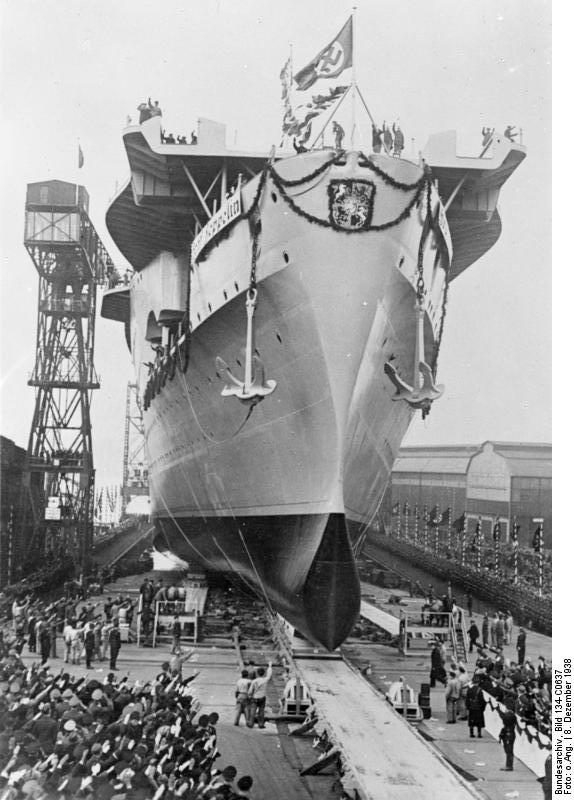
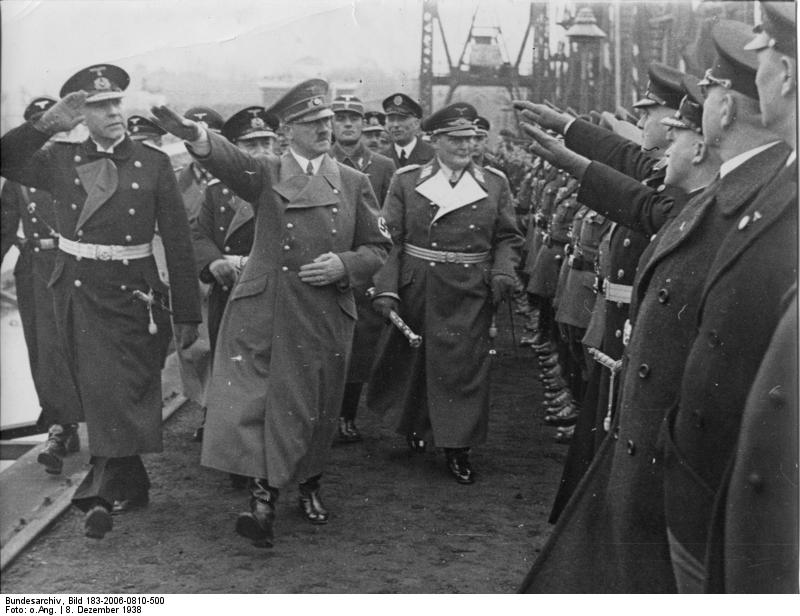
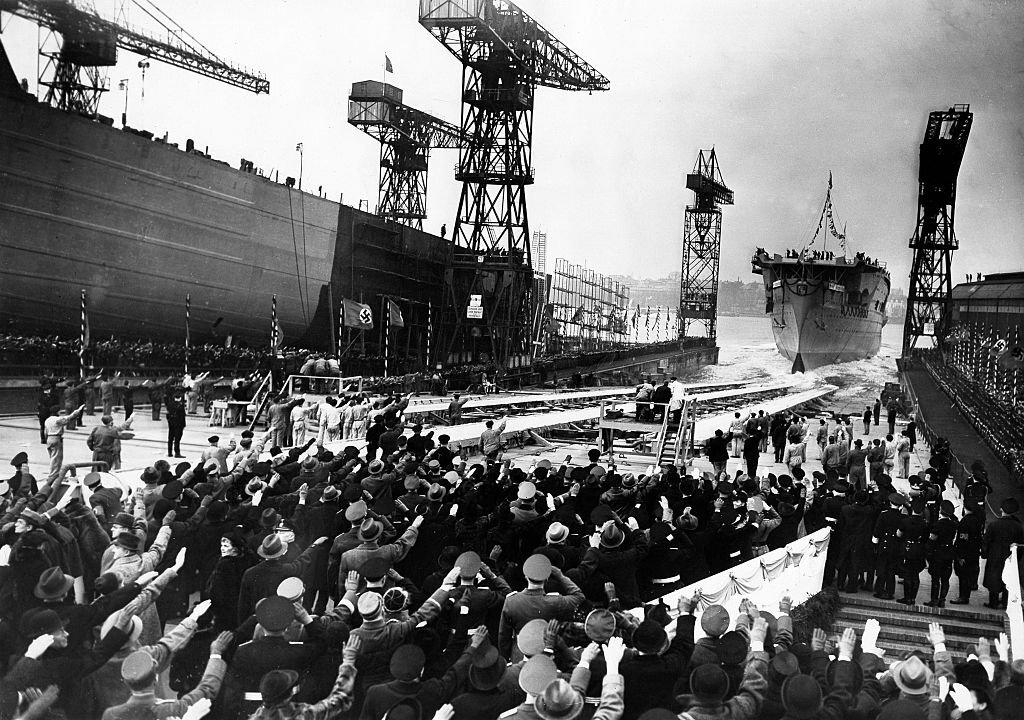
“The seas are open only to the strong.” Field Marshal Hermann Wilhelm Göring, German Nazi minister of air, thundered at Kiel today at the launching of Germany’s first aircraft carrier, Graf Zeppelin. Göring said the ship, a 19,250-ton vessel with space for forty planes, would “Increase the power and prestige of the Reich.” Official German sources asserted the carrier was built to enable the German sea forces to “operate on the wide spaces of the Atlantic… It is the protecting arm of the navy, reaching far into foreign countries — as far as the bombing machines of the carrier can fly,” they said. Germany plans to build another aircraft carrier of the same size. Each ship’s main armament will consist of 16-inch guns, or the same firing power as that of two light cruisers. The carriers will be equipped with ten 4-inch guns and twenty-two machine gun cannons of 1.5-inch bore. With an overall length of 820 feet the ships will be longer than Germany’s new 35,000-ton battleships.
[Ed: But, of course, neither she nor her sister will ever be completed.]
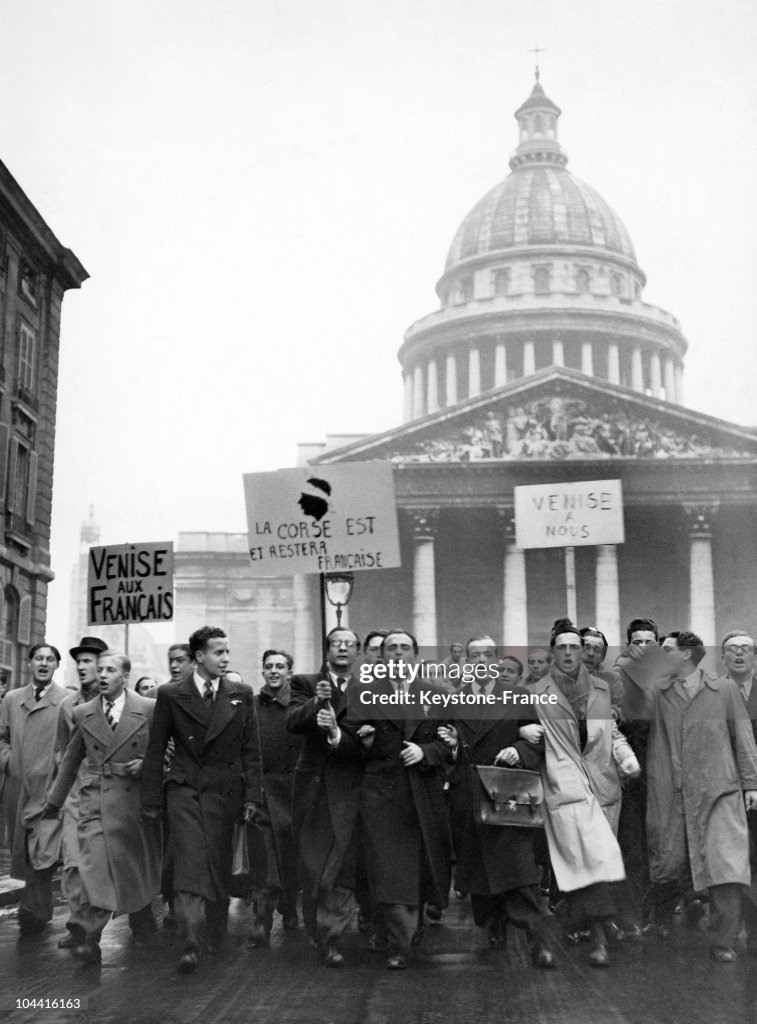
Some 8,000 students from the Sorbonne stage a mock demonstration in Paris, demanding “Venice for the French! and “Give Italy back to Corsica!””
Another day of violence occurred in Tunis as Italians, French and Arabs rioted during competing demonstrations. 16 were arrested. Italian slogans and threats start riots and disorders in Tunis, quelled only when troops from Algiers arrive. Throngs of Italians, French, and Arabs seethed through the streets of Tunis tonight in demonstrations fired by the Fascist clamor for Tunisia, French protectorate in North Africa. The French government strengthened its police with armed patrols from the interior. Heavy reinforcements of mobile guards were ordered to Tunis from neighboring French Algeria. Mr. Silimbani, Italian consul general, protested against the anti-Italian outbreaks. It was understood that he was assured the French police were ordered to restore strict order. Italian residents, it was reported, warned that they would form a self-defense corps if the anti-Italian disorders continued. but French officials denied this was true.
Sixteen demonstrators — Italian, French, and natives — were arrested. Officials announced one person had been wounded gravely and three slightly. Demonstrations continued tonight, with roving bands colliding intermittently with the police. The strains of rival songs, the French “Marseillaise” and the Fascist “Gioveinezza,” sounded through Tunis streets. The fresh wave of demonstrations was unleashed by the march of 1,000 French and Arab railroad workers last night on the Italian consulate general. This protest brought a reply this morning from Italian students in Tunis. Linking their arms, a crowd of youths paraded through the Tunisian capital, singing and chanting. French and Arabs then renewed their own demonstrations, massing near the Italian consulate general, where they were kept back by strong mounted police forces.
There were reports from the French-Spanish border that 40,000 Italian troops have been massed in rebel Spain just across the Pyrenees Mountains from France. This information emphasized fears, expressed in some quarters, that Italy might be preparing to translate agitation into military action.
A contingent of 160 American volunteers in the Spanish government’s international brigade left Spain today for the United States. The men mostly were from New York, Chicago, Cleveland, and San Francisco. They were given three packages of cigarettes each and a hot breakfast when they arrived at the little French border town of Le Tour de Carol. There were two wounded men. among the group. They said the majority of the seventy-five Americans still in Spain were the more seriously wounded who had not yet recovered sufficiently to be moved. The Journey to the United States was to be resumed today, by way of Cherbourg or Le Havre, where 332 Americans were sent last week.
Anti-French demonstrations are held in Libya.
British soldiers arrest 35 members of an Arab band in Tul Karm, Palestine, as well as local magistrates participating in an illegal trial.
President Roosevelt’s plan to revive his government reorganization scheme, popularly known as the dictator bill, received a cool reception today from Senator James F. Byrnes (D-South Carolina), the man who piloted the measure through the Senate at the last session of congress. Mr. Roosevelt made it clear at a White House conference with his special reorganization committee, headed by Louis Brownlow, and with Senator Byrnes, chairman of the Joint Congressional Reorganization Committee, that he wants the legislation revived in a single omnibus measure like the bill which the Senate passed and the House of Representatives rejected at the last session. Such a bill would give the President broad powers to overhaul the executive branch of the government along authoritarian lines.
Senator Byrnes displayed little enthusiasm for the President’s proposal. He not only recommended that the bill be split into four separate measures, but said it would be wise to let the House act first, instead of originating the legislation in the Senate as was done at the last session. This indicated Byrnes has no desire to go through another bitter Senate fight for the President and then run the risk of having the bill repudiated by the House. It also is extremely doubtful that such a fight would be successful again in the Senate. At the last session, the amendment by Senator Burton K. Wheeler (D-Montana), which would have nullified the powers proposed to be conferred upon the President by requiring affirmative congressional approval of his reorganization orders, was defeated by a vote of 43 to 39. If such an amendment should be adopted, either house of congress could exercise a veto power over the President’s orders. Senator Wheeler says he will insist upon this amendment if the President revives the scheme, and there will be 23 instead of 15 Republican votes in the next session.
The President calls the U.S. Ambassador to China Nelson T. Johnson home for a consultation. Announcement today of this order came simultaneously with further clarification by Japan of her intentions in East Asia and followed Great Britain’s declaration that she could not subscribe to creation of an economic-political bloc there dominated by Japan.
Joseph P. Kennedy, ambassador to London, unexpectedly advanced his plans today and announced he would sail Saturday for home. It was not disclosed whether this foreshadowed action by the United States and Britain in bringing pressure upon Japan to prevent her attempted rule over China. Kennedy’s return was considered significant, however, in view of the fact that Britain, like the United States, has displayed worry over events in China. In Tokyo today Prime Minister Arita further outlined Japan’s views to Joseph C. Grew, American ambassador, and Sir Robert Craigie, British ambassador. Grew’s report has not yet reached the State Department.
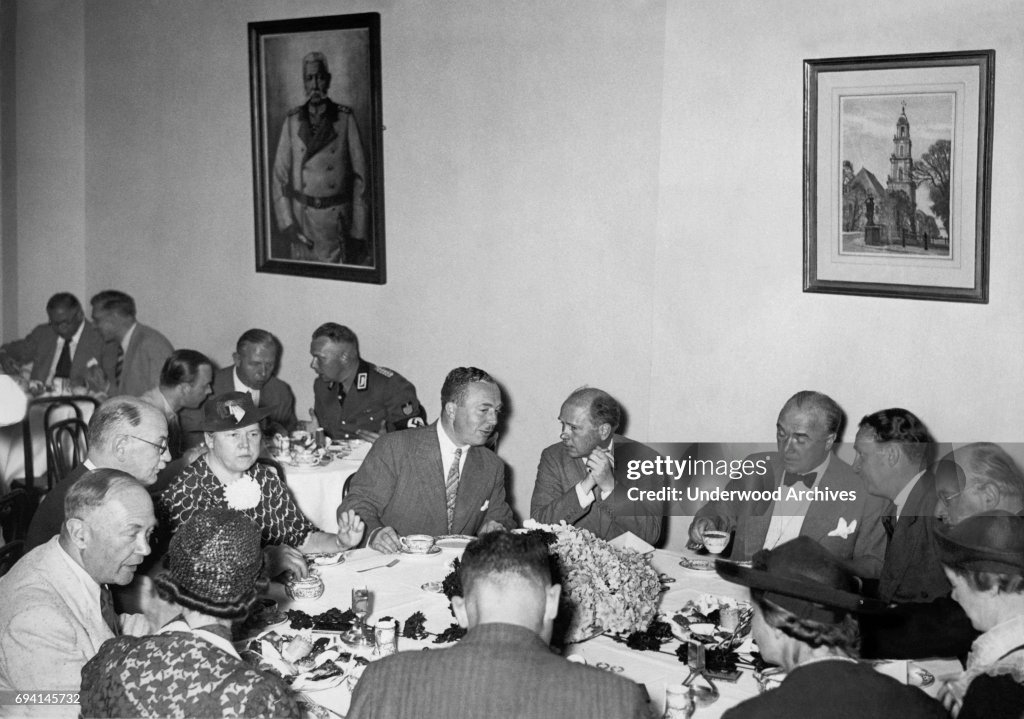
In the presence of Fritz Kuhn, National leader of the German-American Bund, who had appeared unexpectedly, Representative Martin Dies (D-Texas) heatedly assailed communism and Naziism alike today at a luncheon given in his honor by the New York State Economic Council. “I detest the Communist Party and the German-American Bund alike,” Dies declared. He is chairman of the special house committee which has been investigating un-American activities in the United States.
The NLRB reissues a decision against Douglas Aircraft in Santa Monica, California. The company is ordered to reinstate 32 workers with back pay, and to allow the UAW to represent workers. Owner Donald Douglas calls the ruling “absurd.”
Former U.S. Ambassador to Germany William Dodd, Sr., is arrested on a charge of hit and run driving where a 4-year-old girl was struck and injured. The child sustained severe injuries, but would survive. Dodd was ultimately charged with leaving the scene of an accident, convicted, and fined $250 plus court costs. Dodd also paid more than $1,000 for the child’s medical bills. Dodd also lost his voting rights, which were later restored by Virginia’s governor.
In San Francisco, businesses and industries unite in an employers’ council, to bargain collectively.
Highest temperature for December in U.S. recorded in La Mesa California.
The movie version of George Bernard Shaw’s “Pygmalion” premiers. Mr. Shaw will share an Oscar for screenwriting with other contributors to the film.
Mexico and Germany sign a deal trading oil from expropriated fields for a $17 million credit in machinery and products.
Cordell Hull, United States secretary of state, declared tonight on the eve of the opening of the Pan-American conference in Lima, Peru, that the assembly would not seek to separate the American continents from the rest of the world. “The American republics do not seek a regional solution for economic problems confronting the world today,” he said in a radio address. “They recognize the interdependence of all nations of the world in these fundamental questions and are eager to see the principles to which they have adhered adopted by all nations of the world.” Hull was believed to be offering reassurance to Argentina, who has declared she would refrain from turning her back on the old world through any plan such as President Roosevelt’s continental defense proposal.
Heartened by reports from Shanghai that Britain is considering a plan to grant credits to China for the purchase of munitions to continue the war against Japan, Chinese armies today beat back strong attacks on both the southern and northern fronts of their Hengyang triangle defense positions in Hunan Province. Chinese military dispatches reported the Japanese nutcracker attack from north and south on the Hengyang triangle was “completely stalled.” Veteran soldiers from Kwangsi Province, in the south, had beaten off all Japanese attacks on Wuchow, which the Japanese must capture before they can begin their northwestward drive from Canton designed to flank the Hengyang positions, while in the north the Japanese were held up along an east-west line running through Pingkiang, north of Changsha, the Hunan Province capital.
Japan today informed the United States and Great Britain that they should accept as inevitable the revision of the Open-Door policy in China, the usually well-informed Tokyo newspaper Asahi stated. The American and British Ambassadors, Joseph C. Grew and Sir Robert Craigie, attended a conference with Foreign Minister Hachiro Arita, at the latter’s invitation, and it was at this meeting that Arita was said to have conveyed Japan’s view of the “outmoded Nine-Power Treaty” to the ambassadors. The newspaper Nichi Nichi, in connection with Parliamentary debates, asserted that Japan will not tolerate British efforts to block “the new far-eastern order.” The Japanese press generally asserted that third powers cannot expect continuation of special privileges in China, which hereafter must be regarded as independent instead of having a “semi-colonial” status.
A typhoon raced across 15 provinces of the central Philippines today, killing at least 19 persons, making thousands homeless, and was believed to have caused much property damage. The typhoon passed 100 miles south of Manila and out over the China Sea. Samar Island reported 18 dead. One was killed in Camarines Sur province by the storm. Heavy property and crop damage was reported in Sorsogon, Albay, and Camarines Sur provinces. Two dredge boats valued at $100,000 were sunk in the harbor of Legaspi, Albay province. Government relief agencies and the Red Cross immediately began to aid the people in the stricken regions, and authorities prepared to send relief expeditions to the hardest hit areas. Manila experienced heavy winds.
Dow Jones Industrial Average: 147.63 (-1.10).
Born:
Ken Delo, singer, in River Rouge, Michigan (d. 2016).
John Kufuor, President of Ghana, in Kumasi, Gold Coast.
Naval Construction:
The Royal Navy Net-class boom defence vessel HMS Signet (Z 10) is laid down by the Blyth Shipbuilding & Drydock Co. Ltd. (Blyth, U.K.).
The Royal Navy Net-class boom defence vessel HMS Martinet (Z 41) is launched by Smiths Dock Co., Ltd. (South Bank-on-Tees, U.K.).
The Royal Navy river gunboat HMS Dragonfly (T 11), name ship of her class of 4, is launched by Thornycroft (Southampton, U.K.).
The Royal Navy “T”-class submarine (First Group) HMS Tribune (N 76) is launched by the Scotts Shipbuilding & Engineering Co. (Greenock, Scotland).
The Royal Navy “J”-class destroyer HMS Juno (F 46) is launched by the Fairfield Shipbuilding & Engineering Co. (Govan, Scotland).
The U.S. Navy Sims-class destroyers USS Mustin (DD-413) and Russell (DD-414) are launched by the Newport News Shipbuilding and Dry Dock Co. (Newport News, Virginia, U.S.A.).
The Kriegsmarine (German Navy) aircraft carrier Graf Zeppelin is launched by Deutsche Werke, Kiel, Germany. She is 85% complete at the end of 1939, but constant problems keep her from ever being completed.
The Nihon Kaigun (Imperial Japanese Navy) Kaidai-type cruiser submarine (KD6B sub-class) submarine I-75 (later renamed I-175) is commissioned. Her commanding officer at commissioning is Commander Nagai Komei.
—————————————————————————————————
—————————————————————————————————
—————————————————————————————————
—————————————————————————————————
—————————————————————————————————
—————————————————————————————————
—————————————————————————————————
—————————————————————————————————
—————————————————————————————————
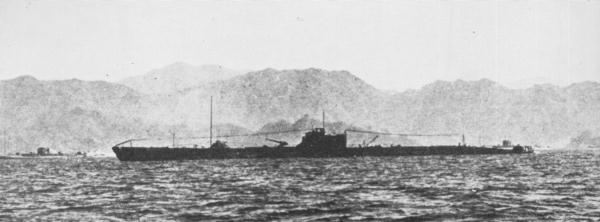
Renamed I-175 on 20 May 1942.
Sunk 4 February 1944, probably by U.S. Navy destroyers USS Charrette (DD-581) and USS Fair (DE-35).
https://en.wikipedia.org/wiki/Japanese_submarine_I-175#Service_history
—————————————————————————————————
 History Diaries