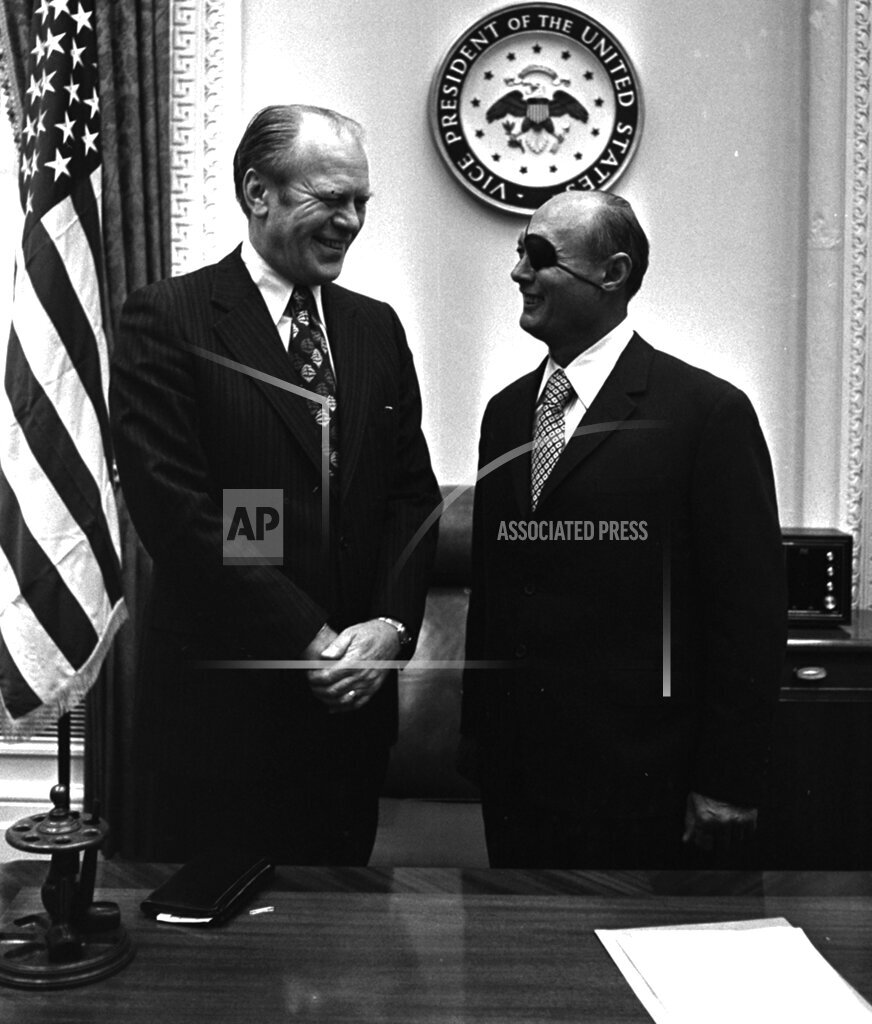
Two Arab oil ministers indicated that they believed that the embargo on petroleum shipments to the United States and the Netherlands would be lifted sometime in 1974. The ministers, Sheik Ahmed Zaki al-Yamani of Saudi Arabia and Belaid Ab-desalem of Algeria, have been in Washington representing nine Arab countries in talks with United States officials.
Deputy Premier Abdel Kader Hatem told the Parliament today that Egypt would take part in the Geneva peace conference but would continue to watch for any possible Israeli attack. Detailing Government policy after the October war, he said that Egypt would not let the peace conference, which is to open Dec. 18, be a platform for Israeli maneuvers or a return to the prewar stalemate. Mr. Hatem, declaring that peace has a long way to go, said: “We have accepted the cease‐fire because we are keen to preserve peace. The real threat to peace is Israeli refusal to implement the United Nations resolutions. “We shall continue to work for peace with weapons at the ready and eyes open for any Israeli maneuvers. We are prepared to take part in the Geneva peace conference, but at the same time prepared to liberate the occupied Arab territories, whatever the sacrifices.” He warned Egypt that “the cease‐fire was not peace” and stressed that Israeli withdrawal from all the occupied territories, particularly Jerusalem, and the restoration of the rights of the Palestinian people were prerequisites for peace.
Israeli deaths attributed to the October war and its aftermath were officially put tonight at 2,412. This is 558 more than the last official count on November 6. The figure includes 293 soldiers missing in action and certified as dead. The total number of missing in action was given as 508. Details of the casualties were made public by Major General Herzl Shafir, head of the manpower division of the Israeli defense forces. He listed the missing as 406 on the Egyptian front and 102 on the Syrian front. Some of those missing on the Syrian front are still believed to be prisoners of war. The Syrians have refused to supply numbers and names of prisoners they are holding.
Thousands of Cambodian civilians fled a strategically important town 29 miles west of Phnom Penh today after it was struck by Communist shells. At least 50 persons were reported to have been rounded up by insurgent soldiers and forced from the Government-held town, Kompong Speu, into jungle areas held by the insurgents. The Communists’ mortar attacks on Thursday, Friday and this morning killed at least one person, a 19‐year‐old woman, according to some of the refugees who fled along Route 4 from the provincial capital. The refugees also said that insurgent soldiers had set fire to six or seven houses on the edge of Kompong Speu. The refugees carried their cooking pots and bedding toward the capital on buses, trucks and motorcycle‐drawn carts. Some of them said they had left the town despite the urging of local officials that they stay. There were also reports from refugees that local authorities were forcing some townspeople, mostly men, to remain in Kompong Speu. Ten days ago, several hundred people left the town after Communist shelling, but many of them had returned a few days ago.
The Government military command in the capital did not mention the refugees in its daily communiqués. The command noted only that three enemy soldiers had been killed and four Government soldiers wounded in fighting north of Kompong Speu. By midafternoon today, about 200 Government paratroopers had arrived in trucks at Ang Snuol, on Route 4 about 14 miles east of Kompong Speu. Their officers said the troopers were deployed at Ang Snuol to prevent the insurgents from cutting the highway there as possible preparation for a major Communist attack on Kompong Speu. Kompong Speu, a dusty town whose normal population of 13,000 families shifts with the tide of the war, is considered important because its capture by the insurgents would give them the psychological victory of holding another provincial capital. Perhaps more significant, capture of the town would make it more difficult for the Government to reopen Route 4, a vital supply lane between Phnom Penh and Kompong Som, Cambodia’s port on the Gulf of Siam. The insurgents have kept Route 4 cut at a point seven miles west of Kompong Speu for almost a month. If they were able to cut it at Kompong Speu, Government troops would probably have to stage a major counterattack to dislodge them from the town’s cement buildings.
South and North Vietnamese forces battled for control of the Central Highlands district capital of Kiến Đức today despite Saigon government assertions that the town had already been recaptured from the Communists without a fight, field reports said. Street fighting reportedly was under way in the town at midday and Communist shelling was said to have closed the outlying airport. Last Tuesday North Vietnamese troops captured Kiến Đức, 110 miles north of Saigon, in the heaviest fighting since the start of the cease‐fire. The airfield five miles east of Kiến Đức reportedly was being shelled by captured 105‐mm artillery and 82‐mm mortars. Communist cease‐fire violations dropped today to the lowest one‐day total since the truce agreement was signed 11 months ago, a South Vietnamese spokesman said. Thirty‐nine violations were reported in the 24‐hour period ended at noon, the spokesman said.
Secretary of State Kissinger arrived in Brussels tonight for a crucial meeting with America’s European allies and said that “a new act of vision” was needed to preserve the alliance’s strength. The stop is the first in a long trip that will take him on a swing through the Middle East and to Geneva for the opening of the Middle East peace conference December 18. Speaking to newsmen after debarking from his Air Force 707 jet, Mr. Kissinger said that in his talks with the other foreign ministers of the North Atlantic Treaty Organization in coming days, “I will stress that the Atlantic alliance remains the cornerstone of American foreign policy.” “But I shall also emphasize that a new act of vision is necessary so that it can remain the cornerstone of our common endeavors,” Mr. Kissinger said. Mr. Kissinger did not elaborate on what new “vision” entailed. Before his departure from Washington, senior State Department officials said that Mr. Kissinger planned not to seek recriminations about the recent problems within the alliance, but to look ahead and seek ways of acting in unison.
Mr. Kissinger, who goes to London on Tuesday night after the conclusion of the NATO meeting and then continues on to the Middle East in advance of the Geneva peace conference, believes that the United States and the Europeans must face up to the problems within the alliance before it atrophies. He has said recently that the West Europeans, in their drive for unifying Europe, have tended to show diminished interest in the overriding issues involved in strengthening Atlantic unity. This difference in viewpoint was underscored, he has said, by the recent events in the Middle East when the Europeans Inked upon the Arab‐Israeli war primarily as a local conflict not involving NATO’s interest, and the United States regarded it as possibly a confrontation with the Soviet Union with implications for the Atlantic alliance.
Significant differences continue to exist within the Nixon Administration on where to go from here in the talks with the Soviet Union on limiting strategic arms. While the talks in Geneva mark time, various segments of the executive branch in Washington are struggling among themselves over future United States moves. A major problem in arriving at a unified American position is the multiplicity of agencies involved in these internal negotiations — the State Department, the Arms Control and Disarmament Agency, the National Security Council staff, the Central Intelligence Agency, the civilian‐run part of the Pentagon, the three military services and the delegation to the Geneva talks. The difficulties are compounded because there are differences within each of these agencies. The branch of the Air Force responsible for the land-based Minuteman missiles, for example, does not see negotiating priorities the same way as the branch responsible for long-range bombers.
The Soviet Union has broadened its campaign to discredit China in the Third World by accusing Peking of new provocations against such smaller neighbors as Bangladesh, Burma, Malaysia, Taiwan and Hong Kong. The charge is one of a number made in the Soviet press in the last few days, marking a new wave in the offensive of words that began late last summer.
At 12:01 a.m., the maximum speed limit on motorways in the United Kingdom was reduced from 70 miles per hour (110 km/h) to 50 miles per hour (80 km/h) by the government, three days after being authorized by Parliament, as a measure to conserve oil to last until at least April 8, 1974. “Although no signs will be altered,” a government press release stated, “police will not regard ignorance of the new law as an excuse.”
The Portuguese Governor-General of Mozambique, General Pimentel dos Santo, granted an amnesty of more than 400 political prisoners in Portugal’s East African colony.
In a nationwide referendum in Australia, voters overwhelmingly rejected a proposed amendment to the federal constitution to allow the government to control prices and wages. The plan was rejected in all six states, with no votes on price regulation ranging from 51% in New South Wales to 68% in Western Australia. The no vote on income regulation was even higher, from 60% in New South Wales to 75% in Western Australia.
Celeste Dandeker, a 21-year-old English dancer, sustained a broken neck while performing at the Manchester Opera House and suffered quadriplegia. After being profiled in a TV documentary on BBC, and encouraged by an admirer to create dances for persons with disabilities, she and Adam Benjamin would create Candoco Dance Company in 1991.
Following the revelation that U.S. President Richard Nixon had paid only a few hundred dollars of federal income taxes in 1970 and 1971, Nixon offered at a press conference to let a Congressional committee review all of his tax returns and said that he would pay back taxes and interest if any of his claimed deductions were improper. Nixon also allowed reporters to inspect his tax returns filed by him as president for the years 1969 through 1972, on the condition that the copies could not be taken out of the White House.
President Nixon made public a voluminous amount of information, including his income tax returns for his first four years in office, which he said should lay to rest “false rumors” about his personal finances. The extensive disclosures, unprecedented for an American President, were made after several months of persistent reports that Mr. Nixon had profited improperly from his office.
The White House conceded that there were serious questions about the legality of two separate aspects of President Nixon’s recent tax returns and said that he and Mrs. Nixon might owe as much as $267,000 in additional federal income tax if both of his original claims were reversed. Mr. Nixon announced that he would let the congressional Joint Committee on Internal Revenue Taxation decide whether he should pay any additional tax because of the two disputed items, “I will abide by the committee’s judgment,” he said in a written statement.
In his first term in office, President Nixon, according to financial records released this weekend, saw his fortune grow by $150,000 a year, and by now he should be a full-fledged millionaire. With the help and advice of multimillionaire friends, Charles G. Rebozo, a Florida banker, and Robert H. Abplanalp, a New York industrialist, Mr. Nixon has bought and sold land in Florida and California, piling up large profits that he deposited in Mr. Rebozo’s bank. By May 31 of this year, an audit of the President’s finances showed, he had $426,000 in cash and tax exemptions were increasing this in a significant amount each day. From Jan. 1, 1969, through last May 31, Mr. Nixon’s net worth increased by an average of $425 a day, the report indicated.
A wealthy friend established a trust fund of more than $25,000 for Mr. Nixon’s older daughter, Tricia, when her father was Vice President, according to information released by the White House. The trust fund was set up in 1958 by Elmer H. Bobst, who was then chairman of the Warner-Lambert Pharmaceutical Company, and the gift consisted primarily of Warner-Lambert stock, White House officials said. At the time of the gift, the late Estes Kefauver, then a Democratic Senator from Tennessee, was preparing extensive hearings into prices and related matters in the drug industry. When he ran for President in 1960, Mr. Nixon, like his opponent, John F. Kennedy, took a strong stand against federal regulation of drug prices, one of the key proposals that evolved from the Kefauver hearings.
Service station owners and their representatives throughout the country expressed concern over a developing gasoline drought brought on by tight supplies and a run on their pumps. The situation has apparently begun developing despite gasless Sundays for which motorists again began preparing themselves today. “Our stations’ December allotments have been cut from 10 to 20 per cent,” said Sebastian Gaeta, president of the 1,500‐member Long Island Gasoline Retailers Association. “The tendency to sell has been overcoming the tendency to spread out these smaller supplies for the whole month. Around the Christmas holidays will be the worst week. A lot of stations just won’t have any to sell at all.”
For months, President Nixon has been citing national security as the reason for authorizing establishment of the secret White House investigation unit known as the plumbers and as justification for restricting some aspects of the Watergate inquiry. One reported fear was that Daniel Ellsberg might pass to the Soviet Union nuclear defense and other secrets far more important than any information contained in the Pentagon papers. The second major concern was said to be that a Russian K.G.B. agent, who was serving as an American counterspy, might be jeopardized.
The Southern Republican Conference, a thousand hard‐core party workers from all over Dixie, gathered in Atlanta this weekend, insisting that Watergate was not a crucial issue but talking about it endlessly. It was a confusing performance that was made even more so by the appearance of such prospective Presidential candidates as Governor Rockefeller of New York, John B. Connally, former Governor of Texas, and Governor Ronald Reagan of California. Youthful street pickets added to the turmoil as they tormented delegates with chanted demands for President Nixon’s impeachment. Some said they had not taken part in any political protests for more than a year.
Mr. Reagan, though he talked about the “pall” of Watergate, easily won the oratorical prize with a smoothly tailored banquet talk tonight about patriotism, fiscal responsibility and bedrock conservatism in general. Mr. Rockefeller long considered an ideological traitor in these parts, spoke of “welfare cheats” and “big government” that would not work. He was cheered.
More than 330,000 daily bus and trolley commuters were without public transportation in Pittsburgh and Alleghany County this week because of a strike of transit operators. The drivers, who struck Port Authority Transit at midnight last Sunday, disregarded contempt of court citations and shouted down their local and international union officers to keep the strike going. The strike involves 2,600 members of the Division 85, Amalgamated Transit Union, of whom 1,680 are operators. Each day they drive 781 buses and 82 trolleys over 118,000 miles on 170 routes.
Flushed with the success of Pioneer 10’s fly‐by of Jupiter, space agency officials are now almost sure to aim Pioneer 11 so that it will reach beyond Jupiter for the first close‐up exploration of Saturn. Pioneer 11, an almost identical sister ship of Pioneer 10, was launched last April. It is now traversing the asteroid belt beyond Mars and is scheduled to rendezvous with Jupiter next December. If Pioneer 11 is to be directed out to Saturn, project officials said yesterday, a midcourse rocket maneuver would have to be ordered no later than February. This would change the spacecraft’s course so that it would approach Jupiter at different angle and fly closer than Pioneer 10 did to take greater advantage of the slingshot effect of Jupiter’s strong gravity.
Pioneer 11 would thus be able to reach Saturn, the second largest planet in the solar system, by November, 1979. At a meeting of Pioneer officials, the vote was overwhelmingly in favor of the Saturn mission. “It was the clearly preferred objective,” Dr. James A. Van Allen of the University of Iowa reported.
“Seesaw” closes at Uris Theater NYC after 296 performances.
Romanian tennis star Ilie Năstase wins his 3rd consecutive season-ending ATP Masters Grand Prix title with a 6–3, 7–5, 4–6, 6–3 win over Dutchman Tom Okker in Boston, Massachusetts
The 39th Heisman Trophy Award goes to John Cappelletti, running back, Penn State.
NFL Football:
Bobby Bryant intercepted three passes, returning one 46 yards for a touchdown and setting up a field goal with another, to spark the Minnesota Vikings to a 31—7 National Football League victory over the Green Bay Packers today. A national television audience watched the Vikings, fired up following defeats in two of their previous three starts, jump to a 14—0 lead after forcing a pair of turnovers on Green Bay’s first three plays from scrimmage. Fran Tarkenton threw touchdown passes of 21 yards to Stu Voight and 20 to John Gilliam. Chuck Foreman, a rookie, raced 50 yards for a touchdown as Minnesota, tuning up for the playoffs, mounted a 28—0 halftime lead and coasted the rest of the way.
Tarkenton’s scoring pass to Wright, who swiped the ball from the Packer safety man, Jim Hill, came seven plays after Jeff Siemon recovered a fumble by John Brockington at the Green Bay 46. Two plays later, Green Bay’s Jerry Tagge overthrew Leland Glass on a sideline pattern. Bryant picked off the ball at the Packer 46 and streaked down the sideline to the goal. The Vikings made it 21—0 early in the second quarter when Foreman burst off right tackle, shook off several defenders and raced 50 yards to score. Tarkenton passed to Gilliam for a touchdown 26 seconds before half‐time. Fred Cox added a 15‐yard field goal midway through the third quarter after Bryant had made a diving interception, got up and scampered 40 yards to the Packer 5. Virtually all of Green Bay’s offense was generated by Brockington, who rushed 27 times for 124 yards and a season total of 1,002. Brockington became the first player in NFL history to rush for 1,000 or more yards in each of his first three pro seasons.
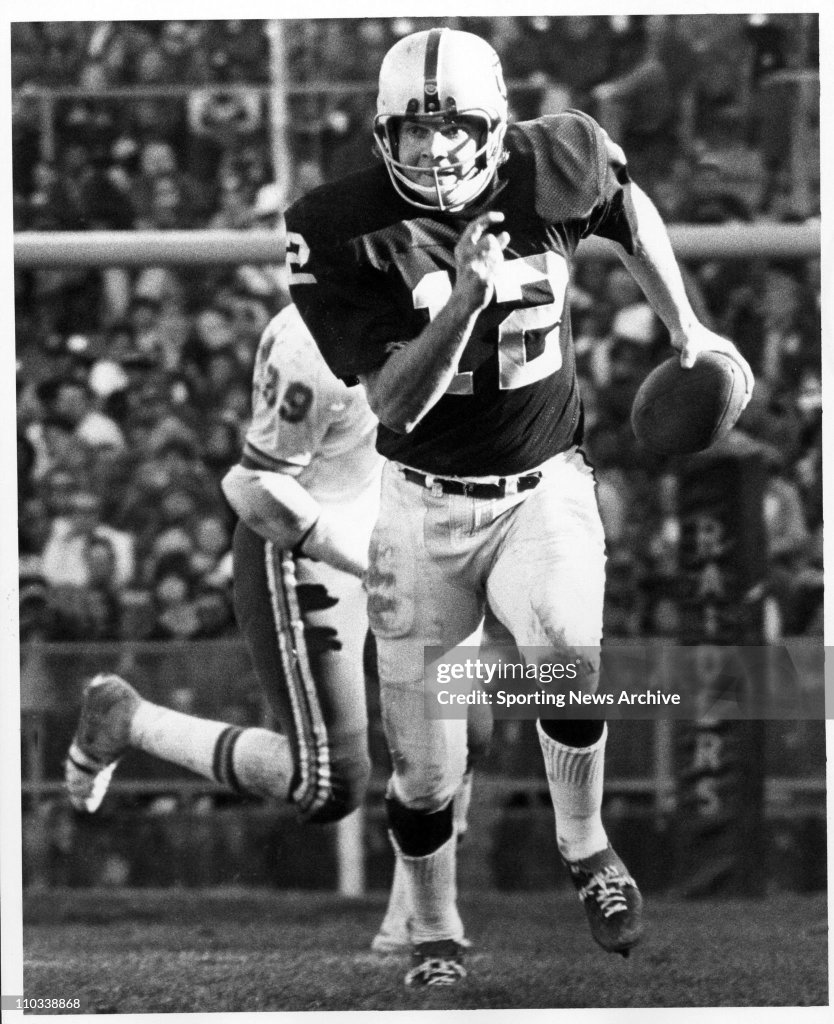
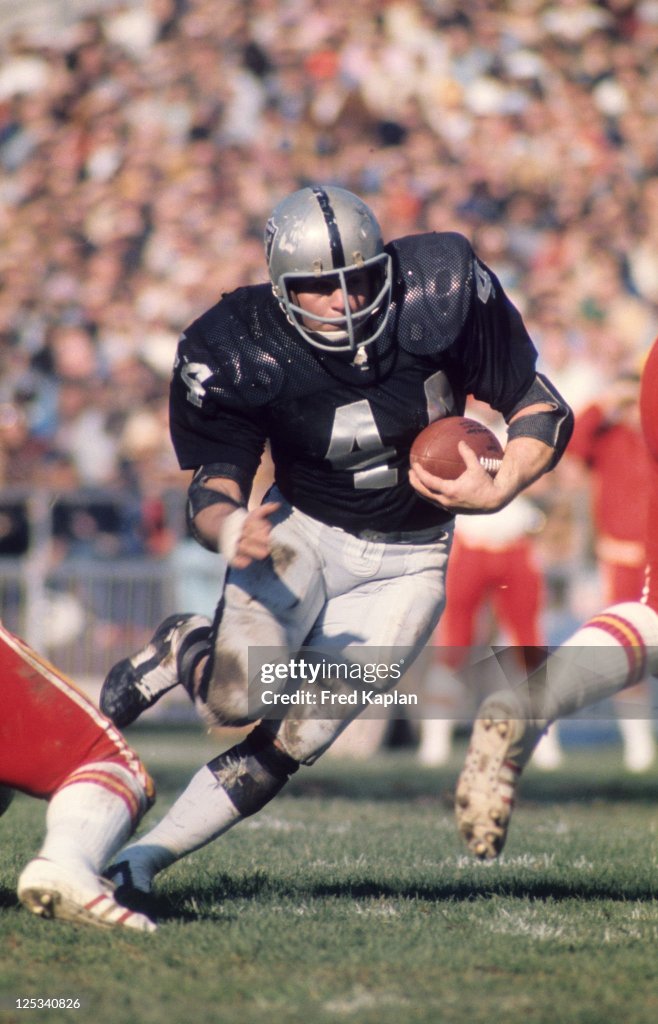
The Oakland Raiders took a firm grip on their division championship and a playoff berth today by crushing the Kansas City Chiefs, 37—7, in the next‐to‐last game of their regular schedule. Mary Hubbard and Charlie Smith, behind a devastating offensive line, led a running attack that ate up both yards and minutes. Ken Stabler did all the passing necessary and generally conducted a flawless attack. And the Raider defense, playing fewer minutes than usual and forced backwards more by penalties than by Kansas City, kept getting the ball back for its imposing offense. The result left Oakland with eight victories, four losses and a tie, with one game to play, against Denver December 16. Denver is the only team left in the race in the Western Division of the National Football League’s American Conference. The Broncos have a 6-4-2 record and a game in San Diego tomorrow. The Chiefs, 6-5-2 with San Diego to play, cannot finish first, although they do retain the slimmest of mathematical chances to reach the playoffs as a wildcard team.
“One more, one more,” cried various Oakland players in the clubhouse, many saying it was their best game of the year. Coach John Madden wouldn’t go that far, however. “It was a good one, but we’ve beaten other tough teams, too,” he said. Madden did admit surprise at his rival’s decision before the game, however. Coach Flank Stram had Kansas City kick off even though he won the toss. “The sun was in their eyes and they were at the muddier end of the field,” Strain explained. “I figured we could hold them there.” He figured correctly. Oakland did have to punt without making a first down, and Ed Podolak returned it to the 46, better field position than a team could expect if it received the kickoff. What he didn’t figure, of course, was that Podolak would fumble when tackled, and that Oakland would recover (in the person of Pete Banaszak).
So it gave Oakland great field position and what followed was a fine demonstration of the phrase “ball control”. The Raiders went on to score on that sequence and to outgain the Chiefs 353 yards to 106. They kept possession for 27 of the first 36 minutes of play while building a 23—0 lead (20—0 at the half), and wound up running 33 plays from scrimmage to Kansas City’s 42. This season, Oakland’s previous high spot was a 12—7 victory over Miami, ending the two‐year winning streak of the Dolphins. But persistently low scoring led to a switch of quarterbacks from Daryle Lamonica to Stabler, and things began to balance off for a team long known for its rugged defense. Today, although the last two Oakland touchdowns resulted from fourth‐quarter interceptions deep in Kansas City territory, the game was completely one‐sided during the first three quarters, even though the 23—7 score at that point gave the illusion that the Chiefs had time to pull it out.
Minnesota Vikings 31, Green Bay Packers 7
Kansas City Chiefs 7, Oakland Raiders 37
Born:
Corey Taylor, American singer (Slipknot, Stone Sour), in Des Moines, Iowa.
Doron Bell Jr., Canadian actor, in Montreal, Quebec, Canada.
Monty Montgomery, NFL cornerback (Indianapolis Colts, San Francisco 49ers, New Orleans Saints), in Dallas, Texas.
Mitch Jacoby, NFL tight end (St. Louis Rams, Kansas City Chiefs), in Port Washington, Wisconsin.
Joe Rowe, NFL defensive back (St. Louis Rams), in East Elmhurst, New York.
Dexter Daniels, NFL linebacker (Baltimore Ravens), in Valdosta, Georgia.
Jeff DaVanon, MLB outfielder (Anaheim-Los Angeles Angels, Arizona Diamondbacks, Oakland A’s), in San Diego, California.
Died:
Yuri Nikolayevich Raevsky, 21, Soviet Russian serial killer who murdered six women in 1971, was executed by a firing squad.
[Ed: Hollywood is Poison.]
 History Diaries