
Plans to redeploy the Marine unit in Beirut away from the airport to safer ground in Lebanon or to amphibious ships offshore are being drafted by the Joint Chiefs of Staff, Reagan Administration officials said. They stressed that no consideration was being given to withdrawing the marines. The officials said the plans were being charted in response to military, political and diplomatic pressures, including increasing uneasiness among senior military officers over the Administration’s course in Lebanon.
A joyful hero’s welcome was accorded to 1,800 marines and sailors as they returned home to Camp Lejeune, North Carolina. They are the survivors of the unit that lost 240 men in a bomb attack in Beirut in October. School bands played, and thousands of yellow ribbons floated from trees, telephone poles and car antennas.
The International Red Cross said Israel is still holding a Palestinian who was supposed to have been among the 4,400 Arabs exchanged for six captured Israeli soldiers last month. Ziad Abu Ein, extradited from the United States to Israel in 1981, is serving a life term for killing two people in Tiberias with a bomb. His lawyer said that Israeli guards pulled him off the bus taking him to the airport for the exchange. Israel claims he was not on the exchange list, but the Jerusalem Post reported that his name had been on the list but misspelled.
Vietnamese Foreign Minister Nguyen Co Thach said that he has new information on the search for U.S. servicemen missing in the Vietnam War and that he will hand it over to the United States. He declined during an interview in Hanoi to give details. He said that Vietnam has done its utmost to investigate the MIA question and is certain that none of those listed as missing is still alive.
An inquiry into the downing of a South Korean airliner by a Soviet fighter plane has led to a report that rejects the Soviet assertion that the jumbo jet was on an espionage mission. Investigators for the International Civil Aviation Organization strongly supported the possibility that the jetliner strayed off course because of human error in operating the navigation equipment.
A national convention of the many Filipino opposition political parties and citizens’ groups throughout the country has been scheduled next month to work out a coordinated strategy against President Ferdinand E. Marcos. Planning for the gathering is being directed by Agapito Aquino, the younger brother of the assassinated opposition leader Benigno S. Aquino Jr. He said the convention would be held January 7 and 8 at a university in Manila.
Two jets collided at Madrid Airport killing 93. More than 30 of the 45 survivors were hospitalized when two jetliners collided in heavy fog on a takeoff runway at Madrid’s airport. A departing Iberia Boeing 727 struck an Aviaco McDonnell Douglas DC-9. It was the second disaster there in 10 days. The Boeing 727 of Iberia (Spain’s state airline) registered EC-CFJ, operating Iberia Flight 350, a scheduled flight to Rome’s Leonardo da Vinci–Fiumicino Airport, was cleared for take-off from Madrid-Barajas Airport’s Runway 01 in conditions of thick fog. At the same time, a DC-9 of Aviaco registered EC-CGS, operating Aviaco Flight 134, was taxiing to the end of the same runway for take-off bound for Santander Airport. As the Boeing 727 rolled along the runway, the crew of the DC-9 accidentally made a wrong turn in the fog and taxied their aircraft onto the runway, into the path of the 727.
The crew of the 727 saw the DC-9 and attempted to avoid the collision by rotating their aircraft for lift-off, however the 727 had not reached flying speed and its rear fuselage struck the DC-9. Both aircraft caught fire and were destroyed; all 42 people on board the DC-9 were killed, while 51 (50 passengers, one crew member) of the 93 on board the Boeing 727 were killed. Investigators found that the Boeing 727 and DC-9 had collided due to the poor visibility at the airport, as well as inadequate signs and markings, which led to the DC-9 entering the runway without clearance as the Boeing 727 was taking off.
In mid-morning, while chatting to UUP party and Queen’s colleague Dermot Nesbitt at the University Square side of the main campus library, Ulster Unionist Party (UUP) politician Edgar Graham, a member of the new Northern Ireland Assembly, was shot in the head a number of times by an IRA gunman and died almost instantly. He was 29 years old. Two persons were later convicted of withholding evidence from the police, but no one was ever convicted for his murder. In a communique taking responsibility for the killing, the IRA command said his killing “should be a salutary lesson to those loyalists who stand foursquare behind the laws and forces of oppression of the nationalist people.” IRA members said that Graham was targeted because of aid and advice he had reportedly given to the Northern Ireland Prison Service.
Graham, a rising star in the Official Unionist Party, Ulster’s main Protestant party, was regarded by many as a future party leader. Former IRA member turned police informer Sean O’Callaghan in his book The Informer suggested that the IRA killed him because he was regarded by a journalist as “potentially the most effective political opponent facing Sinn Féin that the Ulster Unionists had yet produced” and likely to become the party leader. Graham had also gained attention for his strong arguments publicly supporting internment, the revocation of Special Category Status for republican prisoners, and the British government’s network of informers.
Pope John Paul II has asked to meet at Christmas with the imprisoned Turkish terrorist who shot him in May, 1981, Italian government sources said. They added that the government foresees no major obstacles to a face-to-face meeting with Mehmet Ali Ağca, which would take place during a planned papal visit to Rebibbia jail in Rome. A report by the Italian news agency Asca said John Paul called for the meeting as “a renewed and visible act of pardon in the context of the Holy Year of Redemption.” Roman Catholics are celebrating a Holy Year to mark the 1,950th anniversary of the death of Jesus.
Underground leaders of Poland’s outlawed Solidarity trade union have called for nationwide protests on December 16 to mark the 13th anniversary of the death of dozens of workers during anti-government demonstrations against planned food price increases. The leaders said in a statement that workers “will leave factories and hold parades and meetings in city centers.” The government has tightened security measures and warned that protests will not be tolerated.
A bomb exploded in a bank in Bilbao, industrial center of Spain’s northern Basque region, injuring 11 people, two of them seriously, police reported. A second bomb exploded in a branch of the bank, but it caused no injuries. No one claimed responsibility for the blasts, but the bank has been a target of the Basque separatist group ETA in the past.
The Swiss Parliament, voting in a secret ballot today, rebuffed the candidacy of the first woman ever to run for election to the country’s governing body, the seven- member Federal Council. It did so by snubbing the candidate, the Socialist Party’s official nominee, in favor of another Socialist who lacked the party’s endorsement. The candidate, Lilaine Uchtenhagen, a 55-year-old economist and financial expert, has represented the Canton of Zurich in the lower house of the Swiss Parliament since 1971, the year that women were accorded full political rights in national affairs.
Left-wing guerrillas released unharmed the kidnaped younger brother of Colombian President Belisario Betancur, held for 16 days and threatened with death. Jaime Betancur, 54, a law professor, was turned over to four newspapermen by hooded guerrillas at a secret hiding place in Bogota. His abductors, the National Liberation Army, had demanded release of 16 political prisoners and economic changes. The president said no concessions were made.
Nicaragua today invited 165 American and Canadian churchwomen to hold a three-day antiwar vigil in this country, two days after the group was refused entry into Honduras. Various Christian groups in Nicaragua invited the coalition of churchwomen, the Foreign Ministry said in a statement, because they are against “U.S. intervention in Central America.” Honduran immigration authorities refused on Monday to allow 65 women from Protestant and Roman Catholic churches in Canada and the United States to leave their plane when it landed at the Tegucigalpa airport. Another group of 100 was grounded in New Orleans by an order from the Honduran President, Roberto Suazo Cordova, who said the women could not travel on a Honduran airliner.
President Reagan greets King Birendra Bir Kikram Shah Dev and Queen Aishwarya Rajya Laxmi Devi Shah of the Kingdom of Nepal. President Reagan hailed King Birendra of Nepal today as a champion of peace and expressed sympathy about problems he is encountering in trying to improve the quality of life in his Himalayan kingdom. Welcoming King Birendra and Queen Aishwarya at the beginning of a two- week visit to the United States, Mr. Reagan praised the King for condemning the Soviet intervention in Afghanistan and volunteering military forces for United Nations peacekeeping missions.
France performs a nuclear test at Mururoa atoll.
The end of an oil antitrust inquiry was announced by the Justice Department. Antitrust division officials said they had concluded a six-year investigation of American oil companies operating in Saudi Arabia because the four companies no longer had any major influence over the global price of petroleum.
Wide praise for the Spacelab in its inaugural flight was expressed by scientists as the crew of the space shuttle Columbia prepared to bring the research facility back to the earth today, ending a 10-day mission. The crew, two pilots and four scientists, spent their last full day in orbit conducting bonus experiments in human physiology, fluid physics and materials processing.
Budget cuts for education are planned by President Reagan, according to officials of the Department of Education. They said that Mr. Reagan’s proposed budget for the next fiscal year was certain to be below this year’s spending level.
House Republican leader Robert H. Michel (R-Illinois) set off a new wave of charges of broken promises by recommending Democrat Robert Destro for a seat on the U.S. Civil Rights Commission, instead of Jill Ruckelshaus, a prominent GOP women’s rights leader. Democratic congressmen and civil rights groups immediately charged that the move reneges on a deal cut in Congress that provided for Ruckelshaus’ reappointment to the agency. Destro, whose views are close to those of the President, was one of Reagan’s choices last year for the commission but he was never confirmed.
The Environmental Protection Agency may delay issuing permits allowing incineration ships to burn toxic wastes in the Gulf of Mexico until it can develop regulations covering such waste disposal, Jack E. Ravan, assistant EPA administrator for water, said. Ravan was urged by several congressmen at a House subcommittee hearing to develop the regulations before issuing final permits for two ships to begin such incineration at a site about 200 miles off the Texas Gulf Coast.
William P. Clark, making his first major speech as secretary of the Interior, told the National Wildlife Federation in Washington that he will give conservation groups more access to his department, but he also will work “both to develop and protect” the nation’s 550 million acres of federally owned lands. Without mentioning his controversial predecessor, James G. Watt — although he borrowed some of Watt’s phrases and themes — Clark said he hopes to avoid the “us-guys-versus-you-guys” attitude that prevailed in confrontations between Watt and most environmentalists.
The Rev. Jesse Jackson’s enthusiasm and excitement are making him the focus this week of the Democratic Presidential race. When Jackson, in his third speech of the day, won standing applause from an audience of New Mexico Democrats, Charles T. Manatt, the chairman of the Democratic National Committee, seemed impressed. “He gets better as the day goes along,” Mr. Manatt told the audience at the $1,000-a-plate dinner. “I’m glad we don’t have a midnight show.” As the remark suggests, this has seemed to be Mr. Jackson’s week in the Democratic Presidential campaign. He came close to turning the national committee’s Presidential Sweep, a five-city tour he and five other candidates completed here today, into the Jesse Jackson show. Part of the reason was Mr. Jackson’s public challenge of the delegate selection rules for the 1984 primaries and caucuses on the ground that they discriminate against minority and longshot candidates. When Senator Gary Hart of Colorado, former Senator George McGovern of South Dakota and Senator Ernest F. Hollings of South Carolina endorsed Mr. Jackson’s criticism, that made him the center of attention.
But another reason was a phenomenon foreseen by many Democratic strategists when he entered the race. Mr. Jackson appears to be injecting enthusiasm and excitement into the vacuum created in the Democratic race by the cautious approach and apparent lack of personal fire in the campaigns of the two best-known candidates, Walter F. Mondale and John Glenn. Analysts differ, however, on whether Mr. Jackson’s publicity bonanza means he will be able to extend his political base beyond blacks and thereby improve his poll standing, in which he is preferred by 7 percent of Democrats in the most recent New York Times/CBS News Poll. But no one disputes that Mr. Jackson’s message is reaching a broad and apparently enthusiastic audience.
Stanford University officials failed to persuade White House aides today to let Stanford govern President Reagan’s proposed presidential library complex. “We are continuing to discuss the matter,” William Kimball, president of the Stanford board of trustees, said through a spokesman after a White House luncheon with Edwin Meese 3rd, counselor to the President. The issue is whether a public affairs center, part of the proposed library complex, will be governed by Stanford or by the conservative Hoover Institution on War, Revolution and Peace, which is semiautonomous.
Roscoe J. Brown told ABC News’ “Nightline” he will undergo castration rather than spend 30 years in prison for a violent rape of a young woman, although he believes his life could be ruined by either of the alternative sentences handed down recently by Judge C. Victor Pyle Jr. of Columbia, South Carolina. A second man convicted, Michael Braxton, 19, said he probably will choose castration, also. The third man, Mark W. Vaugh, 21, said he probably will choose prison. Lawyers for all three men have appealed.
Evidence shows that drifter Henry Lee Lucas killed 35 women in 23 states, Colonel Jim Adams, head of the Texas state police, said in Austin. Adams spoke to law enforcement officers from four states meeting to determine if their unsolved murders can be linked to Lucas. Adams said he believes Lucas’ claims of killing 150 women since he got out of prison in 1975. Lucas, arrested last June, goes on trial in Texas January 16 for murdering his 15-year-old common-law wife.
Oregon fisheries biologists said the warm ocean current called El Nino caused traditional food sources to disappear, killing thousands of salmon. Governor Victor G. Atiyeh has declared a state of disaster in five coastal counties plagued by poor salmon catches, blaming much of the problem on El Nino. Oregon fishermen landed only 1.9 million pounds of salmon through September 1, down from a 1982 catch of 5.8 million pounds.
The political power of farmers is weakening, but it is still formidable. In the past, the farm lobby could get nearly everything it wanted from the federal government. That ability appears to be eroding rapidly, but this year’s Congressional session confirmed that farmers are as effective as ever in killing what they do not want.
Concern about threats to privacy is increasing among Americans, and about a third of the public believes the Internal Revenue Service, the Federal Bureau of Investigation and telephone companies “probably share” information on individuals with others, according to a poll conducted by Louis Harris and Associates. The survey was made public as the opening message for a four-day Smithsonian Institution symposium on “The Road After 1984: High Technology and Human Freedom.”
Thirteen workers at the Diablo Canyon nuclear power plant in California, including three security guards, were arrested in a drug raid yesterday on charges of selling cocaine and other drugs. The suspects were charged with making sales on and off the plant site, where 8,000 people are employed.
A Tennessee juror who refused to vote for a conviction for three days forced a judge to declare mistrial today for two men accused of hanging an elderly man from an apple tree. “I have never seen a jury more personally distraught that they couldn’t convince a lone holdout,” said District Attorney David Crockett. The 12 jurors spent nine hours over three days trying to decide whether Donald Grant and Kelly Banner were guilty of hanging 73-year-old Ben Tester after he reportedly surprised them burglarizing his home. Five people have already been convicted in the murder. Twice in their early deliberations, the jurors told Circuit Court Judge Edgar Calhoun they were deadlocked. When the jury reported it was still deadlocked this morning, Judge Calhoun declared a mistrial. The judge scheduled a new trial on March 21.
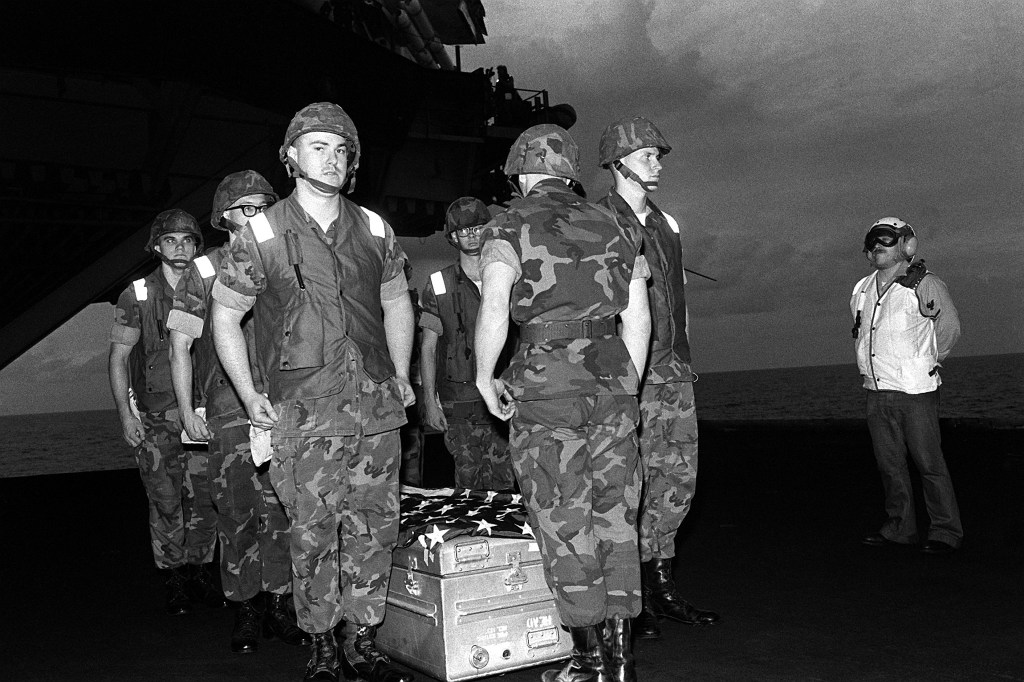
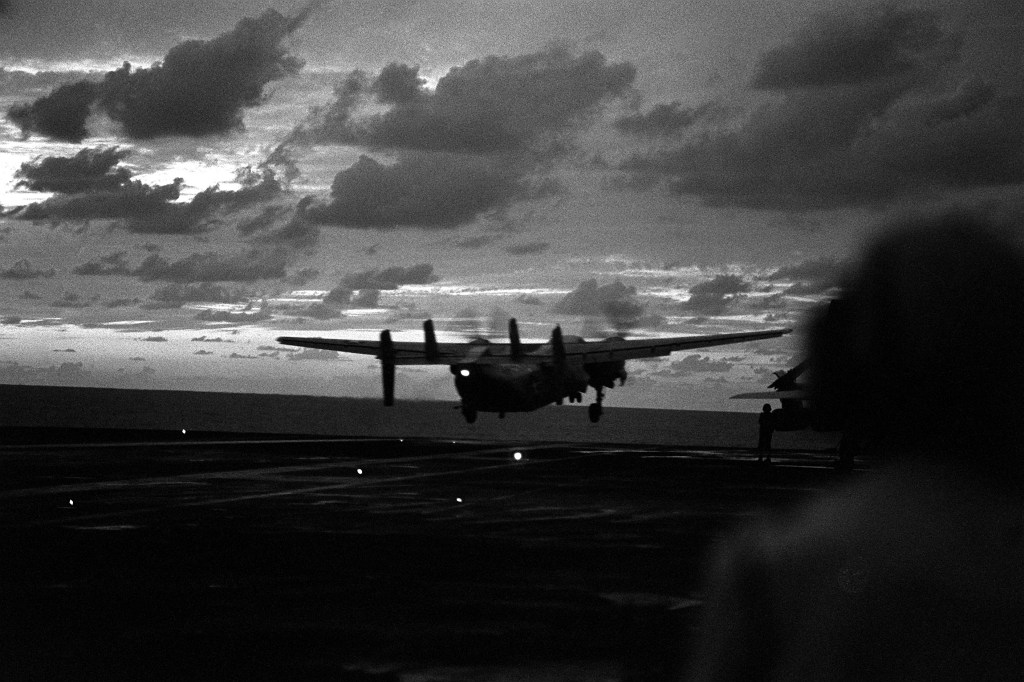
The Navy has recovered the remains of 14 servicemen killed 16 years ago when their plane flew into a remote Alaskan glacier, officials said today. Three of the crash victims were identified from dental records but the identities of the others have not yet been confirmed, a Navy aide, Tina Crellin, said in a telephone interview from San Diego. The twin-engine Lockheed Neptune went down December 14, 1967, while on route from Kodiak to Washington State, Miss Crellin said.
Strong winds created blizzard conditions in the central Rockies and New England, toppling trees, cutting power and burying highways under blankets of snow. Interstate 80 was a no man’s land for the length of Wyoming, where truck stops and motels became small cities of huddled truckers and anxious motorists seeking refuge from a foot of new snow and wind gusts up to 70 m.p.h. Across the nation, a separate low-pressure center made wind gusts of 50 m.p.h. common from the Great Lakes to Maine to North Carolina. The winds prompted New York City area officials to reduce speed limits by half and to ban trailers and motorcycles on the city’s bridges.
In a complicated 3-team swap, pitcher Scott Sanderson is traded from the Expos to the Cubs. Montreal receives pitcher Gary Lucas from San Diego, and the Padres get pitcher Craig Lefferts, first baseman-outfielder Carmelo Martinez, and third baseman Fritz Connally from Chicago.
The Mariners trade second baseman Tony Bernazard to the Indians for outfielder Gorman Thomas and infielder Jack Perconte.
The Reds sign their first major free agent: outfielder Dave Parker, who accepts a 2-year contract.
The Royals trade pitcher Mike Armstrong and minor league catcher Duane Dewey to the Yankees for slugger Steve Balboni and pitcher Roger Erickson. Balboni will hit 36 homers for the Series-bound Royals in 1985, the last Series winner this century to have anyone hit that many homers.
Dow Jones Industrial Average: 1273.77 (+4.47).
Born:
Al Thornton, NBA small forward and power forward (Los Angeles Clippers, Washington Wizards, Golden State Warriors), in Perry, Georgia.
Died:
Edgar Graham, 29, Ulster Unionist Party (UUP) member of the Northern Ireland Assembly, shot dead by IRA.

___________________________________________

___________________________________________
___________________________________________

___________________________________________

___________________________________________

___________________________________________

___________________________________________

___________________________________________

___________________________________________
___________________________________________
___________________________________________
 History Diaries