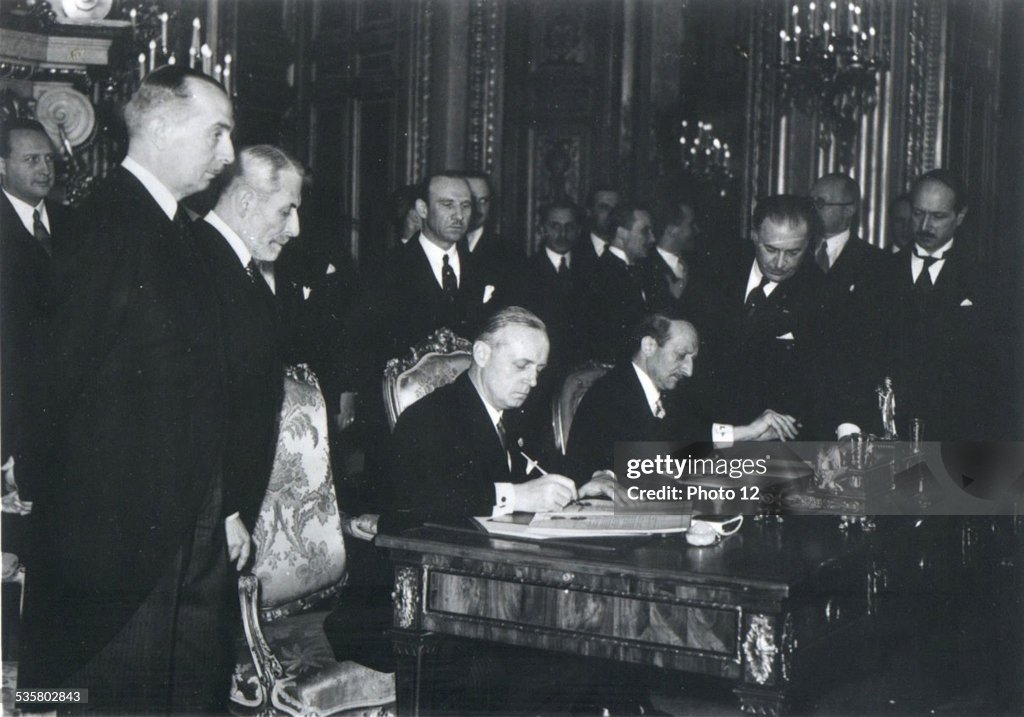
Foreign Ministers Joachim von Ribbentrop and Georges Bonnet signed a treaty in Paris by which Germany and France guaranteed the inviolability of one another’s borders and agreed to engage in mutual consultation to resolve all disputes peacefully. An element of mystery entered the festivities which attended the formal burial of the traditional enmities of France and Germany. Ordinarily it is a diplomatic custom to invite all members of the French cabinet to such an affair. But for some unexplained reason several French ministers received no invitations. Among them were Jean Zay, minister of education, and Georges Mandel, minister of colonies. Both are Jews. Any feeling that the Germans might have resented their presence was dispelled in an announcement that Zay and Mandel were included in invitations to the French cabinet to attend a reception for Von Ribbentrop in the German embassy tomorrow.
Under the good neighbor agreement France and Germany recognized their common border. They agreed to consult each other in case of “international difficulties,” though reserving their “particular relations” with third powers, and decided to begin negotiations to put the pact into effect at once. The reservation regarding the “third 39 powers was believed to refer to Italy in the case of Germany and Great Britain in the case of France. The signing of the pact was regarded as highly important in the tangled affairs of Europe largely because the historic enmities of Germany and France had been cast aside in the interests of peace. The two nations have met in two major wars and affixed their signatures to two peace treaties since the Napoleonic wars, when Prussian armies helped Wellington defeat Napoleon at Waterloo.
Werner Mölders was assigned to the 1st Group of the Jagdgeschwader 133.
Fascists met French protests against their Tunisian claims today with noisy demonstrations in which they shouted their demands anew. Black shirts and university students marched through the streets of Rome, Genoa, and Turin shouting “Tunisia and Corsica for Italy.” The count of Turin, cousin of King Victor Emmanuel, became entangled in a Milan crowd which watched young Fascists parading to the cry of “Tunisia.” Recognized and cheered by the crowd, he made a brief speech expressing sympathy with the demonstrators.
In Rome the demonstration reached its climax when Andrea Ippolito, provincial Fascist party secretary, answered a crowd’s cry of “Tunisia!” by declaring: “There is no need of talking of Tunisia — we will go there.” Several hundred students agitating in support of Italian claims to French-controlled territory marched toward the French embassy. They were turned back by police, reinforced by infantry troops. The demonstrators marched to Palazzo Venezia, where they called for Premier Mussolini. Il Duce did not appear and, after a second attempt to approach the embassy, the students went to Palazzo Braschi, Rome headquarters of the Fascist party.
The Daladier government won a clear-cut victory over Socialist and communist opposition today in the first parliamentary committee test of its firm policy in dealing with strikes. The important finance committee of the chamber of deputies voted approval, 26 to 18, of the government’s fight against strikes, in which it has used military requisition, discharge and arrest against the strikers. The vote was interpreted to mean the premier would have a firm majority when parliament convenes in full session on Thursday.
Rumania files a protest with the German Embassy over savage reporting in German papers about King Carol’s personal life. The Nazi newspaper Der Angriff today published a paraphrase of the biblical Book of Esther, trying to convey the impression that King Carol II of Rumania, under the influence of Magda Lupescu, his red headed Jewish mistress, had ordered the assassination of Corneliu Zelea Codreanu and thirteen followers. Codreanu, leader of the Fascist, anti-Jewish Iron Guard in Rumania, and his lieutenants were shot by prison guards on November 30. A statement issued by police said they had tried to escape while being taken from prison, where they were serving sentences for treason and other crimes, to Bucharest for questioning. King Carol’s name and that of Madame Lupescu, for whom Carol deserted his wife, Princess Helen, were not mentioned in Der Angriff’s article, but pictures of Lupescu and her father were in the top corner of the page with an uncomplimentary caption. The insinuation could not be missed.
Rumania’s suppression of the Fascist Iron Guard led police today into the homes of some leading citizens of Cernauti, where Colonel Cristesku, president of a military court, was wounded by an Iron Guard bullet. Not the leading citizens, but their sons were caught in the police net. Among the alleged conspirators arrested were the son of an army colonel and the son of a school director.
Insurgent pilots have bombed 30 towns and their fields in loyalist Spain since December 2, killing over 300 people. The rebels continued to bomb loyalist towns today with a ferocity that is making this period one of the most horrible of the war. The number of towns bombed since Friday is at least thirty, and the minimum casualties are estimated at 300 killed, with perhaps 1,000 wounded. There are 105 towns on the list which Generalissimo Francisco Franco announced recently are proposed targets for his bombers.
117 Spanish knights under Captain Piet Laros return to Netherlands.
Memel, Lithuania, will hold elections on December 11, and Nazi violence and clashes occur. An American journalist is beaten for refusing to give the Nazi salute.
Current political speculation is revolving around circumstantial evidence of a rivalry developing between President Roosevelt and Postmaster General James A. Farley for control of the 1940 Democratic national convention. The movement to nominate the President for a third term is being actively promoted, not only by the New Dealers who rate as amateurs in politics but by such professional politicians as Senator Joseph F. Guffey (D-Pennsylvania), who recently proclaimed that “the one man to justify the Roosevelt record is Roosevelt.” Asked at his press conference today if he is going to yield to Senator Guffey’s pleading, the President replied that there is no news on that matter.
The common assumption has been that with the two-third nominating rule abolished and the convention preponderantly composed of postmasters, marshals and other federal officeholders, the President would be able to compass the nomination of a candidate of his choice, if not his own renomination for a third term. But percolating into Washington since the November election have come circumstantial accounts of the operations of Mr. Farley pertaining to 1940 which appear to be more in the interest of Farley than of Mr. Roosevelt. In his capacity as Democratic national committee chairman and chief patronage dispenser for the administration, Farley has been in New York and Chicago and now is extending his travels to other centers to commune with Democratic leaders. Democratic leaders who gathered with Farley reported that a third term for Mr. Roosevelt is coldly viewed in their constituencies.
The United States files charges against the whaling ship Frango and accompanying ships, for defying Coast Guard warnings and international treaties. The crew slaughtered at least 900 whales with explosive harpoons; 90 of the whales were young and under the legal size.
Actress Bette Davis (30) divorces musician Harmon Nelson (31) after more than six years of marriage.
The K-2 airship took its first flight over Akron, Ohio, United States.
Davey O’Brien, a 150-pound quarterback, wins the Heisman Trophy.
In a trade of major names, the Giants send Dick Bartell, Hank Leiber, and Gus Mancuso to the Cubs for Billy Jurges, Frank Demaree, and Ken O’Dea. The trade works best for the Giants as the New York-born Jurges will anchor the infield for 7 years; Chicago-born Bartell lasts just a season at Wrigley.
Larry MacPhail ends an agreement with the Yankees and Giants to ban broadcasts in the New York area and sells the radio rights of the Dodgers games to Wheaties.
From Canton, Japanese forces move southwest to capture Kongmoon. Pakhoi, 70 miles from Indo-China, fights off an attempt to land troops.
The Luzon stops near Kiukiang to pick up Americans trapped for months at Kuling, but Chinese troops refuse to allow foreigners to leave the mountain resort.
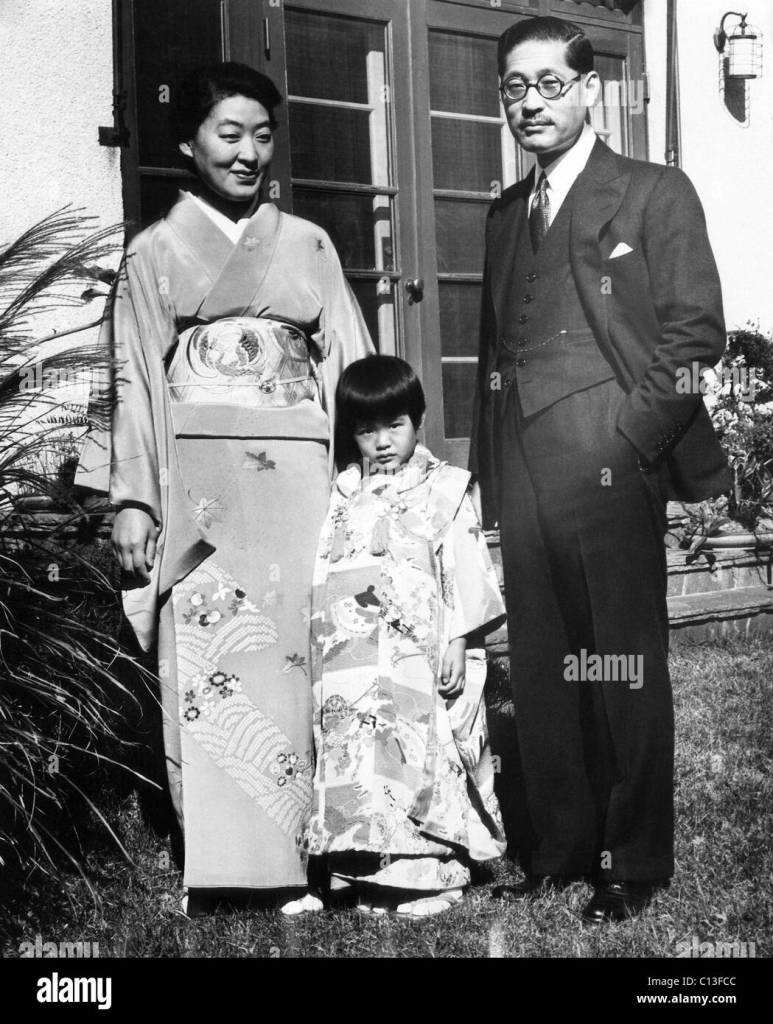
Seishiro Itagaki, as one of the Five Minister Council under the leadership of Prime Minister Konoe Fumimaro, declared that the deportation of Jews in Japan, including occupied territories in China and Korea, was prohibited.
Dow Jones Industrial Average: 148.33 (+0.86).
Naval Construction:
The Kriegsmarine (German Navy) Type IXB U-boat U-65 is laid down by AG Weser, Bremen (werk 953).
The Royal Canadian Navy Fundy-class minesweeper HMCS Nootka (J 35) is commissioned. Her first commanding officer is Lieutenant Commander Harry Kingsley, RCN.
The Nihon Kaigun (Imperial Japanese Navy) No.4-class submarine chaser CH-5 is commissioned.
The Kriegsmarine (German Navy) Type 1934A-class destroyer Z11 Bernd von Arnim is commissioned.
The Royal Navy Tribal-class destroyer HMS Nubian (L 36, then F 36, finally G 36) is commissioned. Her first commanding officer is Commander Richard William Ravenhill, RN.
Born:
Amado Samuel, Dominican MLB shortstop, second baseman, and third baseman (Milwaukee Braves, New York Mets), in San Pedro de Macoris, Dominican Republic.
Patrick Bauchau, Belgian actor (Scarpine-“A View To Kill”), in Brussels, Belgium.



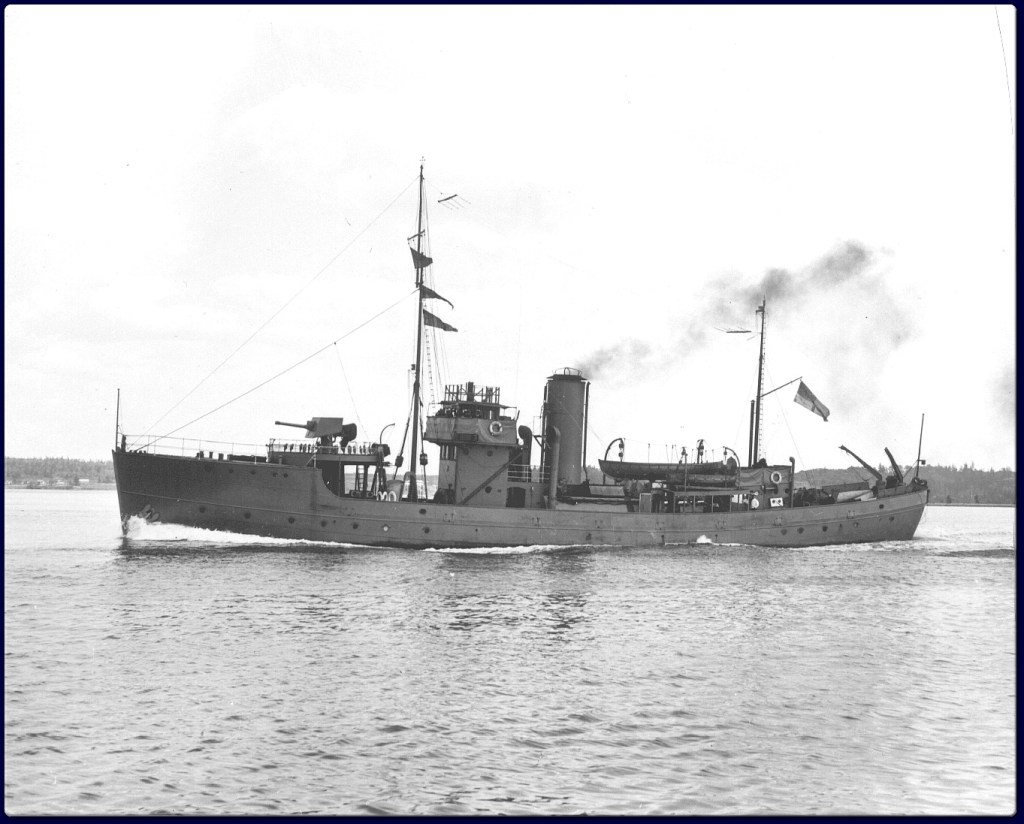
After commissioning, Nootka was assigned to Esquimalt. When the Second World War commenced, she remained a part of the Esquimalt force, performing local patrol duties. In March 1940, she and her sister, Comox, transferred to the East Coast, joining the Halifax Local Defence Force upon arrival. Nootka performed local patrol and minesweeping duties in and around Halifax harbour. The minesweeper spent the rest of the war in this service. On 1 April 1943, Nootka gave up her name so it could be used by a newly constructed Tribal-class destroyer. The ship was renamed Nanoose but kept her pennant number. Nanoose was paid off on 29 July 1945 at Halifax and laid up. In 1946 the minesweeper was sold to Chinese interests and converted for commercial use. She reappeared as the tugboat Sung Ling. The ship’s registry was deleted in 1993.
http://www.forposterityssake.ca/Navy/HMCS_NOOTKA_NANOOSE_J35.htm
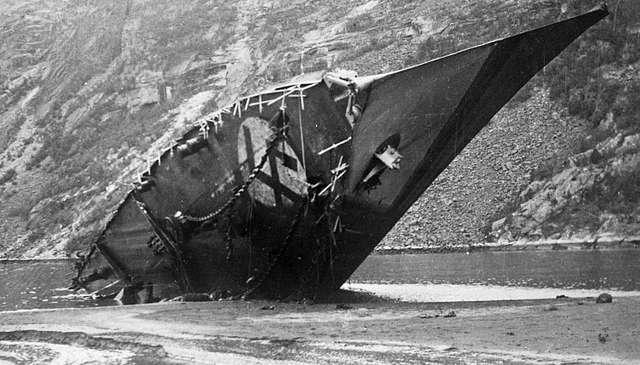
At the beginning of World War II, the ship was initially deployed to blockade the Polish coast, but she was quickly transferred to the German Bight to lay minefields in German waters. In late 1939 the ship made one successful minelaying sortie off the English coast that claimed one British warship and seven merchant ships. During the early stages of the Norwegian Campaign, Bernd von Arnim fought the British destroyer Glowworm while transporting troops to the Narvik area in early April 1940, but neither ship was damaged during the action. The ship fought in both naval Battles of Narvik several days later and had to be scuttled on April 13, 1940 after she exhausted her ammunition.
https://en.wikipedia.org/wiki/German_destroyer_Z11_Bernd_von_Arnim#Career
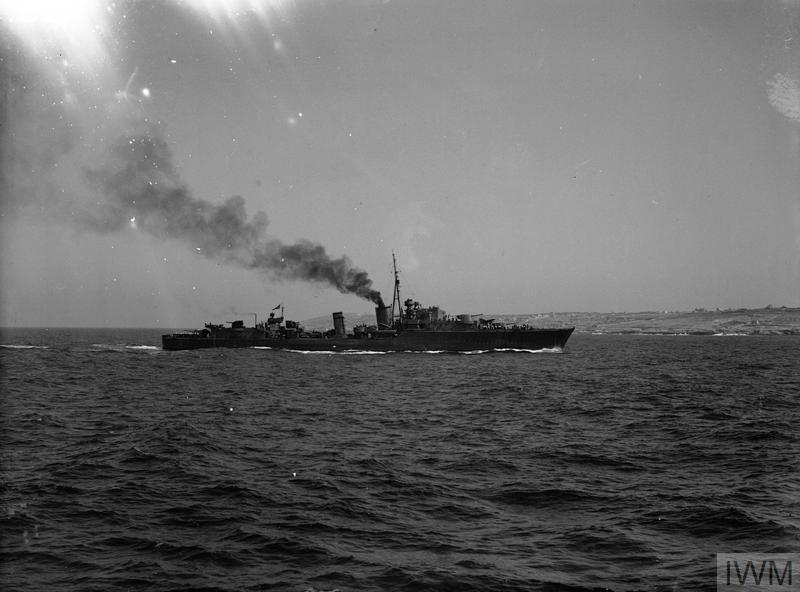
Nubian was in home waters for the early part of the Second World War, and saw action with the Home Fleet during the Norwegian Campaign in May 1940. Following this, Nubian joined 14th Destroyer Flotilla at Plymouth, which was led by Captain P J Mack (temporarily flying his pennant in Janus, whilst has own ship, Jervis, was undergoing repair). Also in the 14th Destroyer Flotilla were Mohawk (another of the Tribal class), and Juno (another J-class destroyer). The flotilla left Plymouth for Alexandria on 18 May 1940, in company with 4 K-class destroyers from the 5th Destroyer Flotilla en route for service in the Red Sea; they arrived in Alexandria on 25 May, just two weeks days before hostilities with Italy commenced on 11 June 1940.
Nubian saw much action, being involved in the actions at Calabria, in July 1940, Matapan (March 1941), Sfax (April), and finally Crete (May). During the battle of Cape Matapan, she delivered the coup de grace to the Italian cruiser Pola, stricken by an aerial torpedo. During the battle of Crete, on 26 May, Nubian was bombed and had her stern blown off, with the loss of 7 of her crew killed, and another 12 wounded. Despite further attacks, she was able to return to Alexandria under escort, but departed there on 12 June under tow for extensive repairs in Bombay, which were not completed for another 18 months.
Nubian returned to the Mediterranean and the 14th Destroyer Flotilla in November 1942, seeing action with them against the Italian torpedo boat Lupo convoy on 2 December and off Tripoli in company with Jervis on 20–21 December. In 1943, she was involved with supporting the landings in Sicily, and at Salerno, before returning to Britain for reassignment to the Arctic. While in the Arctic she conducted convoy escort duty, during which she was involved in at least one direct attack on a U-boat, a cat and mouse hunt which lasted some days. She also tracked at least 11 other U-boats that twice attacked the convoy she was shadowing. During operations conducted in the Arctic, she dispatched back to Norway on two vital operations. These were a strike on the German submarine base at Trondheim Fjord, and a strike on the German battleship Tirpitz at Alton Fjord.
At the end of 1944, Nubian was refitted, ready to be dispatched to the Far East in March 1945 as part of the escort force of the 21st Aircraft Carrier Squadron, seeing action in support of the closing operations in Burma. After the war ended, Nubian and Tartar arrived home by way of the Mediterranean. For a while, Nubian served as a Reserve Fleet accommodation ship alongside Whale Island, Portsmouth England. By 1948 she was empty and lifeless. Condemned as a target vessel in Loch Striven, she was eventually scrapped at Briton Ferry, Wales on 25 June 1949.
(Roper, F G (Lt), Royal Navy official photographer/Imperial War Museum photograph/Admiralty Official Collection/© IWM A 16827)
 History Diaries