Colonel Leuang Kongvongsa, the director of the Deuxiemme Bureau, intelligence agency for the government of Laos, was ambushed while driving home from work. Leuang was driving on a dirt road leading to his house on the outskirts of Vientiane when the assassins’ jeeps blocked his way from in front and from behind, and then shot him to death, in the fifth political assassination of the year. Colonel Leuang, who was hit by 15 bullets from a Thompson submachine gun, had been ambushed on orders from General Kouprasith Abhay.
Madame Nhu, widowed former first lady of South Vietnam, read a statement on leaving Rome for Paris in which she referred to U.S. Ambassador to South Vietnam Henry Cabot Lodge as a “bewildered nanny.”
France will insist on the right to use its developing nuclear force at the first moment of danger, disregarding U.S. arguments for a “nuclear pause,” an authoritative source said today. Two weeks before the foreign and defense ministers of the 15 NATO allies are scheduled to meet here, the source made it clear that France will never agree to Secretary of Defense Robert McNamara’s thesis that there must be a given delay before the alliance employs nuclear arms against the enemy. U.S. officials are expected to press for acceptance of the nuclear pause principle to replace the 1956-7 NATO doctrine calling for all-out retaliation at the first attack.
McNamara has explained his theory as deriving from the fact that the United States, while superior in nuclear strength, is no longer invulnerable to Soviet weapons. In these circumstances, he has contended, war should be limited to conventional arms during the “pause” in hope that mutual destruction can be averted. A study group under NATO Secretary General Dirk Stikker has been examining this proposed change in alliance strategy since last May. France has now served notice that it will veto any change in the eight-year-old massive retaliation strategy, openly admitting to a policy of blackmailing the United States in the event of war.
Parliamentarians of the Western European Union ended a four-day assembly with an agreement that European political union must proceed without Britain.
The former Lord Hailsham won a seat in the British House of Commons at a special election but his margin of victory in the “safe” Conservative district showed erosion of popular support for the party.
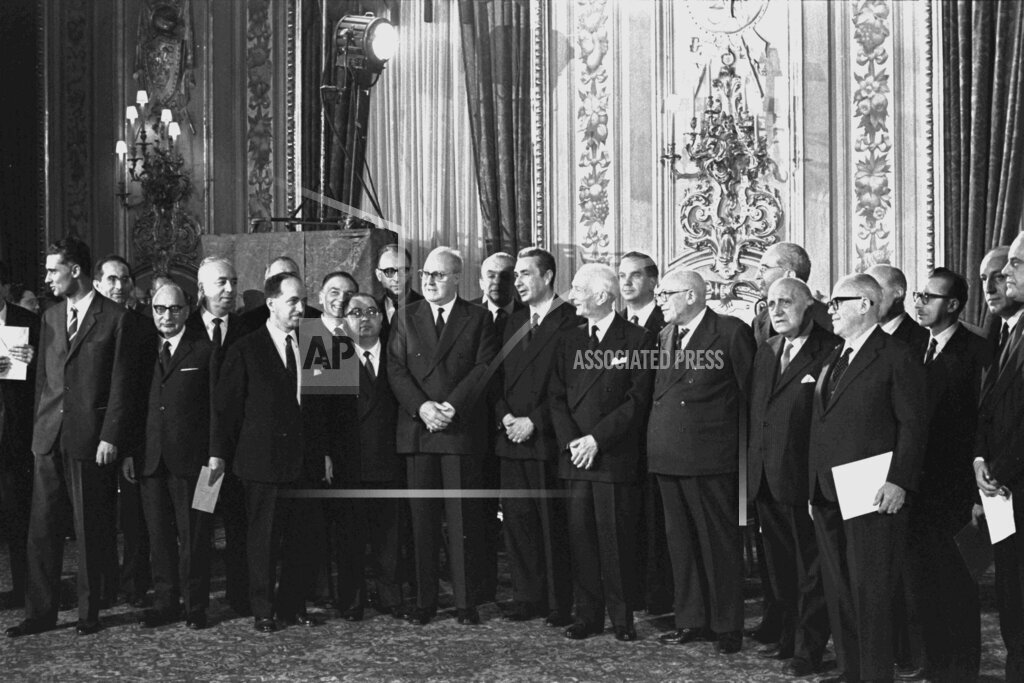
Aldo Moro was sworn in as Prime Minister of Italy for the first time, marking the return to government for the first time, since 1947, of several political parties, the Christian Democrats, Italian Social Democratic Party, Italian Republican Party and Italian Socialist Party. The first Moro coalition would last seven uneasy months, and would pass the tax on the financial returns, before being brought down by an economic crisis. The new government would be approved by the Chamber of Deputies on December 17.
A new American drive is under way to choke off an increasingly dangerous flow of arms from Communist Cuba to pro-Castro subversive forces in Latin America.
“It is a great feeling to be free again,” exclaims Lieutenant Colonel James K. Chenault, 45, deputy chief of the United States military mission in Venezuela, after his release by communist kidnappers who held him captive for eight days. He says his terrorist captors tried to brainwash him, but instead he tried to give them some insight on how Americans live.
The political committee of the U.N. General Assembly adopted by acclamation legal principles for the use and exploration of outer space.
Canadian Defense Minister Paul Hellyer announces plans to prune defense expenditures by more than 40 million dollars in a single year in a move that will reach into most sectors of the country’s defense establishments. Hellyer says the reserve strength of all three armed forces will be reduced from 57,200 to 33,560, mainly by recruiting no replacement personnel.
The West German Seliger Forschungs-und-Entwicklungsgesellschaft mbH demonstrated rockets for military use to military representatives of non-NATO-countries near Cuxhaven. The rockets landed via parachute at the end of their flight and no allied laws were violated, but the Soviet Union protested.
Volcano Irazu in Costa Rica continued to spew volcanic ash Thursday at the estimated rate of 55 tons per day. Congress called upon President Francisco Orlich to declare a national emergency as a layer of pumice three inches deep coated this capital and swirled about in choking clouds with each puff of wind. Drains were clogged. Public health officials urged all persons suffering from respiratory disorders to leave the area. President Orlich said the public works ministry has more than 400 men engaged in clearing away ash accumulations. The volcano has spewed ash and smoke intermittently for several months. The present eruption began Monday. The volcano is 20 miles east of the capital of San José.
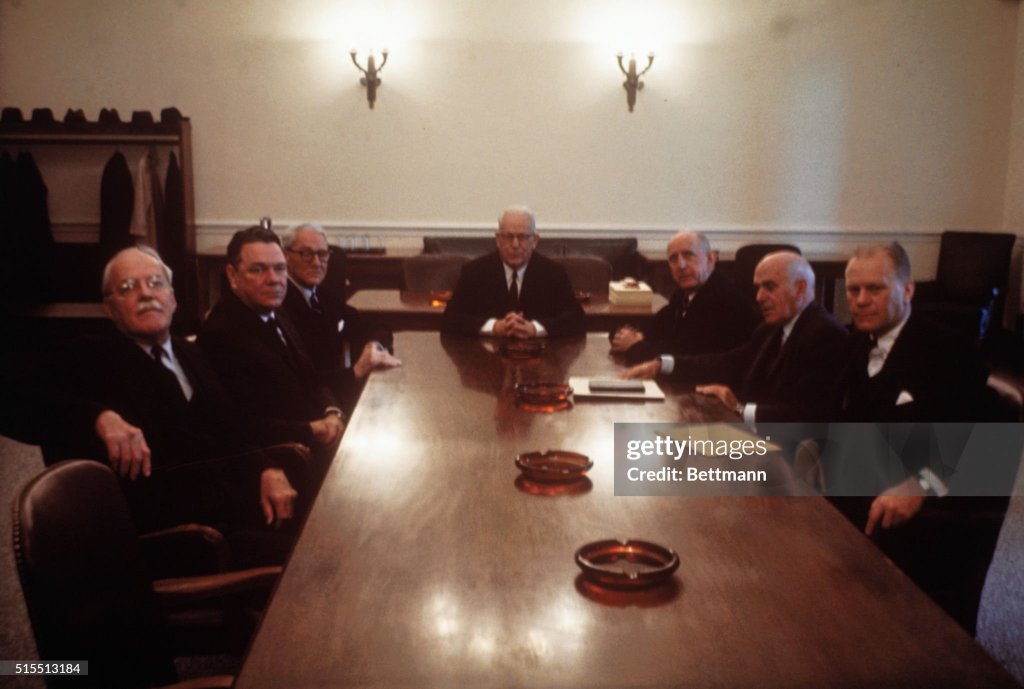
The Warren Commission met for the first time to begin its investigation into the assassination of United States President John F. Kennedy. At the time, only 29% of Americans thought that the assassin acted alone.
The Federal Bureau of Investigation completed its investigation of the assassination of President John F. Kennedy, as Director J. Edgar Hoover approved the final report of the bureau inquiry. The FBI conclusion was that Lee Harvey Oswald and Jack Ruby had each acted alone, and independently of each other.
Mrs. John F. Kennedy and her two children spent their last day in the White House today. The President’s 34-year-old widow and her children, Caroline and John Jr., planned to depart from the White House tomorrow to begin a new life at a home in Georgetown. The house has been lent to them by W. Averell Harriman, undersecretary of state. Mrs. Kennedy was expected to say her farewells to members of the household staff who will be staying on to serve President and Mrs. Johnson. The Johnsons will move in this weekend. Caroline Kennedy is expected to attend her first grade class in the White House school before the family departs. She will be returning to it until January when the term ends and the school, established by Mrs. Kennedy, disbands. Mrs. Kennedy took time out from packing to serve ice cream and cake for John Jr., who was 3 years old on November 25. She had postponed her son’s birthday party because of the first week of national mourning.
The principal of Woodland Elementary School in Woodland, Georgia, resigned after it was revealed that students at the school had cheered when they were given the news of the assassination of President Kennedy.
The bodies of Patrick Bouvier Kennedy and his stillborn sister Arabella were re-interred at Arlington National Cemetery, next to that of their father, President John F. Kennedy last night.
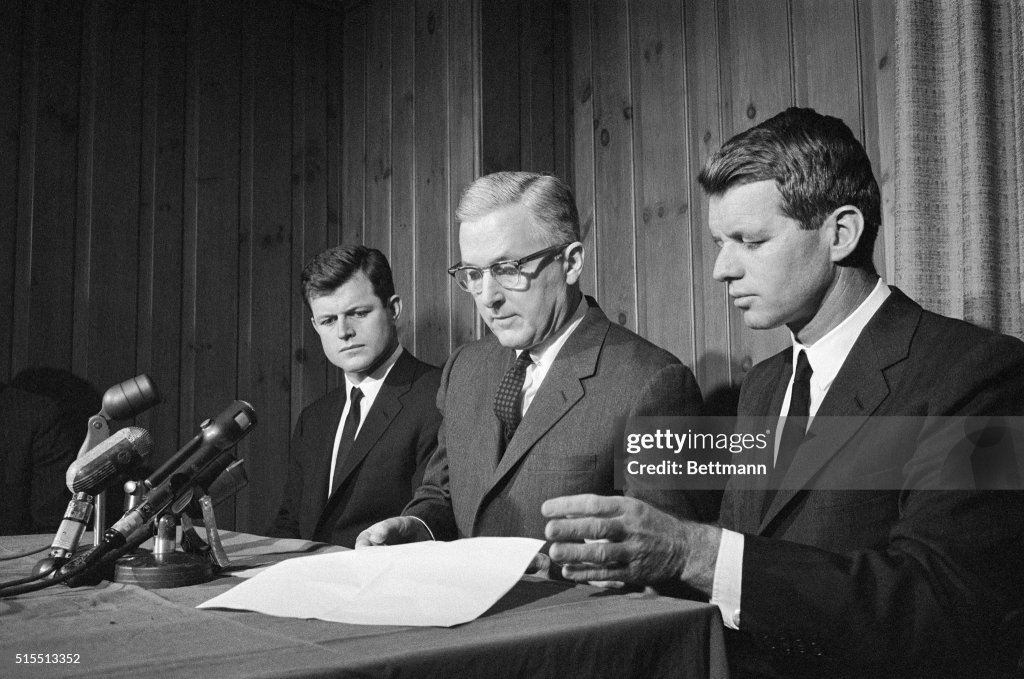
Members of the Kennedy family and the president of Harvard university invited people to contribute toward a 6-million-dollar fund for a John F. Kennedy Memorial library. Attorney General Robert Kennedy said his assassinated brother “has been deprived of the personal enjoyment of such a library, but its speedy completion would be his dearest wish.” Harvard President Nathan M. Pusey and Sen. Edward M. Kennedy (D-Massachusetts) joined in announcing the fund drive in Boston.
Republican Senator Barry Goldwater said today he is undertaking a “major reassessment” of his Presidential prospects in the tangled political picture left by the assassination of President John F. Kennedy. “I don’t think my support has changed from what it was,” said the Arizona conservative, who ranked No. 1 among potential Republican nominees in public opinion polls taken before Kennedy’s death. But Goldwater added in an interview: “I feel you can’t say for sure. The whole country is in a position of flux. There’s no way to assess it.”
Governor John Connally of Texas, seriously wounded in the assassination of President Kennedy, left his Dallas hospital to return to the governor’s mansion at Austin. Connally said he “felt fine.”
House passage of the civil rights bill by the end of January was predicted today after an announcement that the Rules Committee will hold hearings next month on the bill. Chairman Howard W. Smith (D-Virginia) said his Rules Committee will hold hearings “reasonably early in January.” His announcement came as the Democratic leadership was going ahead with plans to try to take the bill away from Smith’s committee by filing a discharge petition Monday. House Speaker John W. McCormack (D-Massachusetts) said the petition will be filed as scheduled. However, Smith’s announcement is expected to take a lot of steam out of the drive to obtain the required 218 signatures needed on the petition.
Many members are opposed to the short-circuiting of the normal legislative procedures involved in the petition maneuver, and it has always been doubtful that a majority of the House would sign up. Prediction that the House would pass the bill in January and turn it over to the Senate where a filibuster by southerners awaits it was made by Rep. Charles A. Halleck (R-Indiana), the House Republican leader. Halleck had just come from a meeting at the White House with President Johnson and was holding a press conference when he was informed of Smith’s announcement.
The National Council of Churches asks Congress to take every step necessary to insure the earliest possible passage of the civil rights bill. A resolution adopted by the general assembly at the council’s triennial meeting in Philadelphia says Americans may lose their faith in the effectiveness of Congress if it continues to delay adoption of civil rights legislation.
A compromise foreign aid bill authorizing expenditures of approximately 3 billion and 599 million dollars was reported tonight by Senate and House conferees. The amount was 930 million dollars less than the late President Kennedy had insisted was necessary for national security. This administration defeat was offset by the deletion of a number of amendments, approved by the two houses, which would have restricted President Johnson in his distribution of funds abroad.
After what Senator J. W. Fulbright (D-Arkansas) called “a hell of a wrangle,” the conferees restored to the President authority to extend to communist Poland and Yugoslavia tariff concessions under the most-favored nation trade clause. Last year, Congress stripped President Kennedy of such authority. However, the conferees wrote in a prohibition against including any other communist nation in this category. The administration put great pressure on the conferees to secure return of this lost authority, which it considers necessary to keep the two communist countries inclined, at least partially, toward the west. The House had rejected the proposal and a floor fight is expected against its revival. The House will act first next week on the bill. When it reaches the Senate, there will be more opposition because of other compromise amendments.
The fate of T. Eugene Thompson, accused of masterminding the murder of his wife for one million dollars insurance and the love of a mistress, is deliberated by a Minneapolis jury. The prosecution pleads for a verdict of guilty to first degree murder. The defense charges there are “more missing links” than facts in the state’s case against the criminal lawyer. The jury retires to a hotel for the night.
An explosion rips through a Louisville, Illinois, hardware store owned by a leader of opposition to missing John R. Harrell, anticommunist sect head. Authorities say the store was blasted with 30 sticks of dynamite. Several adjoining buildings are damaged and the hardware store owner, an ex-marine, says damage to his store is $20,000.
The National Aeronautics and Space Administration has told contractors for the Apollo moon program to stop hiring people until it assesses the impact of congressional cuts on the space budget.
On Flight 97 of the X-15 Program, Major Robert A. Rushworth flew the number one aircraft, Air Force serial number 56-6670, to an altitude of 101,000 feet 30,785 meters) and reached Mach 6.06 (4,018 miles per hour/6,466 kilometers per hour). The rocket plane was dropped from the Boeing NB-52B Stratofortress “mother ship” 52-008, Balls 8, flying at 450 knots (833.4 kilometers per hour) at 45,000 feet (13,716 meters) over Delamar Dry Lake, Nevada. Rushworth ignited the Reaction Motors XLR-99-RM-1 rocket engine, which burned for 81.2 seconds before shutting down.
The flight plan had called for an altitude of 104,000 feet (31,699 meters), a 78 second burn and a maximum speed of Mach 5.70. With the difficulties of flying such a powerful rocket plane, Rushworth’s flight was actually fairly close to plan. During the flight the right inner windshield cracked. Bob Rushworth landed the X-15 on Rogers Dry Lake at Edwards Air Force Base, California, after a flight of 9 minutes, 34.0 seconds. Mach 6.06 was the highest Mach number reached for an unmodified X-15.
Herbert H. Lehman, 85, New Deal architect and a liberal leader of the Democratic Party, died of a heart attack as he prepared to leave his New York home for the White House to receive the nation’s highest civilian peacetime honor.
Dow Jones Industrial Average: 763.86 (+8.35).
Born:
Eddie “the Eagle” Edwards, English ski jumper (subject of 2015 movie “Eddie the Eagle”), in Cheltenham, England, United Kingdom.
Sam Khalifa, MLB shortstop and second baseman (Pittsburgh Pirates), in Fontana, California.
Larry Station, NFL linebacker (Pittsburgh Steelers), in Omaha, Nebraska.
Bryant Jones, NFL defensive back (Indianapolis Colts), in Detroit, Michigan.
Carrie Hamilton, American actress (“Fame”), in New York, New York (d. 2002).
Died:
Herbert H. Lehman, 85, American Democratic politician, Governor of New York, 1933–1942 and later director-general of the United Nations Relief and Rehabilitation Administration 1942–1946.
Huseyn Shaheed Suhrawardy, 71, Bengali leader and former Prime Minister of Pakistan (1956–1957).
Monsignor Alfonso Carinci, 101, Roman Catholic Archbishop and the oldest prelate taking part in the Second Vatican Council.
Karl Amadeus Hartmann, 58, German classical composer.

 History Diaries