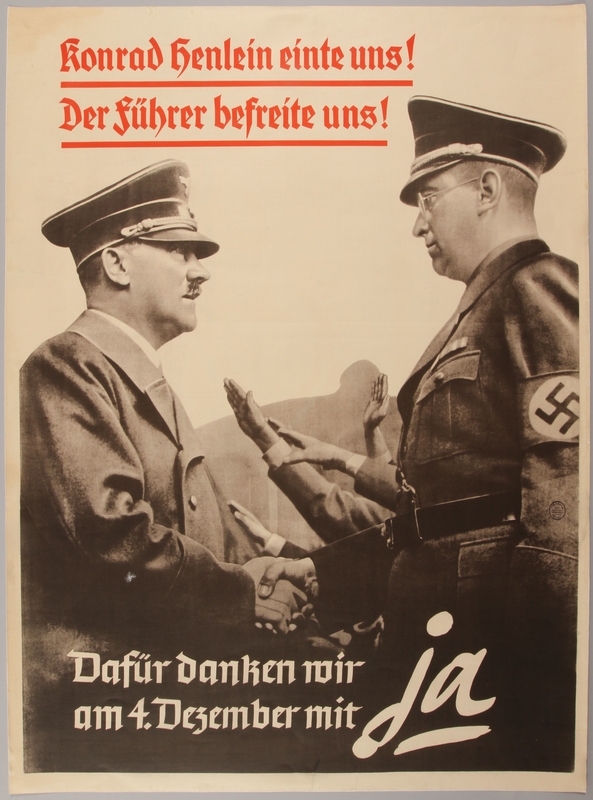
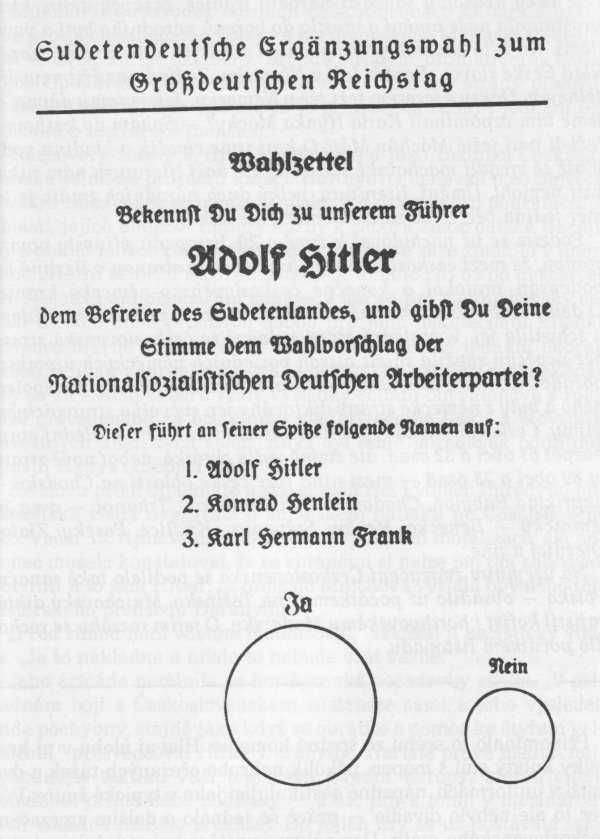
Parliamentary elections were held in the Sudetenland for 41 seats in the German Reichstag. This is the last election allowed under Nazi rule. The Nazi Party “and guests” received 98.9 percent of the vote and captured all 41 seats. Only 27,427 people dared to vote “Nein.” The Sudetenland was the most “pro-Nazi” region in Nazi Germany.
New Nazi orders forced Jews deeper into isolation from German life today amid the beginnings of nationwide Christmas festivities. In the mended windows and showcases of stores taken from Jews after the recent anti-Semitic demonstrations new Christmas goods appeared. But the new proprietors were warned that they must make a completely new start, erasing any ties with their stores’ Jewish origins. There were no new developments regarding the ghetto decrees issued yesterday by Count Heinrich von Helldorf, Berlin’s chief of police. The decrees forbade Jews to appear in the Wilhelmstrasse, the German government district; in the Vosstrasse where the new chancellery is nearing completion and on the northern side of Unter den Linden. The new ghettos for Jews will be situated in the neighborhood of Linientrasse. Residents of Berlin were exhorted officially to visit the “wandering Jew” exhibit, an anti-Semitic exposition which portrays in detail Nazidom’s hatred and contempt for Jews. While Germany was adopting additional measures against Jews, crowds of youngsters thronged Berlin’s traditional Christmas market in the Lustgarten.
The Warsaw Jewish committee today said thousands of Polish Jews, hurriedly expelled from Germany at the end of October, had received word that the wives they left behind have been ordered by German police to leave by January 1. Jews have informed the Warsaw government that they were worried because most Polish Jewesses still in Germany are without passports. The documents were turned over to Polish consulates for inspection and revalidation after October 30 to comply with a new Polish citizenship law. Thousands of these passports flooded the Polish consulates and their examination has proceeded slowly. It is feared many wives may be without passports as late as February.
While two detectives stood guard at the doors of St. Stephen’s cathedral, Cardinal Theodore Innitzer, archbishop of Vienna, today preached his first sermon since October 8 when Nazi crowds stormed his palace. The cardinal told the congregation that “present conditions require redoubled efforts to preserve the sanctity of family life.”
A German National council has been formed in Ruthenia (Sub-Carpathian Russia), autonomous state of Czecho-Slovakia, it was announced today. The council plans to organize a “voluntary protection service” for the German population and a “school inspection board.” Under the direction of this board, German language schools are to be reopened within the next few days in the German speaking part of Ruthenia.
800 refugee children enter France from Germany.
About 1,300 seamen are fired for striking in Le Havre, France. The union sends a delegation to the General Confederation of Labor in Paris. The entire crew of the liner Normandie is on strike and the ship is unable to sail.
Two Spanish Government (Republican) pursuit squadrons gave battle for a half hour today to twenty-six rebel warplanes raiding the waterfront of Valencia. The defense air fleet broke up the raiders’ formations and drove them off but only after about 260 bombs had been dropped, wounding nineteen persons and wrecking twenty-two houses. Reports from the French border claim that 20 people were killed.
Barcelona’s new air defense squadron broke up another rebel raid on this city today, scattering the enemy bombers in a brief dogfight. The rebels were forced to drop all their bombs into the sea outside the port. Officials said two rebel bombers were damaged but it was not learned whether they fell. During the three days that the squadron of snub-nosed government “Chatos” has been protecting Barcelona only one person has been wounded in nine rebel day and night raids.
Generalissimo Francisco Franco today coupled a prediction of a quick rebel victory in the Spanish civil war with a declaration that the new Spain would adopt an aggressive foreign policy. He told of his plans in an interview given on his 46th birthday today. “In return for the blood which has been shed the life of our nation must be fruitful,” he said. “Spaniards who live abroad will be longer be abandoned like outcasts. A sentiment of national solidarity will give them help and protection. Henceforth, no one will be indifferent to the sorrows of their brothers however far away they may be.” Franco sat in his second-floor office. To reach him it was necessary to pass two sharp-eyed Moorish lancer guards at the entrance of his villa. A waiting room was occupied by Franco’s personal bodyguard.
Franco declared the government’s continued resistance against the rebels was “an unique example in history.” “It can only be explained by a total absence of patriotism and the criminal spirit of the Red (government) leaders,” he said. Franco charged that government leaders had “assassinated a half million innocent beings and at present they are trying to endeavor to make the people forget these crimes.” With a rebel victory he said justice would be accorded all in Spain and added the belief that most of the government forces would associate themselves in a united Spain. “All those who have not committed crimes, who have not incurred heavy responsibilities will be reestablished in civil life. “Our forgiveness is open and generous for those who have been mistaken. Only those who persist in their criminal ideals must be isolated.” He said he did not believe there could be peace without imprisonments.
Iron Guard fascists attempt another assassination in Rumania. Over 2,000 fascists are jailed and police search for more.
Two thousand Jewish servants lose their jobs in Italy due to new laws.
Prime Minister Neville Chamberlain may cancel his trip to Rome next month as the result of Italian attacks against France, it was indicated tonight. Chamberlain, it was said, will stay at home if the situation is not cleared up soon. The prime minister faces an attack in the house of commons tomorrow. Some members will demand to know whether he is making the visit to Rome at the expense of an understanding with France. There also were indications that before a stiffened British-French front Premier Mussolini and Foreign Minister Count Galeazzo Ciano of Italy might quiet the clamor for French territory unless Reichsführer Hitler stirs up new agitation. Diplomatic observers saw a new Sudetenland crisis developing in French Tunisia with Italians complaining of oppression the same as the Germans did in Czecho-Slovakia.
In Tunis, a pro-French crowd of 500 vandalizes Italian-owned businesses, and 15 are arrested. Anti-Italian riots broke out in Tunis over Italy’s recent demand that France hand over Tunisia. Windows of an Italian tourist office, newspaper and bookstore were smashed, but police reinforcements prevented any such attack on the Italian consulate. 15 arrests were made.
A pro-French demonstration of 30,000 is held outside the Italian Embassy in Corsica.
Arabs submit to the British rule requiring identification permits for all traveling males. Transporting citrus fruit to market necessitates the change; for weeks no Arab has been legally able to drive.
Louis Johnson, Assistant Secretary of War, declared today that the nation “must spend money” for more and better planes and anti-aircraft guns to assure “minimum” safety from attack. Fighting in Spain and China has shown “the havoc which a hostile bombing attack could and, in the event of war, doubtless would, wreak on our unprotected cities,” he said in his annual report to Secretary Woodring.
Recent advances in other countries have equaled or excelled the quality of American warplanes, which already were far surpassed in numbers by the fleets of some foreign powers, Johnson reported. On the bright side, he said there has been increasing teamwork among the Army, Navy and industry in their continuous preparations to meet demands a war would bring.
Father Coughlin claims Henry Ford’s November 30 statement was written by Detroit’s Rabbi Franklin and published by “controlled newspapers.”
Resolutions suggesting that the United States take direct methods to make known its disapproval of the Nazi persecution of Jews were adopted last night at a meeting, attended by 3,500 persons, in the Ashland Boulevard auditorium in Chicago. The gathering was sponsored by the Jewish People’s Committee Against Fascism and Anti-Semitism. One section of the resolutions urged President Roosevelt to use his powers to establish an embargo on all trade to and from territories controlled by the Nazi government. The meeting recommended that Americans and individuals boycott German made goods until some such action is taken. It was asserted that many Germans strongly oppose the Nazis and that as much assistance as possible be given to these people.
Philanthropist Dr. Godfrey Lowell Cabot establishes the Maria Moors Cabot Awards, in memory of his wife. The prizes, the first in international journalism, will be awarded by Columbia University.
With Chicago’s Mayor Kelly mediating, stockyards owners agree to collective bargaining with the CIO and written contracts. After 13 days, the strike ends.
After bombs destroy a half-mile square section of Kweilin in Kwangsi province, pilots drop leaflets saying the city is being punished because of its loyalty to General Chiang Kai-shek.
Born:
Billy Bryan, MLB catcher and pinch hitter (Kansas City A’s, New York Yankees, Washington Senators), in Morgan, Georgia.
Liesbeth Struppert, Dutch actress (Miep Gies-Anne Frank), in Deventer, Overijssel, Netherlands (d. 1994).
Andre Marrou, American Libertarian Presidential candidate (1992), in Nixon, Texas.
Yvonne Minton, opera soprano, in Sydney, New South Wales, Australia.
Naval Construction:
The Вое́нно-морско́й флот СССР (ВМФ) (Soviet Navy) “L” (Leninec)-class (4th group, Type XIII-modified) submarine L-22 is laid down by Baltiyskiy Zavod (Leningrad, U.S.S.R.) / Yard 189.
 History Diaries