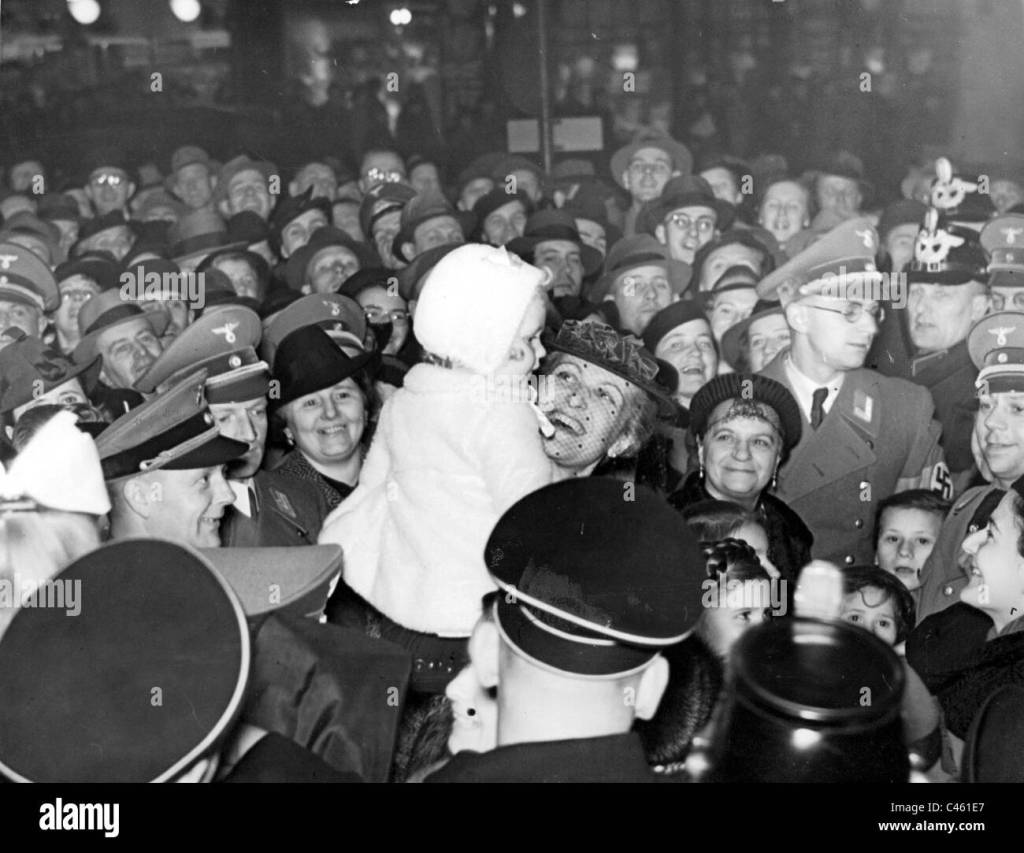
Jews in Germany are warned to stay indoors as Germans celebrate National Solidarity Day. Nazi Germany had a nationwide “day of solidarity” collecting street donations for the Winterhilfswerk fund. Jews were ordered to stay off the streets between noon and 8 p.m. because, according to the order issued by Heinrich Himmler, they had “no share in the solidarity of the German nation.”
Heinrich Himmler ordered all driver’s licenses of Jews invalidated. German government revoked driver’s licenses held by Jews. New laws restrict Jews from driving, and they are advised to move to the northern part of the city as other areas will be barred to them. The Jews are to be driven back into ghettoes, as in medieval days.
Anti-aircraft guns repel insurgent planes in Barcelona, but other cities in northeast Spain, particularly Cervera, are bombed and at least 55 people die.
Hundreds of French ship and dock workers walk off jobs at Le Havre. Over 300 American volunteer soldiers from Spain are among passengers stranded by the strike.
France will tolerate no interference in Tunisia, qualified sources said tonight, whatever may be the outcome of the French protest to Italy yesterday against the Fascist clamor over the French African protectorate. Count Galeazzo Ciano, Italian foreign minister, replied to the French protest by disavowing any official responsibility for the anti-French demonstration in the Italian chamber Wednesday. This reply was considered unsatisfactory by the French. The French were piqued especially by the statement in the Rome newspaper Il Giornale D’Italia yesterday that Italy is “ready to march against France if necessary.”
Great Britain today agreed to support France in the latter’s demand that Italy promise to leave French possessions alone. The British support is expected to take the form of a protest on Monday by the earl of Perth, British ambassador to Rome, to Count Galeazzo Ciano, Italian foreign minister. It is not considered that the situation is likely to hurt Anglo-Italian efforts to improve relations. Prime Minister Neville Chamberlain and Viscount Halifax, British foreign secretary, will reach Rome for discussions with Premier Mussolini on January 11. This was announced tonight. They will leave Rome on January 14.
British government officials have been consulting with the French since the demonstration in the Italian chamber of deputies on Wednesday, when the Italian deputies cried for the French territories of Corsica, Nice, Savoy, Tunisia, and Djibouti. Charles Corbin, French ambassador to London, emphasized that the French take the situation seriously and want the Italians to make a flat statement of their intentions. This is what the earl of Perth is expected to ask when he sees Count Ciano. Just what points Chamberlain will talk over with II Duce still is a mystery. All statements issued here have been vague. Chamberlain and Halifax apparently are going to Rome with a blank check allowing them to do anything they think will appease the Italian appetite and guarantee peace in the Mediterranean area. It is feared by sympathizers of the Spanish government here that the peace missionaries will sell out the loyalists in Rome.
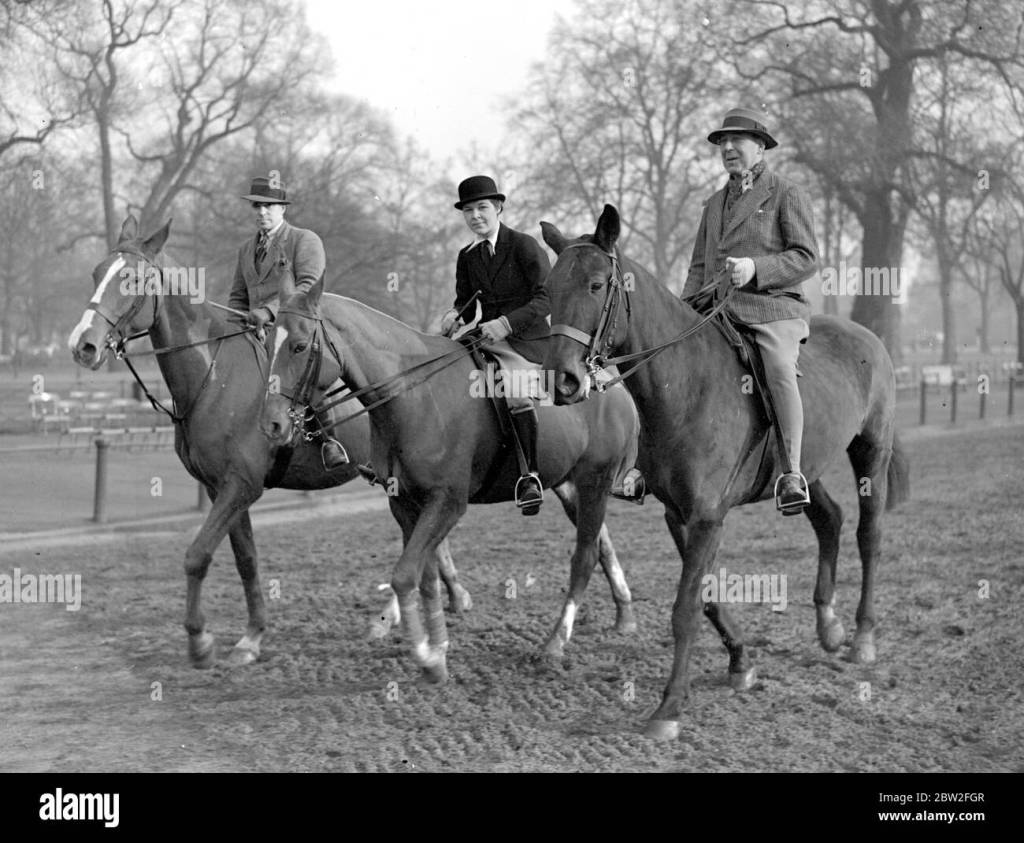
The Duke of Gloucester, brother of King George VI, broke his collarbone in a fall from a horse while on a hunt near Melton Mowbray.
Three confessed terrorist prisoners were shot and killed today by their guards in Rumania’s quick-triggered campaign to wipe out the Fascist-patterned, anti-Semitic iron guard. The shooting of three assassins at Cluj brought to 17 the number of prisoners disposed of in that fashion within four days — all killed, officials claimed, when they “attempted to escape.” [Ed: Of course, they were murdered.] Last Wednesday Corneliu Zelea Codreanu, convicted of treason as leader of the Iron Guard, and 13 sub-leaders were shot down when, it was said, they tried to flee while being transferred from Rumnik-Sarat Prison to Bucharest for questioning. The three killed today had confessed to the assassination attempt on the prison rector, Flory Stefanescu Goanga.
Finland notified the State Department today that as usual it will make its semiannual debt payment to the United States on December 15. Only Finland, of the 13 European nations whose war debts to this country now total $13,000,000,000, has met its obligations without a default. Finland’s December 15 installment totals $232,945.
The United States and Iraq sign their first trade treaty, granting most-favored-nation status.
President Roosevelt, tanned and rested from two weeks of outdoor life, got ready today to return to Washington via Chapel Hill, North Carolina, where he will deliver a formal address Monday afternoon.
The Chicago Tribune opines:
“President Roosevelt's vast rearmament program, which is being promoted by war scare propaganda, is under fire, front and rear. The attitude of senators and representatives returned to the 76th congress, which will assemble January 3, indicates that congress will schedule the Roosevelt program to close scrutiny and put a crimp in any plans of a grandiose character. It also transpires that the program lacks the support in the rear that was expected by the administration. High ranking army and navy officers are looking askance at such features of the project as the construction of from 7,000 to 10,000 army airplanes and provision for equipping an army of 1 million men in six months, as Assistant Secretary of War Louis Johnson has suggested.

“If the Johnson proposal were adopted the country would have not less than 12,000 military planes, including the navy quota. According to army and navy authorities, this is several times as many planes as would be needed to repel the most formidable attack on the American continents conceivable at this time. But even if so large a number of planes were essential it would be folly to build them all at once, say the experts, because of the rapid rate of obsolescence due to inventions and improvements in construction. A plane turned out this year is bound to be obsolete next year and no match for the up to the minute product of an enemy. Far better it would be, according to this view, to provide for the continuing production of a smaller number of planes, a larger percentage of which always would be the last word in efficiency. The army now has about 1,700 first class planes and funds available for the production of 800 more, which production is in progress.

“The President is to confer with the army and navy authorities before submitting his rearmament program to congress. Interest centers in the extent to which he yields to their views or they yield to pressure to support a program which, it is estimated, would call for the expenditure of upward of 3 billion dollars. There is no reason to believe that congress will refuse to vote funds for such ships and arms and other military equipment as the experts are able to justify. But there will be tremendous opposition to voting the President a vast fund to expend on rearmament with the ulterior motive of further priming of the business pump and taking the political curse off Harry Hopkins' WPA by transferring the relief burden from made work to national defense. The general staff of the army is prepared to justify a program of equipment with up to date arms of a regular army of 165,000 (present authorized strength) and the National Guard of 205,000, which, with the new enlisted reserve, would round out a force of about 400,000 men.”
[Ed: We see here how Roosevelt’s excesses with the political use of relief, with Supreme Court packing, and the government reorganization effort have eroded trust not only with Republicans, but within the conservative, mostly southern, wing of his own party. This will now become an impediment to efforts to build a modern military. Congress — not only the soon-to-be America Firsters, but others as well — now mistrust his motives, both in terms of domestic politics, and his intent to be more interventionist in Europe and Asia. Roosevelt has damaged his political credit on Capitol Hill at the worst possible time, as Europe begins the slide to war. America will still re-arm; but the hesitancy of the next two years will ultimately exact a measurable, bitter cost in blood when war comes. The phrase, “Too clever for your own good,” comes to mind.]
The UAW and GM reach agreement: all plants will reopen on December 5, negotiations will begin, and those who called the unauthorized strike will be disciplined by the union.
Guy Hecker, who once scored seven runs in a game, dies in Wooster, Ohio, at the age of 82. Hecker played primarily with Louisville of the American Association, ending his career in 1890. Hecker is the only pitcher to win a batting title hitting .342 in 1884.
College Football Scores:
Southern California, 13; Notre Dame, 0.
Tennessee, 47; Mississippi, 0.
Oklahoma, 28; Washington State, 0.
Rice, 25; Southern Methodist, 14.
N. Carolina State, 14; Citadel, 6.
Bowling Green (Kentucky), 50; Tampa, 7.
Temple, 20; Florida, 12.
Louisiana Tech, 0; Southwestern (Louisiana), 0.
Virginia State, 8; Morris Brown, 6.
Xavier, 32; Knoxville, 6.
Appalachian, 20; Moravian, 0.
Hardin-Simmons, 7; Howard Payne, 6.
Arkansas State, 0; Langston, 0.
Texas Mines, 26; Fresno, 6.
Southern U., 6; Texas College, 0.
Florida A.&M., 9; Kentucky State, 7.
Hawaii, 13; San Jose State, 12.
Japanese plans are balked by General Wu Pei-fu’s refusal to lead a collaborative government. The aging general says he will be glad to take over if every Japanese soldier leaves China — but not before.
Winter storms stall military actions in north and central China. Japanese gains are held to conquered cities and rail lines. Troops still mass 50 miles north of Changsha, and within 50 miles of Kiukiang. In the north, Japan’s troops stay south of the Yellow River, with a large force in Paoting. Winter is fighting for the Chinese. After 515 days of warfare in China, Japanese forces in the Yangtze valley. principal theater of the conflict, appeared tonight to be bogged down, at least temporarily. The Japanese have met blizzards sweeping in from the Mongolian plains of the northwest, overcast skies, and the erratic resistance of hundreds of thousands of Chinese regulars and guerrilla troops. All this has slowed their progress along the Yangtze and elsewhere in the vast land. Chinese sources in Chungking (today Chongqing), provisional Chinese capital far in the interior, said the Japanese forces in China or Chinese waters amounted to fifteen divisions totaling 300,000 men, 600 planes, and 100 warships.
They are engaged in a conflict which has become more than ever a struggle for control of long railways in the Chinese Interior. Japanese based on Hankow were fighting to solidify and expand a vast front curving from the Peking-Hankow Railway on the north around to the west of Hankow, thence south and east to the Kiukiang-Nanchang Railway. Since the occupation of Hankow on October 26 the Japanese had advanced southward along the Canton-Hankow Railway. In the last two weeks, however, they were fought to a standstill or actually thrown back after they had entered Hunan province. Their objective is the Hunan capital, Changsha. Today the Japanese were fifty-five miles north of Changsha. About 150 miles east of this sector was another concentration of Japanese manpower on the Kiukiang-Nanchang Railway at Sunkiapu, within thirty miles of Nanchang, Kiangsi provincial capital. The Kiangsi force had advanced less than fifteen miles in the last month and about six miles since Kiukiang was captured July 26.
Dow Jones Industrial Average: 147.50 (-0.07).
Born:
James Stinnette, AFL linebacker and fullback (Denver Broncos), in Corvallis, Oregon (d. 2014).
Claude King, AFL halfback (Houston Oilers, Boston Patriots)., in Mississippi
Don Jonas, NFL halfback (Philadelphia Eagles), in Scranton, Pennsylvania.
Died:
Félix Córdova Dávila, 60, Puerto Rican political leader and judge.




 History Diaries