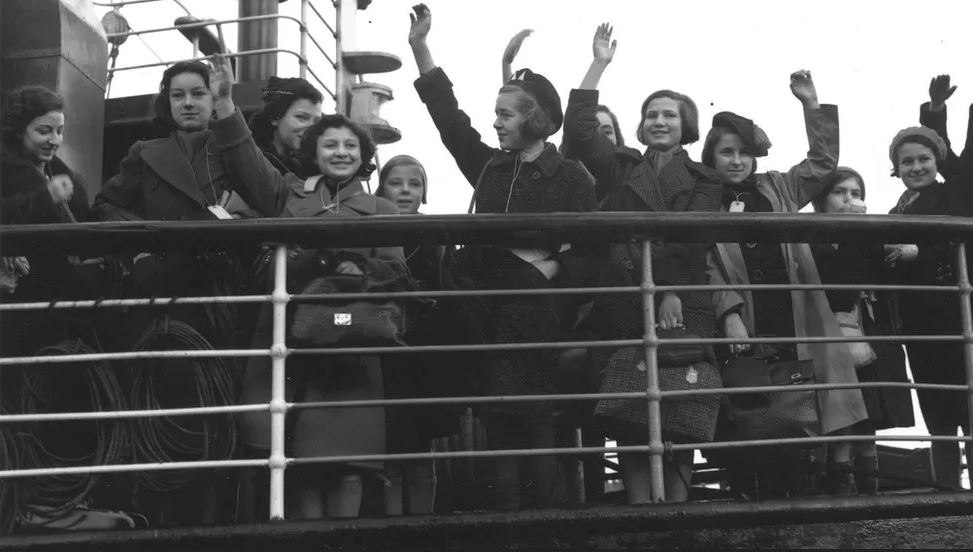
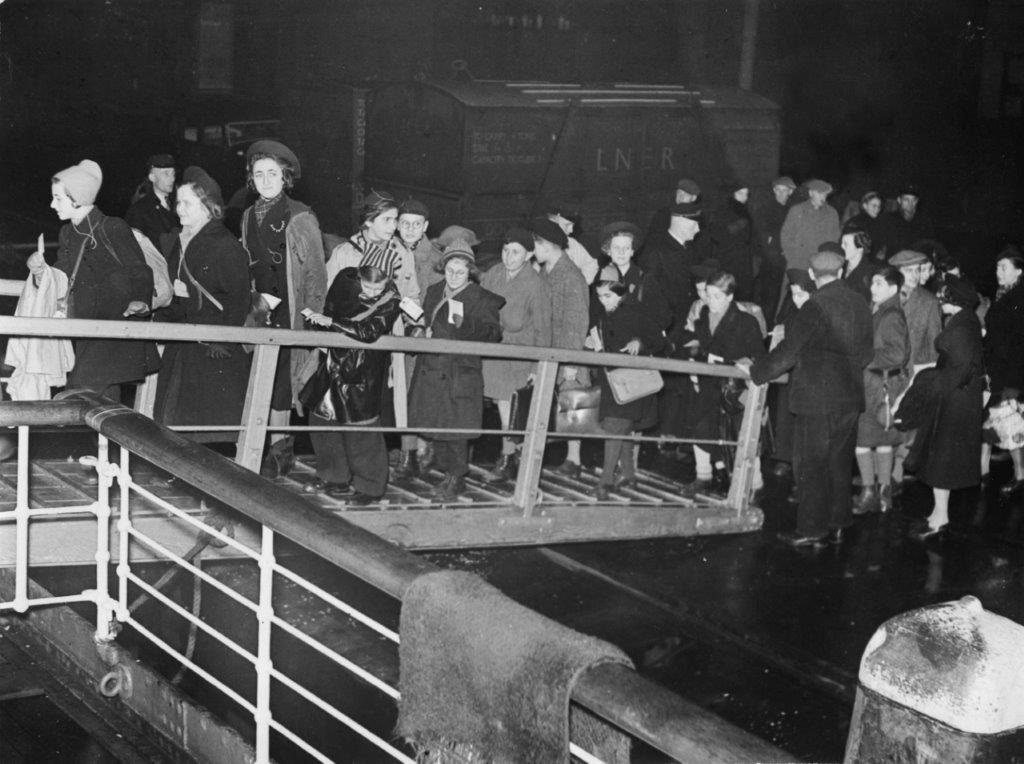
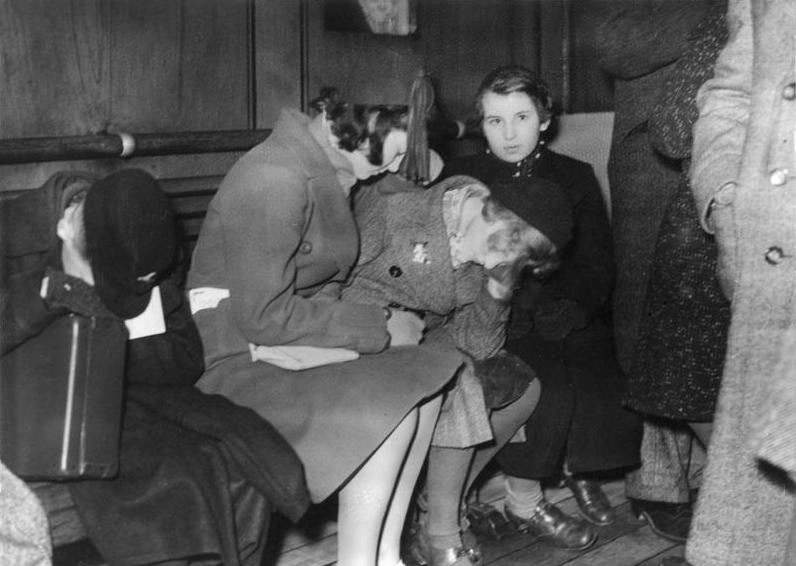
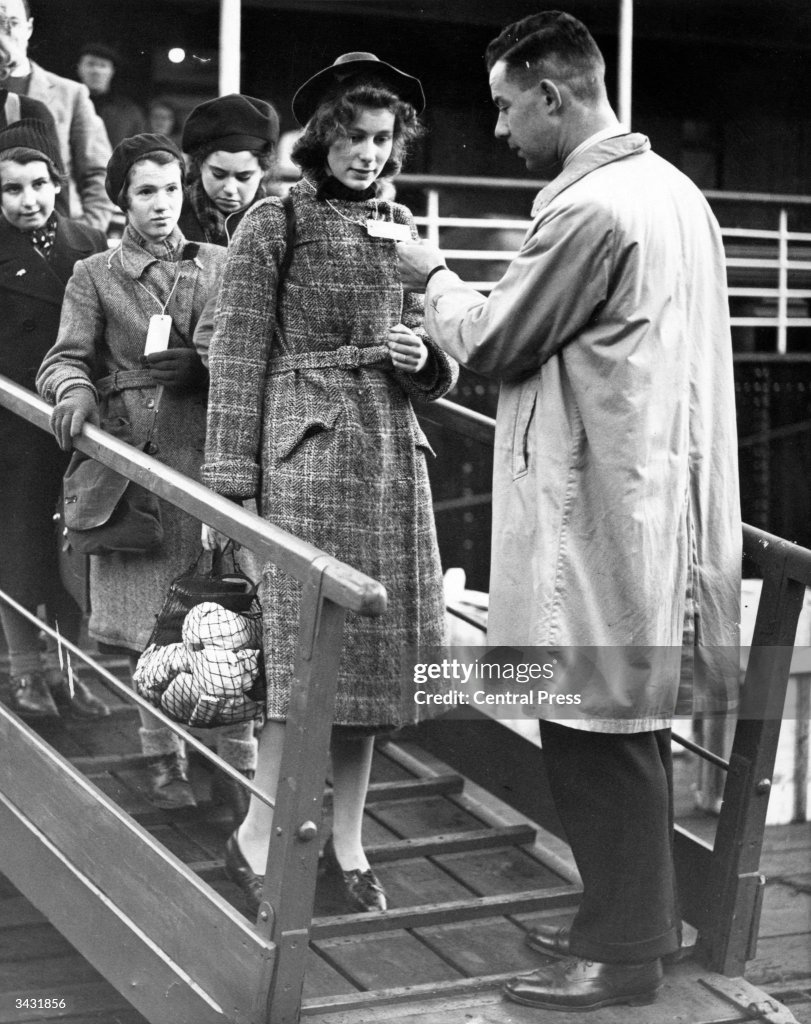
The first ‘Kindertransport’ carrying Jewish refugee children from Nazi Germany arrives in Britain. At 5.30 AM on 2 December 1938 the SS Prague docked at Parkeston Quay in Harwich. On board were 196 children, the first arrivals of the Kindertransport program to arrive in England. Eventually between 9,000 and 10,000 children were rescued via Kindertransport. It was an extremely difficult experience for these children as they were told that they would need to leave their family and friends behind – and there was a chance they might never see them again. Their parents were not allowed to go with them. Most of these girls and boys in fact would never again see their parents, who were murdered during the Holocaust.
The National Socialists welcomed the emigration of Jewish children, but they did not allow them to take capital out of the country. As such, their parents weren’t able to give them money or jewelry to secure their existence. They were only allowed a single suitcase, a pocketbook, and 10 Reichsmarks. The children traveled in groups by train and ship, and were accompanied by adults until they arrived in their new country. Some children could live with relatives there who had already emigrated, but most were sent to foster families or group homes. Often, they had to perform housework in their foster homes, but they generally were able to continue attending school.
Reichsführer Hitler’s navy, it was disclosed today, has made strenuous efforts to keep pace with the German army and air force, which Nazi leaders have described as the most powerful in the world. Strong increases in every category of the German navy, from super-battleships to 20-ton speed boats, are disclosed by the official navy year book of the German admiralty. The construction of two 35,000-ton battleships at Kiel and Wilhelmshaven is rapidly progressing. A third battleship of this type is planned. All three will be armed with eight 15-inch guns, twelve 6-inch guns and antiaircraft artillery. The first of these vessels will be launched next year.
The 26,000-ton battleship Scharnhorst will be placed in commission soon. This will be the second battleship of this class in the German navy. Germany is planning four light cruisers — K, L, M, and N — each displacing 7,000 tons. Two other light cruisers, armed with 6-inch guns and displacing 10,000 tons, are being built. In accordance with treaty obligations, Germany will not increase the number of its more heavily armed cruisers. Two of these are in commission and a third is under construction. Details of their armament, disclosed by the year book, show they are more efficiently equipped against aircraft than any vessel of the same type in the navies of other nations. In addition to their main armament of eight 8-inch guns, these 10,000-ton cruisers have anti-aircraft artillery of twelve 4-inch guns, twelve 1.5-inch guns, and a great number of super heavy machine guns, probably of 20 mm. bore.
These vessels also are heavily equipped with torpedo tubes. They have twelve each of 21-inch bore in triple mounts. Despite their heavy armaments, the cruisers have a designed speed of 32 knots. They carry three seaplanes aboard. The first of Germany’s two 19,250-ton aircraft carriers will be launched at Kiel next Thursday. This vessel is remarkable for its comparatively heavy armament, which is designed to enable it to defend itself against lighter enemy seacraft without depending on the protection of cruisers or destroyers. It is armed with sixteen 6-inch guns, ten 4-inch guns, and twenty-two 1.5-inch guns. The carrier has a designed speed of 32 knots. It is added that the maximum speed probably will be greater. The vessel carries 40 airplanes. It is explained that if this is somewhat lower than ships of the same type and size other navies carry, the German figure does not include aircraft fastened to the flying deck, but only such planes as can be stowed away in the hangars below deck.
The new German ship will carry three-seater planes of the AR-95 type, with twin floats and landing gear enabling them to operate on land. They are equipped with two machine guns and can be used as scouters, bombers, and torpedo planes. They fire torpedoes weighing 1,763 pounds. Germany now has 30 destroyers, either in commission or being built. The construction of twelve 600-ton torpedo boats is planned in addition to eighteen recently completed. Germany is planning the construction of ten more submarines, which will bring the total in this category up to 71. This is more in numbers than the British navy has, although the German U-boats are smaller in tonnage. Fifteen of these submarines are of the 740-ton class, 24 of the 500-ton type and 32, designed for coastal defense, displacing 250 tons each.
Germany also is planning the construction of 12 minesweepers and 12 speedboats, bringing the total in the latter category to 37. The Danube fleet, which has become of great importance since the annexation of Austria and Sudetenland, is being increased by 12 warcraft for the removal of river booms, mines, and other obstructions. A training ship for anti-aircraft gunners also is under construction.
Lord Gort submitted a report noting that the German military had improved in its fighting qualities over the past year, especially since the annexation of Czechoslovakia, while the British Army fighting strength had been weakened due to political decisions made in 1937.
A group of American volunteers, totaling 332, left Spain en route to the United States today. The troops crossed the border from Alp, Spain, to La Tour de Carol, France, just ahead of a rebel air attack, in which eighteen bombs were dumped on a railway near Alp. The Americans have fought with the Spanish loyalists in the civil war. They were members of the Lincoln and Washington Battalion of the 15th International Brigade, and saw service on many fronts — Madrid, Aragon, Ebro, Teruel, and Belchite. There were no wounded in the group, but another body of 300 will include a number of casualties. This other group is expected to leave Spain soon. The Americans are going home under a decision of the Spanish loyalists to dispense with the aid of alien fighters.
The French government ordered a destroyer today to the Strait of Gibraltar. It was announced as a move to halt frequent interference with French freighters by Spanish rebel warships.
The Spanish government command concentrated troops today in the Segovia and Toledo sectors, north and south of Madrid, apparently for some offensive movement. Insurgent air scouts spotted the troop movements. Government attacks in these sectors, it was pointed out, might force the insurgents to shift reinforcements and delay the offensive they are expected to renew against Valencia, on the east coast.
France’s Prime Minister asks companies to rehire employees who followed their union’s orders to strike. Throughout France, 20,000 workers remain on strike. Faced with an open threat of war from Rome, the French government was further harassed tonight by a new wave of strikes. The walkouts came as a result of reprisals taken against workers who participated in the unsuccessful general strike Wednesday. In an effort to relieve the pressure at home while he combats the Italian threat against French colonies, Premier Édouard Daladier addressed an appeal to employers not to penalize workers who obeyed union orders to join the general strike. He warned that collective contracts between workers and employers are not to be tampered with. Some employers have locked out thousands of employees, claiming that the workers themselves broke their contracts by taking part in the strike. The workers have been informed that they will be hired back only individually and on the employers’ terms.
On the international front, the government delivered to Premier Mussolini its second protest in two days against the anti-French scene in the Italian chamber of deputies Wednesday. The deputies, responding to a speech by Count Galeazzo Ciano, Italian foreign minister, in which he outlined the “interests and aspirations of the government,” raised cries of “Tunisia! Corsica! Nice! Savoy!” These are all French possessions. Andre François-Poncet, recently appointed French ambassador to Italy, handed the new protest to Count Ciano. Last night Georges Bonnet, French foreign minister, summoned Raffaele Guariglia, Italian ambassador to Paris, and demanded an explanation of the Italian deputies’ demonstration. The Italian war threat was made by Virginio Gayda, Fascist editor, who is regarded as a spokesman for Mussolini. Writing in the newspaper Giornale D’Italia of Rome, Gayda declared Italy “is united solidly behind its government and is ready for everything, is ready to march — even against France — if it is necessary.”
Brigades of the Young Communist League “raid” Moscow stores, searching for reasons for shortages. The raiders find evidence of poor distribution, hoarding, and “speculation” in unofficial markets.
As the Inter-Governmental Committee on Refugees meets, France and the Netherlands say they can place 10,000 refugees each in their colonies.
In southeast Turkey, flooding kills 72 people and thousands of head of cattle in the Urfa region.
An ambush kills three Jewish officers and leads to a British attack on the Arab band responsible. Daily violence and assassinations show that order has not been imposed in Palestine.
Bungling by the Federal Bureau of Investigation which permitted the escape of higher-ups in a Nazi spy plot was criticized today by federal Judge John C. Knox when he imposed sentences on four defendants convicted of espionage. It previously was disclosed that the army intelligence division first uncovered the spies, then asked the FBI to aid in capturing the ring members. A general officer said that J. Edgar Hoover’s insatiable thirst for publicity upset the army’s plans to capture the ring leaders. Only four of thirteen persons indicted were captured.
Judge Knox imposed sentences ranging from two to six years on the three men and a woman who were found guilty of selling United States military secrets to Nazi Germany. The judge indicated that had they been spies in their native land they would have died beneath the executioner’s ax. Johanna Hofmann, young red haired beauty salon employee on the German liner Europa, was given four years in prison instead of a maximum of twenty. Otto Herrmann Voss, former airplane factory mechanic, was given six years. Erich Glaser, young United States army air corps private, for whom the jury asked for leniency, was given two years. Guenther Gustave Rumrich, who told on the others, received the lighter sentence of two years.
“Had these defendants been convicted in Germany,” the judge said, “their fate would have been much more fearful. Natives of a totalitarian state, they are the recipients of the mercy of a democracy. Some day they may concede they were fortunate to be before a court in a democracy instead of a totalitarian tribunal. In this country we spread no sawdust on the surface of our prison yards” — a sharp reference to the executions in Germany. Terming the spy plot “aborted, puerile, and contemptible,” the judge said the trial went to the edge of too great indulgence. In chiding the prosecution, the judge also criticized, by indirection, the federal agents’ bungling.
The President relaxes his ban on letting Georgia have WPA funds, saying the state has made efforts to cooperate with the federal program over the past two weeks.
General Motors shuts down two plants in Flint, Mich., when a UAW walkout idles 10,000 workers. GM says the strike is in violation of its contract with workers.
Robert Lee Cannon and Albert Kessel become the first people to die in California’s gas chamber.
Dr. Mosquera Narvaez, a Liberal, is the new President of Ecuador.
Chinese troops are forced to pull out of Tsungfa, which they recaptured November 13. Chinese commanders said their troops were forced to withdraw from one point north of Canton today as inconclusive fighting raged in other sectors of the Southern and Central China war fronts. A severe Japanese offensive was said to have resulted in the withdrawal from Tsungfa, 30 miles northeast of Canton. New Chinese lines were established just north of the town. Heavy fighting was reported on the Canton-Hankow Railway and northwest of Hankow. The Chinese said they were holding their ground on both fronts. At Peiping, Japanese authorities acknowledged that their garrisons on the east bank of the Yellow River were being harassed by 10,000 Chinese troops which had filtered into the southwest corner of Shansi Province.
A Chinese force attacking Tungshan, 65 miles south of Hankow, is beaten back and a third of the 2,000 soldiers are killed.
A Japanese army spokesman announced tonight that the imperial army in the Yangtze valley was arrayed on a curving front 150 miles long between the Canton-Hankov and Kiukiang-Nanchang railways. It is ready, he said, for an impending offensive further southward into Hunan and Kiangsi provinces. He asserted that the western wing of the Japanese forces was at Hwang-Shakai on the Canton-Hankow line thirty miles south of Yochow and about 130 miles southwest of Hankow. The eastern wing was reported to be about 150 miles southeast of Hankow on the other railway and within thirty miles of Nanchang, Kiangsi provincial capital. The infrequently reported Kiangsi operations apparently had carried the invaders about sixty miles southward since last July, when Kiukiang fell in campaign against Hankow.
Japanese planes bomb Yiyang, Hunan, in the middle of a snowstorm, setting several warehouses on fire.
Jews in Japan fear a crackdown and racial persecution as a result of the newly signed cultural agreement between Japan and Germany. The Japanese government denies any such plans.
Torrential rains leave 9,000 homeless and wipes out crops in the Philippines.
Dow Jones Industrial Average: 147.57 (-1.06).
Born:
Luis Artime, footballer, in Parque Civit, Argentina.

 History Diaries