An indication that the French railway workers might not join the general strike was seen here at 4:10 a.m., when a local train bound for Mantes pulled out of the St. Lazare station on time. This was ten minutes after the railway men, who have been requisitioned by the government, were to have joined the walkout. The regular crew was on the train and it was unguarded.
Groups of soldiers took up positions in the central squares and crossroads of Paris with arms and equipment piled on the sidewalks at 3:30 a. m. Most of them were stationed outside the subway entrances, as at the busy Place de l’Opera, the Madeleine and Porte Saint Denis. Milk wagons came in throughout the night without interruption. The city’s vegetable and fruit markets slowed to about one-third their normal activity.
Organized labor in France today started a twenty-four-hour general strike, which the government of Premier Edouard Daladier is determined to break. Thus, the government and the militant leftist parties became locked in a struggle which is expected to have a decisive effect on the future of the French republic. Throughout the country regular troops — who have not been called upon in a domestic crisis since the general strike of 1920 — and mobile guards were held in readiness to suppress disorders. At midnight, when the strike began, the army occupied public services throughout the country. The transfer from civilian to military control was, preliminary reports said, accomplished without disorder.
About 5,000,000 workers had been ordered to quit their jobs by the General Confederation of Labor, which called the strike as a protest against decree measures by which Premier Daladier sought to pull the country out of its economic rut. Among these measures was a lengthening of the 40-hour work week and an increase in taxes.
The French general strike fizzled with only a few workers participating, but many labor leaders were arrested. France’s one-day general strike fails, as the Prime Minister requisitions all public service employees to work for the government. Laborers in Paris choose to ignore the strike call, giving a clear signal to Daladier to proceed with his economic plan.
Members of the Italian Chamber of Fasces and Corporations, including Count Galeazzo Ciano, demanded that France turn over Corsica and Tunisia to Italy. Italy’s Chamber of Deputies calls for the appropriation of territories belonging to France: Tunisia, Corsica, Nice, and Savoy.
During the night, under King Carol II’s orders, leaders of the Iron Guard party in captivity in Rumania were executed. On the night of 29–30 November 1938, Corneliu Codreanu and several other legionnaires were strangled to death by their Gendarmerie escort, purportedly during an attempt to escape from prison. It is generally agreed that there was no such escape attempt, and that Codreanu and the others were killed on the king’s orders, probably in reaction to the 24 November 1938 murder by legionnaires of a relative (some sources say a “friend”) of Interior Minister Armand Călinescu. In the aftermath of Carol’s decision to crush the Iron Guard, many members of the Legion fled into exile in Germany, where they received both material and financial support from the NSDAP, especially from the SS and Alfred Rosenberg’s Foreign Political Office.
Czechoslovakia ceded to Poland small patches of land in the Spiš and Orava regions.
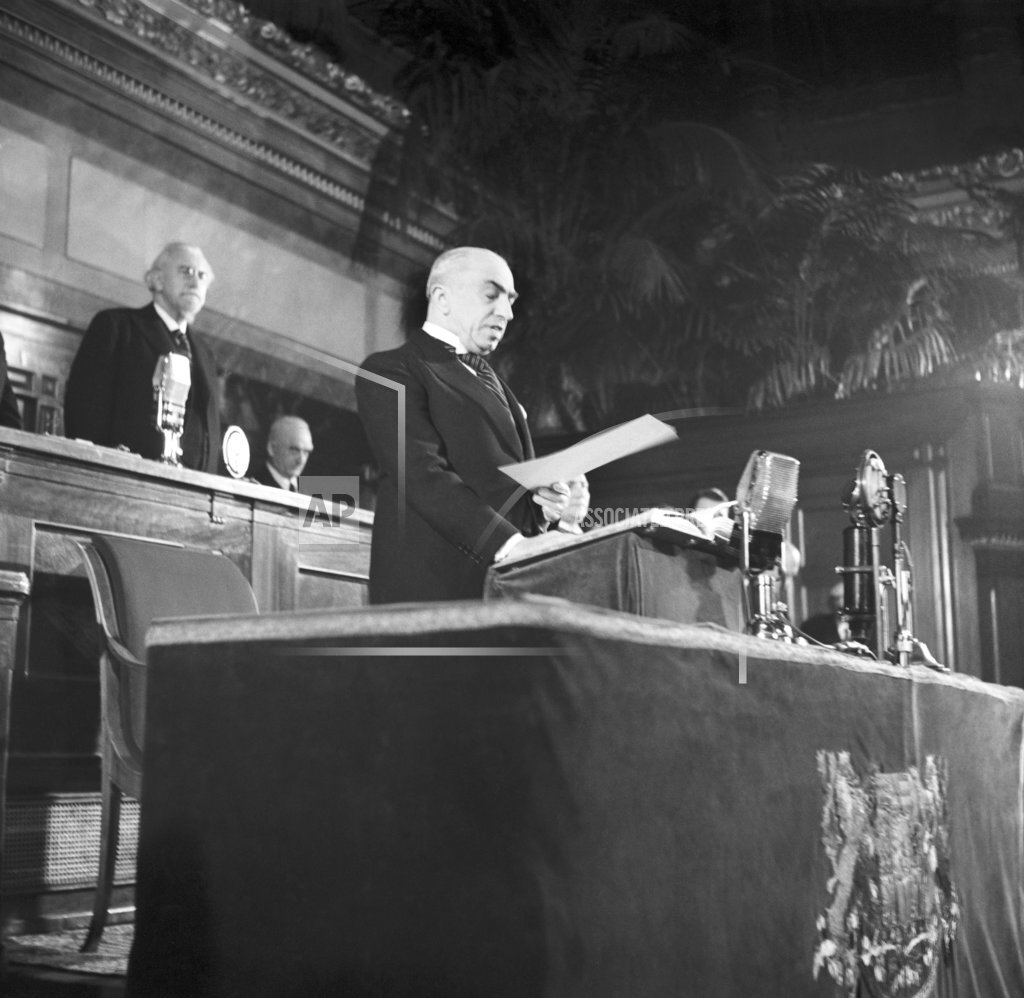
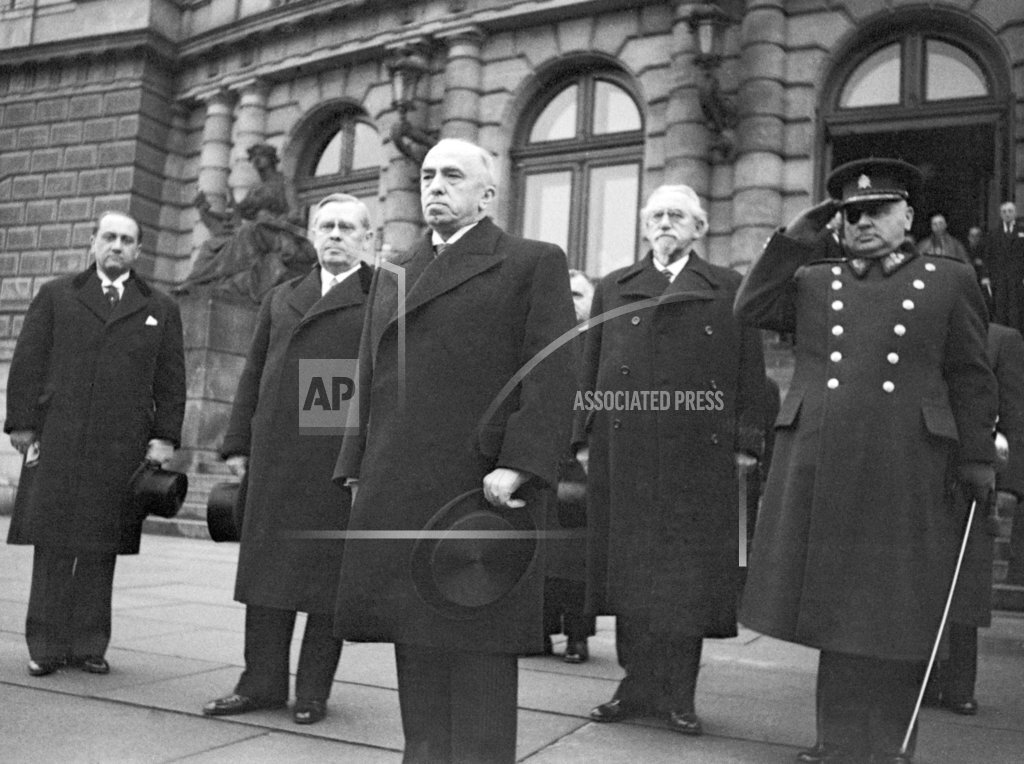
Emil Hácha became 3rd President of Czechoslovakia. The Czechoslovakian National Assembly elected Dr. Emil Hácha as the president of the republic. The official name of the country was changed by adding a dash, becoming Czecho-Slovak Republic, or Czecho-Slovakia for short.
Germany’s Gestapo (GSP) is making large scale arrests in Nazi circles as well as in those charged with being critics of Adolf Hitler’s regime. Even army circles are being searched for persons suspected of expressing “criticism of Nazidom too openly,” and the critics have been warned to watch their step. Some face dismissal. Nearly sixty former Socialists and Democrats were arrested in the last two weeks. They were charged with attempting to “stir up dissatisfaction among the German workers.” A former Democratic mayor of Nuremberg, Dr. Luppe, and two former Socialist deputies, Dr. Herman Brill and Dr. Otto Brass, were among those arrested. Though Rudolf Hess, Hitler’s deputy leader of the Nazi party, and Nazi leaders are telling their audiences the people never have been as happy as they are now, unrest exists. The public is criticizing Nazi measures more openly than it has for a long time.
Nazi leaders were instructed to have flowers held by onlookers confiscated by security wherever Hitler’s motorcade was about to pass through. The Nazis had been trying unsuccessfully for years to discourage the practice of throwing flowers at Hitler because it was feared that an assassin could throw a bouquet containing a bomb.
Germany’s police pass curfews prohibiting Jews from appearing in public at certain hours: the first concrete steps toward creating a ghetto.
Germany’s foreign trade declines by a sudden 8 percent this month.
The League of Nations’ Conference for Intellectual Cooperation opens in Paris.
Henry Ford urges the United States to take in Jewish refugees, saying there will be jobs and opportunities for all. Henry Ford issued a statement urging that Germany’s persecuted Jews be allowed to come to the United States. “I believe that the United States cannot fail at this time to maintain its traditional role as a haven for the oppressed”, Ford’s statement read. “I am convinced not only that this country could absorb many of the victims of oppression who must find a refuge outside of their native lands, but that as many of them as could be admitted under our selective quota would constitute a real asset to our country.”
President Roosevelt took a day off today in Warm Springs, Georgia, and rested between consideration of international and domestic problems. International problems occupied the forepart of the week, when Ambassadors Hugh R. Wilson and William Phillips came to the little White House to discuss persecution of minorities in Germany and Italy, respectively. Domestic problems will take the center of the stage tomorrow, when Speaker William B. Bankhead comes to Pine Mountain for a discussion of the legislative program Mr. Roosevelt will present to the new congress in January. The major item on the White House legislative program, as it has been revealed to date, is national defense legislation and appropriations.
About 7,230 acres of grazing land near Texas is expropriated by Mexico from an owner in the United States. Mexico announces the land will be divided among 59 descendants of slaves who emigrated in the 1860s.
Prince Teh, of Japanese-controlled Inner Mongolia, says he wishes to unite all Mongolian people and revive their language and culture.
Japanese pilots drop incendiary bombs on Kweilin in Kwangsi province. Seventy-two die and hundreds are injured.
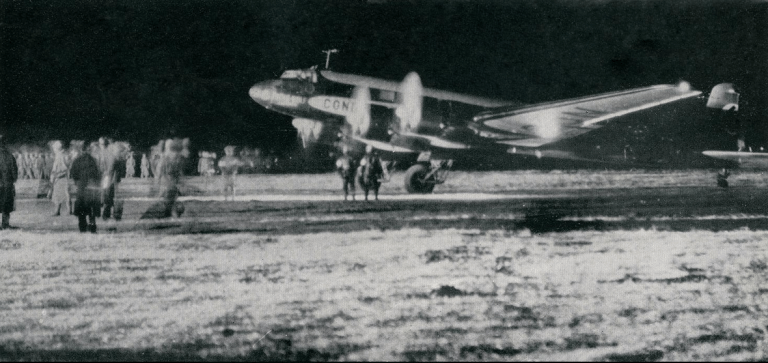
The first prototype Focke-Wulf Fw 200 Condor, D-ACON, arrived in Tokyo, Japan, after a two-day flight from Berlin, to demonstrate the long-distance capabilities of the new civil airliner. The Condor arrived at Tachikawa Airfield in the western part of Tokyo at 10:40 p.m., 30 November. The total elapsed time for the journey was 46 hours, 18 minutes, 19 seconds. The actual flight time was 42 hours, 00 minutes. The Condor’s average speed from Berlin to Tokyo was 198.308 kilometers per hour (123.223 miles per hour). The silver-colored monoplane made only three stops en route, at Basra, Iraq; Karachi, India, and Hanoi, French Indo-China. The final segment was from Hanoi to Tokyo, Japan, a distance of 2,281 miles (3,671 kilometers). Captain Henke and his crew established a Fédération Aéronautique Internationale (FAI) World Record for Speed Over Courses for the journey from Berlin to Hanoi, with an average speed of 243.01 kilometers per hour (150.999 miles per hour). The total elapsed time, Berlin–Hanoi, was 34 hours, 17 minutes, 27 seconds. The Condor’s crew was received by Emperor Hirohito.
Dow Jones Industrial Average: 149.82 (+2.75).
Born:
Hope Holiday [as Hope Zee], American actress (“The Apartment”), in New York, New York.
Died:
Corneliu Zelea Codreanu, 39, Rumanian far right politician, executed.
 History Diaries