Henry Cabot Lodge, American ambassador to South Vietnam, says that the United States government under President Johnson will continue to give strong support to the Vietnamese struggle to win and maintain independence. He makes this statement to reporters on his return to Saigon from Washington where he had talks with President Johnson on American relations with Vietnam.
President Romulo Betancourt of Venezuela called upon the Americas today to wipe out the communist regime of Cuban Premier Fidel Castro. Betancourt appealed for help to the Organization of American States, made up of 21 nations including Cuba, as pro-Cuban terrorists in Caracas imposed a “curfew” on Venezuela and warned that anyone who leaves his home after midnight tonight will be shot. The UPI reported that heavily armed troops and police patrolled darkened streets early today ready to deal with any Reds who might be trying to carry out threats to shoot anyone who violates the curfew. There were no immediate reports of shootings. Foreign Minister Marcos FalIcon Briceno said that President Betancourt’s demand for action against Cuba did not preclude armed invasion. Falcon Briceno reported that Venezuela had asked the O.A.S. for all possible sanctions to be applied against Cuba, including armed action.
Russia finds fragments of glass in wheat received from Canada. A Canadian official says it is believed the glass fragments are broken beer bottles, and that the bottles probably were tossed into the grain by longshoremen loading it aboard freighters. The seven ships carried 2½ million bushels.
Prime Minister Alec Douglas-Home of Britain says that there is hope that the end of the cold war with the Soviet Union is near. Home, foreign secretary until he succeeded Harold Macmillan as prime minister, says: “I could not have stood here as I do now when I became foreign secretary three years ago and held out a hope to you that we were beginning to come to the end of the cold war. I think I am justified in doing that now.”
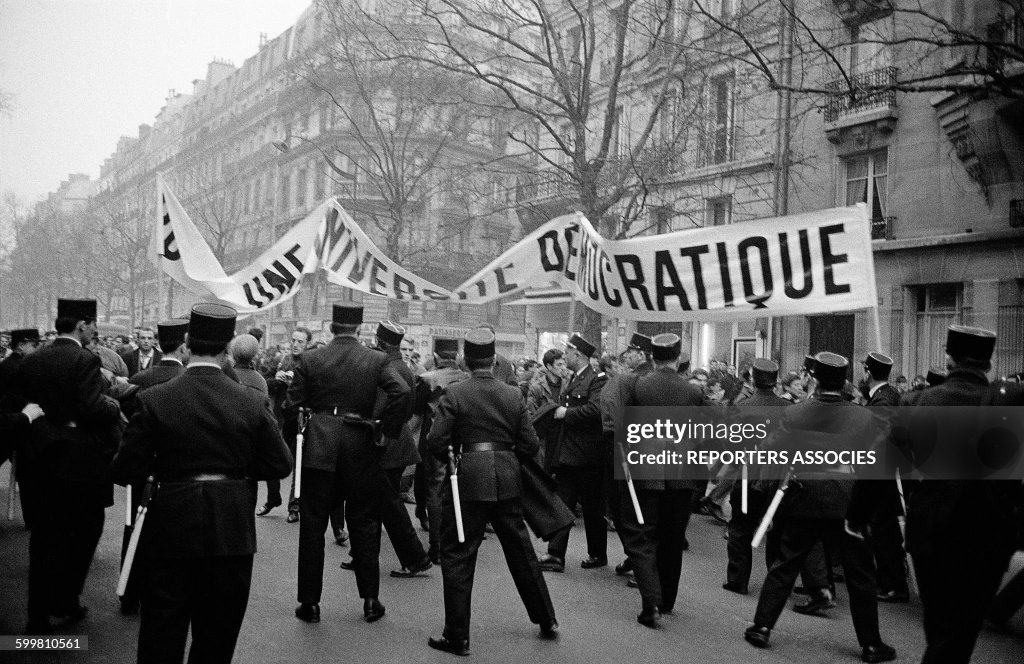
Police armed with clubs and fire hoses repel several thousand students who try to march on the University of Paris in a street battle. Hundreds of other students infiltrate through 5,000 police guarding the university, but charging squads of cops swinging lead-lined capes and night sticks disperse the youths. Three hundred students are arrested, and 40 policemen suffer minor injuries. A few co-eds are injured by blows. A minor riot also breaks out at the University of Reims.
Trans-Canada Airlines Flight 831, a Douglas DC-8, crashed in a field near the village of Sainte-Thérèse, Quebec, shortly after taking-off from Montreal’s Dorval International Airport en route to Toronto as the first stop on a flight to Vancouver. All 118 people on board (the 111 passengers and seven crew) were killed. Most of the passengers were on their way to Vancouver to watch the Grey Cup game for the championship of the Canadian Football League; 16 other people had been caught in a traffic jam on the way to the airport and were fortunate enough to have missed their flight. Until December 12, 1985, when all 256 persons on board Arrow Air Flight 1285 would be killed in an accident at Newfoundland, the Trans-Canada flight would be the worst air disaster in Canada’s history.
At 6:28 p.m., the DC-8 began its takeoff roll on Dorval airport’s Runway 06R. The crew reported back when they reached 3,000 feet (910 m) and were given clearance for a left turn. Shortly thereafter, the aircraft deviated from its expected flight path and began a quick descent. At about 6:33 p.m., the jet struck the ground at an estimated 470–485 knots (870–898 km/h; 541–558 mph) while descending at about a 55-degree angle (± 7 degrees).
The four-engine jet plunged to earth in a driving rainstorm at 6:32 p. m., just 4 minutes after taking off from Montreal’s Dorval airport on a shuttle flight to Toronto. Witnesses said they heard an explosion and saw a red ball of fire as the jet hit the ground. A call for ambulances was canceled. Police dogs searching for life in the wreckage were called off as the hopelessness of their task became evident. Under the glare of floodlights, searchers saw bodies and wreckage strewn in trees and over an area at least a half-mile square.
The plane crashed in an area about midway between Highway 11 and an expressway leading north from Montreal to the Laurentian Mountain resort areas. The crash scene was about three miles northwest of Ste. Therese de Blainville, a town of 12,000, 16 miles north of Montreal. Airline officials and Quebec provincial police at the site said they did not expect to be able to bring bodies out until morning because of the mire. Bulldozers were cutting a rough road into the area. There were school books scattered in the wreckage. The plane was carrying 111 passengers and a crew of 7. The huge jet dug a crater into the earth at least 90 feet across and six feet deep, which quickly filled with water.
The investigation was complicated by the severe damage to the plane and the fact that it did not have cockpit voice recorders or flight data recorders, as they were not required in Canada at the time. Though the official report released in 1965 could not determine the cause of the accident, it pointed to problems in the jet’s pitch trim system (the device that maintains a set nose-up or nose-down attitude) as a possibility, as a pitch trim problem caused the similar crash of Eastern Air Lines Flight 304, another DC-8, three months after the crash of Flight 831. Other suggested possible causes that could not be ruled out included icing of the pitot system and failure of the vertical gyro.
President Johnson was charged with an error in diplomacy in announcing that French President Charles de Gaulle will come to Washington for a conference next year. French sources denied such an agreement was made.
Russia has appealed to Britain to take the initiative for new efforts to ease tension between Moscow and Washington, authoritative diplomatic sources in London said.
Progressive prelates dominated a Vatican Ecumenical Council election to fill seats on the commissions which will work during a nine-month council recess.
Ghana calls on the United Nations to suspend South Africa from the organization because of its apartheid (racial separation) policies. Alex Quaison-Sackey, Ghana delegate, urges the U.N. Security Council action to force South Africa to come to terms. He paints a terrifying picture of increasing tensions in the country.
A moderate program to end racial discrimination in South Africa was presented to the U.N. Security Council by the Norwegian ambassador. Adoption is expected.
The foundation stone for Mirzapur Cadet College was laid in the city of Gorai in East Pakistan (now Bangladesh), by President Ayub Khan.
U.S. President Lyndon Baines Johnson sets up the Warren Commission to investigate the assassination of former President John F. Kennedy. President Johnson tonight appointed a special commission headed by Chief Justice Earl Warren to investigate the assassination of President Kennedy and the subsequent murder of the man accused of the slaying. Announcing the investigation, the White House said President Johnson instructed the commission “to satisfy itself that the truth is known as far as it can be discovered, and to report its findings and conclusions to him, to the American people, and to the world.” The chief executive ordered the inquiry and chose the commission after consulting with the Democratic and Republican leadership of the Senate and House. The White House said President Johnson personally talked with each of the seven members of the commission in asking them to undertake the assignment.
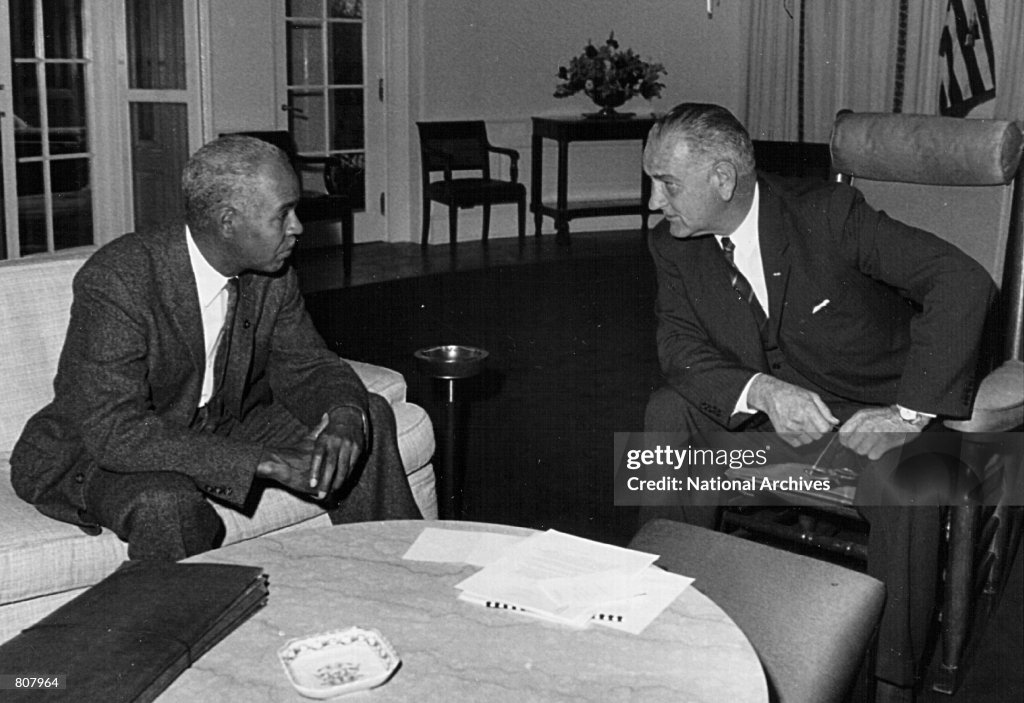
Roy Wilkins, executive secretary of the National Association for the Advancement of Colored People, said today after a meeting in the White House with President Johnson that “we have very great faith” in the new chief executive’s attitude toward civil rights. Wilkins commented he believes Johnson enjoys the respect of the Black community in general, but that “naturally, they (Blacks) are skeptical of a man with a southern background.” The President invited Wilkins to the White House. They discussed the equal rights movement and the administration’s stalled civil rights program pending in Congress in general terms during a 45-minute meeting. At about the time Wilkins was expressing confidence in Johnson’s good faith, another Black civil rights leader, James Forman, was saying that the issue is squarely up to the new President. He said: “If Johnson doesn’t deliver on civil rights, we should not deliver him back to the White House in 1964.”
President Johnson has ordered the nation’s military chiefs to use the strictest economy in the nation’s $54 billion-a-year defense program.
The Labor Department’s Consumer Price Index showed that in October the cost of ting rose 1/10 of 1% despite a drop in food prices of 1%. The rise was attributed primarily to services, such as medical care.
Sources at the White House disclose that Mrs. Jacqueline Kennedy chose a gravesite in Arlington National cemetery for her assassinated husband because she learned from the White House staff that the President on an earlier occasion had commented on the beauty of the view from the site — with the capital stretched before it across the Potomac — and had called it a spot at which he would be content to linger forever.
The eternal flame that burns over the late President Kennedy’s grave will be blended into a permanent monument to be designed for the gravesite.
Congressional leaders have drafted legislation to provide Mrs. Jacqueline Kennedy with free office space and a secretarial staff to help in winding up her duties as the nation’s former First Lady.
Mrs. Jacqueline Kennedy asked President Johnson to rename Cape Canaveral in her slain husband’s memory.
The Student Nonviolent Co-ordinating Committee declares that the death of President Kennedy has not altered the plans for vigorous pursuit of the civil rights program.
A public stenographer in Fort Worth revealed that slain Lee Harvey Oswald, accused assassin of President Kennedy, was writing a book which hinted that he went to Russia as a U.S. secret agent.
“I Want to Hold Your Hand” single released by the Beatles in the United Kingdom.
The New York stock market made a sharp post-Thanksgiving Day rally on moderately heavy volume. The unexpected steep upswing came when many in the financial communities of the nation were taking a four-day weekend. Most brokers had expected a slow trading day with little change in prices. There was nothing to account for the sudden surge but prices were ahead from 1 to 3 points across the board. The Dow Jones industrial average rose 9.52, and the Standard & Poor’s index of 500 stocks was up .98-representing a gain of nearly $5 billion in stock values on the New York Stock Exchange.
Dow Jones Industrial Average: 750.52 (+9.52).
Born:
Mike Natyshak, Canadian NHL right wing (Quebec Nordiques), in Belle River, Ontario, Canada.
Mike Siano, NFL wide receiver (Philadelphia Eagles), in Yeadon, Pennsylvania.
Stan Hunter, NFL wide receiver (New York Jets), in Dayton, Ohio.




 History Diaries