The Mideast cease-fire talks are in serious trouble. Negotiations on the Cairo-Suez Road have collapsed. The Egyptian‐Israeli military talks on troop disengagement broke down in disagreement, and the two sides exchanged heavy machine‐gun and mortar fire less than two miles from the conference site on the Suez‐Cairo Road. No new talks were scheduled. A provisional United Nations report said that the Egyptians had initiated the half‐hour battle that began as the day’s talks got under way. Egypt will request that the United States and the Soviet Union intervene to try to change Israel’s uncompromising disposition. Egyptian and Israeli officials were also unable to agree on a pullback of forces along the canal.
Cease-fire violations occurred at the beginning of the negotiations; United Nations troops investigated the violations. The commander of the U.N. peacekeeping force reported that no headway was made before negotiations broke down.
Israeli forces remained on full alert on all fronts as officials expressed deep concern about the possibility of renewed fighting because of the deadlocked military talks. Differences on the disengagement issue are “fundamentally unbridgeable” said a senior official, who predicted that the differences would have to be put over until the full-scale peace conference.
Secretary of State Kissinger said he was still hopeful that the Middle East peace conference would begin next month despite the breakdown of the Egyptian‐Israeli military talks. Mr. Kissinger made his comment after a private meeting with the House Armed Services Committee.
A spokesman announced that Egypt will attend next month’s peace conference in Geneva, Switzerland. Israeli Prime Minister Golda Meir stated that the Arab summit meeting imposed impossible conditions on her nation for true peace. In New Delhi, India, Soviet Communist party leader Leonid Brezhnev warned that a settlement in the Mideast must be found quickly, before the area explodes into fighting again. Brezhnev praised the current détente between the Soviets and the United States.
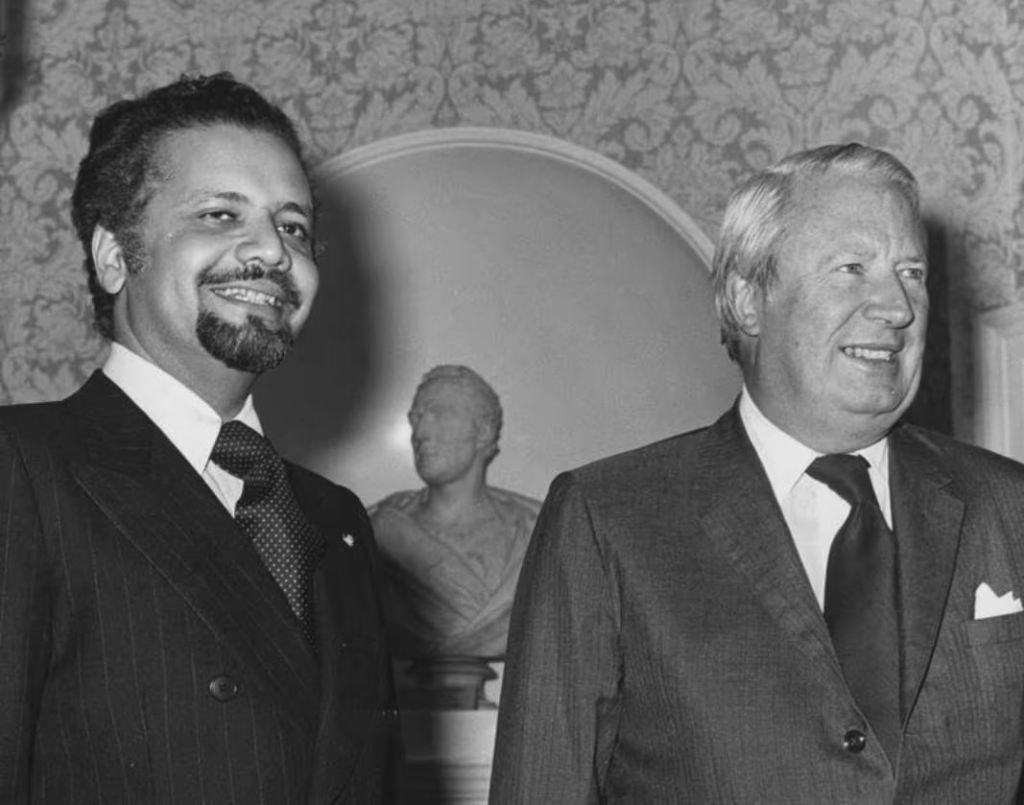
Britain and France will be exempt from Saudi Arabia’s additional oil cutback plan which begins in January. Two of the largest Arab oil‐producing nations assured Britain of continuing petroleum supplies, but indicated that further price increases would be imposed worldwide. The assurances were delivered by representatives of Saudi Arabia and Algeria, who told Prime Minister Heath that Britain would be exempt from the cutbacks that will be imposed on other nations except for France and Spain, in December and January.
Roving bands of extremists, including some with members as young as 14, hijacked vehicles in Roman Catholic areas of Belfast and turned them into barricades, police reported. Troops removed the roadblocks, police said, and explosives experts blew up a bus for fear it had a bomb inside. Bus service in Catholic areas was suspended. A military spokesman said the average age of Irish Republican Army members continues to drop as a result of British army success in rounding up members of the outlawed group.
Greece’s former industry minister, Ioannis Zigdis, a cabinet member before the military took power from civilians in 1967, accused the nation’s new military regime of seeking “to keep the people enslaved forever.” Zigdis’ statement, which said that the Greek struggle for liberty will continue, was the first open attack by a politician on the generals who overthrew President George Papadopoulos. It came just a day after the ruling generals warned that opponents would be pushed aside without hesitation.”
Despite a recent series of space accidents, the Soviet Union will launch another Skylab-like space station within two years, Major General Vladimir Shatalov, chief of cosmonaut training, said in Moscow. The new effort to launch an orbiting space laboratory (Salyut) would come before U.S. and Soviet astronauts attempt a joint docking in space in July, 1975, Shatalov said.
The Soviet Union and India signed four agreements providing for economic and political cooperation.
Soviet dissident physicist Andrei Sakharov said he hopes to visit the United States even though his hopes of then returning to the USSR would be dim. Sakharov hopes to bring his family to the U.S. when he lectures at Princeton.
Marshal Tito, who will be 82 years old next May 25, opened the door today to the possibility that he might step down as President of Yugoslavia if his physical and mental abilities fell below the level required for the position. Responding to a petition urging him to remain as President for life, Marshal Tito said: “The President of the republic is required always to be active. Can any person be equally active always throughout all his life?” The Yugoslav leader, who organized the country’s Marxist Government 30 years ago today amid the battles of World War II, still has bounce in his step and rules without known challenge.
But early this year he acknowledged that his 81 years were making themselves felt, and he turned over some of the ceremonial duties of the presidency.
Versailles Palace is filled with worms, rats and leaks. To save the palace, a large party and a fashion show were given to raise funds. Ticket fees and donations netted only $250,000 from the invited millionaires, however.
The Ford Motor Co. in Argentina has moved 25 of its U.S. executives to Uruguay to protect them from terrorists, informed sources in Buenos Aires said. Two American executives of Ford in Argentina have been killed, the latest last week in Cordoba, where John Albert Swint was machine-gunned. In Detroit, a Ford spokesman said he was not aware of a transfer of executives to Uruguay, but he was aware that security measures were being taken to protect employees in Argentina.
A kidnapped Mexican telephone company official and his young son were rescued after a gun battle in which two of their abductors were wounded, police in Mexico City said. The kidnappers had told the family of Jose Simon by telephone to leave a ransom equivalent of $240,000 near a city square. Police were waiting when four men arrived to pick up the money. A gun battle ensued in which two of the kidnappers and one policeman were wounded. All four of the men were captured. They told police where the hostages could be found.
A 15-year-old schoolboy was reported shot to death and several persons wounded in clashes between police and students in the central Peruvian city of Ayachuco. Three other southern Peruvian cities were under a state of emergency and a curfew because of similar demonstrations in the past week-all connected with student demands for the release of leaders of a banned teachers’ union. The other cities are Arequipa, Cuzco, and Puno.
The reported rejection by the Chilean government of a black U.S. Army colonel to serve as military attaché in that country has touched off a flap involving the Army, Pentagon and State Department. Authoritative sources said Colonel T. M. Gafford was recommended for the post by the staff of the Joint Chiefs of Staff. An investigation is under way to see if Chile did in fact turn him down or some U.S. Embassy official or Army officer rejected the appointment.
In Japan, 104 people were killed in the Taiyo department store fire in Kumamoto, as Kyūshū prefecture. Ironically, the store’s sprinkler system wasn’t working because it was “under repair for fire prevention week.” Many shoppers were unable to locate escape routes when the fire broke out.
Britain has begun delivery of seven Wasp helicopters to South Africa, an issue that threatened to disrupt the Commonwealth nearly three years ago. Three of the copters ordered by the South African navy in 1971 have been delivered and four others will be sent in the next few months, authoritative aviation sources said in London. In 1971, some African leaders threatened to quit the Commonwealth if the helicopter deal went through.
The world’s highest-flying bird was proven to be the Ruppell’s griffon (Gyps rueppellii), a vulture indigenous to central Africa. One of the species happened to be flying at an altitude of more than seven miles when it was sucked into a jet engine flying over Cote d’Ivoire. The plane’s altimeter was at 37,900 feet (11,600 m) when the encounter occurred, forcing an emergency landing.
A special federal grand jury in Illinois indicted President Nixon’s former appointments secretary, Dwight Chapin. Chapin was charged with lying to a grand jury. Chapin stated that the charges against him are unrelated to his work while in the Nixon administration, and he said he has complete faith in the President. Chapin asserted that his work in the White House was carried out ethically and to the best of his ability. When asked about the ethics of his “unofficial” responsibilities, Chapin refused comment.
Judge John Sirica’s court turned up new divisions in President Nixon’s staff. White House attorney Fred Buzhardt explained that he couldn’t reproduce the hum during the 18-minute gap on a White House tape using the tape machine, a typewriter and a lamp, as the President’s personal secretary Rose Mary Woods suggested had happened. Under questioning from prosecutor Richard Ben-Veniste, Buzhardt admitted that the discrepancy between the actual gap and Miss Woods’ testimony was unexplainable.
Woods’ attorney Charles Rhyne accused the White House attorneys of trying to use her as a scapegoat. Attorneys Leonard Garment and Douglas Parker sat glumly in court today as rumors of President Nixon’s displeasure with his legal counsel increased. The two lawyers confirmed they are leaving the case at the end of the week.
The strains from Watergate are becoming more visible at the White House. Press secretary Ron Ziegler failed to firmly support White House attorney Fred Buzhardt in his job as Watergate defense counsel. Ziegler indicated that a breach between the White House and special prosecutor Leon Jaworski may be at hand. Jaworski has suggested that all of the White House tapes be turned over to the court. Ziegler said that he believes Jaworski is honest and fair, but called his staff inefficient.
White House aide Melvin Laird admitted that the 18-minute gap on a subpoenaed tape hurts President Nixon’s “Operation Candor.” Senate Republican leader Hugh Scott stated that the President should start being totally honest with the American people.
The Nixon administration allegedly told federal investigators that leaking knowledge of the White House “plumbers” operation could jeopardize the life of a foreign spy in the Soviet Union.
The House Judiciary Committee confirmed the nomination of Vice President Gerald Ford. The full House will vote next week. The House Judiciary Committee approved the nomination of Gerald R. Ford as Vice President today by a vote of 29 to 8, with one vote of present. Some of the Democrats who voted for confirmation expressed concern over Mr. Ford’s conservative voting record, particularly on such issues as civil rights. But Representative Jack Brooks, Democrat of Texas, drew laughter from Democrats and Republicans alike as he observed: “If he becomes President, I think he’ll be a vast improvement over the one we’ve got. I kinda like Jerry Ford. I’d like to promote him. I don’t think Vice President is high enough.”
The House refused to accept a Senate plan to publicly finance federal elections. The leadership of the House and Senate then reached a compromise to pay for only presidential elections with federal funds. The bill is expected to pass despite a veto warning from the President.
Top economic adviser Herbert Stein warned of a possible recession for 1974 if the Arab oil embargo continues; he noted that unemployment could rise significantly. A Georgia Tech University professor told a Senate hearing today that the major U.S. oil companies and the Nixon administration are the ones responsible for the present fuel crisis, not the Arabs.
The current crisis in heating fuel and gasoline goes far beyond the Arab oil boycott. Government policies and the giant oil companies may in fact be responsible.
Eight major companies control America’s energy supply the entire way from the oil field to the gas pump due to “vertical integration”. Government agencies are investigating the situation to determine if the major oil companies are mainly responsible for the fuel crisis. James Halverson of the Federal Trade Commission believes the amount of control the eight large companies have is contributing to the present shortage, and the FTC has brought charges against them.
Even if the Arab oil boycott is lifted, oil companies do not have enough refineries in the U.S. to process the oil. The companies blame the government for the lack of refineries, citing environmental restraints and uncertainties created by import quotas on crude oil.
Last winter there was a threat of heating oil shortages in New England. The Office of Emergency Preparedness has reported that the government received assurances from oil companies in April of 1972 that oil would be in plentiful supply for the winter. But by July, warnings surfaced from the oil companies. Some believe that the oil companies made threats of shortages to create pressure for removing government price controls. The government requested that oil companies operate refineries at 92% of capacity to prevent shortages in ’72; by November, production dropped to 88%. Production increased in February after oil companies received a price hike, and a heating oil shortage was averted.
Exxon chairman of the board J.K. Jamieson stated that oil companies have only a slight responsibility to the consumer to supply fuel and heating oil in times of shortage, adding that the industry would go broke if companies continued on such a track. The idea of dismantling the large oil firms is gaining more proponents in Congress. Senator Frank Moss favors legislation to that effect. The White House does not plan to implement gasoline rationing now, but a cabinet-level energy group is considering a rationing system. Senate majority leader Mike Mansfield has called for immediate gasoline rationing. A House committee passed a law to set the national speed limit at 55 m.p.h. The Federal Power Commission requested a report from utilities on the feasibility of a 10% power cut.
A former executive of a Key Biscayne, Florida, bank headed by the President’s close friend, Charles G. Rebozo, has told state authorities that the President deposited $100,000 in the bank about the time that Mr. Rebozo received the final installment of a $100,000 campaign contribution from Howard R. Hughes. But the official reportedly provided no indication that the Hughes money had been used to buy the certificate of deposit, and the White House refused to give details.
Chrysler announced that it will shut down seven auto plants for various periods in January because of a decline in the sales of its larger cars. The Chrysler Corporation announced today that it planned to shut down briefly two of the three Chrysler plants where full‐size cars are assembled, and that the third plant would be converted to the production of compact cars. Chrysler thereby became the second of the Big Three auto makers to close large car plants as a result of the energy crisis. Partly because of the gasoline shortage, sales of big cars have slumped in recent weeks while sales of compacts and sub‐compacts — with their greater fuel economy — have boomed. The General Motors Corporation said last week that it planned to cease operations during the week of December 17 at 16 G.M. plants where standard-size and intermediate‐size cars are built. Ford Motor Company officials said they planned no such interruptions of big‐car production. But both Ford and G.M. have said they will convert some big‐car plants to small‐car production after the first of the year.
Pioneer 10, the first spacecraft to navigate the outer solar system, hurtled deep into the magnetic field of Jupiter tonight and found the field’s reach to be greater than expected, its strength 40 times that of the earth’s magnetic field and its direction south instead of north. Scientists at the Ames Research Center here also learned that Jupiter’s mass is even greater than estimated, giving the planet a slightly stronger gravitational pull than had been believed. As a result, the 570‐pound Pioneer 10 is being drawn toward the planet faster than planned and is now expected to arrive two minutes early for its closest approach—within 81,000 miles of Jupiter at 9:24 P.M. Eastern standard time Monday. The spacecraft will send back to earth the first close‐up images of the largest planet in the solar system.
Clifford Irving, author of the phony Howard Hughes autobiography, will be released on parole on February 14.
Dow Jones Industrial Average: 835.11 (-4.67, -0.56%).
Born:
Duane Butler, NFL defensive back (Minnesota Vikings), in Trotwood, Ohio.
Fredrik Norrena, Finnish National Team and NHL goalie (Olympics, silver medal, 2006; Columbus Blue Jackets), in Pietarsaari, Finland.


 History Diaries