The Fuerzas Armadas de Liberación Nacional (FALN), a group of leftist revolutionaries in Venezuela, kidnapped Colonel James K. Chenault, the deputy chief of the U.S. Army mission in Caracas, as he was being picked up at his home by the mission chauffeur.; Colonel Chenault would be released, unharmed, by the FALN gunmen on December 5.
South Vietnamese government planes strike with rockets, bombs, and bullets to break up a communist raid in which three Americans are slightly wounded. Three Vietnamese are killed and six wounded in the attack on an American-Vietnamese army special forces camp near the Cambodian border, a United States military spokesman says.
The Communists, using recoilless rifles and mortars, opened fire on the camp in daylight. They pushed the attack for two hours, but retreated into the nearby hills when the aerial strikes began. The attack area is 120 miles south of Saigon and is heavily infested by communist guerrilla bands. Several mountains rise from a rice paddy plain in the region. The American spokesman said Vietnamese army units pursued the retreating guerrillas northwest toward the Cambodian border. Military sources reported the Communists had penetrated to the camp but were driven off by the air strike by four T-28 fighter bombers and two B-26 bombers.
The Viet Cong claimed they wiped out more than 1,700 South Vietnamese government troops and captured another 207 in the first half of November, the New China news agency said today. The agency quoted “the South Vietnam liberation press agency” as saying the communist guerrillas also shot down or hit 20 government aircraft and sank or hit five military vessels in the same period. The communist report said, “during the period, the people’s armed units… demolished 318 strategic hamlets [and] 1,365 enemy troops crossed over to [their] side.”
Cambodia announced today a military court has condemned to death a Cambodian accused of trying to overthrow Prince Norodom Sihanouk’s government with official backing from the United States. Radio Phnom Penh broadcast this sequel to Sihanouk’s severance November 17 of all aid relations with the United States, from which his neutralist regime had received about 30 million dollars a year. After rejecting further American aid the prince sought closer ties with Red China. The prisoner is Preap Inn, 35, identified as a member of an anti-Sihanouk, anti-communist guerrilla organization called Khmer Serei (Free Cambodians). The United States has acknowledged that it knows such an organization exists but denied American involvement in any plot against Sihanouk.
Premier Fidel Castro said tonight the Kennedy assassination was full of strange factors that bespoke an effort by American reactionaries to pin the blame on Cuba. Castro told his people by radio: “In the eyes of the world, it is clear that the reactionaries of the United States wanted to make our country the victim of their criminal designs even at the price of assassinating the President of the United States.” Castro suggested that “the intellectual authors” of the crime sent Lee Oswald, an avowed Marxist and Castroist, to Mexico to seek a visa to Cuba en route to Russia.
Members of the United Nations general assembly vote for a study intended to lead to a declaration of Latin America as a “denuclearized zone.” The proposal is passed by a vote of 92 to 0, with 15 abstentions by the communist bloc. They protest such an agreement without the liquidation of United States military bases at Guantanamo Bay, Cuba, Puerto Rico, and the Panama Canal.
President Chung Hee Park’s pro-junta Democratic Republican Party swept to a stunning victory in Tuesday’s parliamentary election in South Korea, the first since 1961.
President Johnson’s pledges to devote his efforts to the cause of peace are being cautiously welcomed by Soviet bloc by Sovie commentators.
It may be a year or more before the Soviet Union makes another major test of western intentions in Berlin or elsewhere, a high-level source in Bonn predicted.
President Johnson’s address to the joint session of Congress was received with enthusiasm by delegates to the U.N. General Assembly.
President Charles de Gaulle today discussed with his cabinet his scheduled meeting with President Johnson early next year. Officials predicted the Washington talks would bring a sharp improvement in French-American relations. The date of the visit will be set through diplomatic channels. Informed quarters said that de Gaulle assured Johnson in their brief meeting after the Kennedy funeral in Washington Monday that France fully supports the Atlantic alliance. De Gaulle was expected to press strongly in the forthcoming talks his standing demand that the alliance be revamped to give France the status of a major world power.
The Roman Catholic Ecumenical Council was urged to give special consideration to the 50-million-member Anglican Church in a Christian unity document.
Princess Birgitta of Sweden, wife of Prince Johann Georg of Hohenzollern, gave birth to a 6-pound, 6-ounce baby girl, Princess Desiree of Hohenzollern.
The Strasbourg Patent Convention, providing for a common patent law to apply in Western European countries, was signed by the 17 members of the Council of Europe. It would not be ratified by enough nations to make it effective, however, until August 1, 1980.
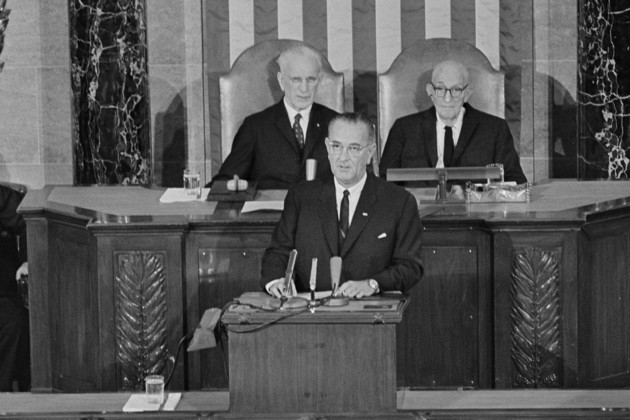
President Lyndon B. Johnson addressed a joint session of Congress in his first major speech since being sworn in as President of the United States, and pledged that he would not depart from the programs that had been started by his predecessor, John F. Kennedy. In what would become known as his “Let Us Continue” speech, he urged Congress to pass legislation for a tax cut and a civil rights bill. “All I have I would have given gladly not to be standing here today,” Johnson told Congress, calling Kennedy “the greatest leader of our time… struck down by the foulest deed of our time.” Reminding his listeners that Kennedy had said “let us begin” in his inaugural address, Johnson added, “Today in this moment of new resolve, I would say to my fellow Americans, let us continue… Let us here highly resolve that John Fitzgerald Kennedy did not live — or die — in vain.”
“All I have I would have given gladly not to be standing here today,” Johnson began. “The greatest leader of our time has been struck down by the foulest deed of our time. Today, John Fitzgerald Kennedy lives on in the immortal words and works that he left behind. He lives on in the mind and memories of mankind. He lives on in the hearts of his countrymen.

“For 32 years Capitol Hill has been my home,” LBJ reflected. “I have shared many moments of pride with you, pride in the ability of the Congress of the United States to act, to meet any crisis, to distill from our differences strong programs of national action.

“An assassin’s bullet has thrust upon me the awesome burden of the presidency. I am here today to say I need your help; I cannot bear this burden alone. I need the help of all Americans, and all America. This nation has experienced a profound shock, and in this critical moment, it is our duty, yours and mine, as the government of the United States, to do away with uncertainty and doubt and delay, and to show that we are capable of decisive action; that from the brutal loss of our leader we will derive not weakness, but strength; that we can and will act and act now.

“No words are sad enough to express our sense of loss,” he continued. “No words are strong enough to express our determination to continue the forward thrust of America that he began.

“I profoundly hope that the tragedy and the torment of these terrible days will bind us together in new fellowship, making us one people in our hour of sorrow.”
The Chicago Tribune reported that Johnson received “a two-minute ovation” and “was interrupted 32 times by varying bursts of applause” in the House chamber.
Passage of the civil rights and tax bills cannot be expected until long after New Year’s despite President Johnson’s plea for action now, Congress was told after he spoke today. Senator Warren Magnuson (D-Washington), who will manage the civil rights bill in the Senate, told his colleagues that the bill is bogged down in the House Rules Committee and may be there indefinitely. He said there is no hope for action before next year. House civil rights supporters began an attempt to force the Rules Committee to give the rights bill quick clearance. They introduced a resolution fixing terms for House debate of the bill. If the Rules Committee fails to act on the resolution within seven legislative days, it can be brought directly to the floor provided 218 members — a majority — sign a petition to get it out.
Senator Douglas (D-Illinois) of the Senate Finance Committee said in reply to a question that the committee cannot have a tax cut bill ready for the Senate before late January at the earliest, and probably not until February. Chairman Harry F. Byrd (D-Virginia), of the Finance Committee told reporters there is no opportunity to accelerate Senate action on the tax bill. Although the last public hearing is scheduled for December 6, the committee has indicated it may want to recall Secretary of Commerce Luther Hodges and William McChesney Martin, chairman of the board of governors of the Federal Reserve System.
Senator Mike Mansfield (Montana), in a final report on the Senate and its leadership during the Presidency of John F. Kennedy, strikes out at “cloak room commandos” and those who have consigned the present Senate “to the waste heaps of history.” Senator Mansfield also replies to critics of his role as Senate Democratic leader who have said he lacks glamor and is a tragic mistake. Mansfield freely admits he lacks glamor. As for being a tragic mistake, Mansfield says, if it means he is not a circus ringmaster, the master of ceremonies of a Senate nightclub, a tamer of Senate lions, or a wheeler and dealer, then he accepts that title, too.
Lying in his hospital bed, Governor John B. Connally of Texas in a closed-circuit television press conference tells of the last split seconds of President Kennedy’s life. Governor Connally says as the bullets hit President Kennedy, his wife Jacqueline cried “O, my God! They’ve killed my husband! Jack! Jack!” The governor says, “the President slumped. He said nothing.” Connally says the first bullet hit the President. The second wounded him. The third hit the President again. Connally says, “I think the man did what he intended to — shoot both of us.”
Gifts from over the nation to the widow and family of Dallas Policeman J. D. Tippit total more than $60,000. The largest donation is from a Dallas dress shop owner who received $25,000 for a film of the assassination. He gave it all to the widow. The film, a 15-second color strip, was brought by a national publication.
The prosecution rests its case against T. Eugene Thompson, St. Paul criminal lawyer, charged with hiring the murder of his wife. The defense announces that it will prove Thompson had nothing to do with the crime and cross-examines Dick W. C. Anderson, 36, confessed killer of Carol Thompson. However, he apparently fails to shake Anderson’s story which links Thompson to the plot.
A minister’s statement that some Dallas public school children cheered the news of President Kennedy’s assassination causes a furor that brings police protection for the minister and his family. Threats against the Rev. William Holmes, pastor of Northhaven Methodist church, who made the statement on a nationally televised program, caused police to guard his home during Tuesday night and then move his family to an undisclosed place. Immediate denials of the minister’s statement, which also had been made in a Sunday sermon, were issued by Dallas school officials and numerous teachers.
The day after the launch of the IMP into space, the United States made its first successful test of the Atlas-Centaur launch system, as well as a new rocket propellant combining liquid hydrogen and liquid oxygen. The five-ton payload was, in the words of a NASA spokesman, a “relatively worthless satellite, made up mostly of old rocket casing”, but large enough to be visible with the naked eye. The spokesman compared its apparent magnitude to “a second or third magnitude star… a tumbling action will make it sort of flash in the sky.” By comparison, all but one of the stars within the “Big Dipper” in Ursa Major are second magnitude.
The first extended-duration firing test of the J-2 engine was conducted by Rocketdyne of Los Angeles. The J-2 engine was developed by Rocketdyne under the direction of NASA’s Marshall Space Flight Center and was propelled by liquid hydrogen and liquid oxygen. A cluster of five J-2 engines powered the S-II stage of the Saturn rocket while a single J-2 was employed on the S-IVB, the third stage of the Saturn V.
Chicago White Sox pitcher Gary Peters edges teammate third baseman Pete Ward and Minnesota Twins outfielder Jimmie Hall for American League Rookie of the Year honors.
The Kansas City A’s acquire first baseman Jim Gentile and $25,000 from the Baltimore Orioles for first baseman Norm Siebern.
Dow Jones Industrial Average: 741.00 (-2.52).
Born:
Princess Desiree of Hohenzollern (princess of the House of Hohenzollern and the second child of Princess Birgitta of Sweden and Prince Johann Georg of Hohenzollern), in Munich, Germany.
Fisher Stevens, American actor (“My Science Project”, “Short Circuit”), in Chicago, Illinois.
Linda Yaccarino, American executive (CEO of Twitter 2023-), in Long Island, New York.
Thornton Chandler, NFL tight end (Dallas Cowboys), in Jacksonville, Florida.

6:10


 History Diaries