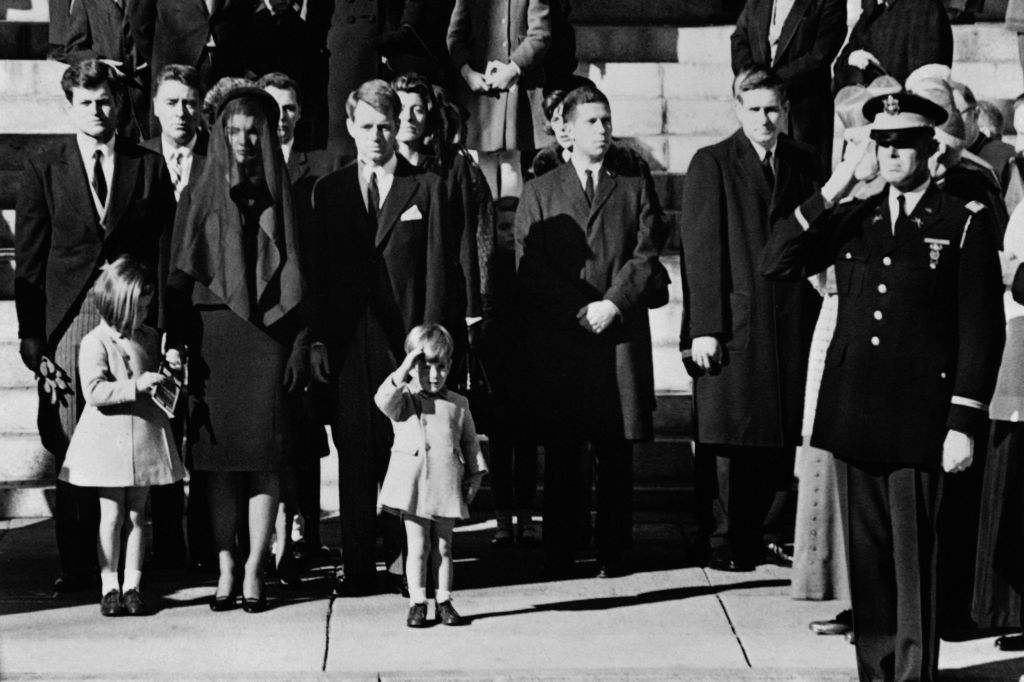
The children were deemed to be too young to attend the final burial service, so this was the point where the children said goodbye to their father. The casket was borne again by caisson on the final leg to Arlington National Cemetery for burial. Moments after the casket was carried down the front steps of the cathedral, Jacqueline Kennedy whispered to her son, after which he saluted his father’s coffin; the image, taken by photographer Stan Stearns, became an iconic representation of the 1960s.
The state funeral of John F. Kennedy took place in Washington, D.C., as the late President’s casket was transported in the funeral procession to the Arlington National Cemetery. Millions of viewers watched the funeral on live television worldwide. Present at the occasion were 220 foreign dignitaries from 92 countries, including eight heads of state and ten prime ministers”. In addition to U.S. President Lyndon Johnson were the presidents of France (Charles de Gaulle); West Germany (Heinrich Lübke); Ireland (Éamon de Valera); South Korea (Park Chung-hee); the Philippines (Diosdado Macapagal) and Israel (Zalman Shazar), and former U.S. Presidents Harry S. Truman and Dwight Eisenhower. Prime Ministers arrived from the United Kingdom (Alec Douglas-Home); Canada (Lester B. Pearson); West Germany (Chancellor Ludwig Erhard); Japan (Hayato Ikeda); Sweden (Tage Erlander); Norway (Einar Gerhardsen); Denmark (Jens Otto Krag); Austria (Chancellor Alfons Gorbach; Turkey (İsmet İnönü); Tunisia (Bahi Ladgham); Yugoslavia (Petar Stambolić); and Jamaica (Alexander Bustamante). Royal personages were Emperor Haile Selassie I of Ethiopia and King Baudouin I of Belgium, as well as Prince Philip, the husband of Queen Elizabeth II; Queen Frederica, wife of the King of Greece; and Jean, the heir apparent to the duchy of Luxembourg. The Soviet Union was represented by its First Deputy Prime Minister, Anastas Mikoyan. The Roman Catholic Archbishop of Boston, Richard Cardinal Cushing, delivered the funeral mass at the St. Matthew’s Cathedral, in the presence of the late President’s widow, daughter and son.
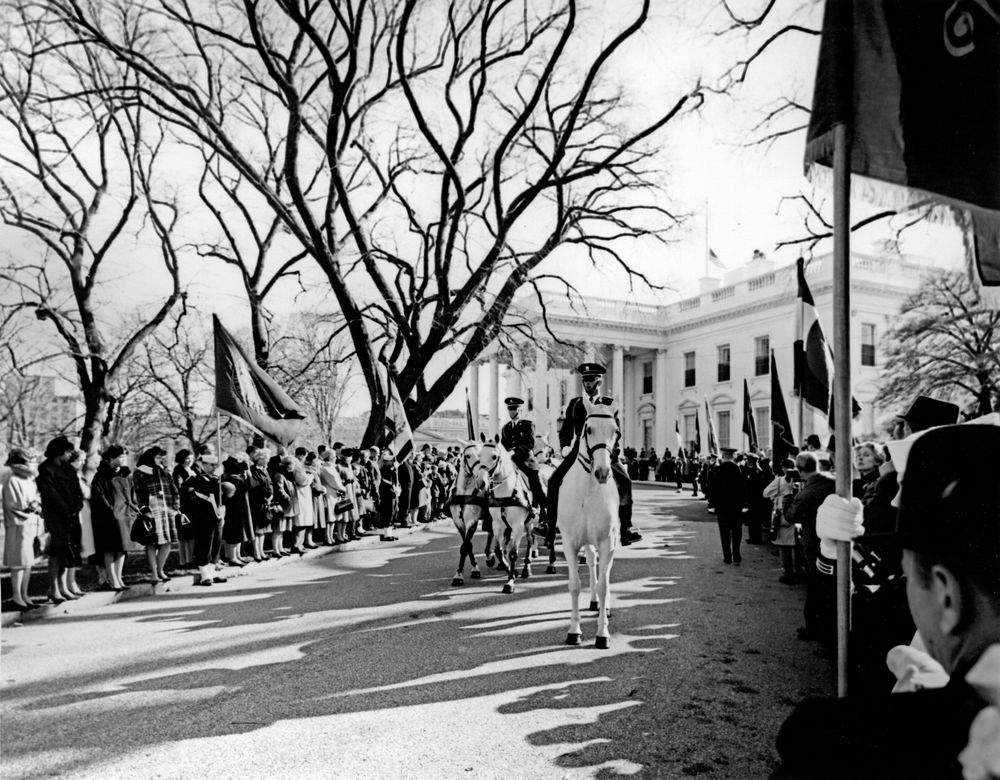
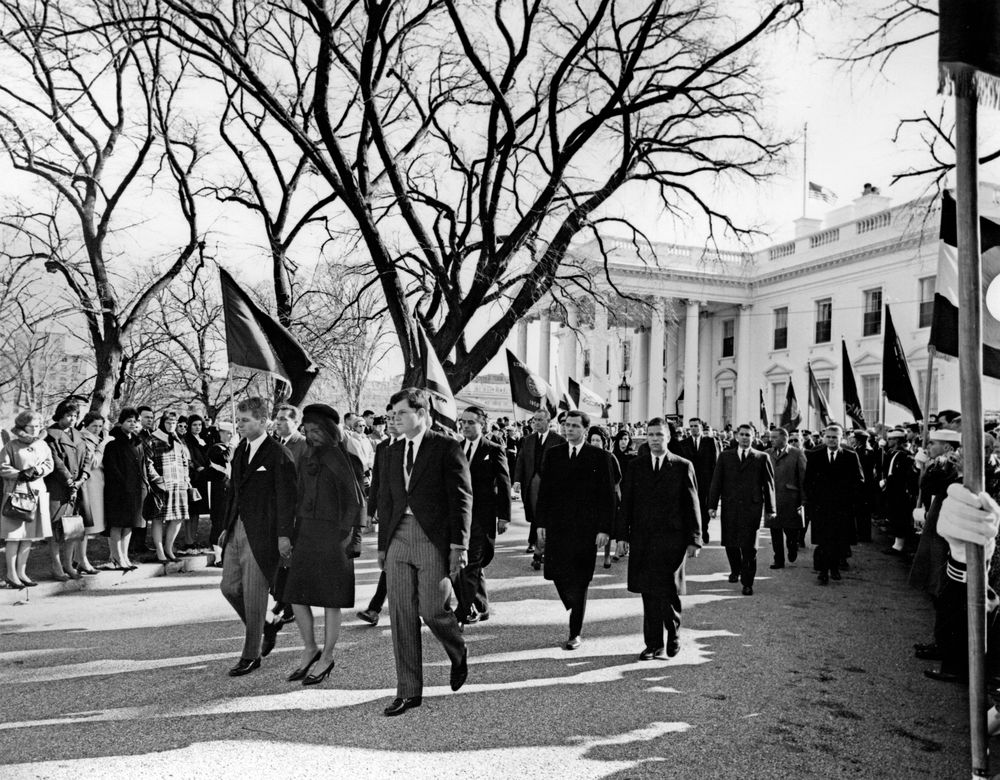
A plain Roman Catholic funeral mass is the final church rite for the late President Kennedy. In St. Matthew’s cathedral, Cardinal Richard Cushing of Boston, who married the Kennedys and baptized their two children, conducts a low mass — the simplest type. Mrs. Jacqueline Kennedy leads a procession of international dignitaries who walk behind the casket from the White House to the cathedral.
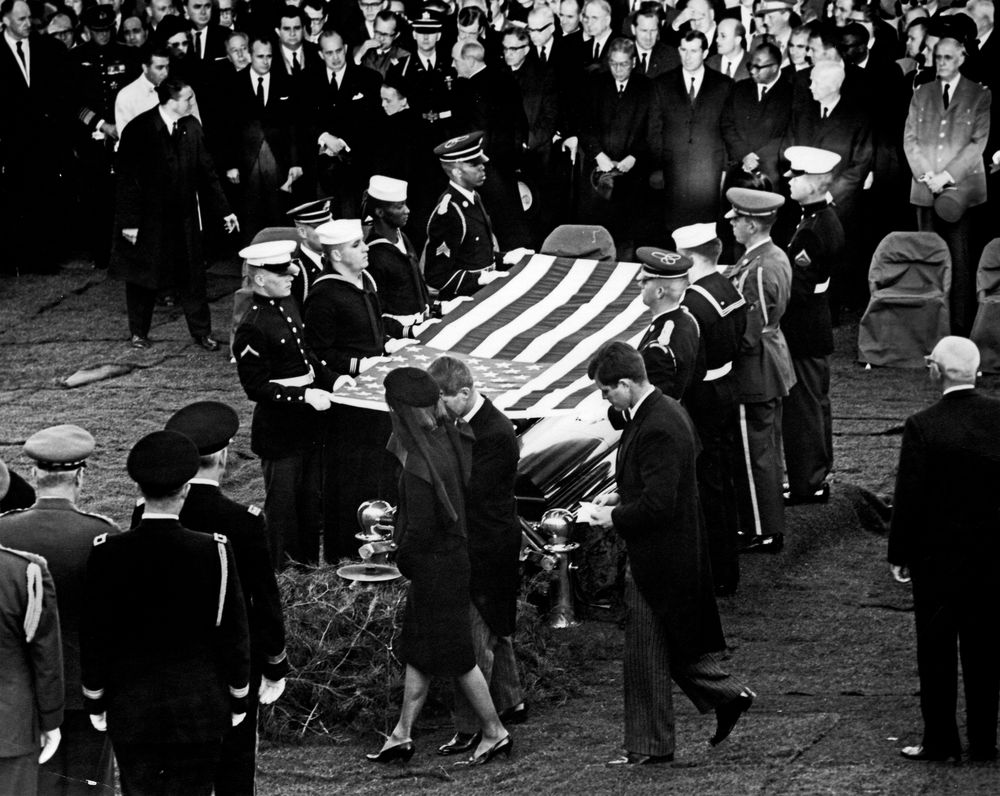
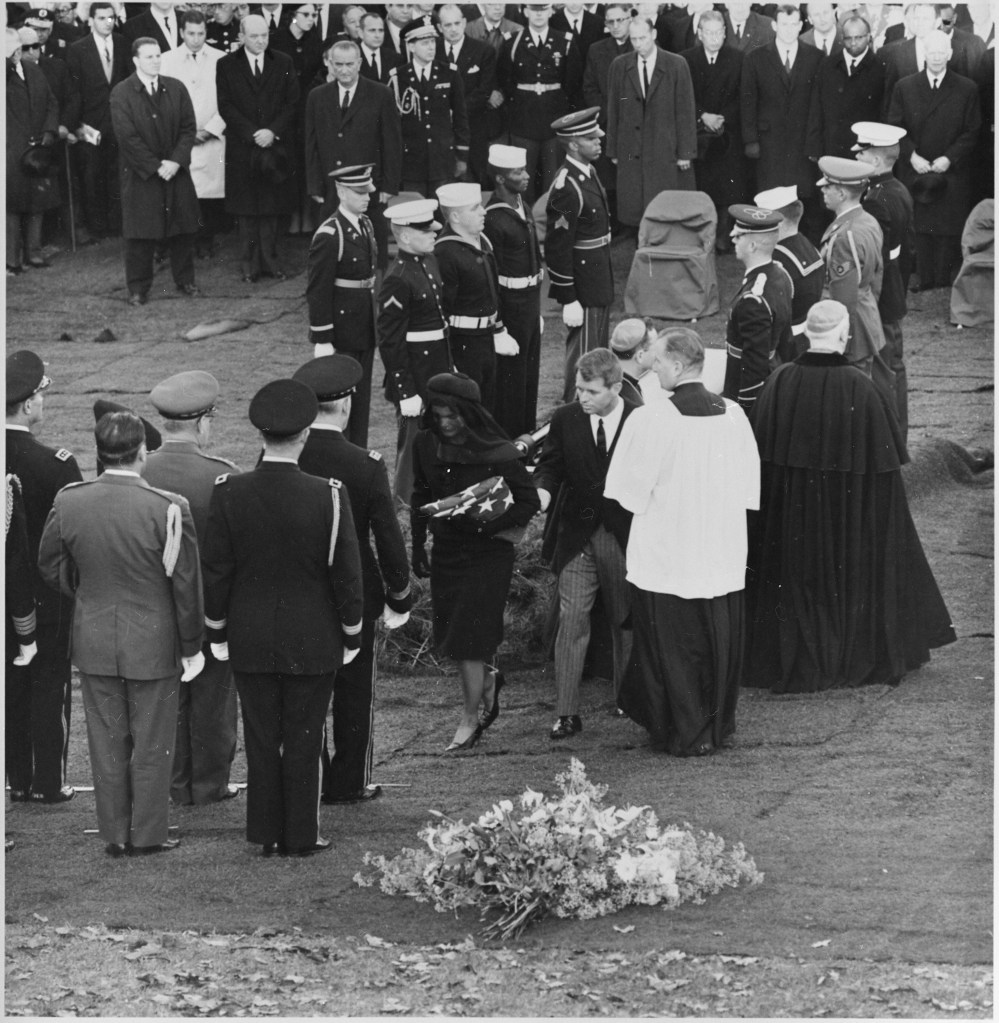
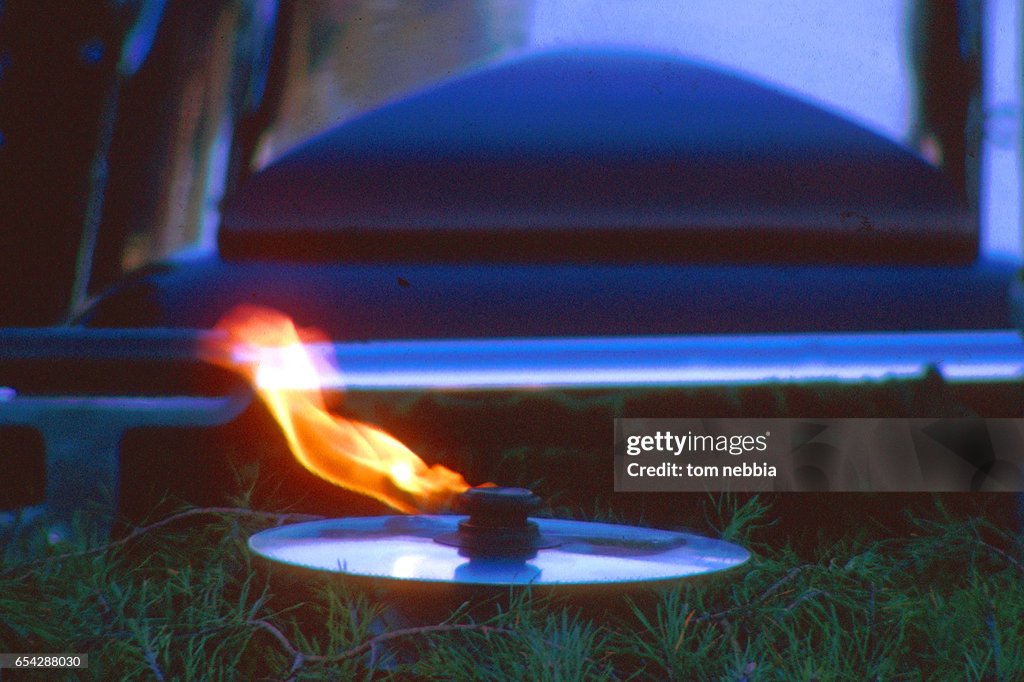
The body of John Fitzgerald Kennedy, assassinated 35th President of the United States of America, is laid to rest in Arlington National Cemetery, Virginia, joining 120,000 other warriors. Burial comes after solemn military and Roman Catholic ceremonies witnessed by many heads of state, representatives of 92 countries, and more than 10,000 American citizens. At the close of the services, Mrs. Jacqueline Kennedy lights an eternal flame that burns at the head of her martyred husband’s grave.
Courage and dignity shine through Mrs. Jacqueline Kennedy despite the agony she goes through in the assassination of President Kennedy and the million and one details she attends to in burying her husband in a hero’s grave in Arlington National cemetery. One London newspaper acclaims her for bringing majesty to the American nation.
The first renaming of places for the late President Kennedy took place in two cities outside the United States. At El Biar, a suburb of Algiers, President of Algeria Ahmed Ben Bella and U.S. Ambassador William J. Porter attended a ceremony where the Place de la Republique was designated as the Place John Kennedy. That evening in West Berlin, the Rudolf-Wilde-Platz in front of the City Hall, where Kennedy had delivered his “Ich bin ein Berliner” speech, was renamed the John-F.-Kennedy-Platz in a memorial ceremony. A few months later, the Algerian sign with Kennedy’s name would be removed and not be replaced; a report a year after Kennedy’s death said that the square at El Biar was dominated by “a huge billboard with the words ‘Self-management is the sure way of socialism!”.
Abraham Zapruder sold all rights to his 8 mm film of the Kennedy assassination to LIFE Magazine for $150,000 to be paid in installments of $25,000 per year. Two days later, Zapruder donated his first $25,000 to the widow of Officer J. D. Tippit.
For only the third time in history, telephone service in the United States was halted for one minute. At noon, Eastern time, AT&T operators bowed their heads in mourning for President Kennedy. The only other occasions were on April 18, 1920, after the death of AT&T President Theodore N. Vail, and on August 4, 1922, following the death of telephone inventor Alexander Graham Bell.
Las Vegas closed all of its casinos for only the third time in its history. The first two times had been on Good Friday (March 22) in 1940, and on April 12, 1945, after President Franklin D. Roosevelt died.
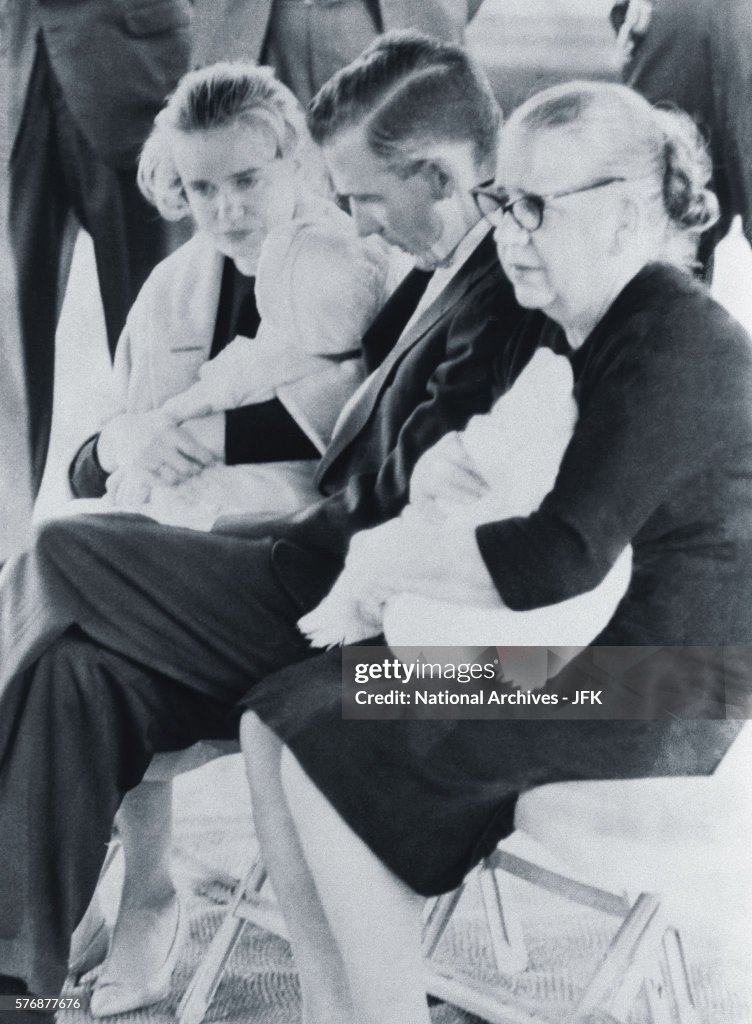
Three hours after the funeral of President Kennedy was completed, graveside services were held for Lee Harvey Oswald at the Rose Hill Cemetery near Fort Worth, Texas. Local police and the U.S. Secret Service did not allow the general public to be present, and the only other persons present were Oswald’s wife, mother, brother, and two daughters. After a Lutheran minister from Dallas reconsidered appearing for the service, the Reverend Louis Saunders appeared on behalf of the Fort Worth Council of Churches, telling newsmen, “We do not want it said a man can be buried in Fort Worth without a minister.” Oswald was buried in a family plot that had been owned for several years by his mother, and six of the reporters present served as pallbearers. The Miller Funeral Home of Fort Worth was hired for the arrangements, and police with guard dogs were stationed at the cemetery indefinitely in order to protect against vandalism.
Funeral services were held for fallen Dallas policeman J. D. Tippit at the Beckley Hills Baptist Church in Dallas, in a service attended by 1,000 of his fellow officers and mourners from the community. Burial followed at the Laureland Cemetery, in a memorial presided over by Pastor C. D. Tipps, in the presence of Tippit’s widow, daughter and two sons.
The Soviet government newspaper Izvestia calls for continuation of President Kennedy’s efforts toward Russian-American friendship as people throughout Russia mourn for the slain western leader. Some Russians turn out for separate Roman Catholic and Protestant memorial services conducted for attendance by Americans and members of the diplomatic corps. Five hundred Russians and diplomats crowd into a little Roman Catholic church in Moscow.
Eastern Europe’s communist commentators sought today to convey the idea that American President Johnson will come under pressure from rightists and racists. Hungarian radio listeners were told that Johnson faces “mistrust among the people of New York because he is a southerner,” and that he “refrained from taking sides in the debate between Kennedy and the opponents of Negro reforms.” Radio Prague asserted Johnson’s accession meant “a certain retreat to the right” in domestic and foreign policy. A commentator said Johnson took a less analytical approach to foreign political problems than Kennedy and one added: “In many respects, Johnson is much more a politician than Kennedy.”
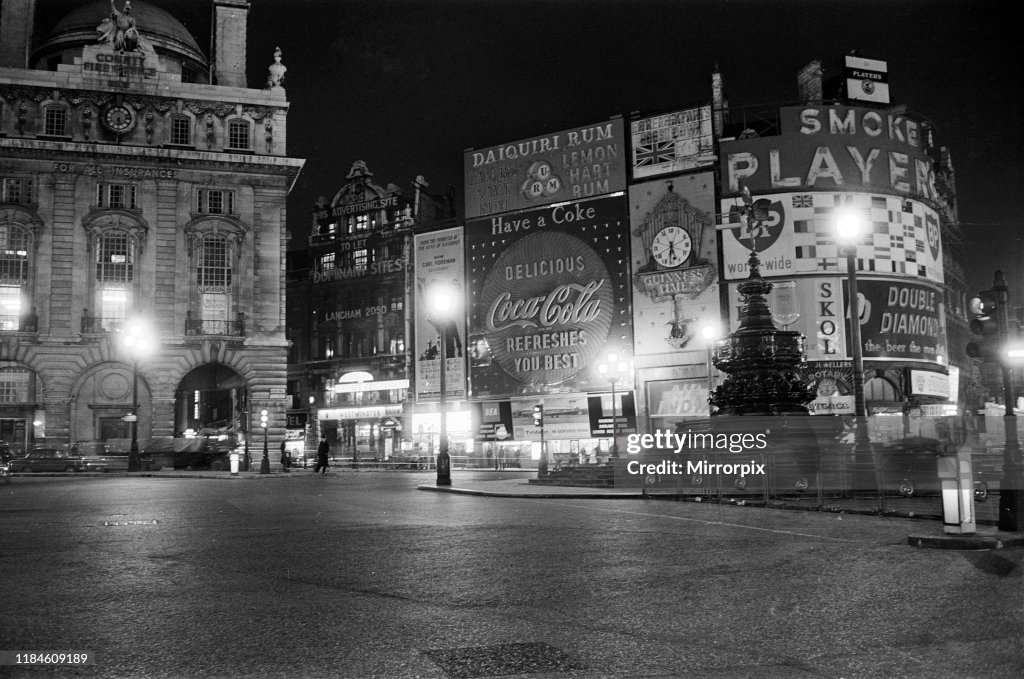
Former Prime Minister Harold Macmillan appears in the House of Commons for the first time since his recent illness to eulogize the late President Kennedy. “To the whole of humanity struggling in this world of darkness, it seemed a sudden and cruel extinction of a shining light,” he says. As dusk fell, the lights of London’s famed Piccadilly Circus went out — and remained out for four hours until the President’s funeral had ended.
At a session subdued by references to the death of President Kennedy, the Vatican ecumenical council votes its final approval, 1,598 to 503, of a decree calling on civil authorities to protect the free flow of information. Outside St. Peter’s Basilica, four priests distribute pamphlets opposing the decree until stopped by an archbishop with the aid of the police.
Communist forces have wiped out two strategic hamlets in the north of South Vietnam in massive attacks, military sources said today. More than 1,000 of the mountain tribesmen who defended them were reported missing. The setbacks, which came after 48 hours of heavy guerrilla assaults, were the worst the Government has endured since January. Whether the tribesmen were captured, fled into the mountains or joined the Viet Cong, as the guerrillas are known, could not be determined from the meager details available in Saigon. Strategic hamlets are fortified villages to which Vietnamese in rural areas have been moved. A main aim of this program is to provide a refuge where villagers cannot be persuaded or forced to support the Viet Cong.
South Vietnamese officials announced that 150 guerrillas have been killed in two days of fighting in the Mekong Delta.
In another development, an American civilian, held captive by the guerrillas for 169 days in the mountains said his release was a birthday gift. Arthur E. Krause, 29 years old, of Onarga, Illinois, said the Communists also gave him small gifts before they brought him near a government outpost Saturday and released him.
United States authorities in Saigon announced that the wreckage of an American combat plane missing for 10 months had been found on a mountain 220 miles northeast of Saigon. The body of the pilot was identified as that of First Lieutenant Clayton A. Fannin, of Tacoma, Washington.
Vietnamese troops also searched for the bodies of two Americans and a Vietnamese believed to have been killed in the crash Sunday of a B-26 bomber. The plane was on a support mission. A United States spokesman said with the latest action, 14 American servicemen are listed as missing and 78 others have been killed in action. Sixty-three have died of accidents and other incidents in the field.
The Government of Prince Sihanouk of Cambodia has asked Britain and the Soviet Union to call a nine-nation conference to negotiate a guarantee of Cambodia’s independence and neutrality. Britain and the Soviet Union were co-chairmen of the 1954 Geneva conference from which emerged the four successor states of Indochina — Laos, Cambodia, South Vietnam, and North Vietnam. In similar notes sent yesterday to London and Moscow, Huot Sambath, Cambodia’s Foreign Minister, proposed that the four successor states meet in either Burma or Indonesia with Britain, France, the United States, the Soviet Union and Communist China. These nine countries participated in the Geneva conference.
The note is believed to have repeated recent public charges by Prince Sihanouk that Cambodia’s independence has been threatened by South Vietnam and that South Vietnam’s allegedly aggressive policies were supported by the United States. Prince Sihanouk canceled the United States aid program to his country last week and followed this up with a request to France to replace the United States in this role. The French Government has said it is studying the request.
Ten South African men went on trial for the second time in the Pretoria Supreme Court today on charges of sabotage. For the second time the defense lawyers applied to Justice Quintus Dewet to quash the indictment. Justice Dewet quashed the first indictment October 30 on the ground that it lacked details. They were then served with a new indictment and remanded until today. Most of the men were arrested in a special branch raid on a home in the Johannesburg suburb of Rivonia on July 11. They include Nelson Mandela and Walter Sisulu, who were at various times secretary general of the banned African National Congress.
President Johnson said tonight the United States government “will work only when people are willing to cooperate and work together for the common good.” He appealed to 35 governors in a hastily called closed meeting for their cooperation in the days ahead “when our whole system has gone on trial.” The governors gave him an ovation at the end of his 20-minute speech.
A partial text of Johnson’s remarks was released later. In it, he said: “If they [the people] insist on glaring at each other, refusing to work together, and standing firmly on prerogatives and forgetting responsibilities, the nation will quickly be paralyzed.” He told the governors “Continuity without confusion has got to be our password and has to be the key to our system.” He said he planned to continue most Kennedy policies, especially in the area of foreign policy.
Governor Nelson Rockefeller of New York said Johnson appealed for support of Kennedy’s tax-cut and omnibus civil rights bill, although this was not in the text released by the White House. I consider it vitally important to ask for your help,” Johnson also said. “I want you to cooperate. I need your heart and your hand. Our country has suffered a grievous shock. The transition while a term is still going on is always a difficult test for democracy. It is doubly difficult in these days of quick decisions on matters that involve the fate of humanity.”
President Johnson, holding a reception for the 200 foreign dignitaries visiting Washington for the funeral of the late President Kennedy, uses the occasion to create some first impressions about how he will handle foreign affairs. He engages heads of government in conversations in the receiving line, and meets others later for more prolonged and less formal talks. President Johnson seeks opportunities to engage three chiefs of government in longer-than-average conversations. Out of these talks comes the announcement that President Charles de Gaulle of France has agreed to make a state visit to the U. S. early next year.
Senator Hugh Scott (R-Pennsylvania) calls for a moratorium until the end of the year on Republican political speeches to allow President Johnson to get acquainted with his job. The move is endorsed by Senator Barry Goldwater (R-Arizona), candidate for G.O.P. Presidential nomination, and by William B. Miller, Republican national chairman.
Even before the body of his predecessor is removed from the Capitol rotunda, President Johnson sends to the Senate press gallery excerpts of past speeches noting his denunciation of communism. The 10-page memorandum also includes his views on education, world leadership, religion, medical care for the aged, public power, civil rights, and space.
Jack Rubenstein, murderer of Lee Harvey Oswald, is transferred secretly from Dallas police headquarters to county jail. The move brings a temporary close to the public inquiry into actions of Oswald, accused slayer of President Kennedy, and of Oswald’s killing by Rubenstein. But Dallas Police Chief Jesse Curry says that unless otherwise instructed by the federal government, his department believes all the information gathered “can and should become public.”
Dallas citizens, in a spontaneous demonstration, turn the grassy plot at the scene of President Kennedy’s assassination into a memorial. Flowers are deposited in the plaza without any formal ceremonies. Motorists leave cars to place wreaths, then drive away, while pedestrians place flowers, pause for a few moments, and walk away.
Born:
Bernie Kosar, NFL quarterback (NFL Champions, Super Bowl 28-Cowboys, 1993; Pro Bowl 1987; Cleveland Browns, Dallas Cowboys, Miami Dolphins), in Boardman, Ohio.
Carlton Thomas, NFL defensive back (Kansas City Chiefs), in Portsmouth, Virginia.
Ron Foster, NFL defensive back (Los Angeles Raiders), in Los Angeles, California.
Lorenzo Charles, NBA small forward (Atlanta Hawks), in Brooklyn, New York, New York (d. 2011).
Kevin Chamberlin, American stage and screen actor, and singer (“Seussical”; “Jessie”; “Wicked”), in Baltimore, Maryland.
Elvis Presley — “Bossa Nova Baby” (from the movie “Fun in Acapulco”)
 History Diaries