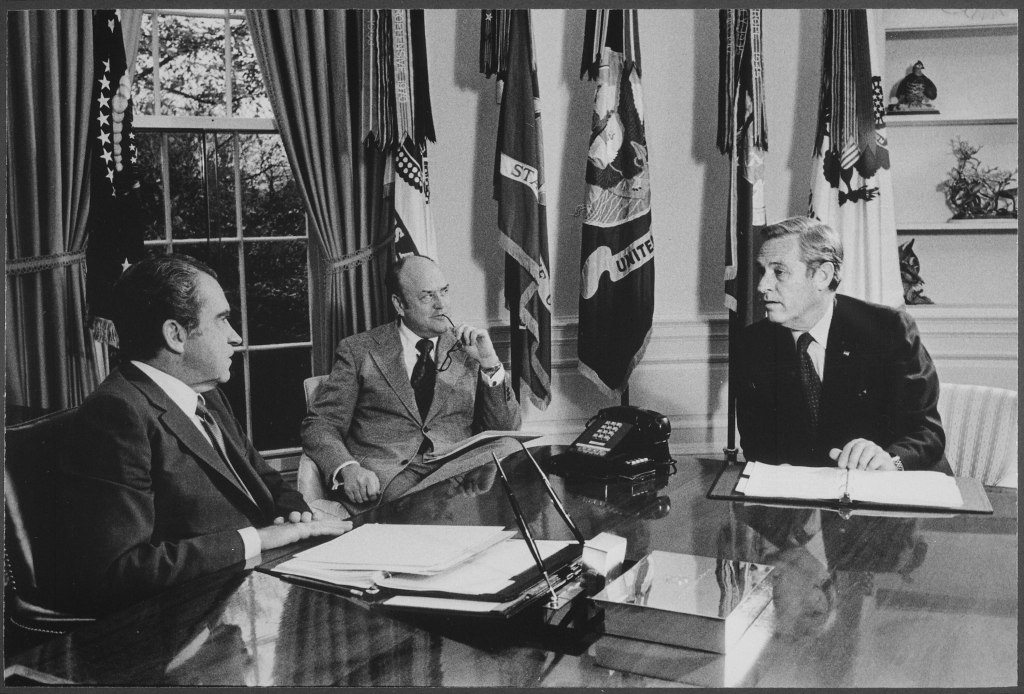
Ismail Fahmy, Egypt’s Foreign Minister, declared at the opening of the Arab foreign ministers’ conference in Staoueli, Algeria, that the Arab countries should step up their use of the “oil weapon,” and Abdelaziz Bouteflika, Algeria’s Foreign Minister, said they should “multiply their forces in the struggle with imperialism and Zionism.” Anti-Israeli militancy was the keynote as ministers and other high officials representing 16 Arab nations and the Palestinian refugees gathered for the first large-scale Arab meeting since the October war against Israel.
Israeli officials said that a major gap was still separating Israel and Egypt on the question of disengaging their forces along the Suez Canal. They said that “no meaningful progress” had been made at an 80‐minute meeting between Israeli and Egyptian negotiators on the Cairo‐Suez highway.
The national radio reported in Tel Aviv that David Ben-Gurion, the 87-year-old former prime minister who helped lead Israel to nationhood, has taken a turn for the worse in his fight to recover from a stroke. The broadcast said Ben-Gurion’s blood pressure and pulse have dropped and that his condition was deteriorating from complications following the cerebral hemorrhage he suffered last Sunday.
The South Vietnamese Air Force has made further large air strikes against Communist-held areas northwest of Saigon, military sources in Saigon reported. The raids on Katum and Thiện Ngôn airfields in northern Tây Ninh Province Friday morning were the heaviest since the January cease-fire, the South Vietnamese sources said.
In Cambodia, the rain is merciful. It fills the fields and swells the rivers beyond their banks, turning much of the flat countryside into a vast, shallow lake through which no army can move. Like snow in New England, the rainwater here smothers the land in a relative calm. Only on the dry spots — the roads, the pagodas, the gentle rises that look like islands — can the war be fought at full ferocity. But the rainy season is now ending and the water levels are falling, When the fields dry out within the next few weeks, virtually everyone here expects the fighting to assume the dimensions of a potent offensive by the Khmer Rouge insurgents. Military analysts and foreign diplomats are generally agreed that in its initial stage, the offensive is likely to be aimed at strangling Phnom Penh, softening the city for the kill.
The main supply roads to the capital — Route 4, to the port of Kompong Som, and Route 5, to the rice‐growing region around Battambang — are now seriously cut. Virtually all the city’s food and fuel comes by Mekong River convoy. For the insurgents, then, the question is whether they can close the Mekong and keep it closed. That in turn will depend on how busy they can keep government troops elsewhere — defending provincial capitals such as Kompong Cham and Takeo, for example, or defending Phnom Penh itself.
Jewish sources in the Soviet Union report a new wave of arrests and trials in alleged harassment of those who have applied for emigration to Israel. Alexander Feldman, 26, a Kiev engineer, was reportedly sentenced to 312 years in a labor camp for allegedly assaulting a woman. Peter Pinkasov, a carpenter, was sentenced to five years in Derbent, Daghestan, for anti-Soviet slander. He had received permission to emigrate to Israel. Others face trials or have been questioned repeatedly by the secret police.
A British soldier was killed by a terrorist booby-trap bomb while he was on duty with a platoon patrolling the Northern Ireland border with the Irish Republic near Crossmaglen. The blast was blamed on the outlawed Irish Republican Army. Meanwhile, the IRA’s militant Provisional wing claimed responsibility for shooting up the home of a leading Roman Catholic politician who has chosen to serve with Protestants on a new power sharing executive for Northern Ireland. Austin Currie, 39, was not at his country home. His wife and two young children were in the house but were not injured.
Argentine President Juan D. Perón, confined to his home with bronchitis, said he was recuperating and would return to work as soon as I am well.” The 78-year-old general said in a brief interview that “some people think I’m finished, but that’s not so.” The government released a picture of Perón working with Welfare Minister Jose Lopez Rega and said the president would be back at his office Monday. But government sources said he would be given a thorough checkup today before it is determined if he can return to work.
At least 3,000 persons on the island of Pico in the Azores were homeless after Friday’s strong earthquake which wrecked 80% of the homes on the island, the Portuguese news agency ANI said. One person was killed by a falling rock during the tremor, but no other deaths were reported. Quakes have been shaking the islands, about 1,000 miles west of Portugal, intermittently during the past 40 days, but have become increasingly severe during the past three days.
The Peruvian city of Cuzco, a tourist center high in the Andes, famous for its Inca ruins, was placed under martial law following clashes between police and students in which one person was killed and many others wounded. The clashes occurred when students demonstrated for the release of leaders in a strike by teachers. The local government subsequently imposed an indefinite dusk-to-dawn curfew and suspended all individual guarantees in the city.
Eight bodies, all bearing trademarks of Rio de Janeiro’s so-called “death squad,” have turned up within a 72-hour period, police sources reported. All had been tortured before they died, bore marks of handcuffs on their wrists and had been shot repeatedly. The “death squad” is said to be composed of off-duty policemen and is reported to have tortured and murdered more than 2,000 small-time criminals in the past few years.
Toyota, Japan’s largest car manufacturer, raised the retail prices of all models by an average of 7%. A spokesman said the price increases will apply only in Japan. The increase will raise the price tags of Toyota cars, trucks and vans by an average of $78.
An explosion touched off a fire aboard the sulfur-laden Taiwan freighter Minily in mid-Atlantic, and rescue craft were sent to aid the ship, the Coast Guard said. The 37 crewmen were reported fighting the blaze, and the situation was not believed critical. The ship was en route to Barie, Italy, from Port Arthur, Texas.
The annual rainfall in the sub-Sahara was sparse this year, and a good portion of the hoped‐for harvests of millet, sorghum and peanuts sits stunted in dusty fields or baked, half‐grown, beneath the yellow sand. For the sixth year in a row that drought‐ravaged belt of open plainland just south of the desert received too little rain to produce a harvest that might have helped to feed its people. And while the worst of the region’s fears are being realized, the vastness of the area, the poor communications and the continuing need for emergency relief efforts combine to make it impossible to make any accurate assessment of the total impact of the sparse rainfall. Several reactions can be observed, however.
A United Nations‐led drought relief team that recently toured the region has, recommended that a total of 662,000 tons of food be brought into the area before next September to prevent widespread starvation among the more than 25 million people there. Since about a third of that amount of the requested food is already en route to the region (a part of the world community’s response to the preharvest crisis of the summer) officials say the sub‐Sahara food deficit could range from 360,000 tons to 426,000 tons.
President Nixon will announce tonight on nationwide television what he described to reporters as “tough, strong action” to meet the energy crisis. The principal steps are expected to be a ban on the sale of gasoline on Sundays and reduced distribution of home heating oil. White House officials stressed that emphasis would be on conservation rather than rationing of gasoline or fuel oil. Meanwhile, House Speaker Carl Albert in a statement blamed Nixon administration policies for the energy crisis, which he said could lead to a recession with more than 8 percent unemployment next year.
Secretary of State Kissinger has said privately that he is “virtually certain” his telephone was tapped at some point since he joined the Nixon administration in early 1969, according to a former White House associate. Mr. Kissinger reportedly made the remark shortly before his confirmation as Secretary of State in September. Mr. Kissinger denied through a State Department spokesman that he had ever expressed such a belief to anyone.
A public interest law firm in Washington published an exposition of what it asserts are “indictable common crimes” committed by President Nixon. The paper lists 28 counts of criminal violations allegedly committed by Mr. Nixon both directly and through his White House and re-election campaign staffs and his private representatives. The alleged crimes involve the Watergate scandal, campaign financing, violation of civil liberties and the use of federal funds for personal enrichment.
Small cars, for years the automobile industry’s unglamorous stepchildren, have in the last few weeks suddenly become the hottest items on the market, with drivers rushing to trade in their big, gas-eating cars with an urgency that automobile dealers describe as “panic” and “hysteria.” As a result, people will wait months for delivery of new compacts; the price of used small cars has increased substantially, and the trade-in and resale value of big cars has plummeted so fast that some new car dealers say they may soon refuse to accept big-car trade-ins at all.
Federal officials said that they were studying two proposals that would probably lower significantly retail prices of prescription drugs. A Cost of Living Council proposal would have every drugstore in the country post a price list of prescription drugs. A Food and Drug Administration proposal would set up a uniform national system for posting drug prices.
The American Civil Liberties Union issued a handbook listing 17 things that citizens can do to bring about impeachment of President Nixon and giving six specific offenses that it said could be substantiated. The citizen activities included commonplace steps such as making speeches and writing to their congressmen. The offenses related to domestic espionage, the Watergate break-in, the Ellsberg trial and the bombing of Cambodia.
President Nixon was urged to counter some of the taint of Watergate by supporting a measure that would provide for a sweeping reform of election campaign practices. Senator Richard S. Schweiker (R-Pennsylvania) asked in a letter to Mr. Nixon that he endorse a bill coming before the Senate Wednesday that would ban private contributions in presidential and congressional general election campaigns and provide tax dollars to finance them. The proposal which reportedly has the bipartisan support of 51 senators, is to be offered as an amendment to a bill to raise the $464 billion ceiling on the national debt.
The Skylab 4 astronauts, fatigued and behind schedule, took the day off to rest and catch up on house cleaning chores in preparation for 11 weeks of intensive space research. Gerald P. Carr, Edward G. Gibson and William R. Pogue slept two hours later than usual and spent their ninth day in space sorting and stowing hundreds of items.
General Motors Corp. was assailed by United Auto Workers Vice President Irving Bluestone for ordering layoffs at 16 assembly plants before the Christmas and New Year’s holiday break. He said this would mean heavy pay losses for low-seniority workers. Bluestone urged GM to reconsider plans to cut production by 79,000 full-size cars during the week of December 17. GM said the move had been forced by declining sales of the large cars, caused in part by the energy crisis.
A gunman suspected of six holdups within five hours was shot to death by policemen in St. Paul, Minnesota, as he fled across a golf course. Authorities identified the man as Kenneth Allen, 26, of Aitkin, Minnesota. He was struck by police gunfire after running 500 yards from his car, which went off a 15-foot embankment during a chase. Police said $900 in cash was scattered around the suspect’s body. Officers gave chase after Allen emerged from a restaurant and fired six shots into a squad car. He was suspected of robbing a motel and five restaurants and wounding a waitress during one of the holdups.
In a show of civic solidarity perhaps unrivaled since the Indian threat, Harlan, Iowa — the self‐proclaimed “Christmas City” — has pulled the plug on all outdoor Christmas lighting this year. A cutback in Christmas lights is a measure being taken with varying degrees of compliance, sincerity and grumbling in villages, cities and homes across the country at the start of the traditional holiday decorating period.
Tornadoes swept through the Midwest and South, killing at least four persons in mobile homes in Missouri and Arkansas. Ruby Taylor died when his house trailer was overturned at Searcy, Arkansas. Earlier three persons — Lucille Nichols, 55; her son, Henry, 26, and her grandson, Terry, 10 — were hurled to their deaths when a tornado ripped their mobile home to bits in the Missouri Ozarks community of Eminence. Six homes were destroyed and 30 damaged in the Missouri twister. Tornadoes touched down in Texas and other parts of Arkansas also.
The championship of Canadian college football was decided with the playing of the ninth annual game for the Vanier Cup. The Huskies of Saint Mary’s University defeated the Redmen of McGill University, 14 to 6, before 17,000 people at Toronto.
Xavier University played its last college football game, defeating the University of Toledo, 35 to 31, to finish with a record of 5-5-1 as an NCAA Division I team. Less than a month later, the private university’s board of trustees voted to permanently discontinue the Xavier Musketeers football program. As of 50 years later, there are no plans to revive XU football. (December 20, 1973).
Bob Gibson wins the last of 9 Gold Gloves on the mound, and Joe Morgan wins the first of 5 at second base.
Born:
Donny Brady, NFL cornerback (Cleveland Browns-Baltimore Ravens), in North Bellmore, New York.
Kendel Shello, NFL defensive end (Indianapolis Colts), in New Iberia, Louisiana.
Suzan Najm Aldeen, Syrian-born film TV actress; in Duraykish, Syria.
Carolina Sandoval, Venezuelan-born U.S. TV anchor; in Caracas, Venezuela.
Alejandro Ávila (stage name for Alejandro Aranda Ávila), Mexican TV actor; in Guadalajara, Mexico.
Died:
General H. L. Glyn Hughes, 81, South African-born British Army General notable for taking care of the victims of the Bergen-Belsen concentration camp.
Nikolai Kamov (engineer), 71, Soviet Russian aerospace engineer.





 History Diaries