
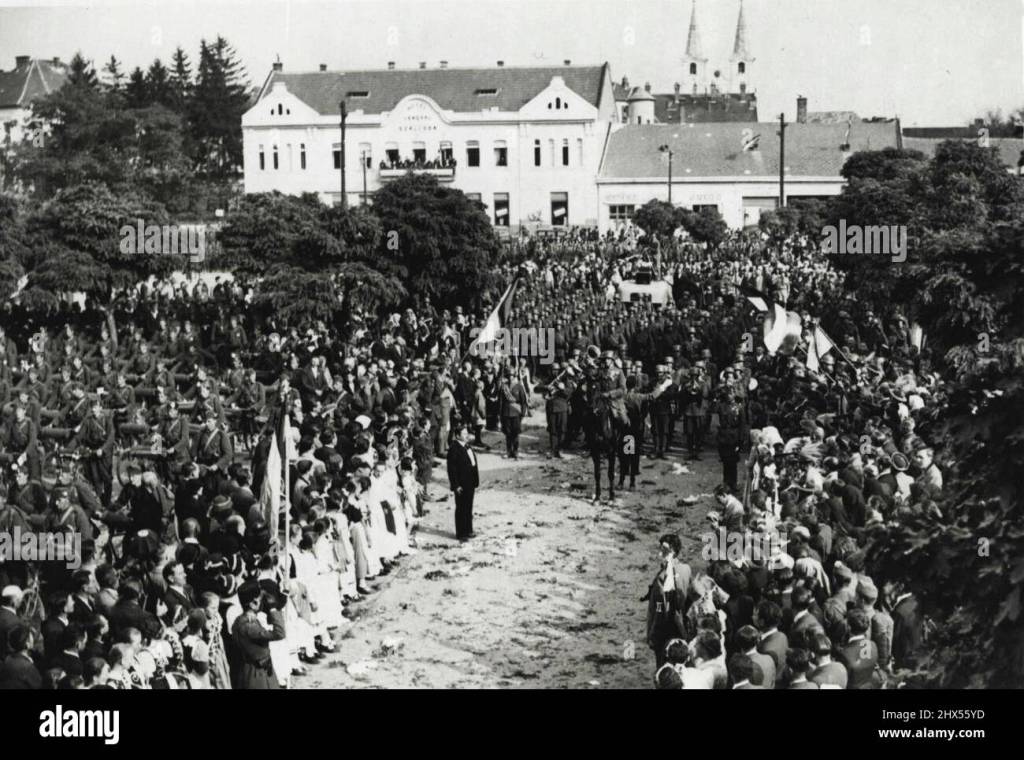
Hungary ordered the expulsion of Slovaks from the territory occupied after the Vienna Award. The Slovak autonomous government in its section of Czechoslovakia responded by threatening to confiscate all property of Hungarians remaining within its borders.
Italy and Germany inform Poland and Hungary that they must accept current borders with Czechoslovakia.
The Spanish rebel counter offensive, designed to recapture the loyalist salient on the west bank of the Segre River in eastern Spain, was halted today, Barcelona dispatches reported. The rebels ceased their costly counter-attacks, the loyalists reported, after approaching within a few hundred yards of the northwest edge of Seros. On the other hand, the government troops drove near the Fraga-Lérida highway. The loyalists took Seros, Aytona, and Soses in a surprise drive across the Segre on November 7.
Lloyd’s of London reported from Spain today the capture of three Greek steamers by the rebels. The 3,404-ton Faneromeni was reportedly confiscated and her crew imprisoned, the Epploia confiscated and the captain sentenced to twelve years’ imprisonment, and the 4,528-ton Nicolaou Eleni captured with & cargo of sugar from Cuba.
Strikes spread in France; each time police pull sit-downers from a plant, employees in another factory sit down.
France is hopeful over Chancellor Hitler’s statement that he would like to be good neighbors.
The number of Jews and part Jews under the Nuremberg ghetto laws whom Germany wants to force to emigrate “considerably exceeds one million.” This statement was made today by the Essener National Zeitung, official organ of Field Marshal Hermann Wilhelm Göring. Of this total 300,000 live in Austria. The others reside in Germany proper and newly conquered Sudetenland. To speed up the emigration of these Jews, the ZEFJA, or central office for the emigration of Jews, is working overtime in the Viennese palace of Baron Louis Rothschild, who was placed in a concentration camp after the seizure of Austria. The central office already has brought about the emigration of 12,000 Jews and now is able to deal with 650 Jewish applicants each day.
It was disclosed that 135,000 Austrian Jews had applied for emigration. Most of the applications were turned down because, as the Essener National Zeitung said: “England and the United States, with vast lands at their disposal, closed their frontiers and with unctuous platitudes left it to Germany to worry about the future of the Jews.” The newspaper said the following documents must be obtained by Jews desiring to emigrate: A statement by tax authorities that applicant had paid the almost prohibitive taxes demanded from Jewish emigrants; a license to get necessary foreign currencies; a record from the police; a statement by military authorities that there are no objections from a military viewpoint; a statement that the landlord has no rent claims, and finally a visaed passport. After the Jews have obtained these papers, the newspaper said, they can leave the country within a week, provided some country permits them to enter. The paper failed to add that many German Jews by then are almost paupers.
A Gestapo newspaper warns democracies that unless they take Jews from Germany, Germany will starve and exterminate them.
Finland dissolves its fascist organization, the Patriotic National Movement.
The United States asks Germany for assurances that American citizens who are Jewish will not be subjected to the same discriminatory rules as German Jews. There was no immediate reply to the American diplomatic note, delivered to the Reich foreign office in Berlin.
Secretary of State Cordell Hull says Japan’s recent reply is unsatisfactory. Japan’s reply to an American note, which demanded the maintenance of the open door and complained that Japan was trying to monopolize Chinese trade, was characterized today by Secretary of State Hull as unsatisfactory. The Japanese reply had rejected all major contentions in the American note and declared that “ideas and principles” of the past no longer applied to the Chinese situation. Hull said today that the Japanese communication conflicted with the general position the United States has taken throughout its history. Officials said that it was the implications in Japan’s remarks about past principles and about the creation of a “new order” in eastern Asia that troubled them most. Observers have interpreted the remarks as an indication that Japan expects to dictate conditions under which foreigners shall live and foreign business be carried on in China. Although Japan promised equality of economic opportunity in China, officials here believe she means that there should be equality among all foreign nations, but that Japan in China is not a foreign nation.
Informally, the President says Georgia will get no more WPA funding until the state legislature cooperates with the federal government and establishes a public works authority. President Roosevelt today criticized Georgia for not going into debt. He expressed annoyance with the state for not changing its constitution so it could be like other states and spend money it doesn’t have. The President, here for a two weeks’ rest, told in a press interview of his decision to close the federal purse strings to his Georgian hosts until they fall in line with his easy money ideas. Despite the friendliness of his vacation surroundings, he said he would not be soft-hearted about the matter. Mr. Roosevelt has been annoyed with Georgia since it refused to go along with his plans to purge the senate of conservative Democrats and emphasized its refusal by a landslide renomination of Senator Walter F. George, for whose defeat the President personally campaigned.
However, the presidential threat to the flow of federal money bore almost instant fruit. In Atlanta, State Senator Paul Lindsay said that legislation to permit the state to borrow money would be introduced in the general assembly at the earliest opportunity. Mr. Roosevelt made his remarks about the Georgia situation in discussing the progress of a federally-financed insane asylum at Milledgeville. He declared that the days of easy money which saw the appropriation of funds for such projects are gone forever-or at least until Georgia comes around to his way of thinking. He recalled that several years ago, when Georgia needed a prison, the state’s borrowing ban was circumvented by the government making an outright grant for the project and then “selling” the prison to the state on a rental basis.
Six high officials of the Roosevelt administration were linked with communist front organizations today as the Dies Committee on un-American Activities delved further into communist influences within the New Deal. Harold L. Ickes, secretary of the interior, and Nathan R. Margold, solicitor of the Interior Department, were identified with the American Civil Liberties Union, which repeatedly has been described in testimony before the committee as a communist front outfit. William O. Douglas, chairman of the Securities and Exchange Commission; Jerome Frank, a member of the SEC; Corrington Gill, assistant administrator of the Works Progress Administration, and Edwin S. Smith, a member of the National Labor Relations Board, were linked with the American League for Peace and Democracy, which is accused of being under communist control. Margold was identified as a supporter of this organization, as well as the Civil Liberties Union.
Steep mountainsides of St. Lucia, among the most beautiful in the West Indies, cracked open today in a series of avalanches. It was estimated that hundreds of persons were buried. The government, supervising rescue work, late today had accounted for seventy-five bodies. Many people were missing. Sixty injured persons were being treated in the Port Castries hospital. Temporary roadside morgues were established in continuing rain, which hampered workers. Long lines of anxious persons, many weeping, waited for news of missing relatives. Two hamlets were buried in the initial slide last night. New avalanches today buried more inhabitants, including injured victims of the first and rescue workers and carpenters building wooden coffins.
Chinese forces in the northwest today were reported fortifying themselves against an expected Japanese thrust across the Yellow River. The Chinese hold Tungkwan on the southern bank of the great bend of the river. Japanese on the opposite bank — in Shansi province — repeatedly have shelled Tungkwan. To the west is the unconquered Shensi province, the stronghold of the Chinese Eighth Route (communist) army. Chinese so far have turned back all Japanese attempts to cross the river at Tungkwan. However, Japanese air raids on Sian and Lanchow, northwest of Tungkwan on the trade route to Soviet Russia, have indicated that the Japanese will make a more determined effort to cross.
For centuries Tungkwan has been known as the “gateway to China” from the west. It is situated at the southern end of the “red earth” plateaus of Shensi and Shansi provinces at the point where the Yellow River leaves deep gorges and spreads out on the plain of Honan province. In central China, Japanese spokesmen said their forces had consolidated their front in Kiangsi and Hunan provinces and asserted the capture of Nanchang and Changsha, the two province capitals, was imminent. The Japanese denied Chinese reports that their offensive had been pushed back across the Sin River, 40 miles north of Changsha. Japanese forces were reported only 30 miles north of Nanchang. The battle front stretches from the eastern shore of Lake Tungting, north of Changsha, about 200 miles eastward to the western shore of Lake Poyang, north of Nanchang.
Chinese commanders reported that their forces were within three miles of Canton, the metropolis of South China, and that the city was in danger of recapture. Japanese reported their military authorities had taken over control of customs in Canton. Japanese planes raided Kweilin, the largest city of northeastern Kwangsi province. Kwangsi is west of Kwangtung province and Canton. The many military planes in the sky above Shanghai have led to the belief that the Japanese are bombing many towns of the Yangtze valley in which Chinese guerrillas are believed to be hiding between raids by which they menace Japanese communications.
The British-American trade agreement, signed last Thursday in Washington, D. C., is regarded in Australia as the embodiment of an unwritten defensive alliance between the British empire and America, particularly in the Pacific area. Most Australians, therefore, cheerfully accept the concessions at their expense in the treaty, which are deemed necessary for America’s cooperation. This aspect has been emphasized by politicians and the press almost to the exclusion of any other consideration. Protests, primarily from producers affected by provisions of the treaty, are received with indifference.
Dow Jones Industrial Average: 149.56 (-0.70).
Born:
Charley Johnson, NFL quarterback (Pro Bowl, 1963; St. Louis Cardinals, Houston Oilers, Denver Broncos), in Big Spring, Texas.
Dave Cloutier, AFL defensive back (Boston Patriots), in Gardiner, Maine (d. 2017).
John Gregory, American football coach (CFL Grey Cup, 1989, Saskatchewan Roughriders; South Dakota State U.), in Webster City, Iowa (d. 2022)
Naval Construction:
The Royal Navy mooring vessel HMS Moorland is launched by W. Simons & Co. Ltd. (Renfrew, Scotland).
The Royal Navy Net-class boom defence vessel HMS Magnet (Z 27) is launched by Smiths Dock Co., Ltd. (South Bank-on-Tees, U.K.).
The Royal Navy “J”-class destroyer HMS Jaguar (F 34) is launched by William Denny & Brothers (Dumbarton, Scotland).


 History Diaries