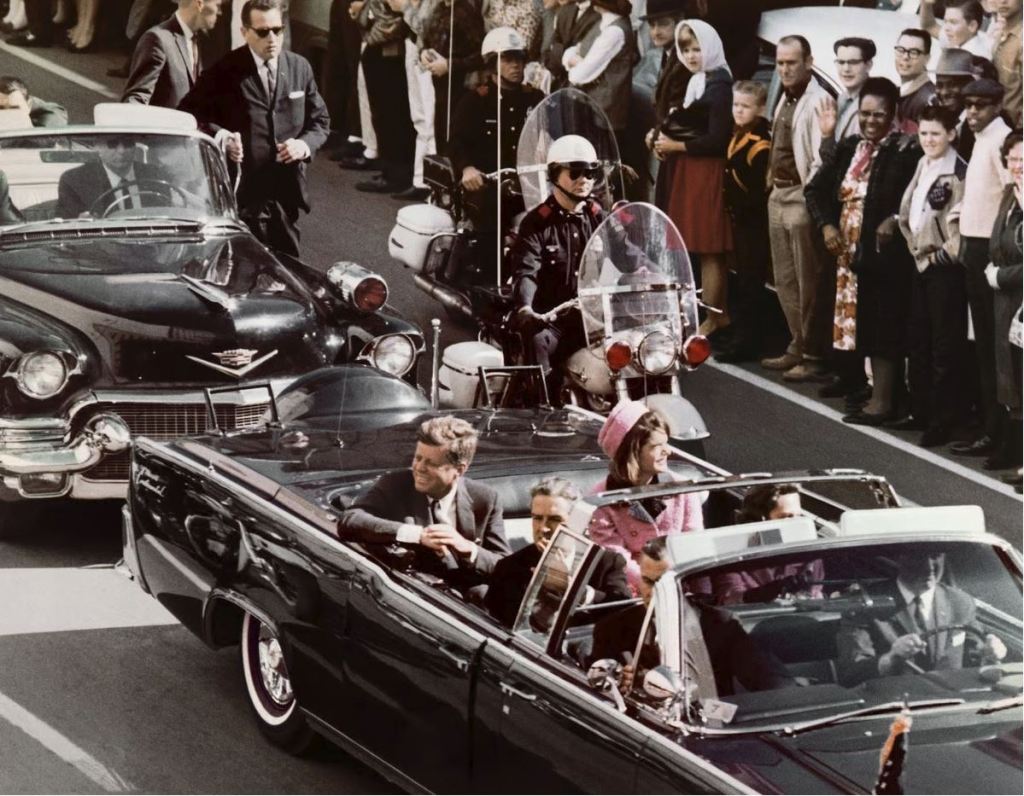
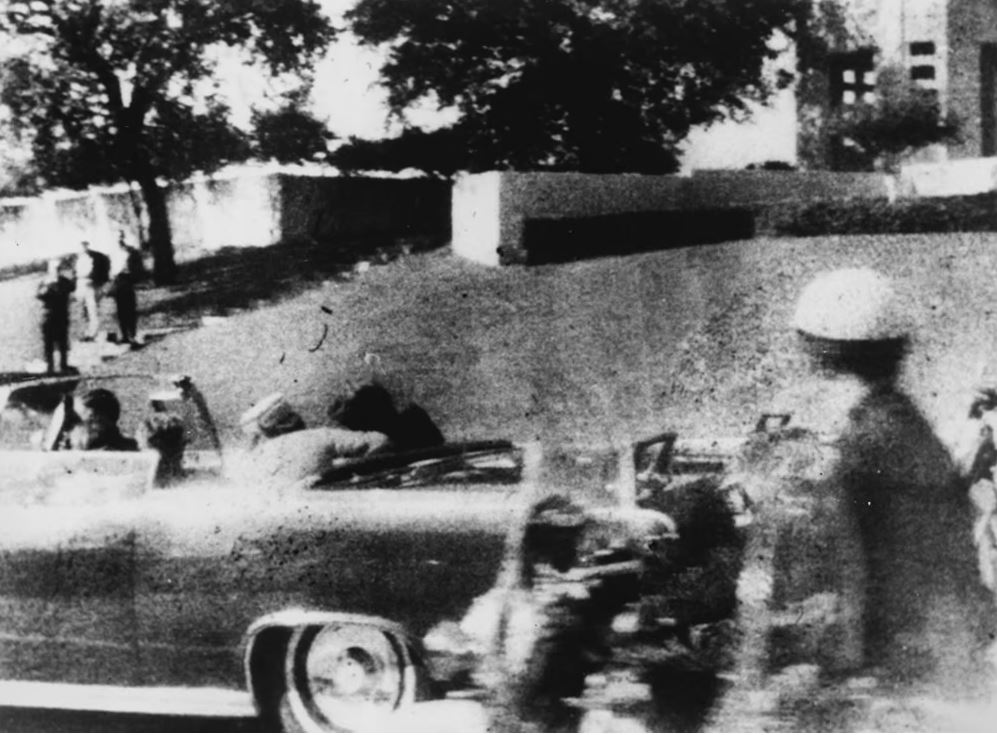
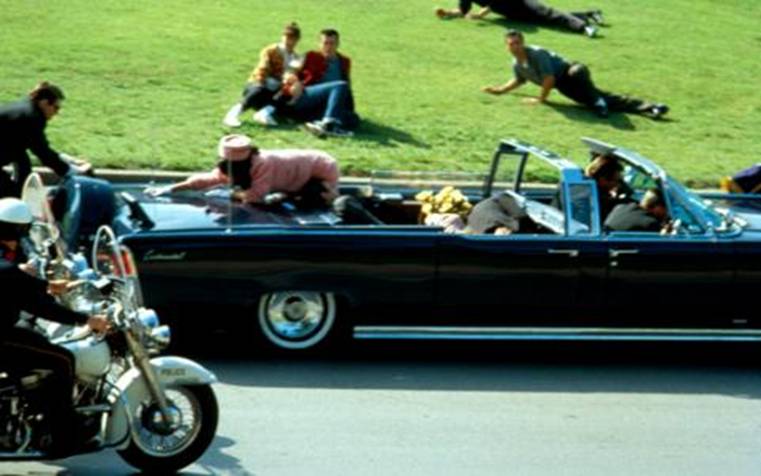
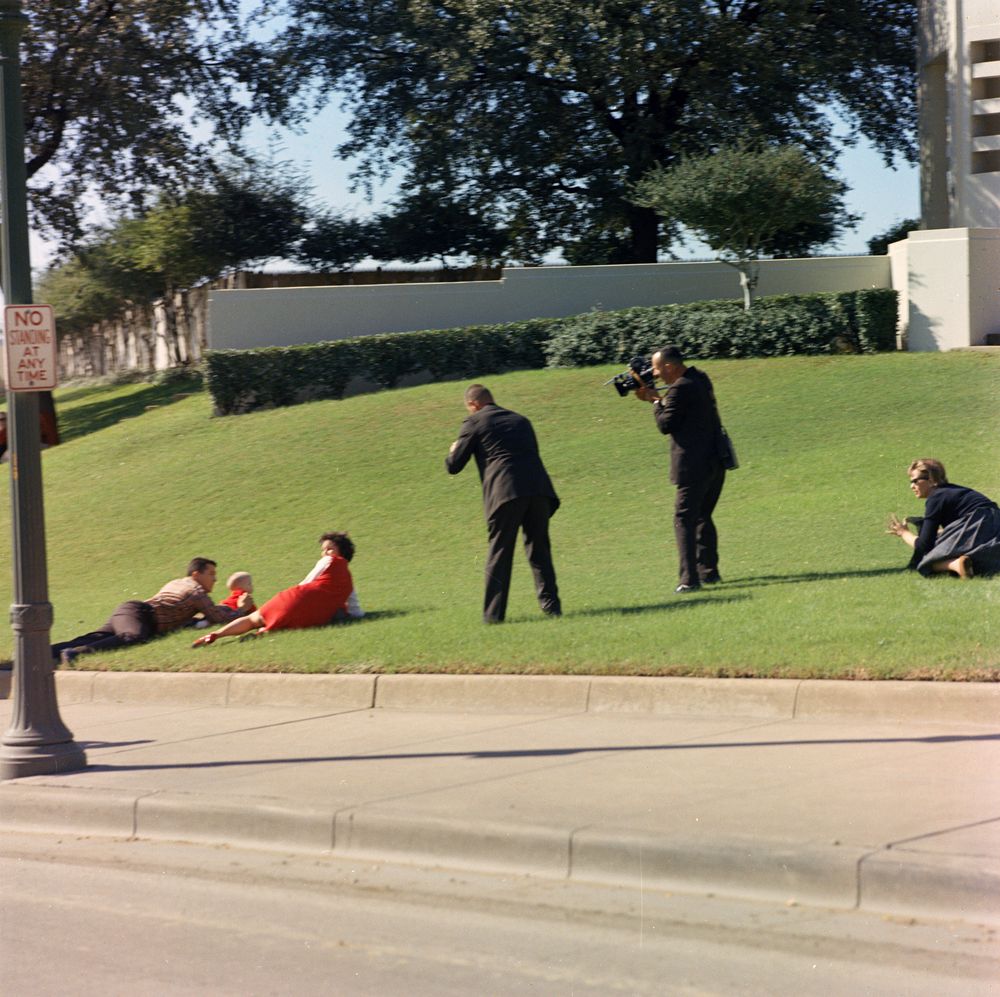
United States President John F. Kennedy was assassinated. Kennedy was riding as a passenger in a Lincoln Continental motorcade in Dealey Plaza of Downtown Dallas, Texas. He was accompanied by his wife, Jacqueline Kennedy, Texas Governor John Connally and the Governor’s wife Nellie Connally, Secret Service Agent Roy Kellerman, and the driver, agent William Greer. The group was part of several cars in a motorcade of vehicles on the way from the Dallas airport, Love Field, to the Dallas Trade Mart, where the President was scheduled to deliver a speech at a luncheon for 2,600 guests. At 12:30 p.m., as their car was passing in front of the Texas School Book Depository at 411 Elm Street, President Kennedy and Governor Connally were struck by bullets fired at long range. The President arrived at the Parkland Memorial Hospital at 12:38 p.m. and was taken into surgery, and pronounced dead at 1:00 p.m.
That morning he woke up in Fort Worth, and a crowd had already gathered in the parking lot where Kennedy would be speaking that day. He checked out the headlines of some of the daily newspapers, which included “Storm of Political Controversy Swirls Around Kennedy on Visit” (Dallas Morning News) and “Yarborough Snubs LBJ” further down the page. An article in the Chicago Sun-Times suggested that Jacqueline Kennedy might turn out to be the one who tipped the political balance in her husband’s favor.
A crowd of 5,000 gathered for the early morning rally and Kennedy used a flatbed truck as a platform for his speech to the crowd. He joked about his wife’s absence, telling the crowd, “Mrs. Kennedy is organizing herself. It takes longer, but of course, she looks better than we do when she does it.” In his speech he promoted the defense industry and promised the crowd “a defense system second to none.” He also spoke about the space race and told the crowd that the United States would not accept second place.
His next stop was to a Chamber of Commerce breakfast in the Hotel Texas ballroom. Author Thurston Clarke writes in his book entitled “JFK’s Last Hundred Days: The Transformation of a Man and the Emergence of a Great President” at pages 338-9:
“As Jackie walked into the ballroom, the businessmen and their wives leaped to their feet. Some stood on chairs, cheering and filling the room with deafening whistles. Kennedy said, "Two years ago I introduced myself as the man who had accompanied Mrs. Kennedy to Paris. I am getting that same sensation as I travel around Texas." The head of the Chamber of Commerce gave Jackie a pair of boots, and presented him with a ten-gallon hat. "We couldn't let you leave without providing you with some protection against the rain," he said. Someone shouted, "Put it on!" He smiled, waived it in the air, and said "I'll put it on in the White House on Monday. If you come up, you'll have a chance to see it there."”
Clarke writes that, after the breakfast, Jacqueline Kennedy said to her husband, “Oh Jack, campaigning is so easy when you’re president. I’ll go anywhere with you this year.” When he replied “How about California in the next two weeks?” she replied, “I’ll be there.”
Earlier in the day, at 10:15 a.m., President Kennedy had placed a telephone call to former U.S. Vice President John Nance Garner on the occasion of Garner’s 95th birthday. President Kennedy delivered a speech to supporters at the Hotel Texas in Fort Worth before flying on Air Force One to nearby Dallas.
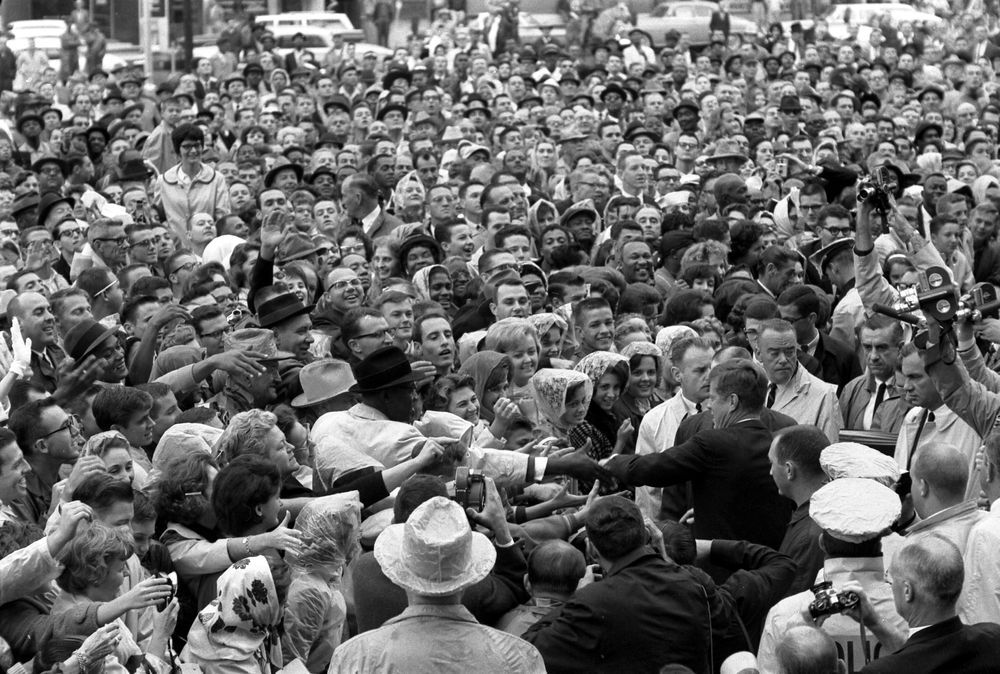
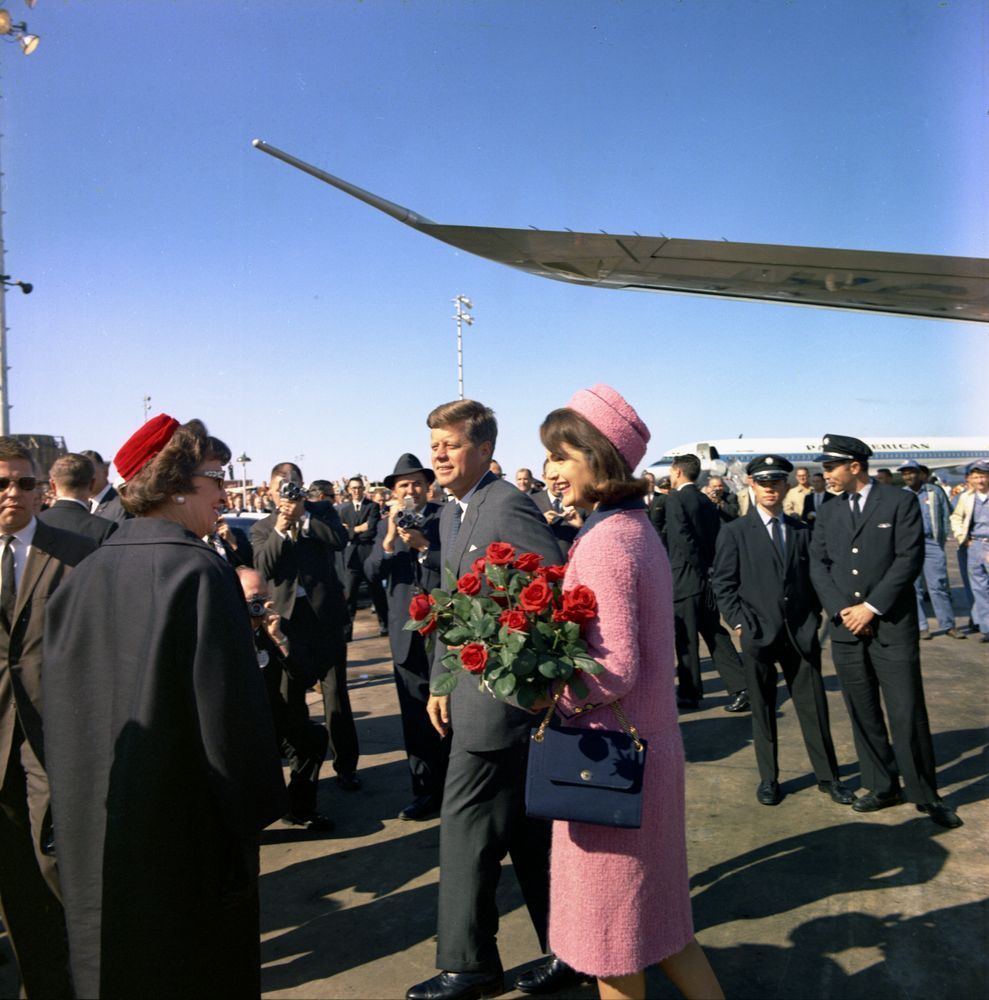
Even though Fort Worth was only a 30-minute drive from Dallas, Kennedy elected to fly because of the photo op available when he got off the plane at Love Field in Dallas. On the flight he strong-armed Governor Connally into inviting Senator Yarborough to the head table of a reception in Austin. Kennedy was met by several thousand people at the airport. The weather seemed to improve as grey skies gave way to sunshine in Dallas. Jacqueline Kennedy was first off of the plane, likely because he had realized what a political asset she was in Texas. Before getting into their limousine, the Kennedys shook hands with some of the people in the crowd. There were some protesters in the crowd with angry placards.
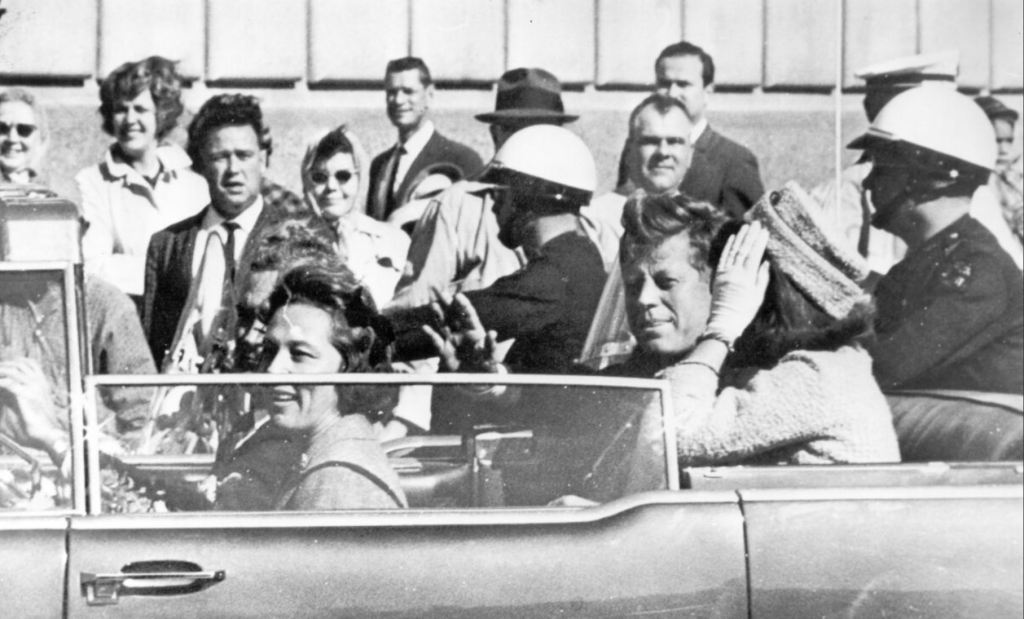
The limousine set off on its way to a luncheon at the Dallas Trade Mart, where the President was scheduled to speak to a crowd of businessmen. Because he was heading to the Trade Mart, the motorcade would make a sharp right turn off of Main Street, on to Houston, and would then take the next left turn on to Elm Street where it would drive past the Texas School Book Depository building. Kennedy’s limousine was the second car in the motorcade, behind a white Ford containing Jesse Curry (the Dallas Chief of Police) and Sheriff Bill Decker. Kennedy’s car, a Lincoln Continental, had two secret service agents in the front seat – the driver Bill Greer, and Roy Kellerman in the front passenger seat. Governor John Connally and his wife Nellie were seated on jump seats behind the two agents, and the President and first lady were sitting in the back seat. The car had running boards that secret service agents sometimes stood on, but Kennedy had told them not to do so on this occasion so that the crowd could have a look at their President.
Clarke describes Kennedy’s last moments of life as follows, at pages 345-6:
“His route took him along Main Street and through the heart of downtown Dallas. The Secret Service did not check the upper floors of buildings unless they had received specific threats, so people stood on rooftops and hung out open windows, cheering and throwing confetti. Spectators were ten to fifteen thick on the sidewalks. In places they had spilled into the street, slowing the motorcade to a crawl, and prompting Greer to keep far to the left in order to leave the greatest possible distance between the crowd and the right hand side of the limousine, where the president was sitting.

“When Main Street flowed into Dealey Plaza, the crowds thinned and his limousine slowed to make two turns, first the ninety-degree right onto Houston Street, then a block later the even sharper left onto Elm Street past the seven story School Book Depository. From here Elm headed down a gentle incline to the Stemmons Freeway and a triple underpass. Jackie, who was perspiring into her pink wool suit, saw it and thought, "How pleasant that cool tunnel will be." Nellie Connally turned around from her jump seat and said to Kennedy, "You sure can't say that Dallas doesn't love you." Their eyes met, his smile widened, and he said, "no you can't."

“The photographer Cecil Stoughton was riding seven cars back. He heard some loud bangs and imagined a cowboy in a ten-gallon hat standing on a rooftop, firing his six-shooter into the air to welcome the president to Dallas.

“Kennedy was waving as the first bullet entered his upper back and exited his throat. It missed his vital organs and was a survivable wound. His hands flew up to his throat and his expression went blank. Nellie Connally remembered his eyes being "full of surprise," and Agent Kellerman thought he said, "My God, I'm hit!" His back brace kept him upright, an immovable target. Another bullet smashed into the rear of his head and Jackie cried out, "They've killed my husband! I have his brains in my hand!"”
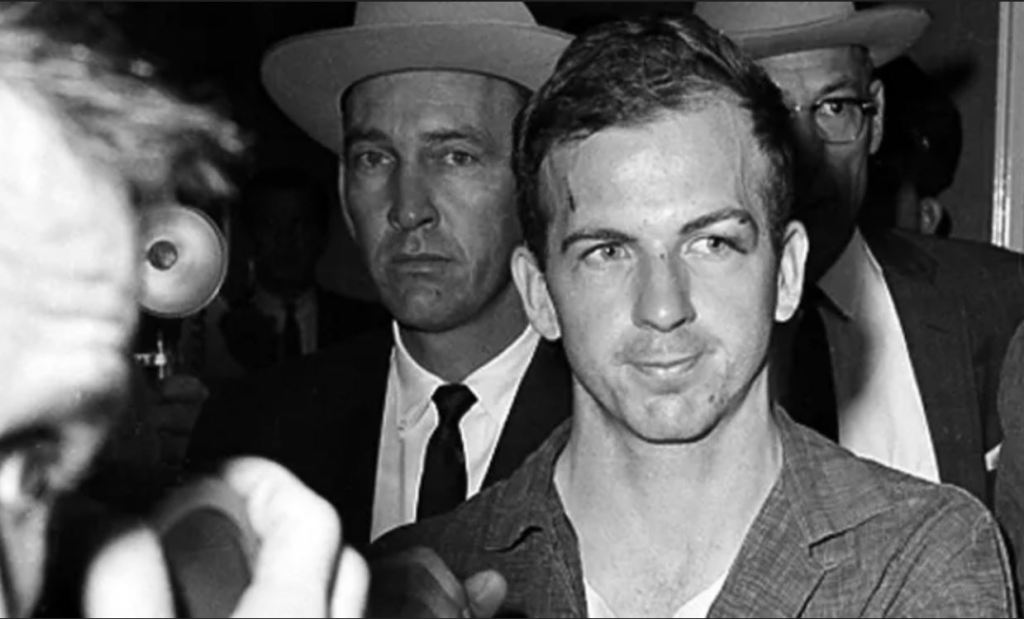
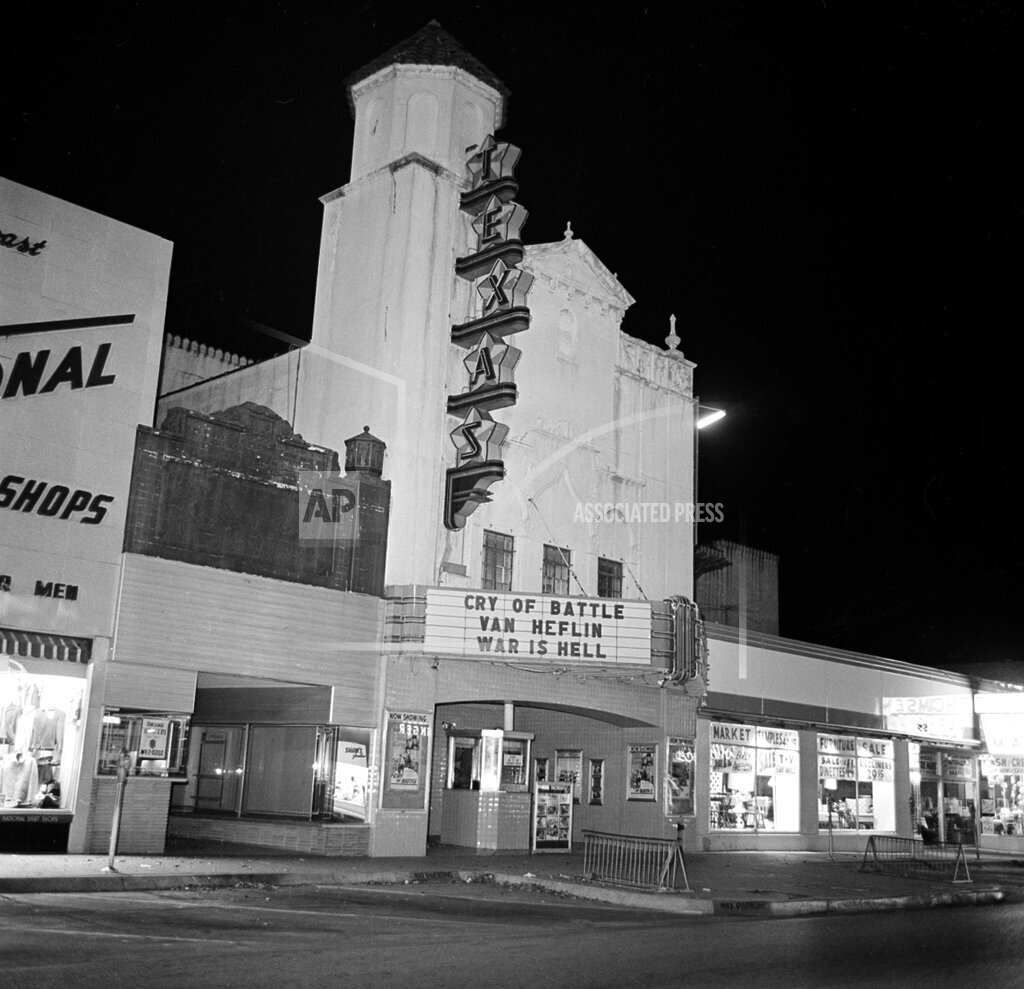
Lee Harvey Oswald, a 24-year-old employee at the book depository, left the building approximately three minutes after the shots were fired, and went to his home at 1026 North Beckley Avenue. At 1:15 p.m., Dallas Police officer J. D. Tippit was shot four times, allegedly by Oswald. Oswald was seen walking into a cinema, the Texas Theatre, where patrolman M. N. “Nick” McDonald disarmed and arrested him at 1:50 p.m.
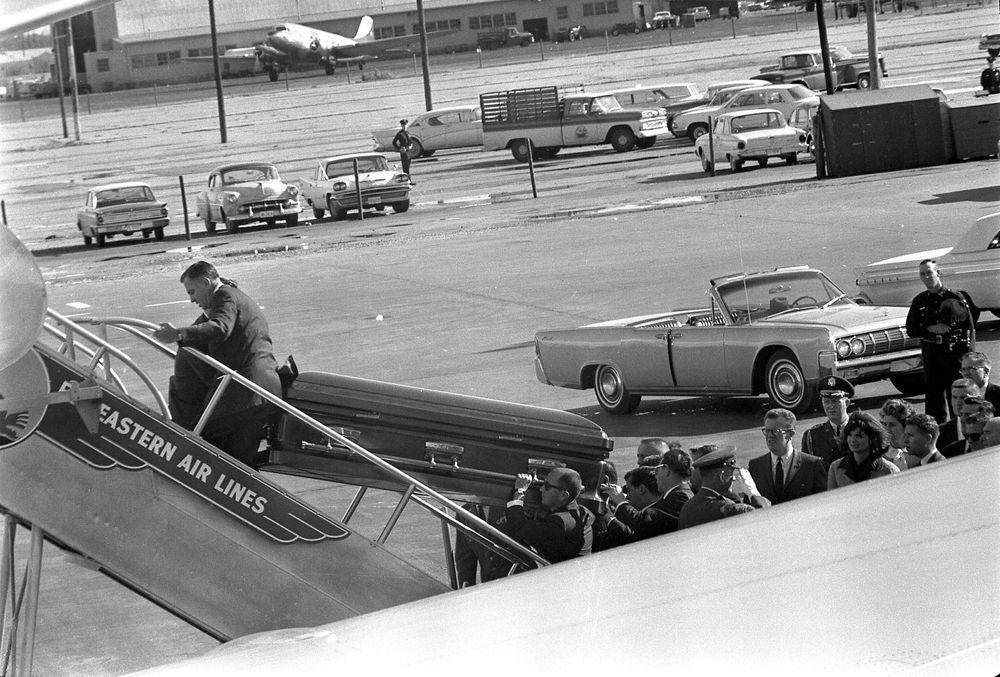
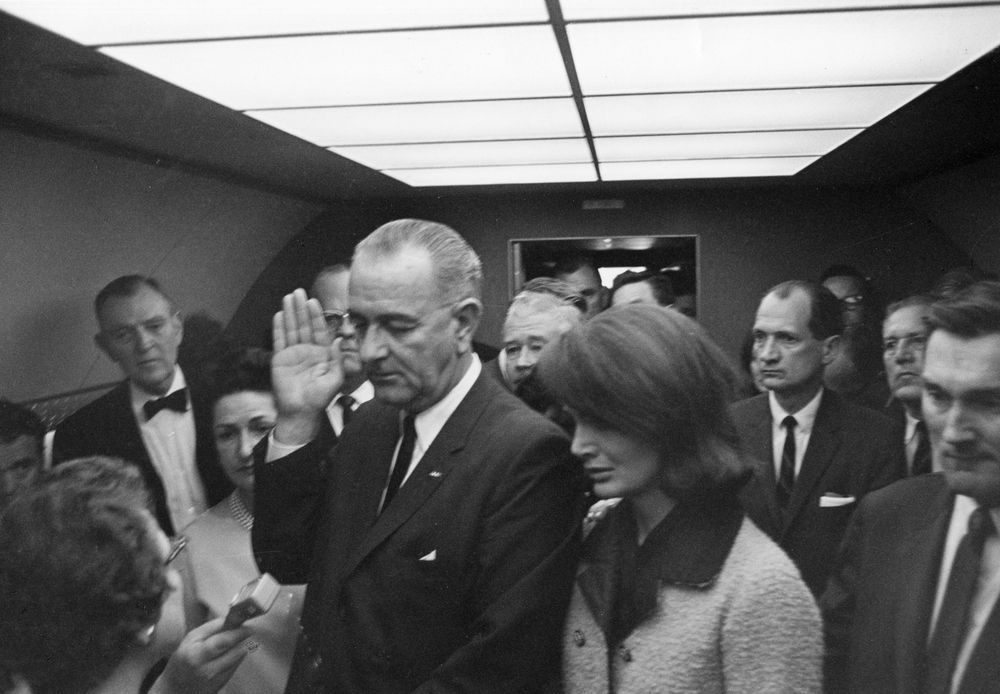
At 2:38 p.m., Lyndon B. Johnson was sworn in as the 36th President of the United States by U.S. District Judge Sarah T. Hughes, on board Air Force One prior to the airplane’s departure from Dallas. Because a Bible could not be located on the plane, Johnson took his oath instead upon a Roman Catholic liturgical book, the Saint Joseph Sunday Missal. Air Force One, with a coffin containing President Kennedy’s body, arrived at Andrews Air Force Base near Camp Springs, Prince George’s County, Maryland, at 5:58 p.m. local time.
Jacqueline Kennedy, 34, spent with grief and numbed by shock, walked unseeing through a blaze of flashbulbs and television lights at Andrews Air Force Base tonight and stepped into the hearse bearing her husband’s body. She had sat alone beside the bronze coffin in the Presidential jet on the flight from Dallas to the capital. No one intruded on her vigil. The navy hearse was battleship gray and the Washington night foggy, but it’s doubtful that Mrs. Kennedy, stricken only last August by the death of her infant son, Patrick, noted either. With Attorney General Robert Kennedy, she rode to Bethesda Naval hospital, where she remained under her physician’s care. She was to return to the White House later tonight with the body of the President, and spend the night in the executive mansion.
Texas Governor John Connally, President Kennedy’s first secretary of the navy who was wounded by the assassin who killed the President, undergoes surgery and is described by his doctor as not in critical condition. The governor appears to have been struck by just one bullet. The bullet entered the back of his chest and moved outward, taking out and fragmenting a portion of a rib. It then emerged from his chest and struck his wrist and thigh.
House Speaker John McCormack (D-Massachusetts), who according to a law enacted under President Truman would succeed to the Presidency in case of the incapacity of President Johnson, is notified of the assassination of President Kennedy as he eats lunch and can only say: “My God! My God! What are we coming to?”
In early afternoon editions, some newspapers in the United States ran stories based on the advance text of the speech that President Kennedy had planned to give at the Dallas Trade Mart, anticipating that the address would already have been delivered by the time that the newspapers were being read.
Kennedy has failed to brief his successor, Lyndon B. Johnson, about important details concerning the U.S. role in the undeclared war against Communism in Vietnam.
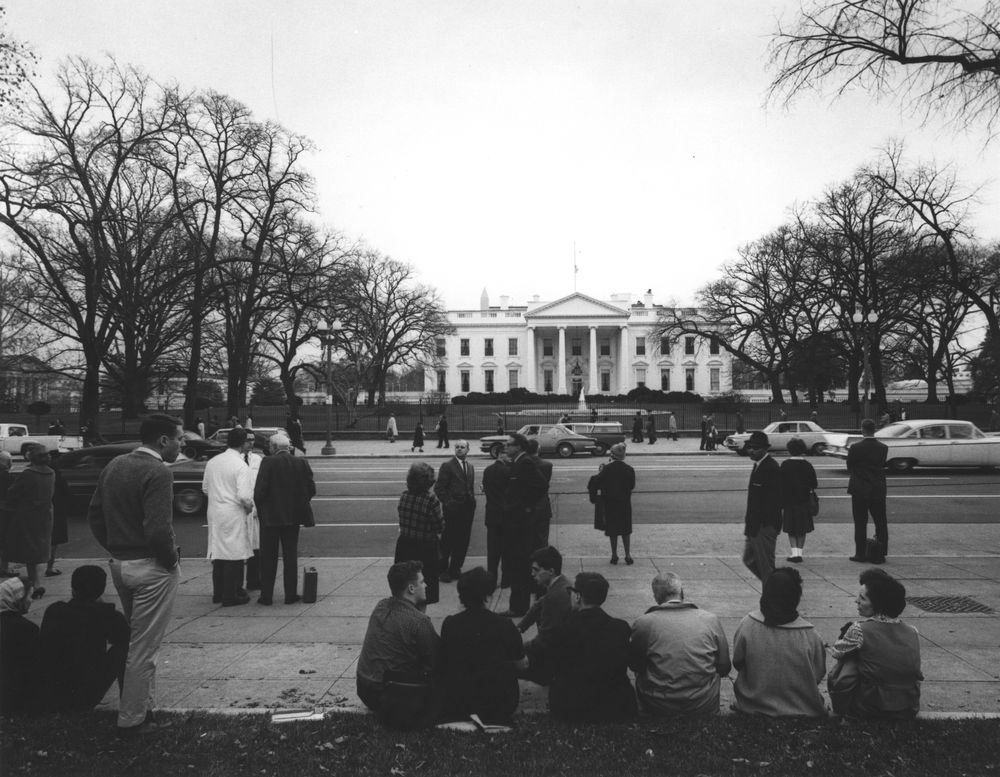
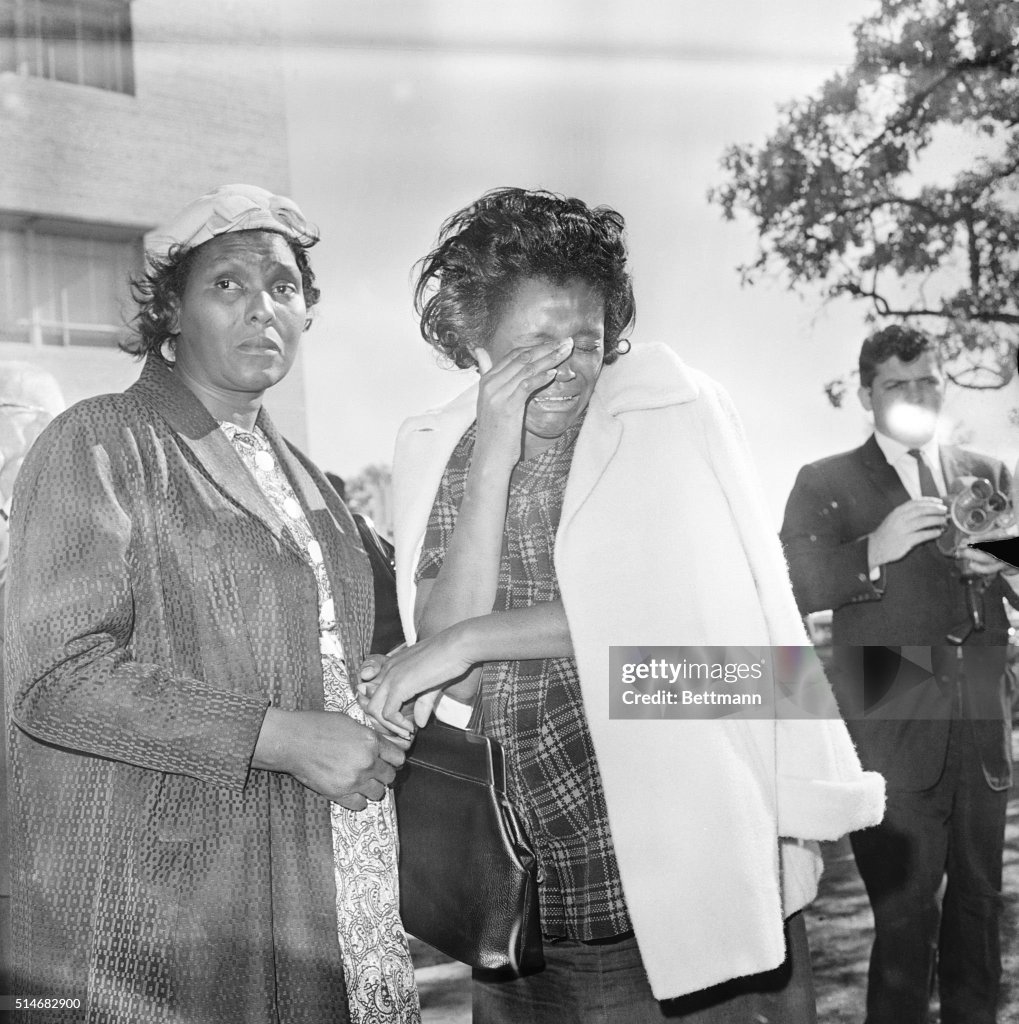
All over the world there is an outpouring of shock and grief at the sudden, violent death of the president. Condolences pour into the White House from everywhere, even behind the Iron Curtain.
Britain’s Queen Elizabeth and Prime Minister Alec Douglas-Home send messages of sympathy to Washington on learning of the assassination of President Kennedy. Mrs. Lee Radziwill, sister of Mrs. Kennedy, will fly to Washington today. Masses are to be said in London’s Roman Catholic and Church of England cathedrals. The tenor bell of Westminster abbey will toll by the minute from 11 a. m. to noon. Sir Winston Churchill says, “This monstrous act has taken from us a great statesman and a wise and valiant man.” Harold Macmillan says, “It is impossible to weigh the consequences.”
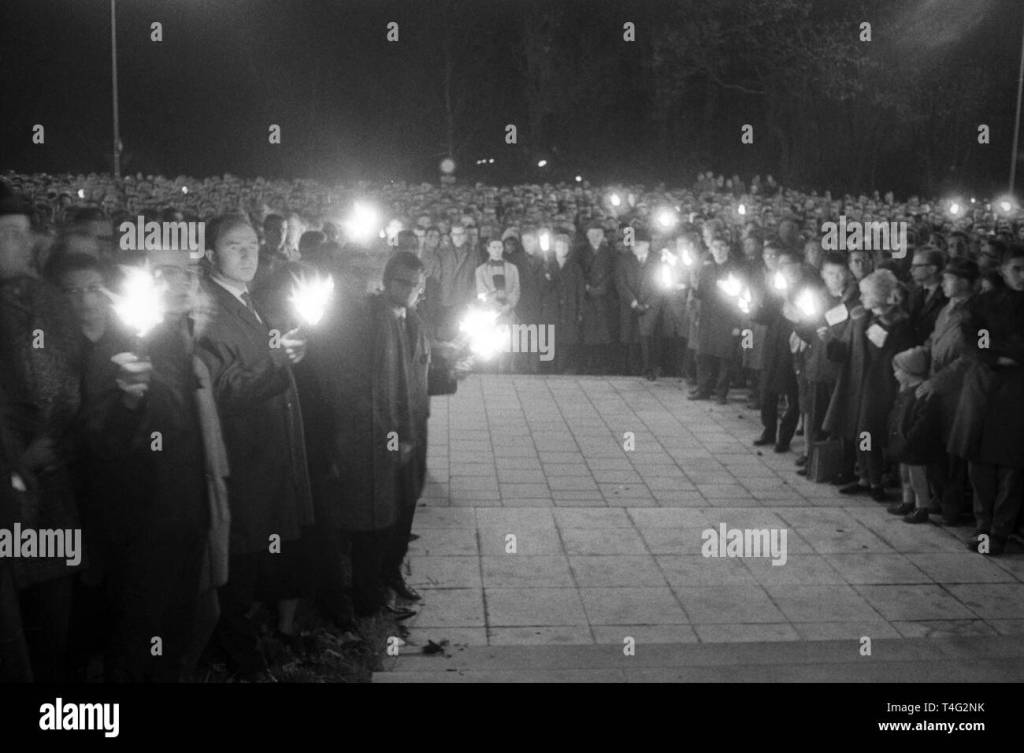
More than 60,000 West Berliners stood in silence before the city hall tonight as the Freedom Bell tolled in mourning at the assassination of President Kennedy. Mayor Willy Brandt had called for a minute of silence as the bell — a gift by American citizens to the people of Berlin — rang out in the rainy night. Addressing the crowd, his eyes red and his voice shaking with emotion, Brandt said: “Here above us on the balcony, President Kennedy stood last June and told us that he was one of us, that he was a Berliner. “We regard his death as our own loss… America has lost its President and a tortured mankind has lost a man of whom so many people believed that he would show the road towards a just peace and a better life in the world.”
World capitals are stunned by the assassination of President Kennedy, and leading statesmen express shock, calling the deed atrocious and frightful. The armed forces radio network, in a direct transmission from Washington, announces the President’s death to American service men and their families in Europe. French President Charles de Gaulle says: “President Kennedy died like a soldier, under fire, for his duty and in the service of his country. In the name of the French people, I, ever the friend of the American people, salute this great example and this great memory.” De Gaulle in a message to Mrs. Kennedy said: “The immense sorrow which has stricken you moves my wife and I from the bottom of our hearts. Please accept our assurance that we are with you in thought and in prayer. “President Kennedy will never be forgotten.”
The Soviet news agency Tass carried this as a “flash” on its international, English-language radioteletype circuit at 1:48 p.m. Chicago time. “It has just been officially announced that United States President John F. Kennedy has died in hospital after an attempt was made on his life by persons, as believed, from among the extreme right-wing elements.” Moscow radio played funeral music tonight after announcing the assassination of President Kennedy. American Ambassador Foy D. Kohler said when told the news: “It’s terrible, terrible.” Foreign Minister Andrei Gromyko telephoned Kohler “to express his shock and greatest sympathy toward the American people,” an American embassy spokesman announced. The Communist party paper Izvestia praised Kennedy for “steps directed toward a healthier international situation.”
Radio stations throughout western and eastern Europe broadcast only funeral music after announcing Kennedy’s death. Television stations kept up a steady flow of bulletins and canceled regular programs. Church bells tolled in many capitals. President Eamon de Valera of Ireland twice broke down from emotion as he addressed the nation over television in a tribute to President Kennedy. He said that during Kennedy’s recent visit to Ireland the Irish came to look upon him as one of themselves. De Valera sent messages of condolence to Mrs. Jacqueline Kennedy and President Lyndon Johnson.
President Tito telephoned the American charge d’affaires in Belgrade to express “deep sympathy.” The Yugoslav government ordered national flags to be flown at half-staff on public buildings tomorrow and cancelled all sports meetings and entertainments, including those on radio and television, as a mark of sympathy.
Belgian Foreign Minister, Paul-Henri Spaak’s sobbing voice said over the telephone, “What can I say about this hideous news, except that I am stunned, and that a terrible, frightening thing has happened. I cannot speak tonight.”
Pope Paul in Vatican City retires to his private chapel for prayers for President Kennedy on learning of his death. Emerging, the pontiff says: “We are strongly shocked by the tragic and sad news of the killing of the President and the wounding of the governor of Texas…. And we are profoundly grieved by this wicked crime, by the mourning that strikes a great and civilized country for its leader, and by the pain afflicting Mrs. Kennedy, her children, and her family.” Cardinal Francis Spellman of New York said in Rome that he was “shocked and grief stricken.” Spellman, his voice shaking with emotion, said, “I am saying the Rosary for him now.”
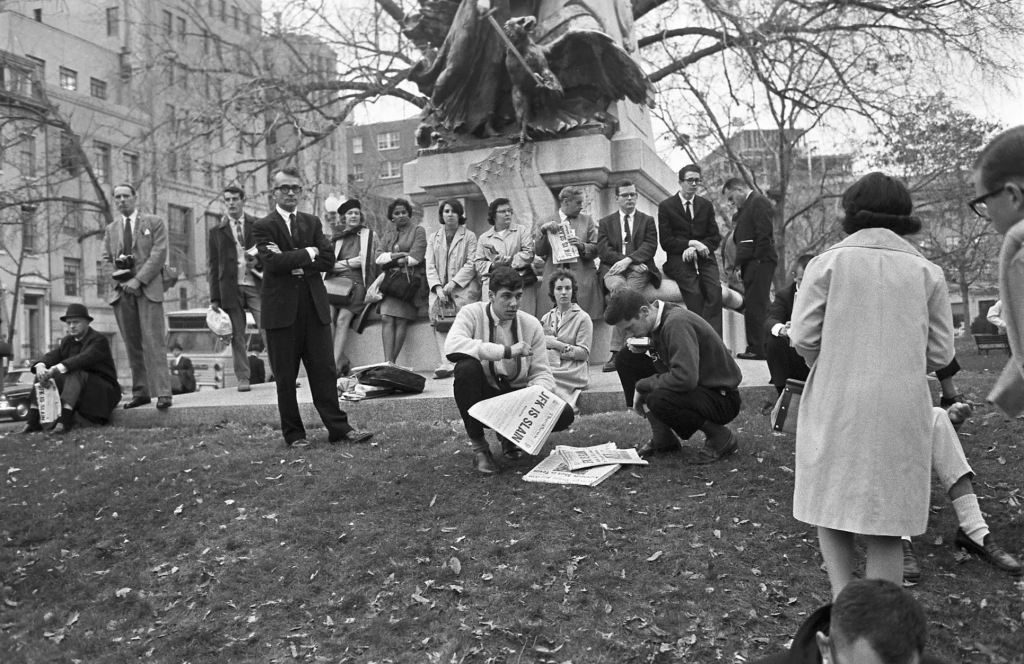
Many conspiracy theories have ensued – that Oswald either did or didn’t act alone, that government agencies and foreign nations were involved, or that a second sniper existed on the infamous ‘grassy knoll.’ Whatever the case, Kennedy was a young, charismatic politician who had high approval ratings, and his death was mourned as a tragedy by many people in America and beyond.
[Ed: Personally… I am no big fan of JFK. In many ways he was a foolish, reckless man whose personal behavior and hidden infirmities put the U.S. and indeed, the entire world at risk of a catastrophe. But when I look at the photos of his widow and young children… I cannot feel anything but grief at the senseless violence of his death. America lost something that day. Not a great president, but maybe something deeper.]
Journalist Mary McGrory said to Pat Moynihan, “We’ll never laugh again.”
And Moynihan, who later became a U.S. senator, replied, “Mary, we’ll laugh again, but we’ll never be young again.”
On the same day, television signals were broadcast from the United States to Japan for the first time, with transmission sent from Barstow, California, via the Relay 1 satellite, across the Pacific Ocean. A pre-recorded message from President Kennedy was hastily removed from the items to be sent, because the President had died an hour before the scheduled broadcast. Because of the 17-hour time difference between California and Japan, it was 4:00 a.m. on Saturday in Tokyo at the same time that transmission began to the NHK.
The military revolutionary council in Saigon today dismissed 31 high-ranking military officers for favoring the ousted Diệm regime. The officers, given leave without pay for an indefinite period, included one who belongs to the politically powerful Cao Đài religious sect. Some observers believed the removal of Brigadier General Văn Thành Cao was partly due to pressure from other leaders of the 2 million-member Cao Đài. Cao Đàists regarded Văn Thành Cao as a traitor for joining the regime of the late President Ngô Đình Diệm, which was ousted by a military coup on November 1. Diem suppressed the Cao Đài as a military and political force. The new military Junta is making a determined effort to win back their support for the fight against the Communist Viet Cong forces in the Mekong River delta, a Cao Đài stronghold.
The Laotian neutralist army reported Friday that Pathet Lao troops reinforced by North Vietnamese elements attacked a neutralist position at dawn today at Ban Namone, 60 miles north of Vientiane. A communiqué said the neutralists beat back the onslaught. It said two neutralists were killed and four wounded. The neutralist commander, General Kong Le, and Pathet Lao General Singapo agreed last Saturday to proclaim a cease-fire but this has not been observed. The pair could not agree at a meeting Tuesday on ways and means to halt the firing and are scheduled to meet again Tuesday.
Cambodia’s Chief of State, Prince Norodom Sihanouk, described Communist China as his country’s best friend. The prince, who has cut off United States aid, disclosed Peking’s promise to supply full military, political and diplomatic support.
In his first news conference since Monday’s revolution, President Abdel Salam Arif offered to set Iraq’s Government on a middle-of-the-road course of cold war nonalignment and Arab conciliation.
Premier Nikita Khrushchev says the United States-Russian dispute over policing military traffic on the road to West Berlin is more serious than the west realizes. Khrushchev’s views were reported today to a press conference by Foreign Minister Per Haekkerup of Denmark, who talked with the Russian premier at Kiev Wednesday. Khrushchev emphasized in their talks that the Kremlin would never agree to changes in clearance procedures on the Berlin autobahn, the Danish official said.
“Mr. Khrushchev said he had the feeling that many people in the world had underestimated the severity of the situation on the highway to Berlin,” Haekkerup added. He described Khrushchev’s position on the issue as very firm and reported the soviet leader emphasized he “will not accept any change in the situation. Haekkerup said Khrushchev told him the recent incidents involving American military convoys on the autobahn apparently had not arisen as a result of a political decision in Washington. Khrushchev speculated: “It may be a case of lack of contact between Washington and the military authorities in West Berlin,” the foreign minister continued.
German Chancellor Ludwig Erhard Friday carried away a clear diplomatic victory from his first encounter with President Charles de Gaulle as he returned to Bonn with French pledges for Atlantic as well as European economic cooperation. A communiqué issued at the end of the chancellor’s third and final talk with De Gaulle declared the two governments’ hope for the success of the so-called Kennedy round of tariff negotiations scheduled to begin between the United States and the Common Market next May. The atmosphere on De Gaulle’s 73rd birthday — officially unobserved — appeared much more cordial than earlier. In place of the reserved greeting he gave the German leader Thursday, the general walked outside on the steps of the Élysée Palace to bid farewell with a smile and a salute Friday morning.
The Vatican Ecumenical Council voted final approval Friday of its first completed schema, providing for modernization of the language used in Roman Catholic worship. The Roman Catholic prelates — cardinals, patriarchs, archbishops and bishops from around the world — put their final seal of acceptance on the council’s liturgy schema by a vote of 2,158-19. All that is left for the document to become the council’s first decree is formal promulgation by Pope Paul VI in a public council session. It is expected to be held next Friday.
The United Nations’ space committee unanimously approved today a compromise United States-Soviet draft to bring the exploration of outer space under international law. The 28-nation committee adopted, without a record vote, a declaration of nine legal principles designed to ensure that space exploration benefits all mankind. More specifically it sets the groundwork for aid and return of astronauts forced down on foreign soil. The declaration was forwarded to the general assembly’s political committee for eventual ratification by the assembly itself. It was the culmination of two years of effort.
Five of India’s top military men, including the army and air force commanding generals in Kashmir and Ladakh, were killed today in a helicopter crash near the Kashmir city of Poonch. The pilot also died.
The GANEFO games closed in Indonesia. Earlier in the day, the games’ soccer championship was played between the United Arab Republic and North Korea before 100,000 fans in Jakarta. The score was tied 0-0 at the end of regulation, and a 30-minute overtime period was added. After the extra time, the score was tied at 1-1, so the gold medal was decided by a coin toss, which the UAR won.
Negotiators of the U.S. Senate and House killed a provision of the foreign aid bill that bans aid to Latin American regimes coming to power through overthrow of constitutional governments.
The U.S. Senate adjourned at 2:30 PM after learning of President Kennedy’s assassination.
Governor George Romney of Michigan expressed “concern” today over a number of positions taken by Senator Barry Goldwater. He said he disagreed with the Arizonian, who is a contender for the Republican Presidential nomination, on civil rights, “right to work” legislation, the issue of labor unions’ power and the Tennessee Valley Authority. Mr. Romney, here for a Midwestern Governors Conference that is seeking solutions to regional problems, expressed his views on the Goldwater candidacy at a news conference. He said the Republican party and campaign should not be allowed to become identified with any right-wing “fanatics.” Ultra-conservatives are among Mr. Goldwater’s supporters. Mr. Romney, often mentioned as a possibility for the nomination himself, said a campaign establishing sound positions and principles was more important to the future of the Republican party. than victory in 1964.
The Citizens Foreign Aid Committee urged Congress today to cut this year’s foreign aid appropriation to less than $2 billion — less than half the $4.5 billion requested by former President Kennedy. “This reduction is essential if we are to return to fiscal responsibility and a sound dollar,” Walter Harnischfeger, Milwaukee industrialist and honorary chairman of the committee, told the Senate Appropriations Committee in prepared testimony. His organization is a conservative group of men from the fields of finance, industry, business and the professions.
A federal judge refused to dismiss an indictment charging Roy M. Cohn with perjury and conspiracy to obstruct justice. He ruled that the former chief counsel to the late Senator Joseph R. McCarthy’s investigating committee had failed to show that the indicting grand jury had been influenced or coerced by news leaks.
Walt Disney decided on the location for his second amusement park, an eastern counterpart to his successful Disneyland park in California. He and several top executives boarded an airplane in Tampa, in order to fly over the area around Orlando, Florida. Earlier in the month, Disney had scouted sites around St. Louis, Missouri; Niagara Falls, New York; and New Orleans, Louisiana. The other potential Florida site was in Ocala, but Disney made his decision after seeing that the ongoing construction of Interstate Highway 4 would meet with the Florida Turnpike, and that the potential site would be adjacent to swampland that would be unsuitable for competing businesses.
The Beatles’ second album, “With the Beatles, “was released in the United Kingdom by Parlophone Records, and became an immediate hit. The album included their hit song “All My Loving.”
William Clay Ford Sr., one of the grandsons of auto magnate Henry Ford, purchased the NFL’s Detroit Lions for $6 million, paid to the other shareholders of the Detroit Football Company that had owned the franchise since 1938.
The American Football League announced Friday night that it was postponing all four of its Sunday games because of the assassination of President Kennedy. The National Football League said it planned to go ahead with its full program of seven games. None of the NFL games will be telecast, however. The two television networks had announced that they would not telecast any of this Sunday’s games.
Trading on the New York Stock Exchange is halted at 2:10 PM, about twenty minutes after news of the shooting of President Kennedy was received. In that short time, prices had dropped sharply.
Dow Jones Industrial Average: 711.49 (-21.16).
Born:
Hugh Millen, NFL quarterback (Los Angeles Rams, Atlanta Falcons, New England Patriots, Denver Broncos), in Des Moines, Iowa.
Mike Zentic, NFL center (Dallas Cowboys), in Tecumseh, Nebraska.
Robert DiRico, NFL running back (New York Giants), in Norristown, Pennsylvania.
Jim Williams, NFL running back (Seattle Seahawks), in Brunswick, Georgia.
Don Pumphrey, NFL guard (Tampa Bay Buccaneers), in Tallahassee, Florida.
Andrew Clyde, U.S. Republican Representative for Georgia-House district 09, in Walkerton, Ontario, Canada.
Brian Robbins, American TV actor (Eric Maridian-“Head of the Class”), TV producer (“Smallville”), and film director (“Varsity Blues”, “Norbit”), in Brooklyn, New York, New York.
Corinne Russell, British model and comedienne (“The Benny Hill Show”), in Birmingham, England, United Kingdom.
Hugh Millen, NFL quarterback (Los Angeles Rams, Atlanta Falcons, New England Patriots, Denver Broncos), in Des Moines, Iowa.
Died:
John F. Kennedy, 46, 35th and incumbent President of the United States, assassinated in Dallas, Texas.
Aldous Huxley, 69, English novelist (Brave New World).
C. S. Lewis, 64, British novelist (“The Chronicles of Narnia”), poet, academic, medievalist, literary critic, essayist, lay theologian and Christian advocate, of renal failure.
J. D. Tippit, 39, officer of the Dallas Police Department, United States Army veteran of World War II, murdered by Lee Harvey Oswald.
Erlic Pinto, 42, Indian air vice marshal (Annexation of Goa), in a helicopter crash in near Poonch.
There are no words…
Walter Cronkite reports on John F. Kennedy’s assassination on November 22, 1963
12:11
 History Diaries