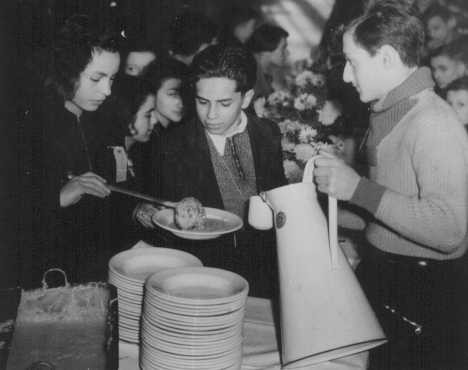
A wave of strikes stops industries in France. New decrees prohibit strikes; observers see a showdown between capitalist and socialist ideas. French police moved swiftly today and crushed two “sit-down” strikes. The quick action reflected the government’s determination to set aside the 40-hour week law for the time being and push ahead with its emergency economic program. The first strike action began with the picketing of the Hutchinson Tire company plant at Puteaux. Four hours later police had cleared the plant of 1,000 workers and police guards replaced the pickets. The second strike action was by workers in the Saint Gobain Chemical plant near Roubaix who protested the longer work week. Police cleared the plant of 250 workers.
Meanwhile, a third strike was in progress among 600 workers in an arms factory at Denain, near Valenciennes. A mass meeting of 20,000 metal workers backed the strikers. The firm handling of the small wave of strikes was said to foreshadow a strong authoritarian plan to be put into effect by Premier Edouard Daladier. This may include dissolution of the Chamber of Deputies. Parliament is to meet next month and an expected event is a dispute between government parties and the Socialists and communists over the 1939 budget and the recent decree laws. Daladier is said to be determined to “go through to the end” to strengthen France’s finances.
Journalists in Spain get documentation of Italian troops who entered the country in October, along with supplies of munitions and new planes.
Spanish rebels reported tonight they had opened a breach in the center of a newly fortified government line on the Segre River in northeast Spain. The government acknowledged the rebels had advanced northwest of Seros in three days of heavy fighting in the sector occupied two weeks ago by government troops. The rebels’ attack was aimed toward Aytona, about five miles from Seros. Rebels said their assault waves rolled against a line of trenches hastily dug by government troops after their surprise capture of a foothold on the west Segre shore on November 7. Government dispatches said the rebels had been repulsed with heavy losses everywhere except in the center.
Neville Chamberlain told the House of Commons of plans to lease at least 10,000 square miles in British Guiana to provide homes for German Jewish refugees. Britain announces its plan to help the Jewish refugees from Nazi Germany: immigration to the uplands of British Guiana in South America or Tanganyika, a former German colony in east Africa. Smaller African properties may be available for settlement in Southern Rhodesia, Kenya, and Nyasaland. Britain’s Prime Minister expects that private funding will pay for resettlement.
Britain agreed to take in Jewish children, provided they would not be a burden on the state. The Kindertransport program was debated in Parliament on this day, where it was agreed that an unlimited number of child refugees were to be allowed temporary refuge in Britain, as long their care was privately financed and they would not become a financial burden on the British state. The Kindertransport was the rescue of around 10,000 mainly Jewish child refugees from Nazi Germany, Austria, Czechoslovakia and Poland. The scheme was entirely financed by private charitable organizations. About half of the children who came to Britain were placed with families — both Jewish and non-Jewish — in foster homes, while others lived in hostels or on farms. The children’s experiences varied — many found support and affection from their carers; others were very unhappy.
As 60,000 children were at risk in Germany and Austria alone, there was an extremely high demand for a place on the transports as parents desperately sought to ensure their children’s safety. To acquire a space, children needed a guarantor in Britain to sponsor them for £50. Vulnerable children were given priority, for example if they were orphans or homeless. However, children with disabilities or sickness were usually excluded from the scheme. Parents were not allowed to travel with their children on the transports. For many Kindertransportees, it was the last time they saw their parents and sometimes siblings. After the war, many of the Kinder discovered that their parents had not survived the Holocaust.
After the start of the Second World War in September 1939, transports from Germany and Austria were stopped. The last Kindertransport departed from The Netherlands on 14 May 1940, shortly before the country’s surrender to German forces. Throughout its existence, the scheme saved 10,000 children.
The German government-controlled press today began a new campaign against Jews. It urged that Jewish real estate be confiscated “in case cash and other objects of value owned by Jews are not sufficient” to meet the $400,000,000 penalty levied for the assassination in Paris of Ernst von Rath, German diplomat, by a Polish Jew. This was construed as an indirect admission that figures on Jewish wealth — placed at $3,200,000,000 by Propaganda Minister Dr. Paul Joseph Goebbels — may be inflated.
Dienst aus Deutschland asserted a decree would soon be issued whereby Gentiles and Jews no longer would be permitted to live in the same apartment building. Adolf Hitler’s Voelkischer Beobachter was even more emphatic, declaring: “The solution of this problem brooks no delay, for otherwise clashes with German tenants become inevitable.” The newspaper was supported by the president of the National Real Estate Federation who published a demand for “restoring German real estate completely to the German people.” The newspaper Nachtausgabe estimated 3,767 Jewish retail stores fell under the anti-Semitic ban in Berlin. alone. According to official intimations, two-thirds of these will not reopen even under “Aryan” managements, but must be liquidated altogether.
Japan and the Reich sign a cultural pact, recognizing their racial principles.
Belgian king Leopold III visits the Netherlands.
British troops take over Beersheba in Palestine, occupied by Arab forces for six weeks. At least three Arab leaders opposed to the Mufti of Jerusalem have been shot in the last four days.
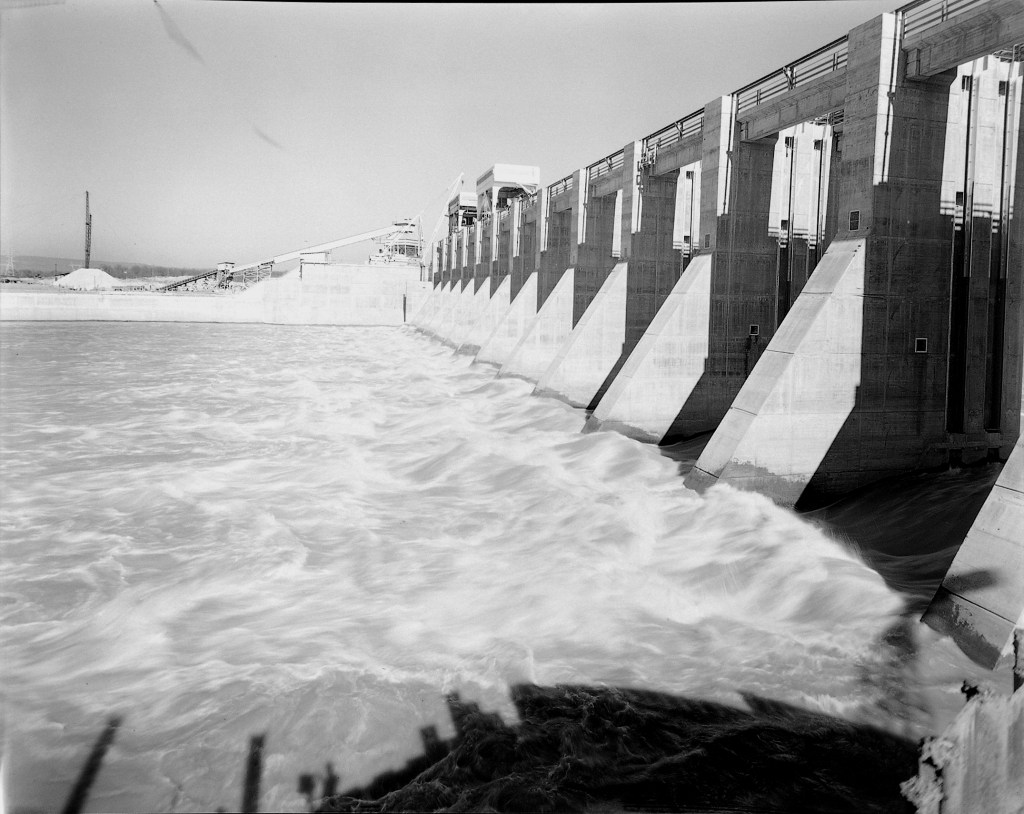
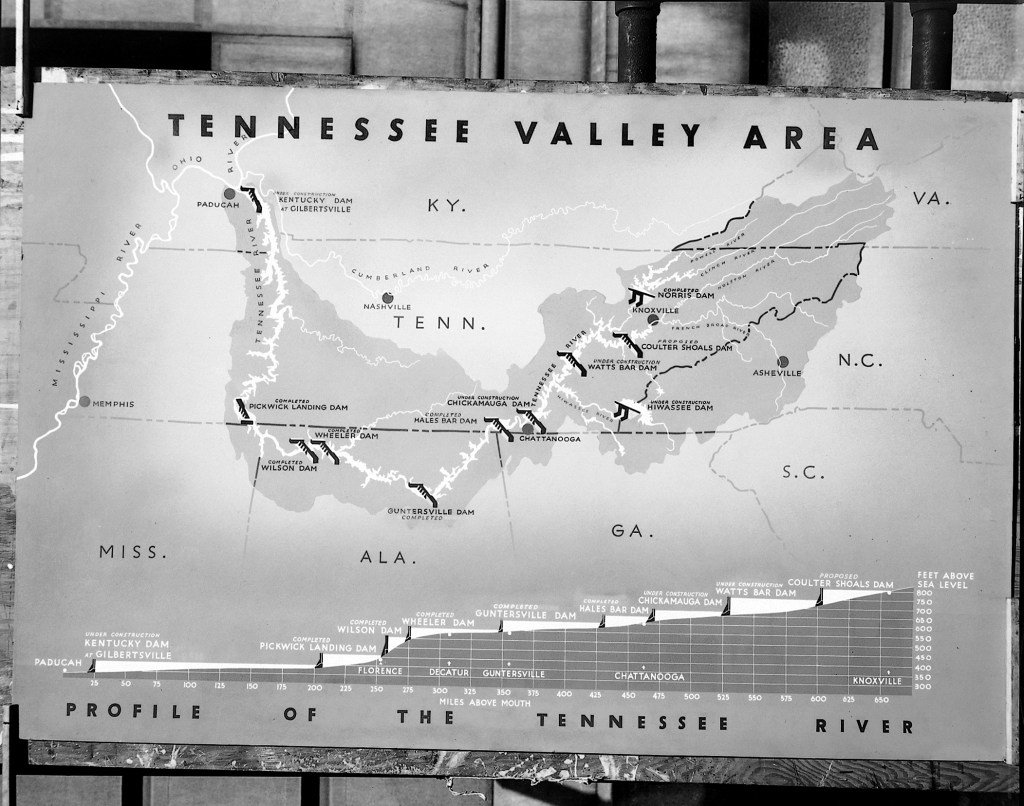
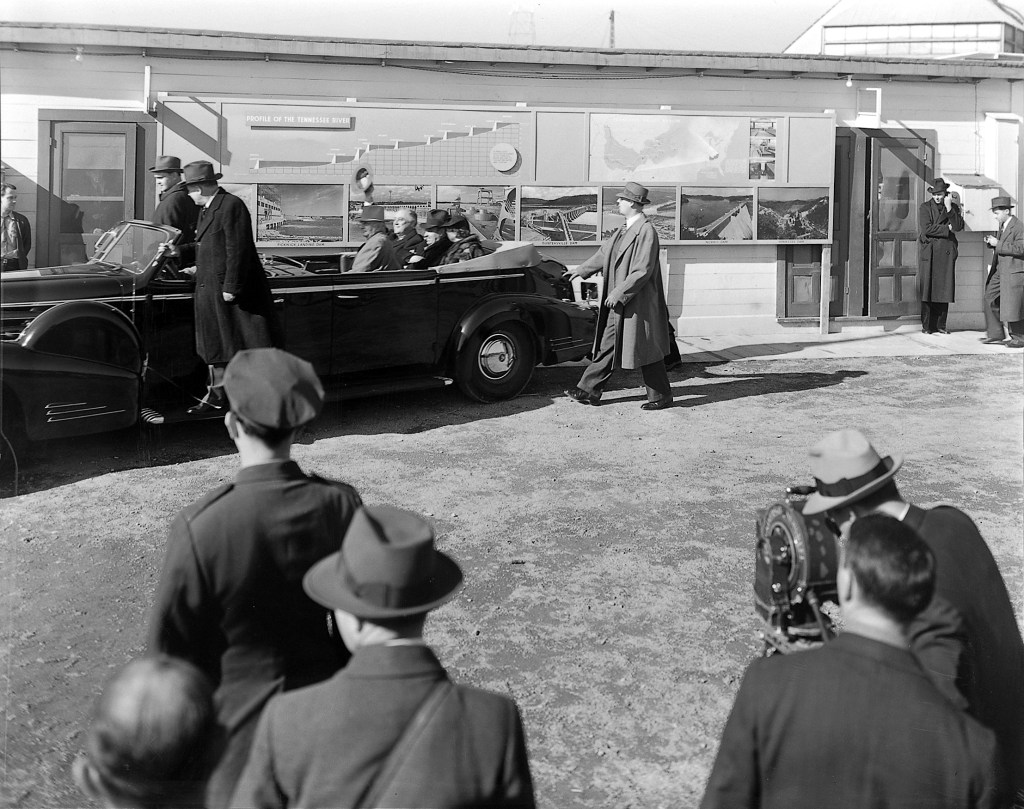
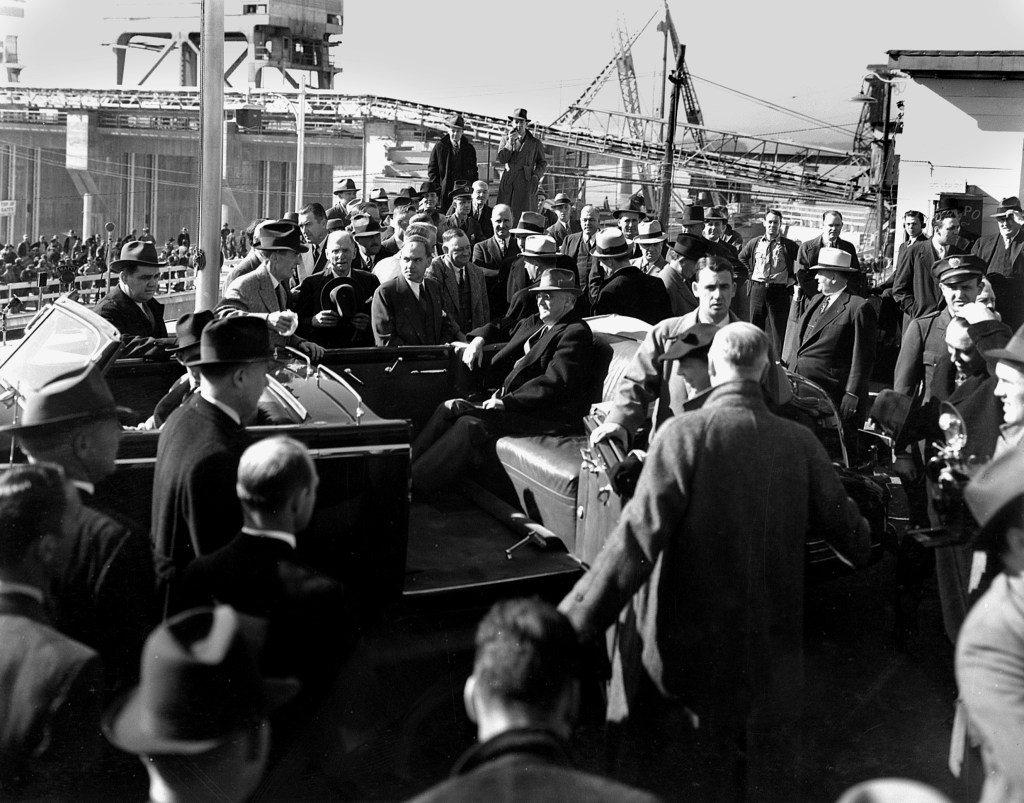
President Roosevelt visited Chickamauga Dam and the battlefields around Chattanooga, Tennessee, today on his way to a two-week vacation at his retreat in Warm Springs, Georgia.
The sixth lynching this year occurs in Wiggins, Mississippi, as a mob of 200 hangs Wilder McGowan. An aged, socially prominent white woman had been attacked the night before, but could not name her assailant. Wilder Charles McGowan, 29, a trucking business operator, was seized on his way to work and hung from a tree. An investigator found there was no merit to the charge against McGowan, but rather that he was lynched because he “Did not know his place,” and in addition had rebuffed a group of white men who had invaded a Black dance hall “looking for some good-looking n****r women”. His death certificate indicated strangulation by “rope party”. Although seventeen men were identified as participating in the lynching, the Justice Department decided no action was merited.
The U.S. Supreme Court decided General Talking Pictures Corp. v. Western Electric Co.
A strike by the CIO-affiliated Livestock Handlers’ Union shuts down Chicago’s stockyards. The union agrees to a truce tomorrow, so that animals can be cleared from the yards before the strike resumes.
Iowa’s Governor Kraschel dismisses the 225 National Guard troops still in Sioux City. A force of 600 was sent a month ago to keep order at the Swift Packing Plant during a strike. The strike is ongoing.
Mary Lincoln Isham, a granddaughter of the 16th president, dies and leaves a portrait of Abraham Lincoln, painted by George P.A. Healy, to the White House.
Two landslides in St. Lucia, West Indies, kill at least 60 people — mostly workers clearing a road of previous slide debris.
Chinese troops claim to have beaten back Japanese forces to within three miles of Canton. Japan reports taking back towns near Hankow.
Japanese planes shell Pootung and suburbs of Shanghai, where Chinese guerillas are positioned.
The Japanese foreign office spokesman today pointed to discrimination against Japanese in the United States as one reason Japan does not like the principle of the “open door” and equal opportunity for trade in China. “We do not like the terms open door and equal opportunity,” he said, and indicated Tokyo soon will have something to say about what it considers “inapplicable ideas and principles of the past.” The spokesman referred to the Japanese reply last Friday which denied the American protest of “unwarranted interference” with trade interests in China.
Dow Jones Industrial Average: 150.26 (-0.12).
Born:
Ray Jacobs, AFL defensive tackle and defensive end (Denver Broncos, Miami Dolphins, Boston Patriots), in Corsicana, Texas (d. 2021).
Robert Drivas [as Robert Choromokos], American actor (“Cool Hand Luke”) and theatre director, in Coral Gables, Florida (d. 1986, of AIDS).
Naval Construction:
The Royal Navy M 1-class minelayer HMS M 1 (M 19) is laid down by George Philip & Sons Ltd. (Dartmouth, U.K.).
The Royal Navy “T”-Class (First Group) submarine HMS Torbay (N 79) is laid down by the Chatham Dockyard (Chatham, U.K.).
 History Diaries