One day to Dallas.
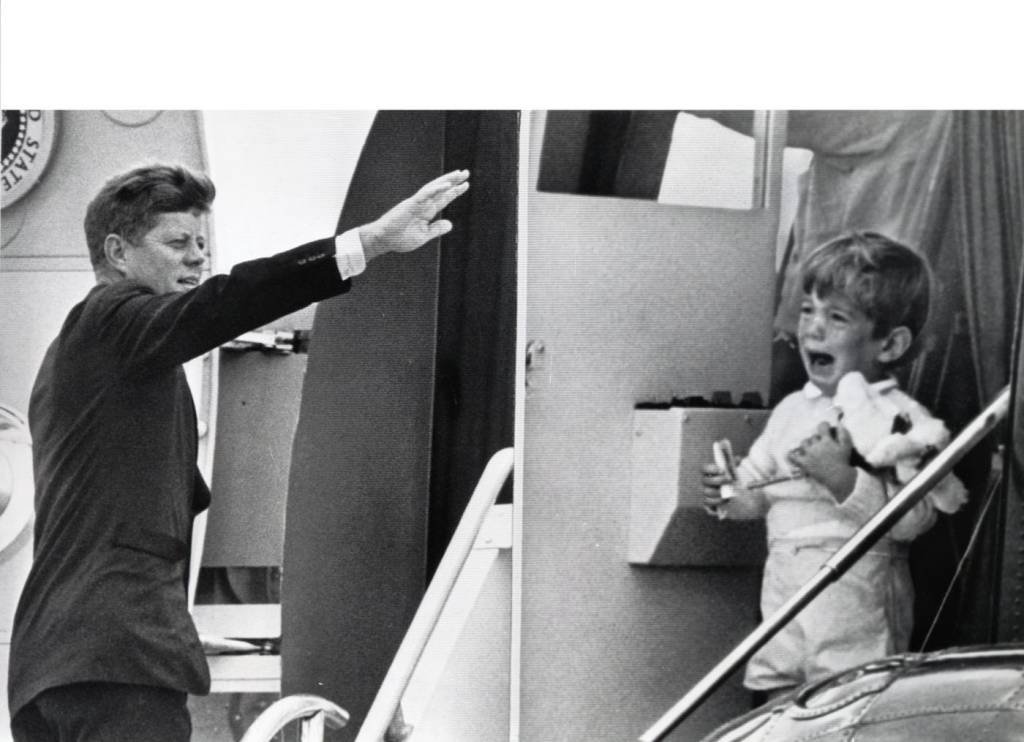
President John F. Kennedy departed for Texas. In the morning he asked his secretary, Evelyn Lincoln, to check the weather forecast for Texas, and when he found out that it was going to be much warmer than predicted, he became upset because the first lady had packed woolen suits, anticipating cooler weather. Kennedy was so upset that he called the naval officer responsible for the erroneous forecast and tore a strip off of him. The Kennedy children accompanied their parents on the helicopter ride to Andrews Air Force base, over the objections of their nanny. On the way to the helicopter, he approved a two-week vacation for his security adviser McGeorge Bundy. At 10:50 a.m., President Kennedy and his wife Jacqueline Kennedy departed the White House on the Marine One helicopter.
Kennedy had brought along a copy of the numbers that showed that the Democrats had narrowly won Texas in 1960, while individual Democratic candidates for other offices won by much larger margins. He intended to shame leading Texas Democrats for not getting their supporters to vote for the top of the ticket. He expressed doubt over the prospects of his patching up the internal Texas Democratic party schism that existed between the conservative faction led by Vice-President Lyndon Johnson and Governor John Connally and the moderate faction led by Senator Ralph Yarborough. Both he and the first lady were dreading the prospect of a weekend at Lyndon Johnson’s ranch.
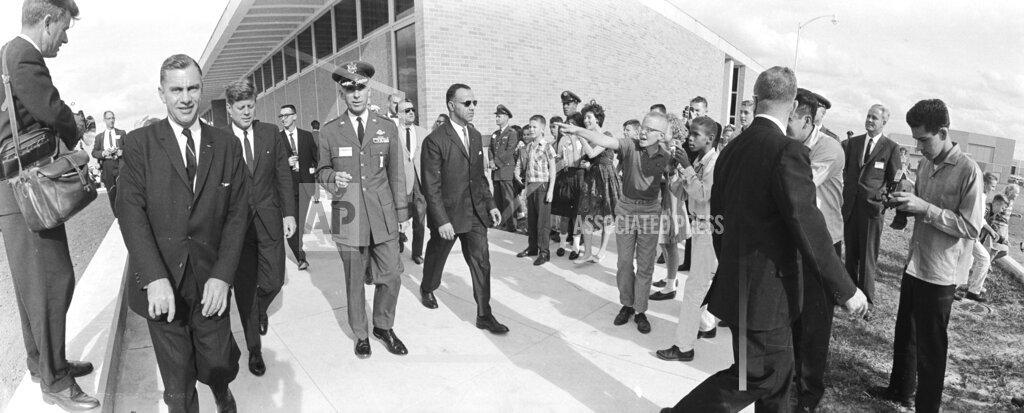
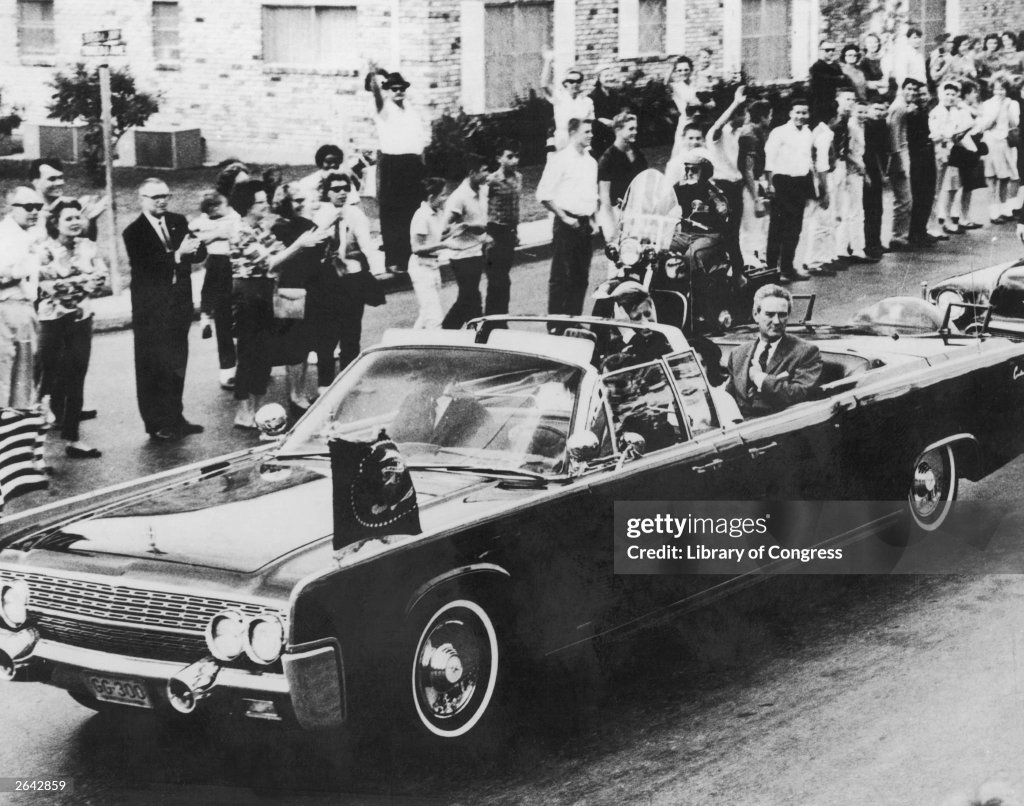
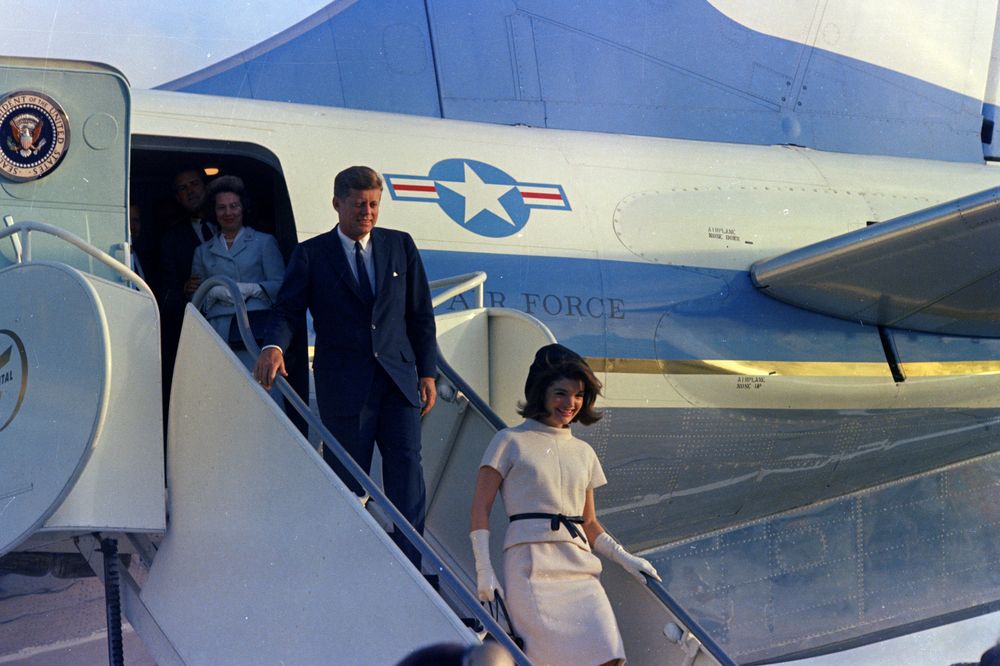
The President’s plane touched down in San Antonio, Texas, where a crowd of over 120,000 turned out. At one point, spectators broke through police barricades to shake Kennedy’s hand. A reporter for the San Antonio express commented that “despite the conglomeration of Secret Service agents on hand, it’s appalling to note how simple it would be to approach a president.”
Not all in the crowd were well-wishers. Demonstrators from the NAACP held signs which read “Mr. President, you are in a segregated city.” A group had hired a sky-writer to write “Cuba?”
President Kennedy finds himself in the middle of a party squabble. Conservative and liberal Texas Democrats have been widening a split, which is further spread when Senator Ralph Yarborough, traveling with Kennedy, attacks Governor John B. Connally Jr. Connally had snubbed Yarborough in passing out invitations to a reception. Yarborough later refused to ride with Vice President Johnson in his automobile.
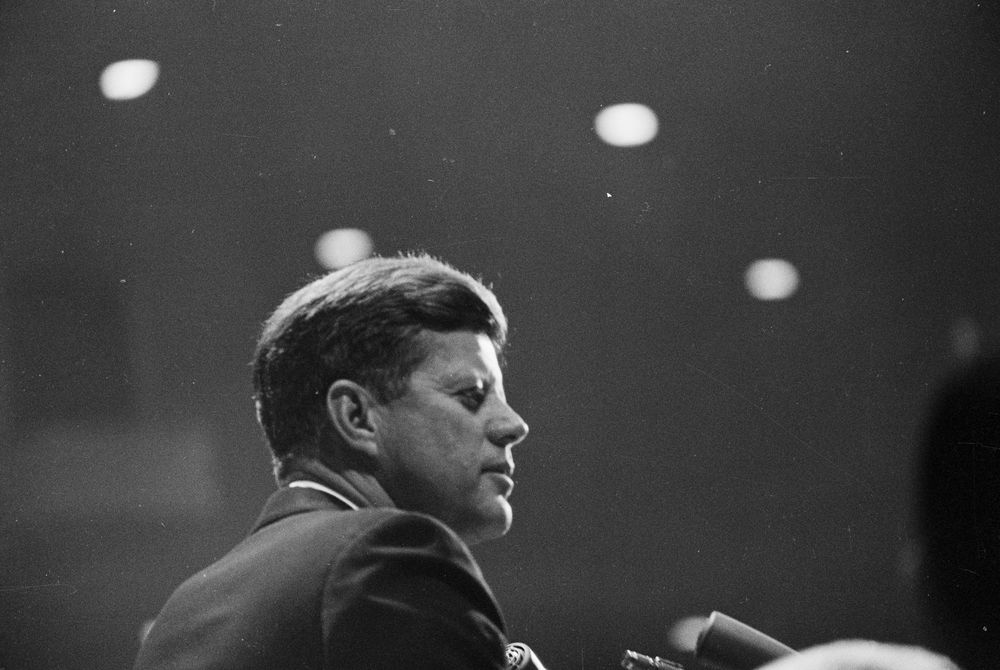
Kennedy gave a speech at Brooks Aerospace Medical Center in which he told the crowd that the nation “stood on the edge of a great new era characterized by achievement and by challenge,” one that called for “pathfinders and pioneers.” He later toured a laboratory at Brooks. There he also invited astronaut Gordon Cooper to accompany him on his trip to Dallas, but Cooper was unable to do so because he was scheduled to return to Cape Canaveral for some tests. If Cooper had been able to go, he likely would have been in the limousine with Kennedy in Dealey Plaza at the time that Kennedy was shot.
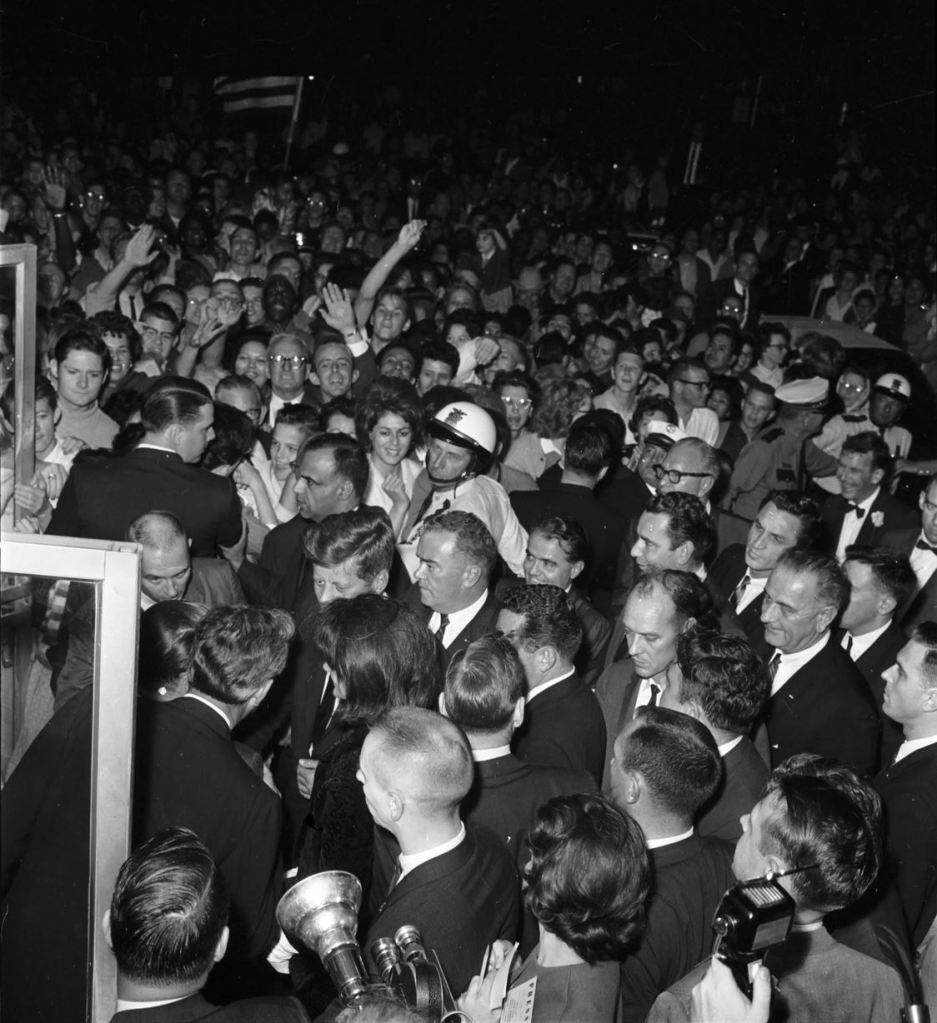
From San Antonio, Kennedy flew to Houston. When he arrived, the crown was smaller than in San Antonio, but still impressive. Over 100,000 people turned out. In his hotel room he met with Lyndon Johnson and the meeting was not a happy one. Jackie Kennedy later said that she could hear shouting. Kennedy was upset with Johnson for not trying to settle the rift between Yarborough and Connally. The first lady said that she disliked Connally because he was very self-centered and always talking about himself. Later, the Kennedys dined in their suite with the publisher of the Houston Chronicle. Kennedy learned that the paper had conducted a poll that showed that Goldwater leading Kennedy in Texas. He agreed not to publish the poll results until after the Kennedys left Texas.
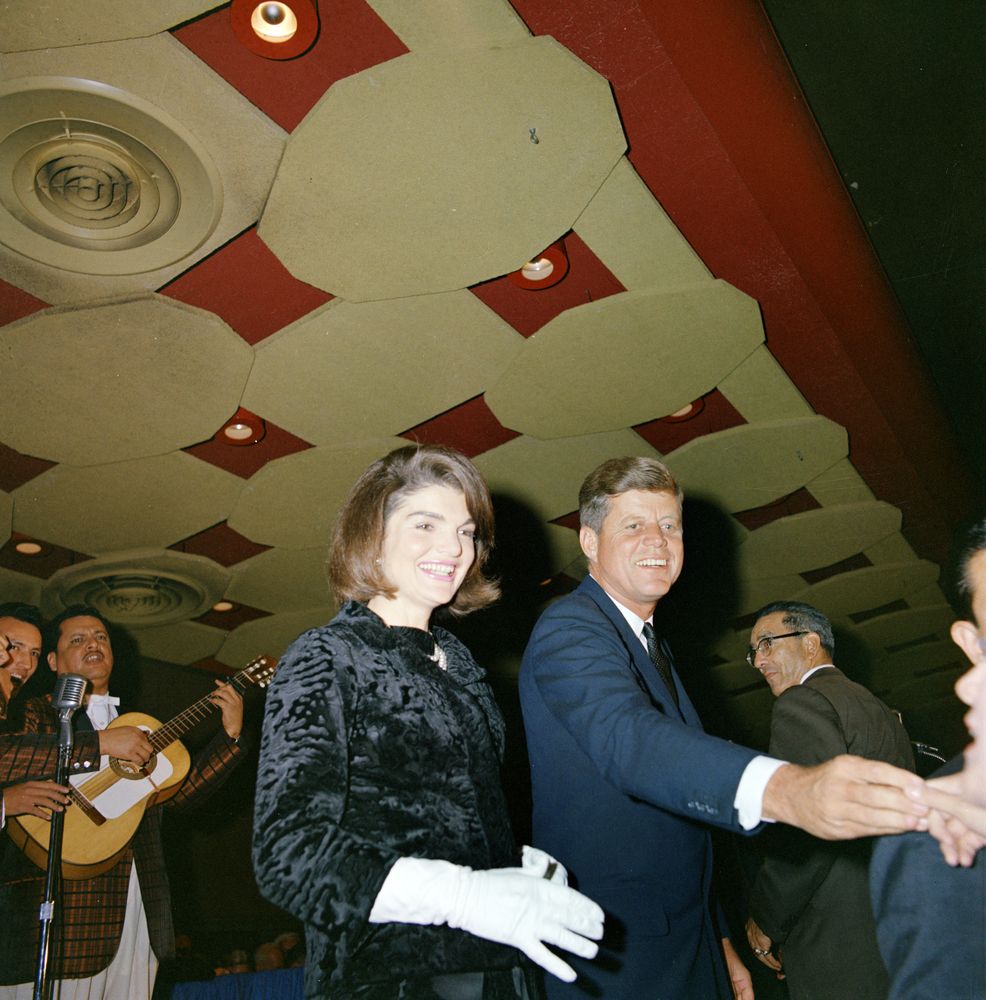
That evening after supper, Kennedy had two speaking engagements. He spoke at a meeting of the United Latin American Citizens before addressing a testimonial dinner at the Houston Coliseum honoring Congressman Albert Thomas. After the speech, the Kennedys traveled to Fort Worth, arriving after 11:00 p.m. They spent the night at the Hotel Texas on the eighth floor in Room 850. Speeches were set for the next day at Fort Worth, Dallas and Austin. Author Thurston Clarke writes in his recent book entitled “JFK’s Last Hundred Days: The Transformation of a Man and the Emergence of a Great President at page 336”:
“He and Jackie arrived in Fort Worth shortly after eleven that night and checked into a small three-room suite at the Texas Hotel that the Secret Service had chosen because it only had one entrance. Mary Gallagher should have preceded them so she could unpack Jackie's suitcase and lay out her nightclothes, but she had taken the wrong motorcade car and arrived late. Kennedy chewed her out for a slip-up that, like the erroneous weather report, he considered a threat to Jackie's happiness and her willingness to campaign next year.

“They could not sleep in the same bed because the special hard mattress that he brought on trips covered only half of the king-sized box spring and the hotel had neglected to provide a single mattress for Jackie. She was so exhausted that instead of calling housekeeping, she decided to sleep alone in the small bedroom. They embraced and he said, "You were great today." She went next door and laid out the pink suit and pillbox hat she would wear the following day.”
The United States formally notified Cambodia today it will close out its foreign aid program in the Asiatic country. There was no other choice. Prince Norodom Sihanouk, chief of Cambodia’s one-man government, had demanded the action in a note accusing the United States of plotting against his people and their liberties. Richard I. Phillips, state department press officer, said the American note, delivered in Phnom Penh by Ambassador Philip D. Sprouse, contained:
- A categorical denial the United States was plotting to overthrow Sihanouk.
- A statement that the American embassy was ready to start talks on terminating the economic and military aid programs.
- An expression of satisfaction for Sihanouk’s thanks for aid already given — 356 million dollars’ worth since 1955.
- Welcome for Sihanouk’s expressed desire to continue diplomatic relations with the United States.
The United States thus wrote “finis” to its eight-year effort to bolster the independence and so-called neutrality of Cambodia.
Government officials in Tehran said today that Soviet military jets shot down an Iranian civil survey plane without warning at least 15 miles inside Iran, killing two persons aboard and critically injuring the pilot. A strong protest was filed in Moscow. Disclosure of yesterday’s attack by three Russian planes near the northeastern town of Darreh Gaz, came as visiting Soviet President Leonid Brezhnev was telling Iran’s parliament in a speech that “good neighborly relations” existed between the two nations.
Officials said the twin-engine Iranian survey craft was on an aerial mapping mission inside the Iranian border when a Soviet MIG fighter plane and two other military aircraft tracked it down and swept in toward it. The MIG opened machine gun fire on the Iranian plane, which caught fire and crashed at a point north of the Iranian town of Meshed, eyewitnesses said. “In the light of this situation, Iran is strongly protesting to the Soviet Union,” an official said.
The Soviet Union accused the United States of creating dangerous incidents on the Berlin Autobahn and demanded that they stop. The Russian charge came in a note rejecting U. S. protests over the stalling for more than 41 hours of a U. S. Military convoy on the autobahn at Marienborn on November 4. The note was delivered to the U. S. Embassy and quoted by the news agency Tass. The Russians asserted that Soviet checkpoint procedures had functioned without trouble “until complications of this kind were artificially provoked by the American side. The note declared that instructions given to American convoys were “in no degree valid for the Soviet military authorities.” It warned that a situation could arise “when some irresponsible American officer… could spark off dangerous incidents.”
The wreckage of a U-2 plane was found on the bottom of the Gulf of Mexico. But the cockpit was empty, keeping alive a faint hope that the pilot, Captain Joe G. Hyde Jr., 33, of La Grange, Georgia, might somehow have survived the crash. Presumably returning from a mission over Fidel Castro’s Communist Cuba, the high-flying reconnaissance aircraft vanished suddenly from radar scopes at 10:32 a.m. Wednesday, some 40 miles northwest of Key West and 180 miles north of the Cuban coast. It was there that debris was sighted this morning by the searching Coast Guard cutter, Nemesis. Havana Radio said tonight the U.S. Defense Department “does not want to say what the plane was doing when it disappeared.” It was the first Cuban comment heard about the crash.
Today is the 73rd birthday of President Charles de Gaulle of France, who has outlasted World War II leaders of Russia, Britain, and the United States. Parisians must glance through a carriage gate watched by republican guardsmen clothed in scarlet and black to glimpse the building from which de Gaulle has guided his country since being reelected five years ago. It is the Élysée Palace, 18th century home of Madame de Pompadour, mistress of King Louis XV.
The long-standing chicken war between the United States and the European Common Market ends on a disappointing note for America. The United States accepts a decision by a special international arbitration panel of the General Agreement on Tariffs and Trade setting the annual value of its poultry trace to West Germany at 26 million dollars. This is 20 million below what the United States has proposed and 10 million above the amount urged by the Common Market.
Congolese Premier Cyrille Adoula charges that Russia is financing a plot to overthrow his pro-western government. Adoula orders the Russian embassy staff out of the country and announces that two Russian diplomats arrested Tuesday will be expelled within 48 hours.
Nationalist China said its commandos killed more than Communist soldiers and brought back one prisoner in a raid on a small Red Chinese island off the China mainland. The entire guerrilla force was said to have returned safely after Monday night’s raid on Langchi, at the mouth of the Min River near Foochow
Israel protests to the United States for allowing an American compromise resolution on the Palestine refugee question to be amended to satisfy Arab states. The resolution urges the United Nations’ Palestine conciliation commission to continue efforts to obtain repatriation or compensation for 1.2 million refugees from the 1948 Arab-Israeli war.
In Japan’s general election, the Liberal Democratic Party, led by Prime Minister Hayato Ikeda, retained its comfortable majority in the 467 seat House of Representatives (the Shugiin), despite dropping from 296 seats to 283.
India began its space program with the launching of a sounding rocket from the Thumba Equatorial Rocket Launching Station (TERLS), located at the far south end of the Indian subcontinent, near Thiruvananthapuram in the Kerala State. The rocket test took place 25 minutes after sunset, and reached an altitude of 200 kilometers (124 miles) where it released a sodium vapor cloud in the thermosphere.
Governor Nelson A. Rockefeller of New York yields to the plea of Governor William A. Scranton and agrees not to raid Pennsylvania delegates to the Republican national convention. Rockefeller will enter the state’s primary for a popularity expression of voters but will not seek to grab off pledged delegates — unless, he indicates, Senator Barry Goldwater (Arizona) goes after them.
The civil rights bill is reported to the House by the Judiciary Committee. Along with the majority report, supplemental views are submitted by 12 members of the committee, portending the debate the bill is expected to encounter when it reaches the floor. Rep. Emanuel Celler (D-New York), committee chairman, sends the report to the Rules Committee with a request for an early hearing by that committee.
The Senate investigations subcommittee has recessed its on-again, off-again hearings into the TFX warplane contract award. Resigned Navy Secretary Fred Korth is the next probable witness when the probe is resumed.
Senator J. William Fulbright (D-Arkansas) urges the Senate banking committee to oppose a measure sponsored by Senator Karl E. Mundt (R-South Dakota), which would prohibit American government financing of credit to the Soviet Union for the purchase of 250 million dollars in American grain by Russia. He tells listeners there is nothing to fear from communist ideology, only from Marxist imperialism.
A new threat of a nationwide railway strike was raised when the AFL-CIO Executive Council and railroad unions pledged to support sleeping car porters in their demands for a 40-hour work week.
Former Vice-President John Nance (Cactus Jack) Garner observed his 95th birthday in Texas today, still with a twinkle in his eyes.
Dr. Jerome B. Wiesner, the President’s science adviser, struck back at a critic, Dr. Philip H. Abelson, who denounced him in a Houston speech.
Rep. John W. Byrnes (R-Wisconsin) said he was innocently trapped by a well-meaning friend in a 1960 stock deal that is now causing him grief.
The head of the American Medical Association testified against President Kennedy’s medical care for the aged program and drew the wrath of its chief sponsor in the House.
The transcript of testimony by a Nashville lawyer for James R. Hoffa in a federal district court discloses that the lawyer denied the Teamster president had any part in an alleged attempt to bribe a prospective juror for Hoffa’s jury tampering trial January 6. The attorney has been disbarred by two federal judges from their court.
The Wabash Railroad’s Cannonball collided head-on with a diesel switch engine in northwest St. Louis. The railroad reports 25 persons injured, eight of them hospitalized. The cause of the collision is not immediately determined, but a Wabash railroad spokesman says the switch engine “obviously was not on the right track.” There is no derailment, indicating that neither the Cannonball nor the switch engine was traveling very fast.
A government researcher reported the first cure of cancer-related acute leukemia in experimental animals by combined treatment with chemicals and radiation.
Dow Jones Industrial Average: 732.65 (-9.41).
Born:
Nicollette Sheridan, British actress (Paige-“Knots Landing”), in Worthing, England, United Kingdom.
Died:
Robert Stroud, 73, American murderer, convict, and ornithologist known as “The Birdman of Alcatraz”, while incarcerated at Springfield, Missouri.

 History Diaries