
Yasser Arafat was cornered along with several thousand guerrilla loyalists by Syrian-supported Palestinian rebels at the edge of downtown Tripoli, Lebanon. A spokesman for the P.L.O. leader said the rebel offensive had severed the last road links between Mr. Arafat and pockets of his backers holding out in the Beddawi refugee camp.
The people of Tripoli are resigning themselves to a long, painful siege and continuing nerve-shattering artillery shelling.
Moscow condemned the fighting between Palestinian factions in Tripoli. In the sharpest statement to date, Soviet television said the Palestinians in the northern Lebanese city were killing innocent civilians.
Soviet ships appear to have ended their search in the Sea of Japan for wreckage from the South Korean jetliner that the Soviets shot down September 1, Japanese coast guard officials reported. A Japanese vessel patrolling off the southern tip of the Soviet island of Sakhalin reported that for the first time, no Soviet ships were in the area. At the height of the search, ships from the United States, Japan and the Soviet Union were combing the area for the flight recorders from the Korean Air Lines plane, downed with 269 people on board.
All United States foreign aid would be administered by a new agency under a recommendation by a high-level commission created to review American assistance programs. In a 108-page report, the panel called for the abolition of the Agency for International Development, which has administered economic aid, and for merging it with those agencies that handle military aid.
Poland’s leader increased his control over the country by setting up a powerful military panel that will decide when a state of emergency or war should be declared and then assume sweeping executive powers. The action will give the leader, General Wojciech Jaruzelski, the ability to move swiftly against any protests over food price increases that are to take effect at the start of 1984.
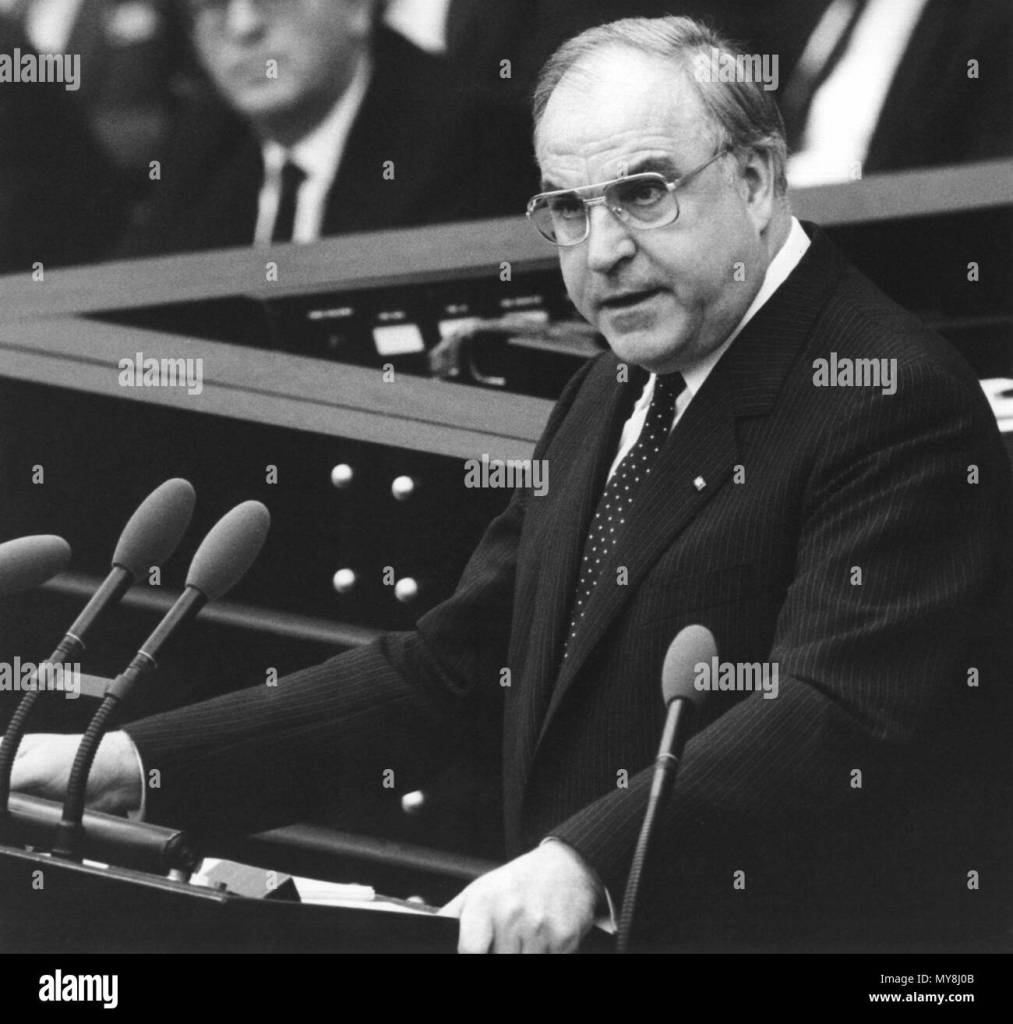
Bonn’s Parliament opened debate on the deployment of American missiles in West Germany, and Chancellor Helmut Kohl pledged to go ahead with the program. Outside, 3,000 demonstrators protested the planned deployment.
Politicians, religious leaders and the outlawed Irish Republican Army condemned a submachine gun attack on worshipers at a Protestant church service in Northern Ireland that killed three church elders and wounded seven other people. Police said they suspect the outlawed Irish National Liberation Army, a Marxist offshoot of the Irish Republican Army, and are hunting one of its leaders, Dominic McGlinchey, described as Northern Ireland’s most wanted terrorist suspect.
About 100,000 Greek Cypriots gathered in Nicosia’s main square to denounce last week’s declaration of an independent state by the Turkish Cypriot minority. The rally, attended by more than a fifth of the island’s Greek population, was said to be the biggest ever held in the square. Meanwhile, thousands of Turkish Cypriots gathered on their side of the divided capital to denounce a U.N. Security Council resolution that condemned the independence declaration as invalid.
The semi-official Anatolia press agency said today that 89 people had been indicted over the past few months on charges of armed rebellion and trying to “establish a Communist regime” in Turkey. The indictment said the suspects, alleged members of the “Third Path” left-wing group, included officers who had purportedly been assigned to infiltrate branches of the army. The indictment, drafted by a military prosecutor of the Istanbul martial law command, said the group was responsible for the June 1979 bombings of the headquarters of a now-defunct right-wing party and of a union building in Ankara. It also accused the group of a number of robberies.
Italian Communists suffered a setback in municipal elections in Naples, where they have been the leading party in the governing coalition for eight years. Though remaining the largest single party, their share of the vote fell to 27% compared to 31.7% in 1980 voting. Elsewhere, both Christian Democrats and Communists lost ground in Trentino-Alto Adige, while the South Tyrol People’s Party moved into the leading position.
The wife of Philippine President Ferdinand E. Marcos resigned from the government’s powerful Executive Committee and officially declared herself out of the running for the presidency or any other major office. The National Assembly speech by Imelda Marcos essentially confirmed statements she made in September, when she denied any ambition to succeed her husband. In a related development, the ruling New Society Movement advocated abolishing the Executive Committee and restoring the vice presidency in 1987, when Marcos’ term expires. The committee is currently empowered to take over the government if Marcos leaves office.
Crippling strikes hit two inflation-ridden Latin American countries. Public transportation was halted in most of Peru as bus and truck owners launched an indefinite walkout to demand government tax breaks. The owners say runaway inflation is outstripping government-fixed fare increases. A 24-hour general strike paralyzed Bolivia as about 13,000 workers marched through La Paz to protest austerity measures aimed at slowing inflation and reducing the foreign debt. Public transportation was already at a standstill in Bolivia due to a drivers’ strike.
Salvadoran leftist guerrillas said they killed 34 government soldiers, captured 152 and seized at least 150 U.S.-made rifles in battles over three provinces, part of a rebel offensive. The heaviest fighting was reported in Cabanas province, where guerrilla forces attacked three towns around the provincial capital of Sensuntepeque, 40 miles northeast of San Salvador. Intense battles were also reported in La Union province, and combat continued for a second week around the town of Sociedad, in Morazan province near the Honduran border.
Repression in Grenada was charged by a Grenadian who said he had been held in custody for four years until United States troops arrived on the island. The man, who has lived most of his 40 years in Brooklyn, said he had never been involved in politics. He said he was beaten and tortured and held in a forced labor camp because the authorities accused him of criticizing the Marxist government when he was in Brooklyn.
About 13,000 workers marched through La Paz today to protest the Bolivian Government’s tough austerity measures. Industry, including the country’s vital tin mines, came to a halt and shops remained closed in the 24-hour nationwide general strike, the first since President Hernan Siles Zuazo came to power over a year ago. Public transport has been at a standstill since Sunday when drivers went on an indefinite strike. The Government, faced with an inflation rate that reached 100 percent between January and August and an estimated $2.8 billion foreign debt, announced a program last week that includes a 60 percent devaluation of the peso and increases of 46.5 percent to 79 percent in the prices of basic foods.
Africans’ attitude toward Moscow has changed in the last five years. After the seemingly successful Soviet involvement in Angola and Ethiopia, African diplomats and Western officials often said that Moscow’s influence was dominant in much of the continent and was increasing. But now, Soviet influence, like Washington’s, is ranked below that of South Africa, France and Libya.
Two American lawyers said here today that the Zimbabwean authorities had refused to allow them to visit Bishop Abel Muzorewa, the former Prime Minister, who has been jailed and accused of subversion. The lawyers — Albert Blaustein, president of the New York-based Human Rights Advocates International and a law professor at Rutgers University, and Charles Printz, vice president of the group — arrived here Friday with the hope of seeing Bishop Muzorewa. They left today.
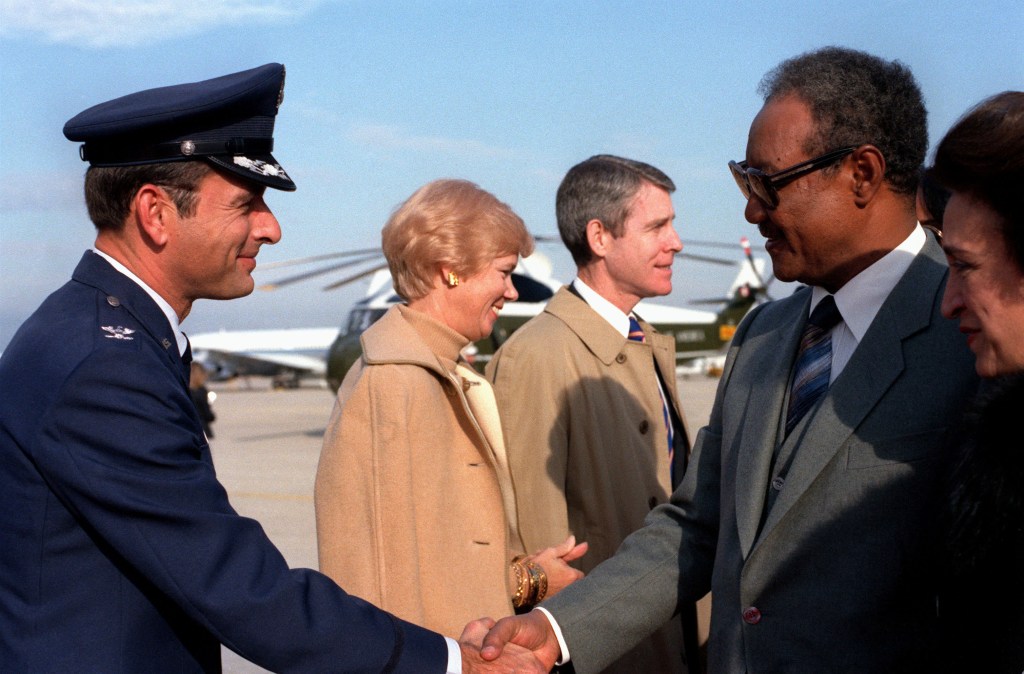
President Reagan meets with the President of the Democratic Republic of the Sudan Gaafar Mohamde Nimeiri.
President Spyros Kyprianou of Cyprus met with President Reagan today and said later he was encouraged in his efforts to obtain a reversal of the declaration of sovereignty last week by Turkish Cypriots in the northern third of the Mediterranean island. Mr. Kyprianou, who earlier talked with Secretary of State George P. Shultz, said he had “expressed our deep appreciation” for the firm United States opposition to the Turkish Cypriot move, which was declared legally invalid by the United Nations Security Council on Friday.
President Reagan participates in the Swearing-in ceremony for William Clark as Secretary of the Interior. Mr. Clark, who had been national security adviser to President Reagan, was sworn in at a small private ceremony at the White House attended by the President. With the tone set by Mr. Clark’s polite noncommittal answers, delivered in a quiet near-monotone, the hearings on his nomination were friendly and not very informative, according to several Senators. The performance underscored the contrast between Mr. Clark and his predecessor, James G. Watt, whose fixed beliefs, quick temper and taste for verbal combat in public led to abrasive exchanges with members of Congress. It also paved the way for confirmation of Mr. Clark’s nomination by the Senate.
The Commission on Civil Rights, in one of its final reports before its expected reorganization, blasted the Reagan Administration for trimming the federal government’s civil rights enforcement effort and making it difficult “to alleviate long-standing problems.” President Reagan has been criticized by civil rights groups for curtailing the independence of the bipartisan watchdog group. Compromise legislation was worked out in Congress last week, but Reagan has yet to sign the measure.
President Reagan signed a $30 million measure that calls for a study of veterans exposed to radiation, extends the Vietnam storefront counseling centers and provides for community care to keep aging veterans out of institutions. The bill also establishes a women’s advisory committee within the Veterans Administration. The committee follows a hearing at which female veterans testified their gynecological needs were not being met at VA hospitals.
A bomb disposal team removed a ticking package addressed to President Reagan from the post office building at New York’s Kennedy International Airport. Port Authority Police Lt. Jose Elique said the parcel was X-rayed and “it appeared to contain two sticks of dynamite.” However, a spokesman for the New York police bomb squad that picked up the parcel for inspection later at an isolated firing range said it was uncertain if it held dynamite. At the White House, an aide said “there was no way” an unexamined package would have gone to the President. “All packages are checked when they come in,” he said.
Several dozen consumer organizations asked the Federal Trade Commission to crack down on advertising for alcoholic beverages, including a ban on ads aimed at young people and problem drinkers. The advertising “has helped make alcohol America’s most popular and harmful drug,” said Michael Jacobson of the Center for Science in the Public Interest. Consumer spokesmen said at a news conference that the alcoholic beverage industry spends well over $1 billion a year to encourage Americans to drink, a habit they said causes more than $100 billion worth of economic damage and contributes to at least 100,000 deaths annually.
A workers’ “right to know” rule that will allow 14 million factory employees to know the identities of hazardous chemicals they are handling is expected to be announced today by the Labor Department. The new regulation was criticized by a spokesman for organized labor as “ineffective” and praised by a Carter Administration official as “a major step in the right direction.”
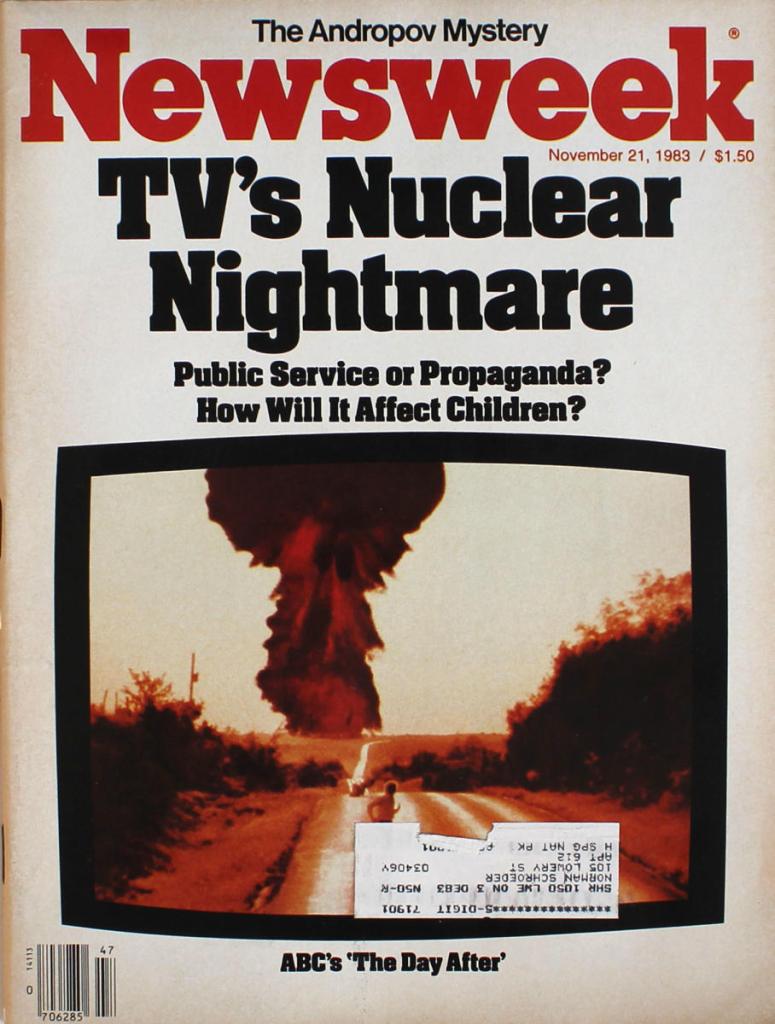
Millions talked of fear, hope and the horrors of nuclear war as the emotional and political impact of a television movie of atomic holocaust reverberated around the country. Preliminary estimates were that 100 million Americans — more than half the nation’s adults — watched Sunday evening’s ABC-TV movie, “The Day After.” For a dramatic program, the audience was apparently surpassed only by the 106 million viewers of the last episode of the military comedy series “MAS*H” on CBS-TV last February 28.
Nancy Reagan is visiting her ailing mother, Edith Davis, in Phoenix. Sheila Tate, the First Lady’s press secretary, said Sunday that later Mrs. Reagan would stop in Los Angeles before going to the Reagans’ Santa Barbara, California, ranch Wednesday.
Newly hired Greyhound drivers put on the roads to replace strikers who walked out on November 2 are being closely monitored and so far their training and qualifications have met federal standards, the federal Bureau of Motor Carrier Safety said. “The result (of the inspections) was a clean bill of health, which should lay to rest any residual concerns about the ability of our newly hired drivers,” said Frederick Dunikoski, Greyhound Lines president.
Another failure aboard NASA’s new data relay satellite will sharply reduce communications flexibility planned for Monday’s Spacelab flight aboard the space shuttle Columbia, officials said. The one remaining usable high-speed Earth-to-shuttle communications link aboard the $100-million tracking and data relay satellite failed last week. A similar problem knocked out an identical system earlier this month. Instead of having separate radio channels for the ship’s pilots and the ship’s scientists, all six crewmen will have to share a single lower-volume channel with flight controllers and scientists directing the nine-day mission in Houston.
Baltimore’s rapid transit era began as its Metro was opened to the public. The eight-mile subway system cost $797 million, making it one of the costliest lines in the world. It was long before daylight, but to Baltimoreans a new age was dawning. At 5:03 A.M., the silver cars of the Metro glided out of Reisterstown Plaza Station. The age of rapid transit had begun for Baltimore. As a moment in history, it was among the briefest, involving one of the shortest of subway systems and one of the costliest of lines. The price tag came to $797 million for the eight-mile run downtown from the massive, concrete elevated platform at the plaza in the city’s northwest quadrant, nearly $100 million a mile.
The California condor has been saved from extinction, according to a controversial rescue project operated by a group of wildlife biologists, mountaineers and volunteer observers. In addition, the scientists believe they can also begin to build up the numbers of the rare species in the wild by returning captive-raised birds to the California mountains.
Actor Ed Harris (33) weds actress Amy Madigan (33).
“Doonesbury” opens at Biltmore Theater NYC for 104 performances.
New York Ranger hockey player Ron Greschner marries model Carol Alt.
Darryl Strawberry becomes the first non-Dodger since 1978 to win the National League Rookie of the Year Award. Strawberry hit .257 for the Mets with 26 home runs and 74 RBI and also stole 19 bases.
The Mariners trade reliever Bill “The Inspector” Caudill (his theme was the Pink Panther theme) and a player to be named later (minor leaguer Darrel Akerfelds) to the A’s for catcher Bob Kearney and pitcher Dave Beard.
NFL Monday Night Football:
The Jets, who have not had much success or fun this season, spoiled someone else’s fun tonight in the Superdome. After trailing for most of the game, the Jets beat the New Orleans Saints, 31—28, on Kirk Springs’s 76-yard punt return. The touchdown came near the end of a game that the Saints were primed to win in a bid to sustain their chances at a playoff position, a goal no New Orleans team has ever achieved. Springs scored on a beautiful run, going up the middle, cutting sharply to the left and then running down the sideline to the end zone with 2 minutes and 11 seconds to play. The Jets had already scored 10 points in the fourth quarter, which began with the Saints ahead and dominant, 28—14. A victory would have given New Orleans a first-place tie with the Los Angeles Rams and the San Francisco 49ers in the West Division of the National Conference. The defeat made their record 6-6 instead.
New York Jets 31, New Orleans Saints 28
Dow Jones Industrial Average: 1268.79 (+17.78).
Born:
Steven Tolleson, MLB second baseman, third baseman, and pinch hitter (Oakland A’s, Baltimore Orioles, Toronto Blue Jays), in Spartanburg, South Carolina.
Claire van der Boom, Australian actress (“The Pacific”), in Broome, Western Australia, Australia.
Brie and Nikki Bella, American pro wrestlers, aka The Bella Twins and reality TV stars (“Total Divas”), in San Diego, California.




 History Diaries