Spanish Nationalist forces have pushed Spanish Republican forces back across the River Ebro in Spain, and preparations for a new drive were reported under way today in rebel Spain. Though the armies of both sides were quiet following yesterday’s rebel victory on the Ebro River, a new offensive toward Valencia and Tarragona was said to be the next planned step of the insurgents. Loyalist troops meanwhile strengthened their positions on the east bank of the Ebro in southern Catalonia. An insurgent counter-drive to force them back from territory on the western bank, which they seized in July, was completed Wednesday. The loyalists asserted their new positions would halt any rebel offensive against Tarragona this winter. New withdrawals of foreign troops from the rebel forces were predicted today by Francis Hemming, British secretary of the committee for nonintervention in the Spanish war. He left insurgent Spain with what was asserted to be General Francisco Franco’s approval in principle of a proposal to withdraw more alien fighters. Previously 10,000 Italians were called home.
An explosion at a munitions plant near Barcelona kills 400 workers, who suffocate or burn. No news of the blast is published is Spain.
A representative of the Foreign Office noted after an internal speech by Göring on 18 November 1938:
“Very critical state of the Reich’s finances. This was first remedied by the billions imposed on the Jewish community and by the Reich’s profits from the ‘Aryanization’ of Jewish enterprises.”
The financial squeeze that the German state was in in November became apparent from the fact that the urgently awaited fines from the “Jewish Penalty” were pre-financed with the help of major German banks. 1 billion Reichsmark increased Reich revenue from 16 to 17 billion marks in one fell swoop, i.e. by a good 6 percent.
The recall of Hans Dieckhoff, German ambassador to the United States, was explained in official German quarters tonight as “the natural reply” to the action of the American government last Monday in ordering Hugh R. Wilson, United States ambassador to Germany, to return to Washington, D. C., to report on the Nazi campaign against the Jews. The announcement of Ambassador Dieckhoff’s recall, carried by DNB, official German news agency, said “the ambassador will inform the foreign minister (Joachim von Ribbentrop) in detail concerning the strange attitude toward events in Germany of a domestic nature which is apparent from declarations by President Roosevelt and other authoritative personalities in the United States.”
In German business circles the explanation for Ambassador Dieckhoff’s recall is different. They say that he has been recalled to help prepare a new campaign to increase trade between the two countries. While general attention still centers on the Nazi efforts to cast out 800,000 Jews, business circles are seriously alarmed by the drop in the export orders received by Germany’s newly conquered provinces of Austria and Sudetenland. Their finished goods now must be marked “Made in Germany” and therefore must pay higher duties in the United States. Most of the Austrian and Sudetenland manufactures are articles of luxury which are not of vital necessity. German business circles feel that once the markets are lost for the Austrian or Bohemian goods, there will be enough American substitutes to take their places and this will make it difficult ever to reconquer the markets. This would turn the conquests of Austria and Sudetenland into commercial liabilities instead of assets.
King Carol of Rumania ends a state visit to Britain without the economic help and trade concessions he hoped to achieve. Carol will turn more strongly to Germany.
After consulting with the Netherlands, Belgium’s Foreign Minister says his country will no longer turn away Jewish refugees at its border.
Switzerland today repeated previous refusals to offer itself as a haven for Jewish refugees from Germany. The refusal was contained in a note replying to a formal inquiry by the Netherlands legation whether Switzerland would be willing to admit refugees. The Hague government had addressed such inquiries to several other states. The Swiss answer pointed out that Switzerland’s facilities for taking care of refugees were overtaxed and that, therefore, with but few exceptions, refugees could be admitted only for transit to other countries. This position was substantially the same as that expressed by the Swiss delegate to the Evian-les-Bains conference on refugees last July.
British troops inflicted heavy casualties today on a large band of Arab rebels which ambushed a detachment of Coldstream guards patrolling South Bethlehem. Arab casualties in a furious, night long battle were estimated at fifty. One British soldier was killed.
Japan replies to the U.S. note of October 6, denying that Japan intends to discriminate against the United States, but affirming that a “new order” is being built in China. The United States takes this as a dismissal of the Open Door policy.
The President tells Labor Secretary Perkins to extend the visitors’ visas of up to 15,000 political refugees from Germany for six months, and to continue extending them each six months.
Trade union members elect John L. Lewis as the first president of the Congress of Industrial Organizations. John L. Lewis is unanimously elected as head of the new Congress of Industrial Organizations, a new group replacing the old CIO.
In a radio speech, AFL president William Green calls for a boycott of German goods. William Green, president of the American Federation of Labor, asked the nation tonight to boycott German goods and services in protest against persecution of Jews in Germany. In a broadcast address he said: “If anything can impress upon Hitler the tragic folly of his course and induce him to change his ways, it is economic pressure from the outside world.”
3,500 members of the motion picture industry attended a “Quarantine Hitler” rally at the Philharmonic Auditorium in Los Angeles. John Garfield, Frank Capra, Joan Crawford and Thomas Mann were among the participants. The crowd unanimously voted to send a telegram to President Roosevelt urging him to use his authority to “express further the horror and the indignation of the American people” at the Nazi persecutions of Jews and Catholics.
Colonel Batista, military leader of Cuba visiting in New York, says his country will provide a haven for refugees from Nazi Germany, and urges other countries to do the same.
Japan explains that all goods transported on the Yangtze River are for its armies, and not commercial purposes. Other nations have complained that their ships are not allowed to use the Yangtze.
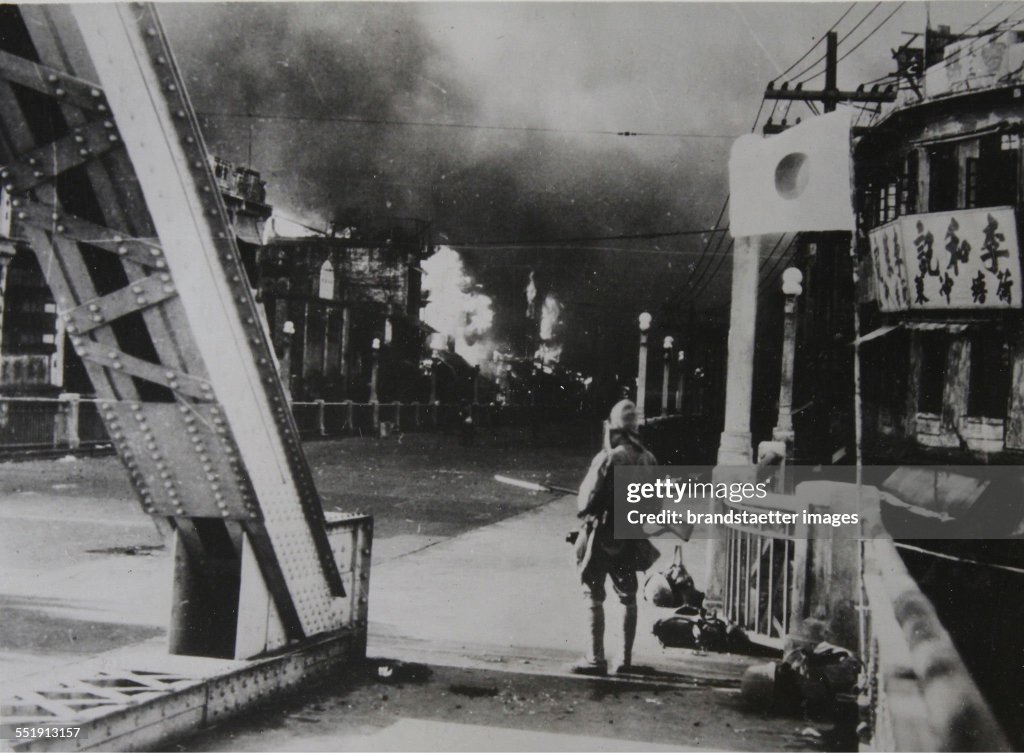
The Japanese today are rushing heavy reinforcements to Canton to oppose more than 200,000 counterattacking Chinese soldiers who fought their way into the environs of the great South China metropolis. Japanese admitted the situation is serious and that thinly-held Japanese positions in the Canton area have been captured by the Chinese forces composed of well-trained regular army units from Kwangsi Province commanded by Generals Li Tsung-jen and Pai Chung-hsi. Foreign military attachés believe the Chinese offensive has thrown the whole Japanese campaign in Southwest China out of gear and that Generalissimo Chiang Kai-shek may be able to hold his Hengyang triangle defense area in Hunan Province for an indefinite period. British observers sighted more that 10 Japanese warships and transports going up the Pearl River toward Canton yesterday.
Japanese Consulate officials expressed regret today over an incident in which Japanese soldiers were said to have thrown a liquid disinfectant at Dr. Logan H. Roots, American missionary physician. Japanese soldiers were said to have thrown the disinfectant at the missionary doctor, who was unharmed, when he closed the gates of his mission at Wuchang, across the Yangtze River from Hankow, to Japanese seeking Chinese refugees.
Chinese planes attack Japanese positions 40 miles from Changsha. The Chinese central government has renewed its challenge to Japanese superiority in aerial warfare. After many weeks of unexplained inactivity, Chinese warplanes are taking the air again, striving to assist the defense of Changsha, capital of Hunan province, and to aid a counter-drive on Canton, which the Japanese hold. Chinese planes, it was reported, strafed Japanese troops along the Canton-Hankow railway where the invaders had pushed to within forty miles of Changsha. Chiang Kai-shek, Chinese commander in chief, is pressing for speedy production of planes and the training of pilots to make a better showing in the type of warfare for which the Chinese virtually were unprepared when the war started 500 days ago. A well-informed neutral military observer said the Chinese now have 172 warplanes, including bombers and pursuit craft. Of these 118 are Soviet Russian and are manned by Russians, he asserted. The same source reported the Chinese had lost 752 planes and the Japanese 648 since the war started.
Japanese planes bomb an airfield in Kiangsi, and shell downtown Sian, in spite of a snowstorm.
Dow Jones Industrial Average: 149.93 (-2.85).
Born:
Karl Schranz, Austrian alpine skier (Olympics, silver medal, giant slalom, 1964), in St. Anton, Tyrol, Austria.
Bud Zipfel, MLB first baseman and left fielder (Washington Senators), in Belleville, Illinois.
Don Stallings, NFL defensive tackle (Washington Redskins), in Rocky Mount, North Carolina.
Naval Construction:
The Вое́нно-морско́й флот СССР (ВМФ) (Soviet Navy) Project 7 class (Gnevny-class) destroyer Stremitelny (Стремительный, “Impetuous”) is commissioned.

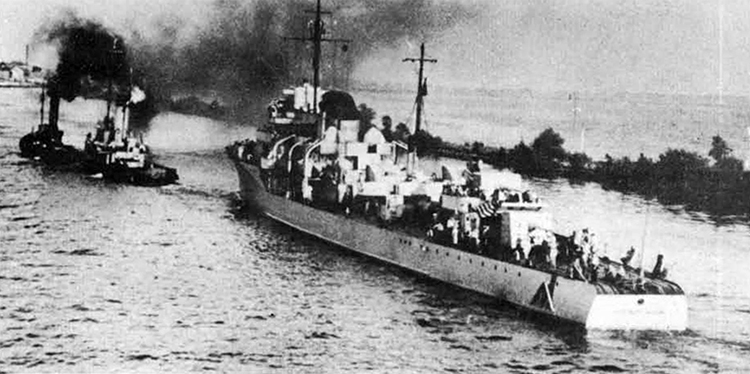
The ship served on patrol and escort duty with the Baltic Fleet during the Winter War, aside from bombarding the coastal artillery positions on the Finnish island of Russarö on 1 December 1939 with her sister ship Smetlivy and the light cruiser Kirov. Stremitelny was transferred to the Northern Fleet on 9 May 1940.
Lost 20 July 1941.
When Operation Barbarossa, the German invasion of the Soviet Union, began on 22 June 1941, the ship was based in Polyarny. Together with her sisters Gromky and Gremyashchy, Stremitelny covered the landing of troops on the western side of the mouth of the Zapadnaya Litsa River on 14 July during Operation Platinum Fox, the German attempt to capture Murmansk. Six days later, she was attacked by Junkers Ju 87 “Stuka” dive bombers while docked in Polyarny and was struck by four bombs amidships. They detonated in the boiler and engine rooms, killing all the crewmen in those compartments and breaking the ship in half. The stern section sank in a few minutes, but the bow section took 20 minutes to sink. A total of 111 people were killed, including several entertainers who were giving a performance aboard when the aircraft attacked. Her wreck was partially salvaged in April 1942 and her stern was used to repair her sister Razumny.
 History Diaries