
Moscow indicated that it would cut by half the number of its SS-20 missiles if the NATO alliance agreed to drop plans to deploy the 572 new American missiles in Europe. According to an announcement by the State Department, Yuli A. Kvitsinsky, the chief Soviet arms negotiator in Geneva, told Paul H. Nitze, his American counterpart, that Moscow would accept a proposal if offered by Washington. The Reagan Administration turned down the offer.
The Soviet Defense Minister accused the United States of having deliberately doomed disarmament negotiations. The Minister, Dmitri F. Ustinov, also reaffirmed standing Soviet demands on the issues, lessening hope for a last-minute shift in Moscow’s position. In his criticisms, which were published by Pravda, Marshal Ustinov stressed Soviet pledges to match any American buildup.
President Reagan attends a briefing delivered by Secretary of Defense Caspar Weinberger and Chairman of the Joint Chiefs of Staff General Vesey. Reagan writes in his diary: “A most sobering experience with Cap W. & Gen. Vessey in the situation room — a briefing on our complete plan in the event of a nuclear attack. The Chiefs have been working on it for 2 yrs. in reply to my request in Oct. 1981.”
The Polish authorities have ordered the Roman Catholic Primate, Jozef Cardinal Glemp, to silence some 69 “anti-socialist” priests, warning that otherwise they may face arrest, church officials said today. The warning came in a letter delivered to the Cardinal within the last week, the sources said, heightening the growing tension between the Communist state and the church, many of whose priests have openly identified themselves with the outlawed Solidarity labor union.
The church hierarchy, after a two-day meeting of bishops, criticized the government today for its plan to raise food prices at the beginning of the year. The bishops said the authorities would do better in encouraging “fruitful work” by ending political trials and releasing political prisoners. Bemoaning the nation’s economic problems, the bishops’ statement said that “it is not the people who are responsible for these conditions,” leaving the clear implication that it was the government that must bear much of the responsibility. Meanwhile, Poland’s rulers began a two-day meeting of the party’s Central Committee to discuss the failing economy amid rumors of a pending government shakeup.
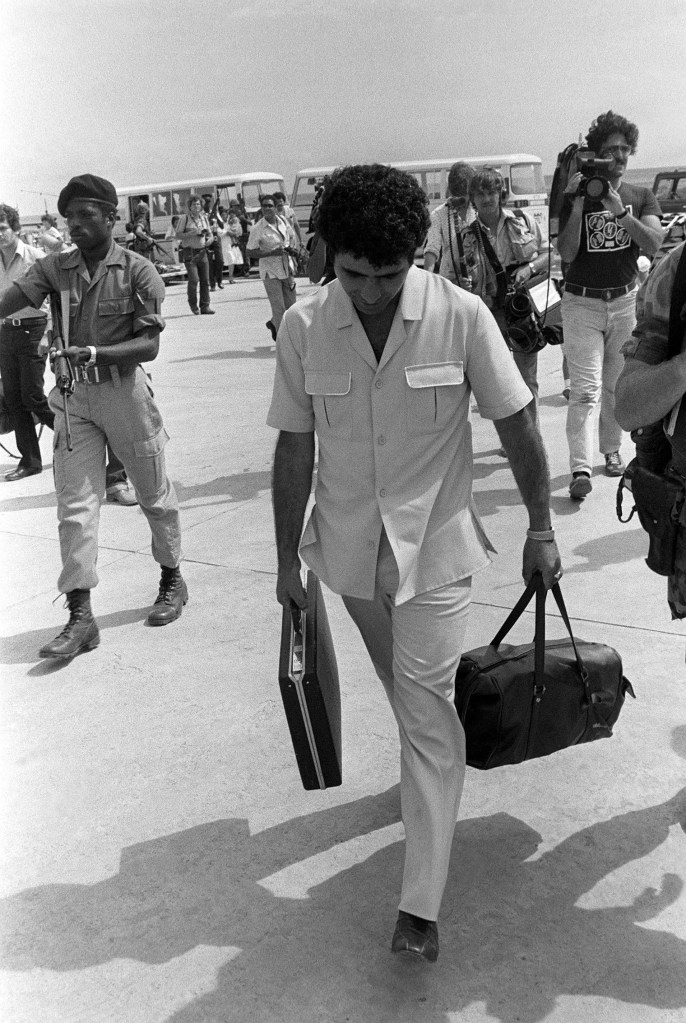
Dutch newspapers have reported that the Heineken brewery raised $10 million for the ransom of its chairman, Alfred H. Heineken, and his chauffeur, who were kidnapped November 9. Algemeen Dagblad, a Rotterdam newspaper, said Thursday that the ransom was “packed in six suitcases,” ready for delivery. De Telegraaf of Amsterdam reported that the kidnappers made contact with brewery officials by telephone Saturday night and said instructions could be found in a railway luggage locker. The paper’s account said the locker contained two pictures showing the kidnapped men holding copies of last Saturday’s issue of De Telegraaf.
Justice Minister Robert Badinter was quoted Thursday night as saying that Klaus Barbie, former Lyons Gestapo chief, would not go on trial until 1985 “at the earliest.” Rabbi Marvin Hier, dean of the Simon Wiesenthal Center in Los Angeles, said Mr. Badinter gave the information during a meeting to discuss progress in the case. Rabbi Hier said the center would have observer status at the trial. “The Minister told us that because of the full use of legal delaying tactics by Barbie’s lawyer, he did not expect the trial could be held next year,” the Rabbi said in an interview. The former Gestapo chief, known as the Butcher of Lyons, was expelled this year from Bolivia and was turned over to the French authorities. He is accused of causing the deaths of thousands of Jews and Resistance workers and participating in torture.
Yasser Arafat said a “large area” of the Beddawi refugee camp on the edge of Tripoli in northern Lebanon had been regained by his forces. But Palestinian rebels who fought their way into the camp this week and are still holding most of it said through a spokesman in Damascus that they had turned back three attempts by Arafat forces to advance and had lost no ground.
Sanctions against Salvadoran exiles in the United States are being considered by the Reagan Administration. The exiles are strongly suspected of financing and at least partly directing death-squad activities in El Salvador, a senior State Department official said.
The House and the Senate approved legislation today that would provide $24 million in covert aid to insurgent forces in Nicaragua but require the Central Intelligence Agency to return to Congress if additional funds are sought. The aid is included in a military appropriation bill for the fiscal year that began October 1. The measure, calling for an appropriation of about $250 billion for military spending, was approved by voice vote in both houses and sent to the White House after House and Senate conferees working on a separate measure to authorize all United States Government intelligence activities ended a months-long struggle over whether to allow United States covert operations in Nicaragua. The conferees agreed to authorize the aid to the Nicaraguan insurgents provided by the military spending bill and incorporated a provision to that effect in their intelligence policy measure. The authorization agreement broke a three-day deadlock between the House conferees, who sought an outright ban on covert aid to Nicaraguan rebels, and Senate conferees who wanted to authorize some aid.
Argentina can enrich uranium, it announced, giving it the capacity to make the fuel for nuclear explosives. Rear Admiral Carlos Castro Madero, head of Argentina’s National Atomic Energy Commission, said Argentina would use its new nuclear capacity only for “peaceful ends.”
Justice officials have found the bodies of 27 Indian peasants, 12 of them children, who were dragged from a village wedding party on Monday and shot, the authorities said. According to witnesses, the victims were celebrating a wedding when masked men burst into the home in Soccos, shot them and dumped their bodies in a ravine near Soccos, an Andean village in southeastern Peru about 15 miles outside Ayacucho. Witnesses identified the gunmen as police agents and said the victims had been tortured. The police denied involvement and blamed guerrillas of the Maoist terror group Sendero Luminoso (“Shining Path”).
An 18-year-old youth died tonight as riot police fired tear-gas grenades and used water cannon to disperse demonstrators at the end of Chile’s biggest anti-Government rally in a decade of military rule. The police said the youth slipped, fell and banged his head while running away as the police broke up crowds that had swarmed into the streets of the capital from the rally, singing and chanting slogans against the Government of President Augusto Pinochet. However, the independent radio station Cooperativa quoted witnesses as saying the youth was hit with either a tear-gas grenade or a police billyclub.
The disturbances, in which several people were arrested, came as hundreds of thousands of people left Santiago’s O’Higgins Park at the end of a rally called by the centrist political parties of the Democratic Alliance but backed by all other opposition groups. Calls for General Pinochet’s resignation and a return to democracy were broadcast throughout the country by a network of independent radio stations.
The national debt ceiling would rise and the Defense Department would get $250 billion under legislation given final approval by Congress on the eve of its holiday recess. Other bills would increase the United States contribution to the International Monetary Fund by $8.4 billion, and authorize the outlay of $15.6 billion for subsidized housing programs.
The Senate approved the nomination of William P. Clark as Secretary of the Interior, voting 71 to 18. All of the no votes were cast by Democrats. Voting followed a debate that focused largely on the policies and the character of James P. Watt, the former Secretary.
Responding to “The Day After,” the ABC-TV movie about a nuclear war and its aftermath, the Reagan Administration is stepping up its efforts to persuade the public that its policies are the best way to prevent such a war. The movie, which is to be broadcast Sunday, has become a rallying point for opponents of the Administration’s nuclear arms policies. As a result, the White House press office issued an 18-page booklet titled “President Reagan on Peace, Arms Reductions and Deterrence.”
Congress is leaving President Reagan with a politically painful choice on a bill that would, for the first time, pay farmers to reduce milk production. “The bill ought to be vetoed,” said a highly placed Agriculture Department official who asked not to be quoted by name. “It’s against the President’s philosophy and if he signs it, his enemies will call him a hypocrite. But politically a veto would certainly hurt the Republicans in some farm state Senate races.” In addition, the Democratic-controlled House has pushed Mr. Reagan and the Republicans into another political corner by passing a costly wheat bill that most grain farmers have been demanding and the Administration has been opposing. Action on the wheat measure in the Republican-controlled Senate was held up tonight when Senator Richard G. Lugar, Republican of Indiana, objected to parts of it.
Former Representative Barry Goldwater Jr. of California said today that it was “irresponsible” of the House ethics committee to say there was “substantial evidence” that he had used drugs. But former Representative John Burton of California acknowledged in an interview with The San Francisco Chronicle that he had had a problem with drugs and alcohol. He said he had overcome it. “I don’t even take aspirin now,” Mr. Burton said. “I’m clean.”
On Thursday the House ethics committee ended a 16-month investigation into drug use on Capitol Hill by releasing a 147-page report citing “substantial evidence” that Mr. Goldwater and Mr. Burton and former Representative Frederick W. Richmond of Brooklyn had used illegal drugs while serving in Congress. The panel, which conducted an investigation headed by Joseph A. Califano, said it would take no action against them but referred the findings to the Justice Department. Mr. Goldwater, in a telephone interview from his home in Los Angeles, noted that in July the Justice Department had found insufficient evidence to prosecute him.
Saying it was a “fair, adequate and reasonable settlement,” a federal district judge has signed a consent decree that would increase the number of black police officers in Philadelphia and end a 13-year-old racial discrimination case. The consent decree, signed Thursday by Judge John Fullam and released today, guarantees that 293 black police recruits will be among the next 2,442 hired. The agreement was reached among representatives of the Guardian Civic League, an organization of black policemen, the state and the city.
Dissident members of the United Steelworkers of America, unhappy with the current union administration, plan to meet this weekend to consider running a candidate in next year’s special election for the union’s presidency. Steelworkers from around the country are to meet Saturday in Hammond, Ind., to discuss the special election on March 29 and the next regular election of a union chief, in November 1985, Ron Weisen, the president of Local 1397, said today. The March election will provide a president to finish the term of Lloyd McBride, who died November 6.
Two houses and seven acres of beachfront property in the resort town of Vero Beach, Florida have been seized in one of the largest drug-related takeovers of real estate by the Government, the United States Attorney’s office in Miami said today. The property, worth more than $1.5 million, reportedly was bought in 1979 with money made from the sale of illegal drugs. It was forfeited to the United States Government on Thursday.
The Government filed a complaint on June 23, 1982, alleging the drug connection. The owner of the property, Pica Investments, a Panamanian corporation, entered the lawsuit to defend the charge, the attorney’s office said. But Francesco Gaviria-Ovalle of Colombia, the corporation’s president, refused to identify the company’s shareholders or release documents showing who controlled Pica Investments, the Government charged.
Walter H. Kupau, president of the Hawaii State Federation of Labor, has been convicted by a federal jury on perjury charges involving the picketing of a nonunion contractor on the island of Maui. Mr. Kupau, 47 years old, who was convicted Thursday, is to be sentenced January 9 and could receive a maximum term of 30 years in prison. He was accused of lying to a federal grand jury, to the National Labor Relations Board and to a jury at the federal trial earlier this year of two business agents for the carpenters’ union.
President Kennedy’s legacy is indelible, observers and the fervid band of people, now scattered, who served him, say as the anniversary of 35th President’s assassination approaches.
Leaders of the Greyhound bus strike agreed to submit the company’s latest contract proposal to a membership vote within 10 days. Greyhound reiterated its intention to continue limited operations with newly hired replacements and non-striking workers.
Three confessed South Carolina rapists were sent to prison for 30 years Friday, with an unusual choice: They can obtain their freedom at any time if they agree to be castrated. Circuit Judge C. Victor Pyle imposed the sentence Thursday in a case he called “the most horrible” he has heard. The victim was repeatedly raped, beaten and burned with a cigarette lighter. She nearly died. Roscoe Brown, 27, of Pendleton, South Carolina, Mark Vaughn, 22, of Clemson, South Carolina, and Michael Braxton, 18, of Sarasota, Florida, pleaded guilty last month. Pyle sentenced them to 30 years — the maximum term for first-degree criminal sexual conduct — or castration with five years’ probation. The defendants reportedly appeared stunned as they listened to the sentence in Anderson County General Sessions Court. They were sent to the Perry Correctional Institution in Greenville Friday.
Crew rosters for four space shuttle missions call for six of the eight women who are United States astronauts to go on flights in 1984, with one to become the first woman to walk in space. The rosters and revised schedule made public today by the National Aeronautics and Space Administration also listed the first American space mission to have two women on the same flight. The schedule also announced separate flights for husband-and-wife astronauts, William and Anna Fisher.
The two-woman mission, scheduled August 30, 1984, would include Dr. Sally K. Ride, America’s first woman in space, and Dr. Kathryn D. Sullivan. The August mission would make Dr. Ride the first woman to venture into space twice. The mission plan also calls for Dr. Kathryn Sullivan, a geologist, to become the first woman to walk in space. The new schedule also has a third woman, Dr. Shannon Lucid, 40 years old, of Bethany, Oklahoma, flying October 24, 1984, with a crew also including four men. The remaining six women in the astronaut corps scheduled to fly in 1984 include three others previously announced. They are Dr. Fisher and Rhea Seddon, both medical doctors, and Judith Resnik, an electrical engineer.
Hector (Macho) Camacho retained his World Boxing Council superfeatherweight title by knocking out Rafael Solis of Puerto Rico in the fifth round of a scheduled 12-rounder tonight. Camacho, the 21-year-old undefeated champion who was born in Puerto Rico and raised in Manhattan, floored Solis with a quick right hand in the fifth round.
Dow Jones Industrial Average: 1251.01 (-3.66).
Born:
Travis Buck, MLB outfielder (Oakland A’s, Cleveland Indians, Houston Astros), in Richland, Washington.
Quentin Moses, NFL defensive end (Miami Dolphins), in Athens, Georgia (d. 2017).
Julius Hodge, NBA shooting guard (Denver Nuggets, Milwaukee Bucks), in New York, New York.
Died:
Hilton Smith, 76, American Baseball Hall of Fame pitcher (6-time Negro League All Star; Monroe Monarchs, Kansas City Monarchs).





 History Diaries