Winston Churchill fails to muster the necessary votes to force industries to make armaments for Britain. The House of Commons again voted, 321 to 130, to back Prime Minister Chamberlain’s policies on defense. Churchill, former First Lord of the Admiralty, charged that Sir Thomas Inskip, Co-ordination of Defense Minister, was “in no way fitted” for his post and labeled army equipment “deplorable.” Similar attacks on the government’s defense program came from Clement R. Attlee, Labourite leader, and Cooper, who resigned as First Lord of the Admiralty in protest at the Munich accord. Cooper charged that the rearmament program was “rotten, inadequate and out of date.” Answering for his government, Prime Minister Chamberlain said that “despite disappointments, checks and delays, the armament program is succeeding.”
Prime Minister Chamberlain says governors in colonies have been queried as to how many Jewish refugees they can absorb.
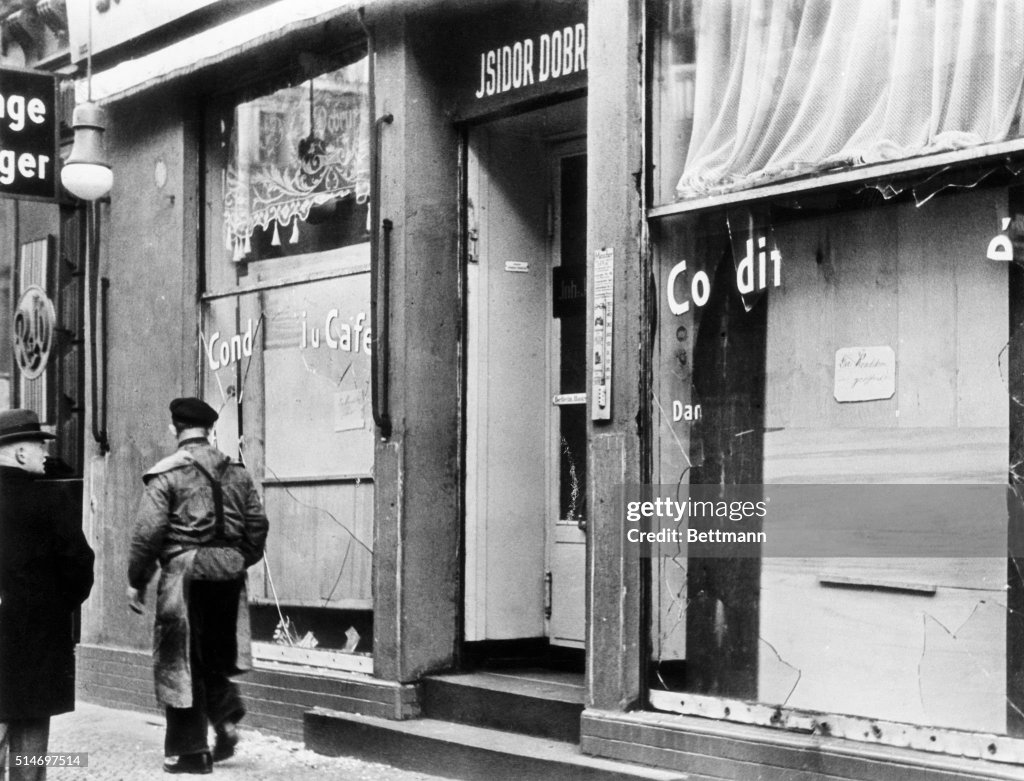
Danzig’s Nazis say that all synagogues are destroyed and most Jews arrested or driven off. They warn that Catholic churches and convents will be next.
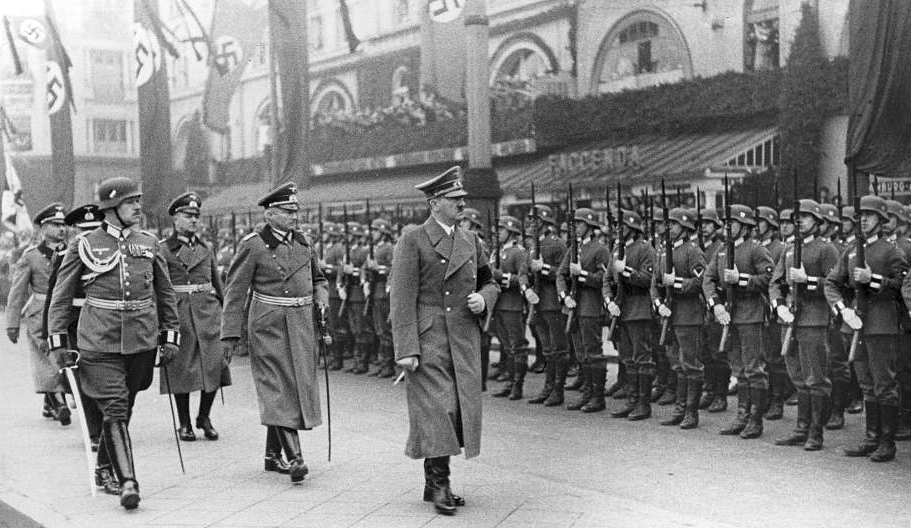
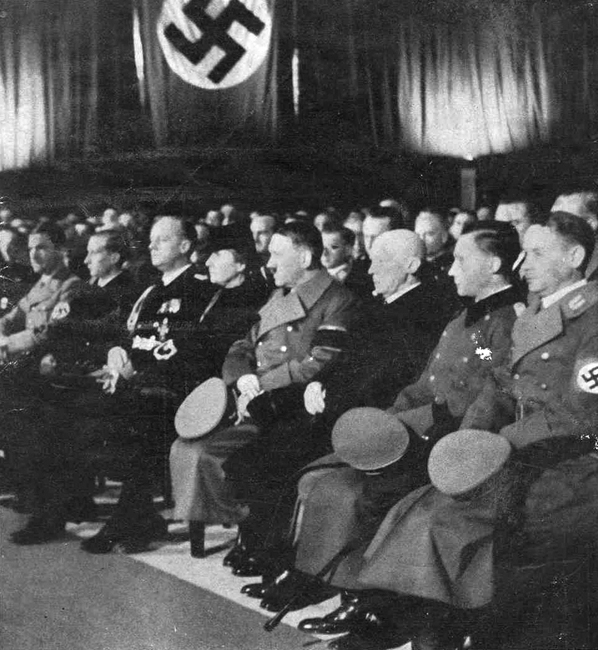
Ernst vom Rath was given a state funeral in Düsseldorf, Germany attended by Hitler.
Douglas P. Miller, United States commercial attaché and expert on German economics, today was called to Washington, D. C., less than twenty-four hours after the departure of Ambassador Hugh R. Wilson. The ambassador was called home by President Roosevelt for a report and consultation on the Nazi campaign against Jews. In business circles the summoning of Miller was taken as evidence that the United States does not expect an improvement in trade relations with Germany which is seeking self-sufficiency. Political circles saw in it a consequence of the wave of destruction which swept over Germany last week when Jewish property was smashed and other non-Nazi property owners felt that their turn was coming soon.
The United States became the butt of Nazi press attacks with Pope Pius XI., world Jewry, and those Germans who dared to criticize the wrecking of Jewish stores and synagogues and the wholesale arrests of Jews. “America is merely using anti-German agitation to cover up her imperialistic plans,” said the Berlin Nachtausgabe. Declaring that American Jewish bankers invested five billion dollars in South America, the paper said: “Washington believes that with the help of scandalous agitation against Germany, South American politicians can be scared into submitting to America’s imperialistic program at Lima. If Washington now discusses boycott plans against Germany this is only directed against German trade in South America.”
The Nobel Peace Prize is given to the Nansen International Office for Refugees in Switzerland.
Italy imposes its own version of anti-Jewish Nuremberg laws. The Italian Racial Laws passed on October 7 were adopted and became known as the November Laws.
The Battle of the Ebro River, one of the longest and most bitterly fought of the Spanish Civil War, has ended with Spanish rebels once more in complete control of the west bank. Rebel dispatches hailed the victory as one of the greatest triumphs of the war, now two years and four months old. Government dispatches insisted, however, that the defending militiamen had withdrawn to the east bank in good order after abandoning positions they took from the rebels last July 25. Border observers expected the rebels to follow up their success in northeastern Spain by launching a new general offensive quickly. A rebel communiqué asserted the government lost 75,000 men and more than 200 airplanes in the campaign.
11 people were trampled to death in Istanbul when the crowd pushed forward at Mustafa Kemal Atatürk’s lying in state, fearing the doors would close before they could see his flag-draped coffin.
Two British platoons and a detachment of guards are ambushed at dusk after clearing an Arab town of rebels. They suffer seven casualties but drive off the Arab attackers.
The leader of a faction of Arabs opposing the Mufti of Jerusalem’s group is shot down in Jerusalem; his assassin escapes. Other violence, which has become routine, continues.
The United States signs reciprocal trade agreements with Canada, the United Kingdom, and all its colonies, lowering or abolishing duties on many items. They become effective on January 1, 1939.
The Democratic majority on the legislative committee “investigating” graft charges tonight refused to permit an examination of Governor George H. Earle’s bank accounts in connection with large advances of cash he obtained from a political contractor. In the face of vigorous protests from the Republican minority, Committee Chairman Herbert Cohen, who also is Earle’s floor leader in the house, ruled against a motion which would have thrown light on the governor’s mysterious financial affairs. Earle, under fire during the primary campaign, admitted he obtained $26,500 in “loans” from Matthew H. McCloskey Jr., the Philadelphia political boss and contractor. McCloskey was awarded 10 million dollars’ worth of public works contracts by the state authority which is headed by Governor Earle.
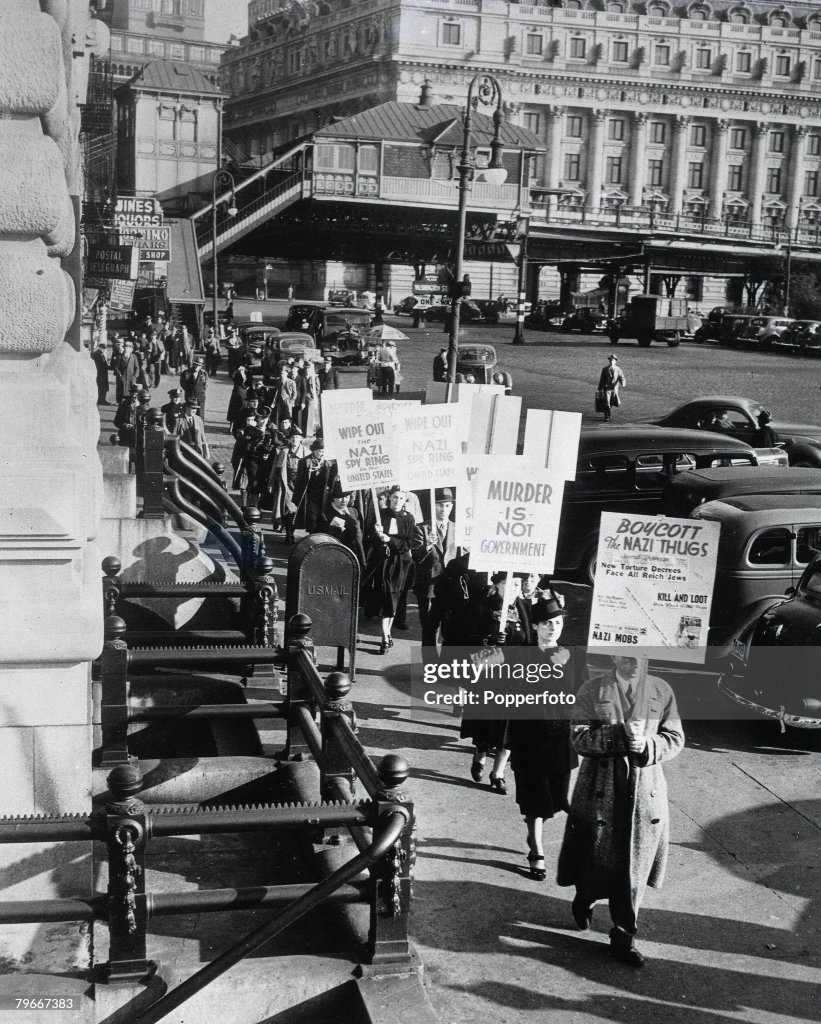
The administration, discussing the Jewish refugee problem, points out that Congress would have to change immigration laws to permit entry of more refugees. The quota from Germany and Austria is filled for the next 14 months. Government officials today expressed the opinion that the next congress will consider opening the gates of this country to refugees from the Nazi reign of terror. Special action would be necessary, because in many instances quotas now are filled far ahead. Secretary of Labor Frances Perkins said that proposals to liberalize the immigration laws undoubtedly would be offered in the next congress. The secretary, who already is under fire for laxity in enforcing immigration laws, said she had no opinion on the admittance of Nazi refugees. Madame Perkins explained that Germany’s quota of slightly more than 27,000 immigrants a year is filled for nearly eighteen months ahead and that the Rumanian quota is filled for twelve years ahead. The Spanish quota is filled for nearly nine years.
The labor secretary lunched with President Roosevelt today, but said she did not discuss immigration with him. She disclosed, however, that the state department is considering a plan to mortgage the German quota for three years ahead to permit the entry of 81,000 persons in one year. Such a proposal would require congressional action, however. Immigration Commissioner James L. Houghteling said the State Department had informed him that it had received thousands of applications in excess of the combined German-Austrian quota of 27,370 persons a year. He said that no more quota numbers could be assigned for seven or eight months.
The CIO threatens a boycott of Ford products if the company refuses to bargain collectively.
Two people are killed and 150 arrested in a strike at a jute mill near Calcutta, India. The dispute involves 30,000 workers.
Tokyo confirms that within a month, General Wu Pei-fu will head a collaborative government in central China. Wu has already been given a large fund to begin his organization.
Towns in west Kiangsi (Jiangxi) province are being burned by the Chinese as they are deserted, say Japanese pilots.
Japanese planes today made their heaviest bombing raid to date on the route of supplies coming from Soviet Russia to aid Generalissimo Chiang Kai-shek’s Chinese armies. The planes bombed Lanchow, the main crossroads of motorized supply caravans. The city is in Kansu province, 700 miles northwest of the Japanese new advanced air base at captured Hankow. Kansu borders on Tibet and Mongolia. Midway between Hankow and Lanchow, the Japanese bombed Sian, the capital of Shensi province and headquarters of the Chinese communist army.
The Japanese asserted the Lanchow raid was directed at Soviet Russian pilots and mechanics who were attempting to rebuild the Chinese air force. No account of casualties was given, but Chinese residents were said to be fleeing in fear of future raids. The Japanese also made raids along the southwestern route of supplies from French Indo-China and British Burma to China. Twenty planes raided Lungchow, in western Kwangsi province, the terminus of a railway from Indo-China. Raiders also bombed the barracks and airdrome at Liuchow, in central Kwangsi province.
On the central war front the Japanese were momentarily held up halfway between Yochow and Changsha in their drive on Changsha, the center of the Chinese silk industry. Changsha is about 200 miles southwest of Hankow. A 70-mile stretch of the Canton-Hankow railway south of Changsha was air bombed and tracks were blown up. Ichang, 175 air miles west of Hankow, was bombed twice. Vice Admiral Koichi Shiozawa, commander of the Japanese fleet in South China waters, arrived at Hong Kong today to repay a courtesy call which a British commander paid to Canton last week. It was said at Hong Kong that the Japanese and British were attempting to establish a friendlier feeling between the two navies.
Dow Jones Industrial Average: 152.78 (+1.24).
Born:
Gordon Lightfoot, Canadian folk singer-songwriter (“Sundown”; “The Wreck of The Edmund Fitzgerald”), in Orillia, Ontario, Canada (d. 2023).
Charles Guthrie, Baron Guthrie of Craigiebank, British Army general, in Chelsea, London, England, United Kingdom.
Aubrey Gatewood, MLB pitcher (Los Angeles-California Angels, Atlanta Braves), in North Little Rock, Arkansas (d. 2019).
Ken Frost, NFL defensive tackle (Dallas Cowboys), in Brentwood, Tennessee (d. 2021).

 History Diaries