Yale University Professor Frederick C. Barghoorn was released by the Soviet Union after 16 days of imprisonment. Dr. Barghoorn, a 52-year-old professor of political science, had been arrested while walking on a street near the Hotel Metropole in Moscow, the day before he was scheduled to fly home from a vacation. He was accused of espionage, and kept in a cell in the Lubyanka Prison. Ten days passed before his American colleagues became aware that he had been arrested. After protests by the U.S. Department of State, and the personal assurance by President Kennedy to Premier Khrushchev that Barghoorn was not a spy, the professor was ordered released. Less than two hours later, he was put on British European Airways Flight 911 from Moscow to London.
Communist troops molested three U.S. airliners last week with high-powered searchlights in what informed sources said could mean the Soviet Union is shifting its challenge of western rights to Berlin, from the autobahn to the air corridors. The United States, Britain, and France filed a sharp protest with the Russian air safety officer today, charging the searchlights constitute a hazard to the crews and passengers aboard the American planes. The Soviets have created several international incidents in the past month by blocking allied troop convoys on the 110-mile autobahn from West Germany to West Berlin through Communist East Germany.
Western officials said today they are concerned that the searchlight harassment indicates the beginning of a new Communist campaign of pressure on allied air traffic through the three 20-mile-wide air corridors from West Germany to West Berlin. The first searchlight incident occurred Thursday night when a Pan American World Airways plane was approaching Tempelhof Air Base over the western border of West Berlin, near the East German suburb of Potsdam.
The United States is expected to proceed — after some delay — with negotiations for a new cultural exchange agreement with the Russians, now that Moscow has released Professor Frederick C. Barghoorn of Yale.
The Soviet Union fired another unmanned satellite into orbit and warned that its nuclear missiles are capable of devastating the United States in a matter of minutes.
Arturo Illia, the President of Argentina, announced a decree cancelling all contracts between Argentina and private corporations for oil production. The largest companies affected were Standard Oil of New Jersey (later Exxon), which operated in the north at the Salta Province, and a combine of British companies that drilled in the south near Comodoro Rivadavia.
U.S. congressional leaders called today for an immediate suspension of American aid in retaliation for Argentina’s cancelation of agreements with United States oil companies. The demands for swift retaliation came although State Department sources said details of the Argentine action still are lacking. Unanswered as yet, these sources said, is the key question of compensation to the American companies involved in the complicated decrees issued yesterday in Buenos Aires. Senate Democratic Leader Mike Mansfield of Montana and Republican Leader Dirksen of Illinois expressed the opinion in separate interviews that action should be taken quickly under existing law to suspend assistance. In Argentina’s case this has been running around 100 million dollars a year in loans and grants.
Existing law says such aid shall be cut off to countries which confiscate American property and do not pay for it in six months. Tightening this up, the Senate wrote into its version of the pending foreign aid authorization bill an amendment automatically suspending all aid to nations that repudiate or nullify contracts with foreign principals and do not settle justly within six months. Mansfield said aid should be suspended “pending a just settlement.” If there is no reasonable compensation made to the companies, he said assistance should be terminated.
Claims by aides of Madame Ngô Đình Nhu that the former South Vietnamese strong woman is virtually penniless have been greeted skeptically in Saigon by government officials, businessmen, Roman Catholic priests, and others. Some sources close to Saigon’s financial circle have estimated the Ngô family’s assets as high as 50 million dollars. No one can verify these estimates, and probably no one except surviving members of the family knows what the Ngô estates are worth.
Madame Nhu left a trail of unpaid bills after her five-week visit to the United States. She left for Rome on Wednesday without settling thousands of dollars’ worth of bills at hotels in New York, Washington, and Los Angeles and some merchants’ accounts. In at least two instances, it was reported here, she started to cash travelers checks but was advised by an aide that the money “should come out of the account.” A luggage shop in New York City allowed Madame Nhu to charge $520.45 worth of luggage and gifts a month ago. No payment has been received. When the sister-in-law of the late president of South Vietnam checked out of the Madison Hotel in Washington, later in her United States visit, she again offered travelers checks, but they charged her bill, it was reported. Madame Nhu is also understood to have left the Barclay Hotel in New York without settling her account. The Beverly Wilshire Hotel in Los Angeles said that she still owed nearly $1,200 for her 10-day stay there.
Cambodia seems to be drifting gently to the left economically, but the Southeast Asian nation is expected to retain its strict policy of political neutrality.
A former chairman of Guatemala’s National Congress and a group of former deputies have been arrested and accused of plotting against the ruling military junta, sources said today. Manuel Orellana-Portillo and the unidentified former deputies were described as followers of former President Miguel Ydigoras-Fuentes, who was ousted by a military coup last March. Sources said they were arrested while trying to hold a secret session reasserting constitutional government and naming Colonel Catalino Chavez as president.
Success of the Alliance for Progress now appears to hinge to a great extent on selection of a chairman to head the newly formed committee that will oversee the vast aid program. for Latin American nations.
The municipality of Knox, Victoria, was established in Australia by proclamation of the Governor of the state of Victoria, with a population of about 21,000 residents. On July 4, 1969, Knox would qualify to be upgraded from a shire to a city. Fifty-five years later, Knox, a suburb of Melbourne, had more than 150,000 residents.
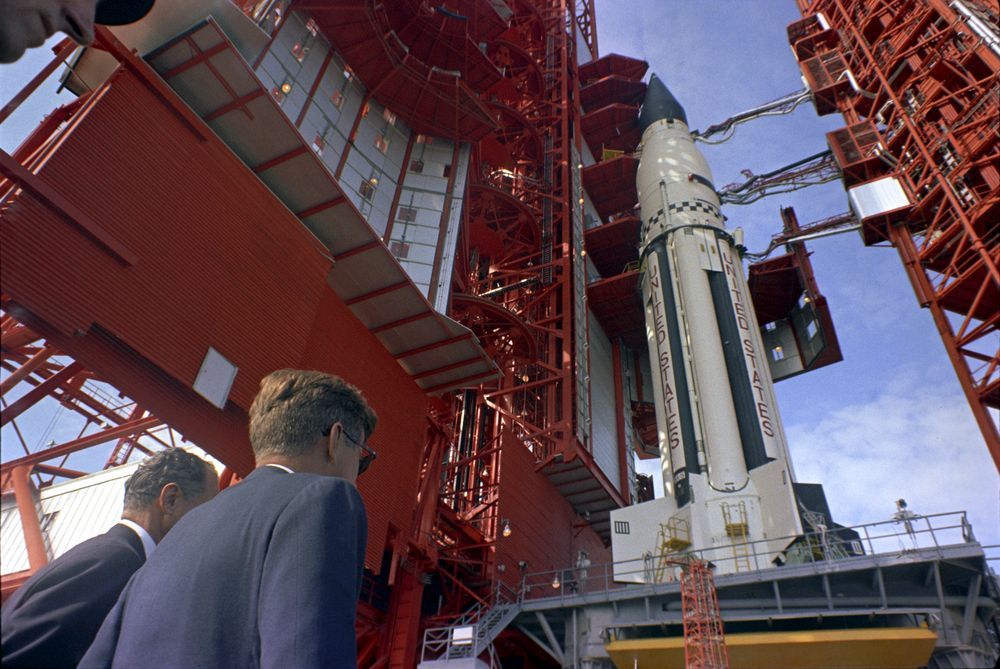
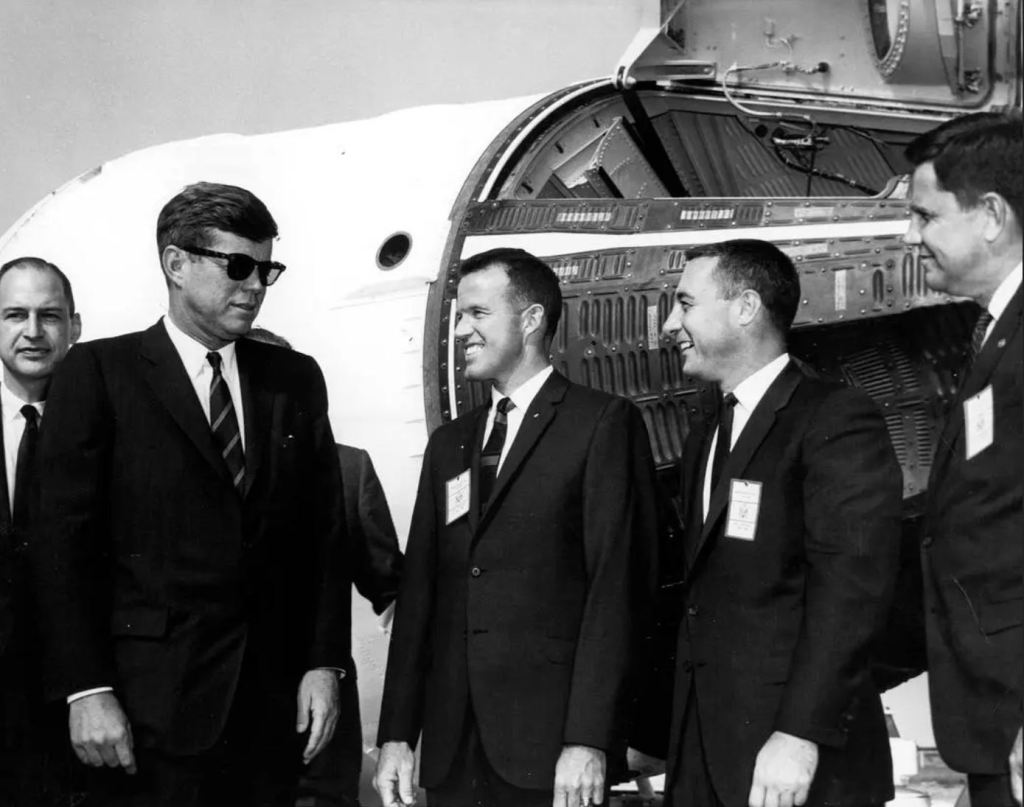
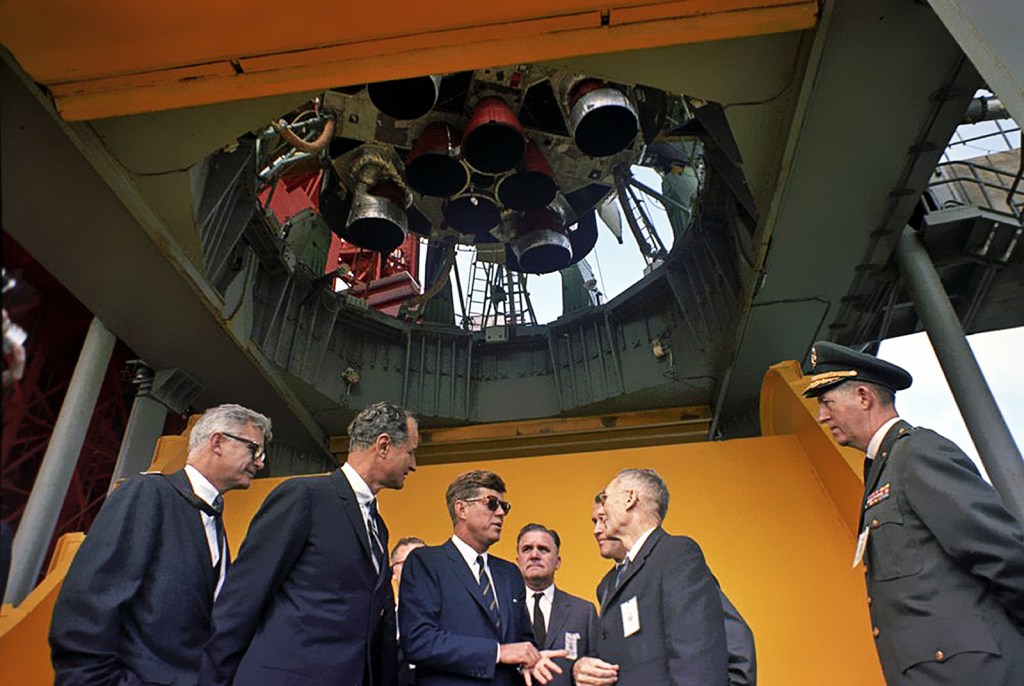
President John F. Kennedy was in Florida to visit the Cape Canaveral Space Center (later to be renamed Cape Kennedy). While there he received a briefing from Dr Werner von Braun, the NASA scientist who had once been one of the leading figures in the development of rocket technology in Nazi Germany during World War II. He was also briefed by astronauts Gus Grissom and Gordon Cooper.
After emerging from the Saturn Control Center into the blinding sunshine, von Braun and Kennedy were driven to a launch pad where the skyscraper-high Saturn I rocket stood pointed at the heavens. Von Braun explained that when it was launched next month, it would be more powerful and would carry a heavier payload than anything the Soviet Union had shot into space.
After staring at it for several moments, Kennedy said, “Now, this will be the largest payload that man has ever put into orbit, is that right?” After von Braun again assured him that it was, he said, “That is very, very significant.”
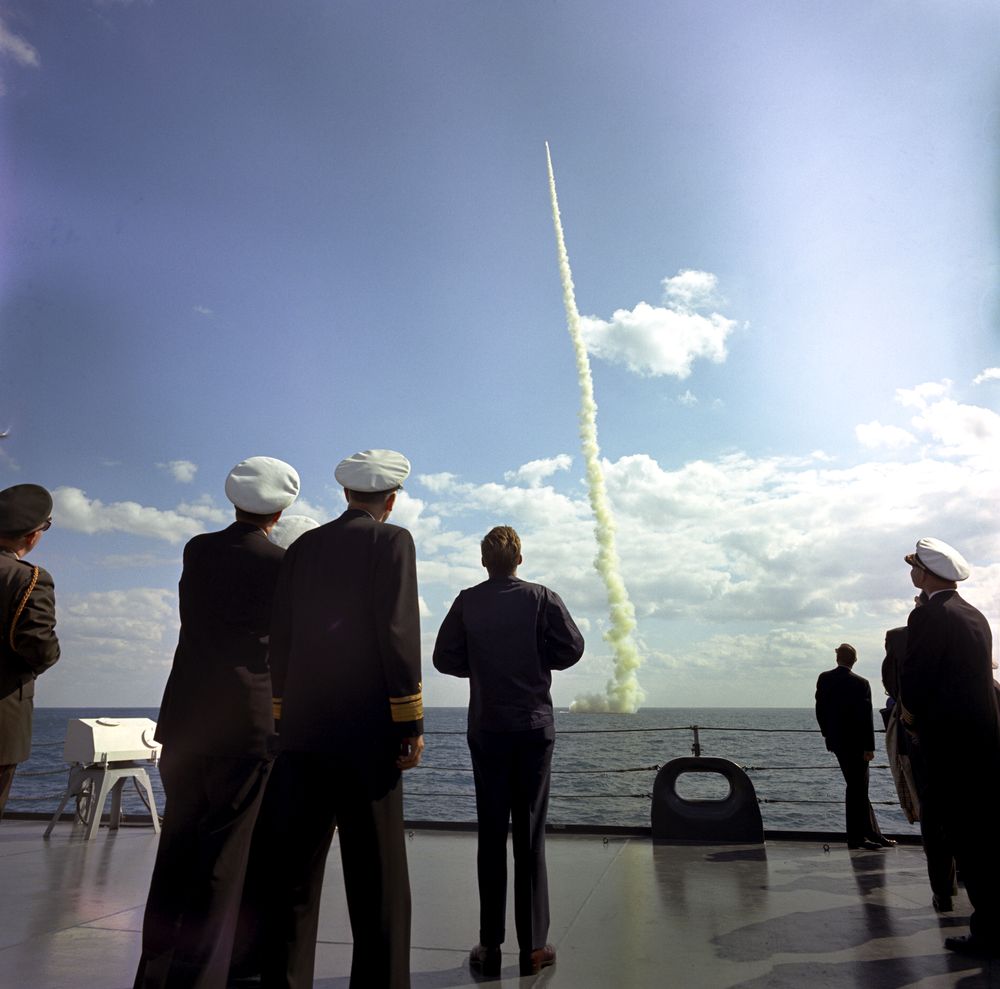
The president later traveled by helicopter from the Cape to a Navy vessel, the USS Observation Island (EAG-154), where he watched the launch of a Polaris A-2 missile from a submarine.
Governor Nelson A. Rockefeller of New York tonight, in his first major speech since becoming a candidate for President, said the Kennedy administration is jeopardizing peace and demoralizing our allies with a weak, indecisive foreign policy. “The fog of soothing statements coming from Washington will not be able to hide indefinitely that all is not well within our position in the world,” Rockefeller said in a speech prepared for delivery at an awards dinner of the Press Club of metropolitan St. Louis. “We must realistically face the fact that our world position has deteriorated under the present administration.”
Leaders of the drive to make Senator Barry Goldwater the 1964 Republican Presidential nominee sized up their operation today — and their chairman said he thinks at least 500 convention votes already are in the Goldwater column. It will take 655 votes at the San Francisco convention next August to nominate the Republican candidate for the White House. Peter O’Donnell Jr., Republican state chairman of Texas and head of the national Draft Goldwater organization, gave that forecast of the senator’s delegate strength after meeting with 65 leaders of the draft movement.
Harold E. Stassen said he is “testing the extent of sentiment” for his becoming the Republican Presidential nominee. He said he has been told that “as Republican nominee for President I could unite the supporters of both Senator (Barry) Goldwater and Governor (Nelson) Rockefeller and add the essential additional 10 to 15% of independent voters to lead the Republican Party to victory next November.” Stassen, 56, was elected three times as governor of Minnesota, from 1939 to 1945. He resigned in his last term to enter the Navy, and later was president of the University of Pennsylvania and disarmament adviser to former President Dwight D. Eisenhower.
Former President Dwight D. Eisenhower does not rule out the possibility of a dark horse winning the 1964 GOP Presidential nomination; he is staying neutral so far.
The Toledo, Ohio newspaper strike began. The American Newspaper Guild struck and closed down The Toledo Blade and The Toledo Times today. After mediation failed to settle the walkout, The Blade called off publication for the first time in its 135-year history.
Roughly 10,000 dead gulls have been found on the shores of Lake Michigan this week. Scientists are working to determine a cause.
High winds whipped a prairie fire over 60 square miles of eastern Oklahoma today, destroying a dozen buildings and endangering two small communities and a girls’ reform school. Hundreds of volunteers battled the Muskogee County fire, described by a highway patrolman as the worst he has ever seen. Several smaller fires branching out from the main blaze were reported under control shortly after dark, and firemen began concentrating on flames which swept toward Boynton, Oklahoma, which has a population of 600. Backfires were started on the outskirts of Boynton in an attempt to halt the flames, driven by winds which spectators estimated reached 50 to 60 miles an hour.
A bank in Tulsa, Oklahoma, that closed because it had too much business, will not reopen for another two weeks while harassed clerks catch up on their bookkeeping. Customers, meanwhile, are having a hard time since they cannot get at their deposits.
Washington’s smooth road to the Rose Bowl became rocky today when the Huskies were rudely upset by the downtrodden UCLA Bruins, 14-0, in the Coliseum. In an intersectional battle, California rallied to overcome Utah, 35-22. Michigan State, the Big Ten’s top Rose Bowl hopeful, survived a scare to defeat Notre Dame, 12-7. Purdue nipped Minnesota, 13-11; Michigan and Iowa played to a 21-21 tie; Illinois whipped Wisconsin, 17-7; and Northwestern beat Ohio State, 17-8. Navy stormed past Duke, 38-25, and Pittsburgh halted Army, 28-0. Texas virtually clinched a Cotton Bowl bid with a 17-0 victory over TCU.
Born:
Zina Garrison, American tennis player (Wimbledon runner-up 1990, Olympics doubles gold, 1988), in Houston, Texas.
Kevin Sweeney, NFL quarterback (Dallas Cowboys), in Bozeman, Montana.
Murray Wichard, NFL nose tackle (New England Patriots), in New York.
Mani [Gary Mournfield], English rock bassist (Stone Roses; Primal Scream), in Crumpsall, Manchester, England, United Kingdom.
Died:
Carlo Buti, 61, Italian popular singer.
Six Days to Dallas.
 History Diaries