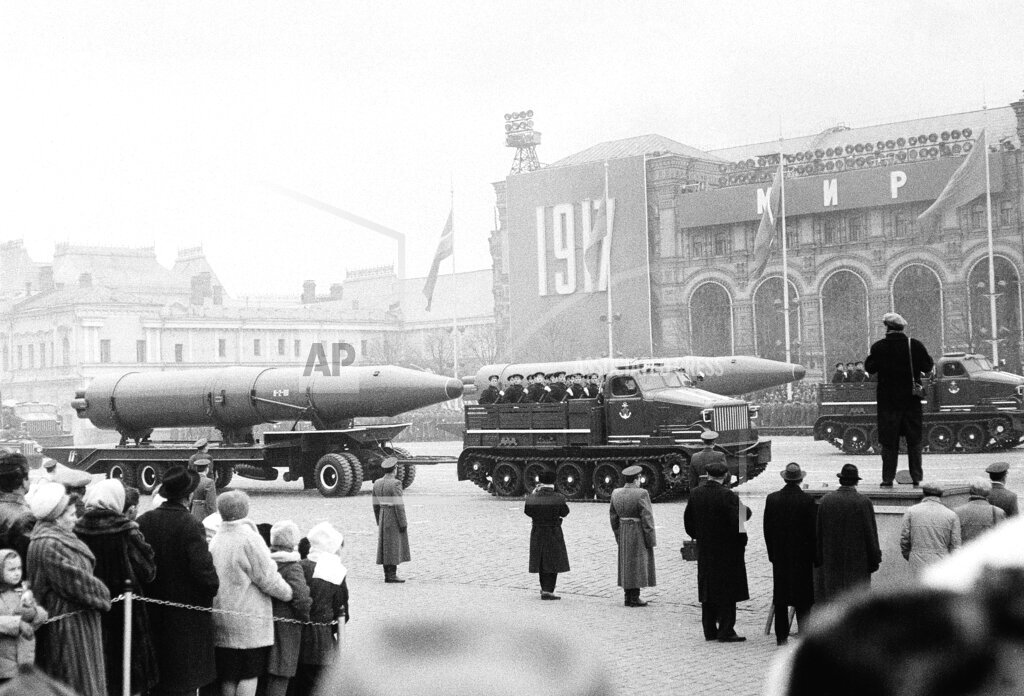
Photograph: View of the Soviet Naval rocket, November 15, 1963, which resembles American Polaris which can be fired from underwater subs. Western military experts doubt that the Soviet rocket has the same capability. (AP Photo)
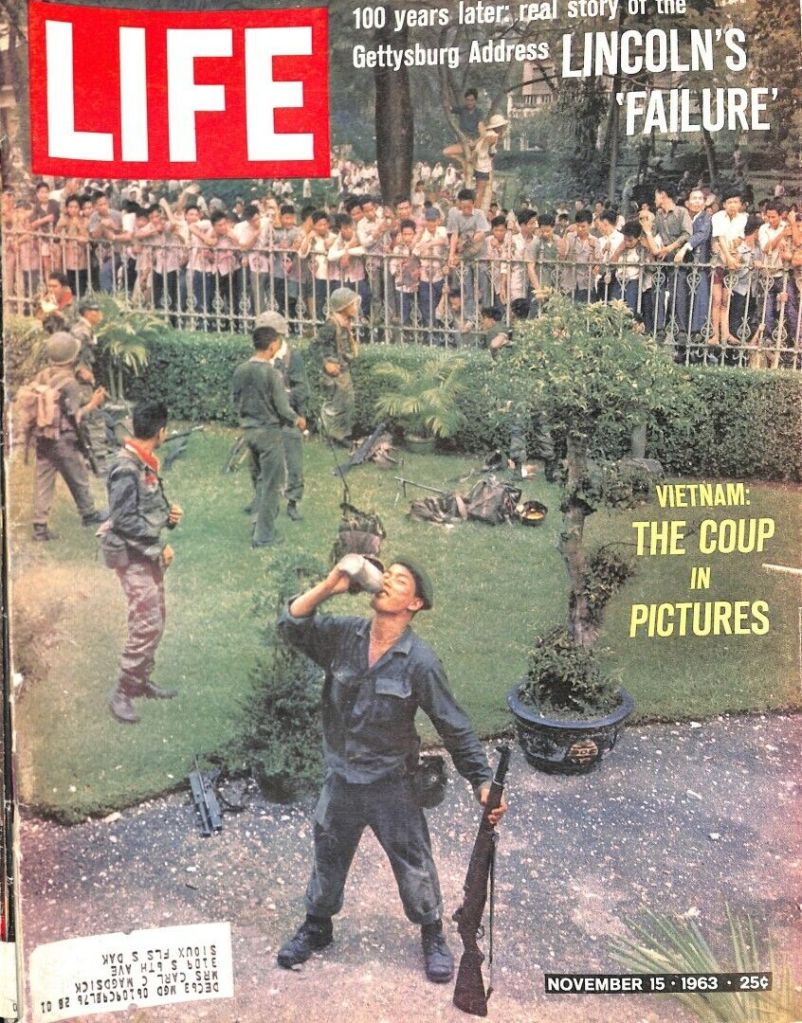
A U.S. military spokesman in Saigon reports that 1,000 U.S. servicemen will be withdrawn from South Vietnam beginning 3 December.
General Dương Văn Minh, acting chief of South Vietnam’s revolutionary government, said that Madame Ngô Đình Nhu’s diplomatic passport has been ordered withdrawn.
Members of the Ba’ath International Command announced they are assuming control of the Iraqi government where a power struggle threatens revolt.
President Arturo Illia tonight annulled Argentina’s multi-million-dollar oil contracts with American and other foreign oil companies. He put Argentina’s petroleum production and development completely under state control. The companies said they had invested nearly 400 million dollars in the last five years in fulfilling the contracts.
The refineries have been operated by Shell Oil — a British-Dutch consortium — and Esso Argentina, a subsidiary of Standard Oil (New Jersey). It was not immediately clear whether the decrees also covered the refining operations. The long-awaited decrees fulfilled promises made in the six-month-long presidential campaign and reiterated almost daily by Illia since he took office. W. Averell Harriman, United States undersecretary of state, has warned that the action could have serious consequences unless promptly followed by adequate compensation.
Members of the United Nations main political committee voted by acclamation for a compromise resolution worked out by United States and Russian delegates calling for the resumption of disarmament talks by the 18-nation U. N. disarmament commission in Geneva. The body has been stalled for two years.
American embassy officials angered by the arrest of Yale Professor Frederick Barghoorn tonight boycotted a Soviet-American friendship meeting. Valerian Zorin, deputy foreign minister, retorted that they were making “a mountain out of a molehill.” The meeting to celebrate the 30th anniversary of the restoration of United States-Soviet diplomatic relations by the Roosevelt administration was attended by Mrs. Nina Khrushchev. But American Ambassador Foy Kohler flew to Copenhagen for the day and other American officials stayed home.
While speakers lauded United States-soviet friendship before a background of crossed American and Russian flags in Friendship House and in front of 25 empty chairs. Zorin told newsmen he regretted that no one came from the American embassy. The reception was held shortly after the United States had delivered its seventh demand this week that the professor be freed immediately and that American officials be allowed to talk with him. Barghoorn, 52, has been held incommunicado since October 31 on spy charges.
The Russians reportedly are seeking alcohol in the United States to alleviate a shortage of vodka, their national drink. The embarrassing turn, which one industry spokesman likened to a shortage of bourbon in Kentucky, came just one week after Premier Nikita Khrushchev boasted to an American business man in Moscow: “Our vodka is better than yours.” The businessman is Edgar M. Bronfman, president of Joseph E. Seagram & Sons, Inc., the biggest American distiller. Seagrams confirmed that it received an inquiry on the possibility of selling 30,000 tons of potable alcohol to the Soviet Union. The company declined to name the source of the inquiry. The potentially great Russian thirst is believed to be a result of a poor harvest, forcing the Russians to use available grain and potatoes for food instead of alcohol.
The United States and Britain differ over the question of long term credit to communist countries. Undersecretary of State George Ball and Edward Heath, British trade chief, hold a 90-minute meeting but reach no policy agreement. The meeting is held on the eve of the trade conference opening in Paris next Monday. The United States wants a five-year limit on credits given to communist countries and Britain wants no limit, since it would tie her hands on potential trade.
The new island of Surtsey was created off of the coast of Iceland by the eruption of an undersea volcano, and was first spotted by the crew of the Isleifur II, a fishing boat from Iceland. By June 5, 1967, upon the halt of the eruption, the island would have an area of 2.8 square kilometers (1.08 square miles).
Eighteen Latin-American nations approved the formation of a committee designed to act as a “watchdog” over the United States’ Alliance for Progress funds.
Seven days before President Kennedy’s scheduled visit to Dallas, Democratic Party leader Baxton Bryant sent an angry telegram to President Kennedy complaining that Democratic supporters were being shut out of the planned November 22 luncheon by Dallas Republicans who were in control of the Dallas Citizens Council. The plea was for the President to do something or face a boycott by his most loyal supporters. “A motorcade from Dallas Love Field to downtown Dallas was arranged for the Kennedys after another Bryant complaint,” a United Press International report would note on the eve of the President’s visit.
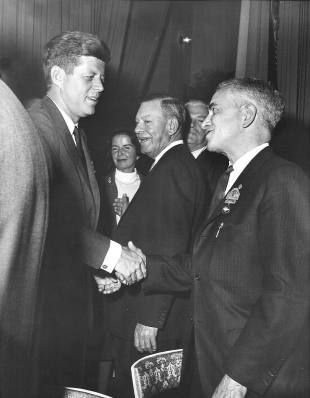
November 15, 1963 was another busy day for President John F. Kennedy. He began the day with a meeting with Henry Luce, the publisher of Time and Life magazines. He complained to Luce that his magazines were biased against his administration, despite the fact that they were often filled with flattering photos of him and the first lady. That afternoon he spoke at a convention of the AFL-CIO, and boasted about how the average factory worker was making $10 a week more than at the time of Kennedy’s inauguration and how a 5.5% unemployment rate would improve even more if his proposed tax cuts were passed. The speech covered a variety of other subjects, including peace through strength and civil rights.
Later that day he spoke at another convention, this one of the Catholic Youth Organization. After the speech, he flew to Palm Beach, Florida. On the flight he became upset with Senator George Smathers, who asked about a rumor that JFK intended to drop Lyndon Johnson from the Democratic ticket in the 1964 election. In his recent book entitled JFK’s Last Hundred Days: The Transformation of a Man and the Emergence of a Great President, author Thurston Clarke writes, at pages 303-3:
When Smathers remarked offhandedly, "Everyone on the hill is saying that Bobby is trying to knock Johnson off the ticket," Kennedy's denial was so vehement that the comment had obviously struck a nerve. "George, I presume you have some intelligence," he said sarcastically. "I love this job, I love every second of it." Why then, he asked, would he risk it by picking a fight with Johnson that might guarantee him losing all of the southern states? And if he dropped Johnson now, when his protege Bobby Baker was in the headlines, it would appear that he had some kind of involvement in the Baker scandal that he wanted to conceal. And if that happened, he predicted, "Life magazine would put twenty-seven pictures of these lovely looking, buxom ladies running around with no clothes on, twenty-seven pictures of Bobby Baker and hoodlums and vending machines, and then the last picture would be of me. And it would say 'Mess in Washington under Kennedy Regime,'" and then 99 percent of Americans would conclude that he was running around with the girls. (He had forgotten, or decided to overlook that Smathers was a regular at Baker's Quorum Club, and had known many of these "buxom ladies.")
Seven Days to Dallas.
President Kennedy, making a pitch for labor union support, tells the AFL-CIO convention in New York that jobs are the most important issue of the day and that civil rights are second. Kennedy assails the record of former President Eisenhower and takes hefty jabs at Senator Barry Goldwater (R-Arizona).
The Senate, which showed almost as much determination as the House to reduce foreign aid spending, today voted 63 to 17 to lower the total of the 1964 program to $3,702,365,000. Passage of the 1964 aid authorization bill came as a compromise was reached after a fight to include in the bill an amendment to bar the Export-Import bank from providing the credit for sales of wheat to Russia and its satellites.
The Senate agreed to send the question of the Export-Import bank credit operations in the sale of American wheat to iron curtain countries to its banking committee for hearings next week and a decision before November 25. The Export-Import bank, it was announced, will withhold further credit guarantees until the Senate can reach a decision. Senate Democratic leader Mike Mansfield emphasized that a decision must be reached on the issue immediately. The aid bill, which is $827,250,000 lower than the 4.5-billion-dollar program President Kennedy proposed last spring, is just 200 million dollars higher than the 3.5-billion-dollar ceiling on aid spending approved by the House in its bill.
The bill now will go to a Senate-House conference committee to compromise the differences in the two measures by the two houses. After passage of the bill today, Press Secretary Pierre Salinger said the White House would have no comment on the action.
Senator Barry Goldwater (R-Arizona), speaking before the Harvard Business School association in Pittsburgh, says the present administration’s taxing and spending policies are partly responsible for the nation’s large unemployment. Instead of providing jobs for 1,125,000 new workers every year, he says, the government has been holding down job opportunities by curbing the economy and destroying incentive.
Virginia’s Democratic Senator Harry Byrd, chairman of the Senate Finance Committee, says public concern over the nation’s solvency, as reflected in his mail, is higher than at any other time in his 30-year career. He predicts that the administration will find this concern reflected in next year’s election.
Two Senate Democrats report that they at one time wanted and would have gotten Judiciary Committee assignments, held by Democrats of more conservative persuasion, if the former majority secretary, Bobby Baker — under investigation for alleged conflicting outside interests — had not made false reports to the Senate leadership about their preferences.
A former convict, testifying at the trial of Attorney T. Eugene Thompson in the murder of Thompson’s wife, says two men were asked if they would commit murder for $2,000 and that both turned down the offer. Sheldon Morris, 34, tells jurors that Norman J. Mastrian, alleged middleman in the “murder-for-hire” plot, asked Richard L. Sharp and Willard Ingram, separately, if they were interested in “a small hit.” The state charges that Mastrian eventually hired Dick W. C. Anderson and that Anderson killed Mrs. Thompson.
Two gunmen wearing shore patrol uniforms rob a crowded bank at the San Diego naval station and escape through the guarded main gate with $125,700, the Federal Bureau of Investigation reports. Officials of the Bank of America branch say the loot is “mostly cash.” The bandits, wearing white helmets, fire two shots into the ceiling to cow an estimated 45 persons in the bank. One of the gunmen holds a revolver on the crowd, and the other scoops up the money from the cash drawers of five tellers.
The U.S. Air Force announced that Major Robert W. Smith had set a new record for altitude reached by an airplane from ground takeoff, topping out at 118,860 feet, or more than 22½ miles above sea level. Although the feat is commonly described as having happened on this date, Brigadier General Irving L. Branch noted only that it had happened “this week” rather than on that day. Major Smith, a former fighter pilot during the Korean War, was flying an F-104A Starfighter jet that had been outfitted with an additional rocket motor with 6,000 pounds of thrust. He had taken off from the Lockheed Corporation proving grounds in Palmdale, California, about 2,600 feet above sea level, and broken a Soviet record of 113,890 feet set on April 28, 1961.
Fritz Reiner, one of the great conductors of the world, died of pneumonia last night in New York’s Mount Sinai hospital. He had been confined there since Sunday, when a collapse canceled his return to the Metropolitan Opera as conductor of Richard Wagner’s “Die Gotterdammerung.” He would have been 75 on December 19.
Dow Jones Industrial Average: 740.00 (-7.04).
Born:
Lee Weigel, NFL running back (Green Bay Packers), in Marshfield, Wisconsin.
Michele McAnany, female infielder (Colorado Silver Bullets), in Los Angeles, California.
Died:
Duncan K. MacTavish, 64, Canadian Senator from Ottawa, and former president of the National Liberal Federation, was killed in a five-car pileup on the Queen Elizabeth Way.
Linus McAtee, 65, American Hall of Fame jockey (Preakness Stakes 1916; Kentucky Derby 1927, 1929; US Champion Jockey by earnings 1928).
(Frederick) “Fritz” Reiner, 74, Hungarian-American conductor (Cincinnati Symphony, 1922-1931; Pittsburgh Symphony, 1938-1948; Chicago Symphony Orchestra, 1953-1963), and educator (Curtis Institute), of pneumonia.
Seven Days to Dallas.


 History Diaries