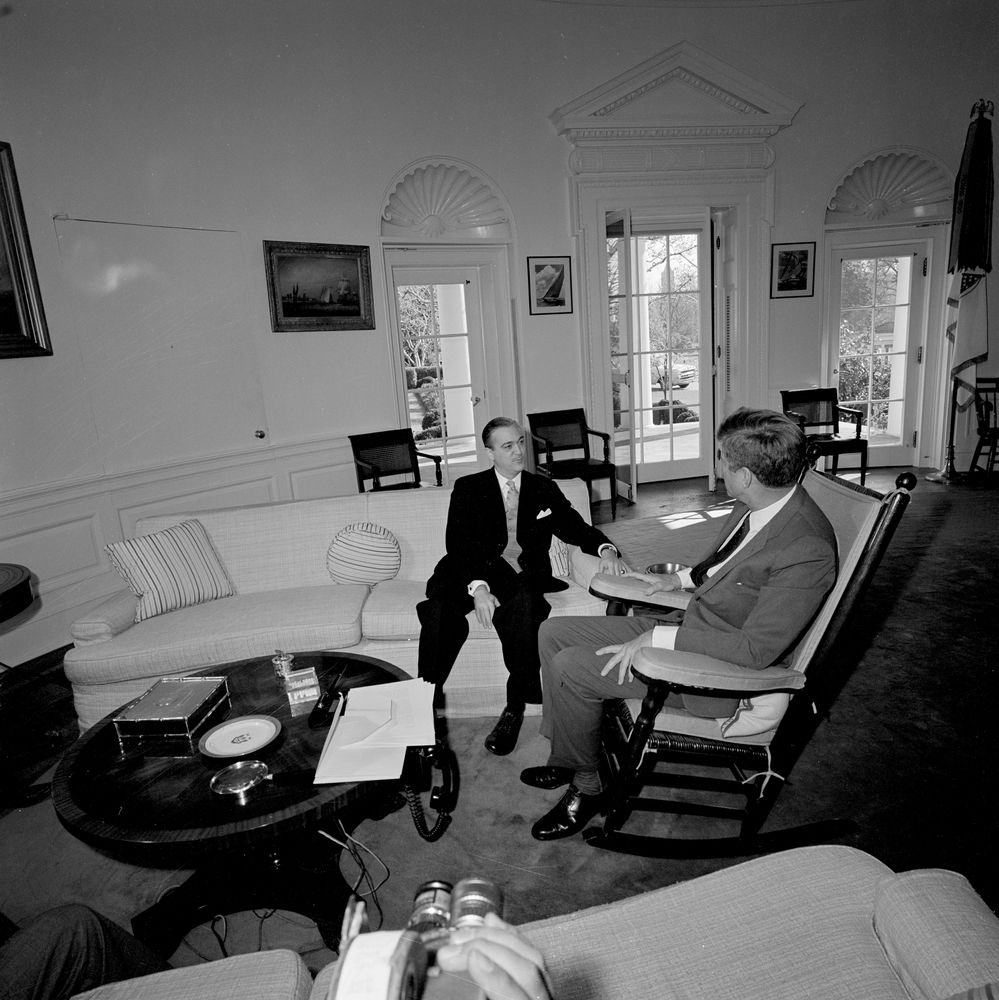
Photograph: President John F. Kennedy (in rocking chair) meets with newly-appointed Ambassador of Uruguay, Juan Felipe Yriart, in the Oval Office of the White House, Washington, D.C., 12 November 1963. An unidentified person (mostly hidden, holding a motion picture camera) films in the foreground.
10 Days to Dallas.
The Soviet government newspaper Izvestia denies that the Soviet Union promised the United States it would withdraw all Russian troops from Cuba. It insists no such pledge was made to W. Averell Harriman, United States special envoy, and says the problem of stationing troops in Cuba should be decided between Russia and Cuba.
Professor Frederick Charles Barghoorn, a Yale University Russian specialist visiting the Soviet Union as a tourist, is under arrest on a charge of spying, the Russians announced today. Tass said Barghoorn, 52, the author of several books critical of the Soviet Union, was picked up “the other day” in Moscow for espionage by state security organs and an investigation is underway. The foreign ministry notified the United States embassy of his detention, the first such case involving an American since the summer thaw in the Cold War.
Senator Thomas J. Dodd (D-Connecticut) urges U.S. Secretary of State Dean Rusk to suspend the sale of wheat to Russia in retaliation for the seizure of a Yale professor on spy charges. Dodd tells Rusk that immediate pressure should be brought to bear on the Kremlin for his release.
The United States closed about 11% of its territory to travel by diplomats of five European Communist countries to curb Red collection of defense data.
Neutralist Cambodian Prince Norodom Sihanouk today renounced U.S. military and economic aid as of next January 1 and said French and American troops must leave his Southeast Asian kingdom. There was no indication he would renounce the aid he has been receiving from the Soviet Union, Communist China, and other Communist nations, and he said he would call in five Red Chinese experts to help organize “state control.” U.S. officials in Washington expressed concern over the development because of Cambodia’s strategic location in Communist-threatened Southeast Asia and said they were disturbed over the possibility Sihanouk might swing closer to Communist China.
High ranking American officials will gather next Wednesday in Honolulu for a strategy meeting on the anti-communist war in South Vietnam in the light of the military coup which deposed the Diệm regime. Among those participating will be Secretary of Defense Robert S. McNamara, Secretary of State Dean Rusk, and Henry Cabot Lodge, ambassador to South Vietnam.
The strong-willed Madame Ngô Đình Nhu, still emotionally shaken by her husband’s death and the coup that overthrew her country’s government, was described tonight as trying desperately to pull herself together to leave tomorrow for Rome. She was under a doctor’s care tonight for the third time in 24 hours. And for the third time in one week, she is attempting to get to Rome where her three younger children await her. After this morning’s visit, the Beverly Hills physician advised her to remain in bed in the Bel-Air home where she is a guest until “probably Friday.” He pronounced her “physically exhausted and emotionally depleted.” But shortly after he left, she told an aide she felt “all right.”
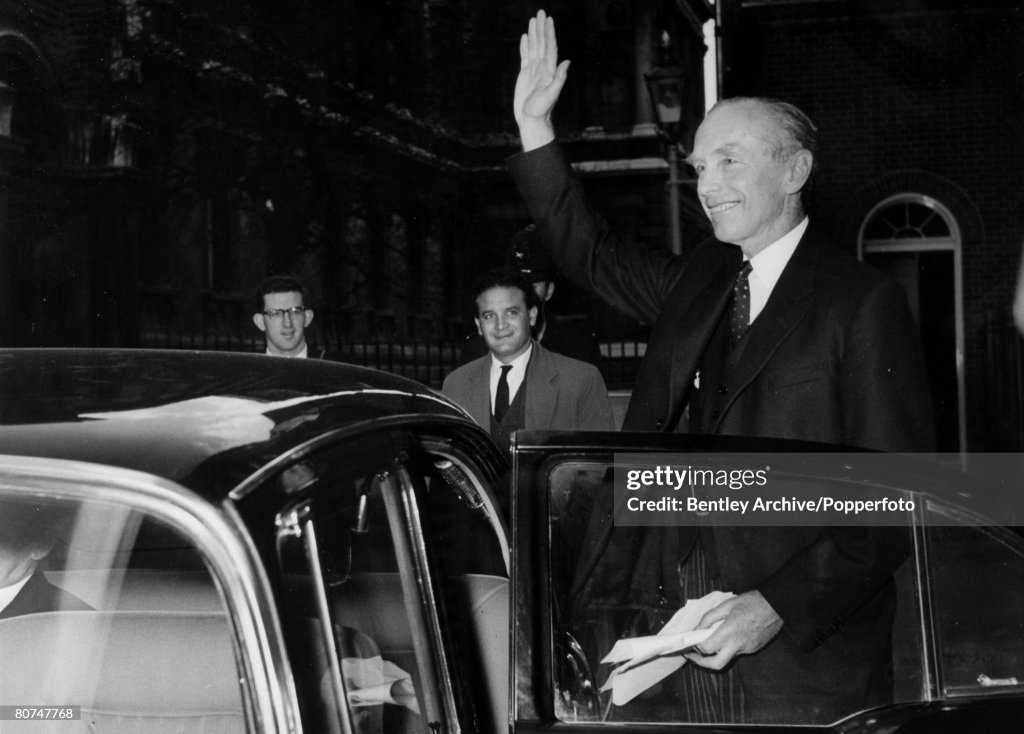
Britain’s new prime minister, Alec Douglas-Home, opens his attack on the British Labor party with an appearance, his first in 12 years, in the house of commons. Home says his battle cry will be, “A Britain modern and efficient, happy in shared prosperity, a world at peace.”
Salah al-Din al-Bitar stepped down as Prime Minister of Syria, and was replaced by Major General Amin al-Hafiz, the commander in chief of Syria’s armed forces and chairman of the National Revolutionary Council. Bitar had talked for several months about his wish to resign from the Ba’ath government, and his departure was not related to the shakeup within the Ba’ath Party in neighboring Iraq.
In a major political shakeup in Iraq, Ali Salih al-Sa’di, the Vice Premier, was fired from the leadership of Iraq’s Ba’athist Party, and he and 18 of his colleagues were seized at gunpoint and flown into exile in Madrid. Replacing the Ba’ath leadership was Prime Minister Ahmed Hassan al-Bakr at the head of a 15-member council. The shakeup would lead to repercussions that would change the Iraqi government. Reportedly, 15 members of the Iraqi Army burst into a meeting of the Ba’ath Congress and seized al-Sadi and the other advisers at gunpoint before putting them on the airplane to Spain.
The United States suffers a parliamentary defeat in the United Nations special political committee as the communist nations combine with the Afro-Asian bloc to give priority to an Afghanistan resolution criticizing the failure to solve the Palestine refugee problem.
A general strike called by Communist labor unions flopped as a demonstration of left-wing strength in Italy’s cabinet crisis.
The Argentine government brushed aside warnings from U.S. sources and made it clear it will proceed with its plans to cancel oil contracts with foreign firms.
The West German Defense Ministry acknowledged that a cable suggesting a meeting between the ministry and Lockheed Aircraft Corp. over Bonn charges of lobbying by the U.S. firm had been received.
Felipe Herrera, president of Inter-American bank, tells a Sao Paulo conference that there has been a grave deterioration in the Latin-American financial position in recent years. He says 11 Latin-American countries are in the grip of inflation, and private investment is declining.
President John F. Kennedy’s day had at least two important themes: Cuba and re-election. Author Thurston Clarke, in his recent book entitled JFK’s Last Hundred Days: The Transformation of a Man and the Emergence of a Great President, tells us that on November 12, 1963, Kennedy chaired a meeting of senior administration officials to discuss the issue of getting rid of Fidel Castro. The President was discouraged to learn from CIA Director John McCone that Castro’s military remained fiercely loyal to the Cuban strongman. Desmond Fitzgerald, who was in charge of the CIA’s anti-Castro activities, reported that US sanctions against Cuba weren’t doing very much because Canada, Spain and the United Kingdom continued to trade with the Cubans. In spite of the ineffectiveness of the US effort against Castro, the group agreed to continue their efforts because they didn’t cost that much and because they helped the morale of the anti-Castro Cubans in the United States. Kennedy also agreed to used private diplomatic channels to send an invitation to Dr. Rene Vallejo, one of Castro’s main advisers, to visit the United States.
Kennedy convened the first formal meeting of his re-election team in the cabinet room on Tuesday afternoon. Attending it were his brother Bobby, his brother-in-law Stephen Smith, who would be managing the campaign, his political advisers Lawrence O’Brien and Ken O’Donnell, Ted Sorensen, John Bailey who chaired the Democratic National Committee (DNC), DNC Treasurer Richard Maguire and Richard Scammon, the Director of the Census Bureau. Vice-President Johnson had not been invited. It is unlikely Kennedy simply forgot to invite him to the meeting, because he frequently complained about Johnson’s sensitivity and must have known he would be hurt to be excluded from the first major planning session for the 1964 campaign. Johnson had left for his Texas ranch two days earlier but would surely have stayed in Washington to attend an important meeting like this one. Sorensen believed he had been excluded because he was “not part of the inner circle and did not have the warmest relations with – or full confidence of – everyone in that room,” a polite way of saying that, as Sorensen well knew, Kennedy had little confidence in his ability to perform the only vice-presidential duty that really mattered, assuming the presidency.
Kennedy and Johnson’s relationship had reached a nadir that fall after Johnson aligned himself with the hard-line Diệm supporters in the administration and criticized the wheat deal. He sat silently at White House meetings, offering a few mumbled remarks or becoming infuriatingly loquacious. Kennedy may not have wanted him around because he was afraid that a man who considered himself more politically astute than anyone else in the White House would try to dominate the meeting, and perhaps because he was undecided about keeping him on the ticket. Even so, it was a curious omission, since the meeting concerned a re-election campaign in which Johnson’s home state that would play a key role. Kennedy even raised the subject of his forthcoming visit to Texas at the meeting, saying in an irritated voice that he would be seeking campaign funds as well as votes, and adding, “Massachusetts has given us about two and a half million, New York has been good to us, but when are we actually going to get some money out of those rich people in Texas?”
Ten days before his death, President Kennedy signed off on National Security Memorandum Number 271, a then-secret memorandum to NASA Administrator James E. Webb, entitled “Cooperation with the USSR on Outer Space Matters”, telling him “to assume personally the initiative and central responsibility” to develop specific technical proposals “for broader cooperation between the United States and the USSR in outer space, including cooperation in lunar landing programs.” Following Kennedy’s death, the United States continued pursuing its goal of putting a man on the Moon before the end of the decade — and without Soviet assistance.
Chief Justice Earl Warren notified the House today that he “would not approve” a congressional proposal to inscribe “In God We Trust” above the bench of the Supreme Court. In a letter to Rep. Robert T. Ashmore (D-South Carolina), Warren said that the motto would “detract” from the beauty of the U.S. Supreme Court chamber. Rep. Howard Smith (D-Virginia) told the House that these words are inscribed in gold on the walls of both the Senate and House chambers, and “is the motto of the United States.”
A spectacular general alarm fire in buildings adjacent to the historic Cliff House restaurant on San Francisco’s ocean front was brought under control after two and a half hours of hazardous work. Nine firemen were hurt, none seriously. Seven of them were treated for smoke inhalation. However, no tourists or employees of the Cliff House complex of buildings were reported injured.
A heavy pall of smoke drove everyone into the street before flames exploded in a gift shop, two coffee houses, and a museum. Flames came within 50 feet of the Cliff House restaurant, but the building escaped damage, thanks to a westerly ocean breeze which blew the fire away from it. At the height of the blaze, flames shot 100 feet into the sky and were visible for miles. The Cliff House area, south of the Golden Gate, was closed off by police to all traffic, but thousands of people swarmed into the area anyway, along the beaches, on top of nearby hills and into the streets.
New York police disclose reasons why the jewel robbery last week was a dismal flop: The driver of a getaway car containing 3 million dollars worth of gems and gold was unfamiliar with a manual gear shift and repeatedly stalled the car, finally abandoning it near the site of demolition work. Workmen on the job helped themselves to jewels.
Police fear a bizarre kidnap-slaying has been repeated in Alameda County, California, with the disappearance of an 18-year-old University of California co-ed, Judith Williamson. Many parallels between her case and that of a 14-year-old school girl in 1955 are brought out by police. Judith Gail Williamson was a motivated kid; she won a Bay Area Science Fair award and was an honor student at Albany High in the East Bay. By the time she was 18, she was a sophomore at UC Berkeley taking pre-med courses. Her grades weren’t quite as high as they’d need to be for her to make it into medical school, but this only made her study harder. She wasn’t the type to run away from it all, but on October 29, 1963, she just disappeared. She left her family home in Albany just before 7 a.m. that Tuesday morning, with an umbrella and a straw bag filled with books and school supplies. A white convertible was seen creeping up behind her as she walked the three blocks down San Pablo Avenue to catch the bus to Berkeley. She never made it to the bus stop.
On April 9, 1966, when four men looking for leaf mold found Judy’s skeletal remains in a wooded ravine in the Santa Cruz Mountains. Her breastbone was pierced by a narrow-blade. The fraying remnants of her sweater that clung to her ribcage bore 15 knife holes. A paring knife with a wooden handle was found in a pile of litter near the corpse along with Judy’s watch and her UC Masonic Club pin.
Atlanta police search for a gang of Black youths who seized a white man, dragged him behind a house, and set fire to his clothes on Monday night. The victim, William Lanigan, 39, is in poor condition in a hospital with third degree burns.
The Supreme Court agrees to review the ruling of the Illinois Supreme court upholding the conviction for murder of Danny Escobedo, who is serving a 20-year term for the murder of his brother-in-law. He reputedly confessed arranging with two confederates to have Manuel Viltierra slain in 1960, but refused to sign the confession.
American singer and actor Robert Goulet (30) weds American actress Carol Lawrence (31); they divorce in 1981.
Dow Jones Industrial Average: 750.21 (-3.56).
Born:
Mikhail Kravets, Russian NHL right wing (San Jose Sharks), in Leningrad, Russian SFSR, Soviet Union.
Sonny Brown, NFL defensive back (Houston Oilers), in Tinker Air Force Base, Oklahoma.
Mike Prindle, NFL kicker (Detroit Lions), in Grand Rapids, Michigan.
Damon Galgut, South African playwright and writer (2021 Booker Prize), in Pretoria, South Africa.

The new #1 song in the U.S. this week in 1963: Nino Tempo & April Stevens — “Deep Purple”
 History Diaries