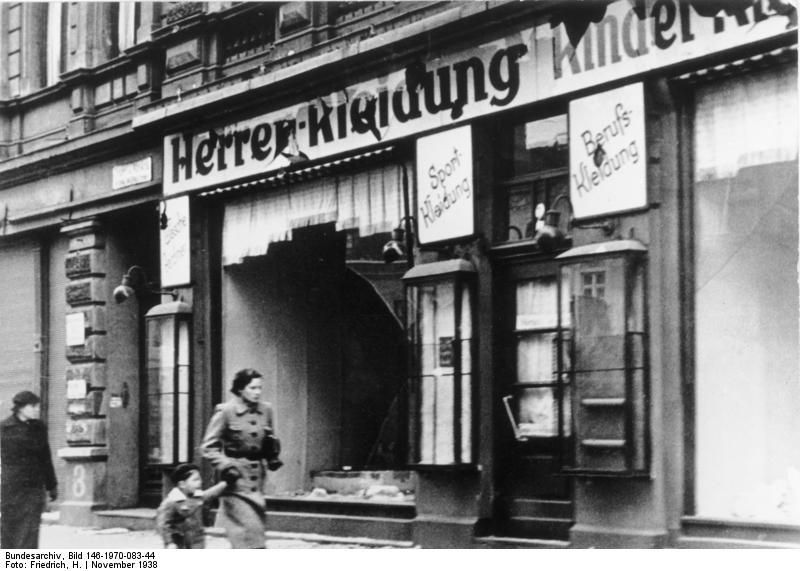
Photograph: Jewish business destroyed during Kristallnacht, Magdeburg, Germany, 9 November 1938.
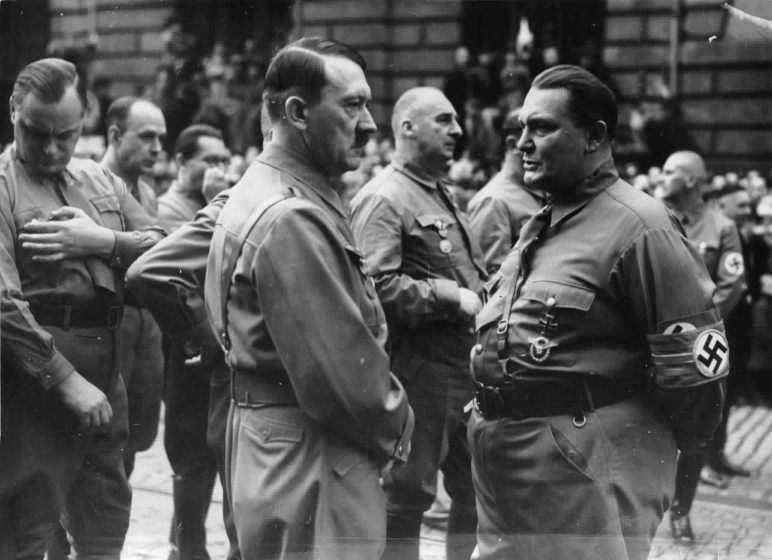
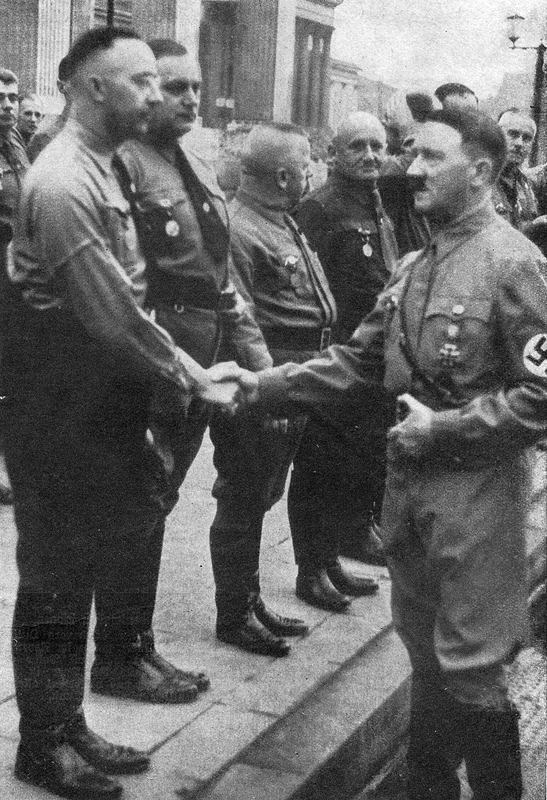
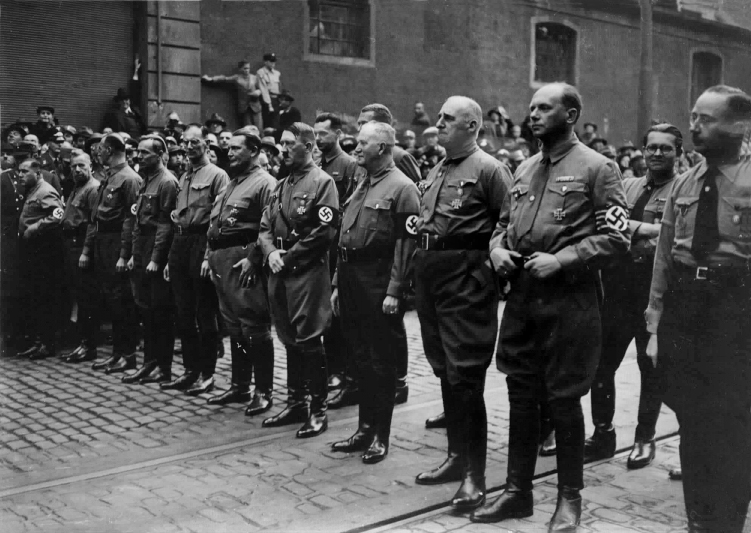
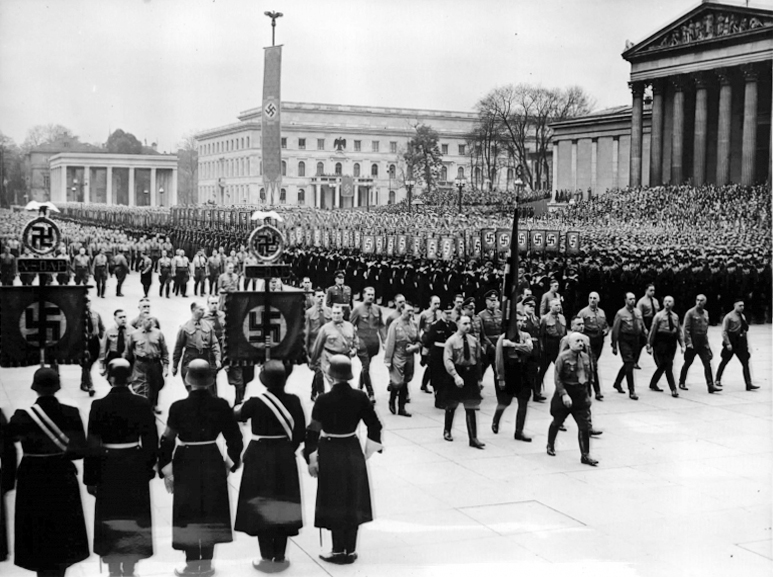
Ernst vom Rath died. Word of his death reached Hitler that evening while he was with several key members of the Nazi party at a dinner commemorating the 1923 Beer Hall Putsch. After intense discussions, Hitler left the assembly abruptly without giving his usual address. Propaganda Minister Joseph Goebbels delivered the speech, in his place, and said that “the Führer has decided that… demonstrations should not be prepared or organized by the party, but insofar as they erupt spontaneously, they are not to be hampered.” The chief party judge Walter Buch later stated that the message was clear; with these words, Goebbels had commanded the party leaders to organize a pogrom.
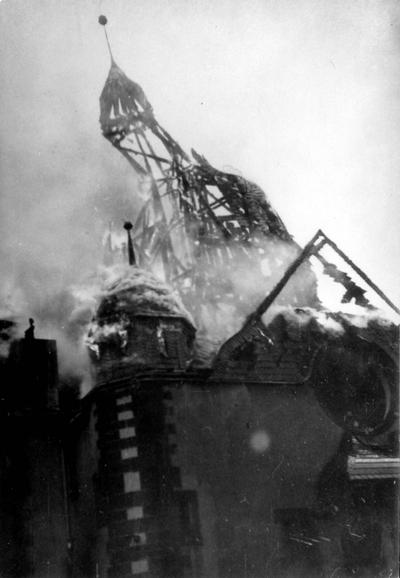
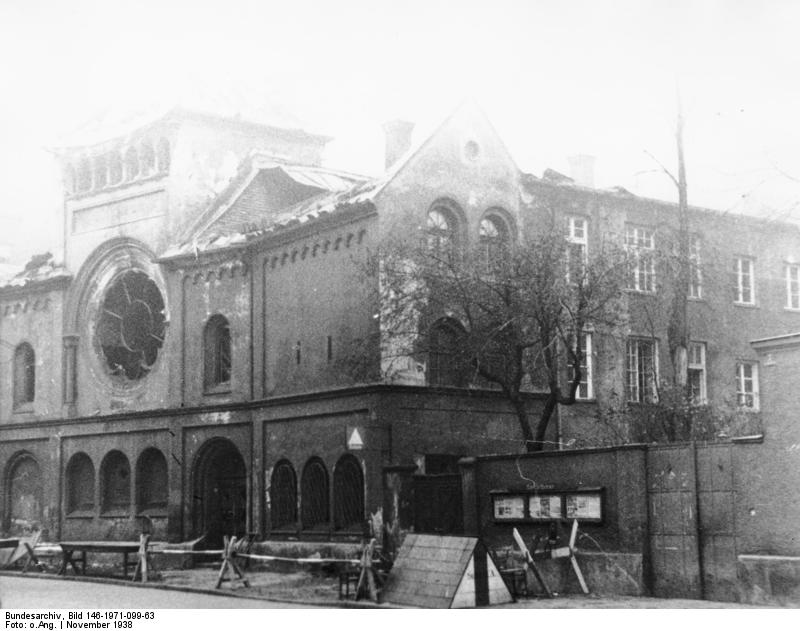
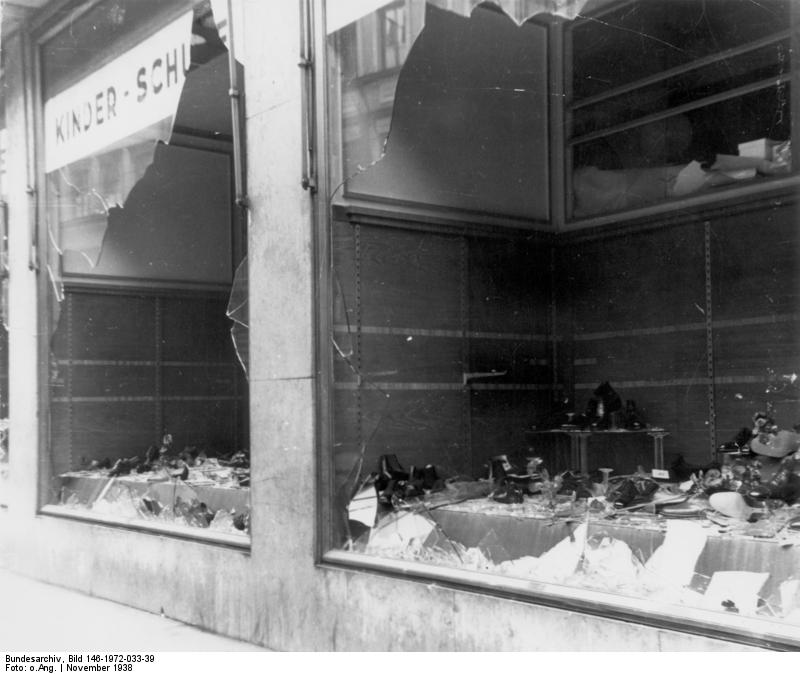
Kristallnacht: The Night of Broken Glass. Also known as the November Pogrom. A wave of violence targeting Jews occurred throughout Germany and Austria in retaliation for the assassination of Ernst vom Rath. Nazi authorities did not interfere as Jewish shops and synagogues were burned and looted, but 30,000 Jews were arrested. The vast amounts of broken glass littering the streets outside the Jewish shops gave the night its name. The two-day, government-orchestrated attack on Jews results in the destruction of up to 500 synagogues, 7,000 shops, and 29 department stores.
Many Berliners were, however, deeply ashamed of the pogrom, and some took great personal risks to offer help to their beleaguered Jewish neighbors. The son of a US consular official heard the janitor of his block cry: “They must have emptied the insane asylums and penitentiaries to find people who’d do things like that!” The former German Kaiser Wilhelm II commented “For the first time, I am ashamed to be German.”
Göring, who was in favor of expropriating the property of the Jews rather than destroying it as had happened in the pogrom, directly complained to Sicherheitspolizei Chief Heydrich immediately after the events: “I’d rather you had done in two-hundred Jews than destroy so many valuable assets!” (“Mir wäre lieber gewesen, ihr hättet 200 Juden erschlagen und hättet nicht solche Werte vernichtet!”).
The reaction of non-Jewish Germans to Kristallnacht was varied. Many spectators gathered on the scenes, most of them in silence. The local fire departments confined themselves to prevent the flames from spreading to neighboring buildings. In Berlin, police Lieutenant Otto Bellgardt barred SA troopers from setting the New Synagogue on fire, earning his superior officer a verbal reprimand from the commissioner.
The British historian Martin Gilbert believes that “many non-Jews resented the round-up”, his opinion being supported by German witness Dr. Arthur Flehinger who recalls seeing “people crying while watching from behind their curtains”. Rolf Dessauers recalls how a neighbor came forward and restored a portrait of Paul Ehrlich that had been “slashed to ribbons” by the Sturmabteilung (SA). “He wanted it to be known that not all Germans supported Kristallnacht.”
In 1938, just after Kristallnacht, the psychologist Michael Müller-Claudius interviewed 41 randomly selected Nazi Party members on their attitudes towards racial persecution. Of the interviewed party-members 63% expressed extreme indignation against it, while only 5% expressed approval of racial persecution, the rest being noncommittal. A study conducted in 1933 had then shown that 33% of Nazi Party members held no racial prejudice while 13% supported persecution. Sarah Ann Gordon sees two possible reasons for this difference. First, by 1938 large numbers of Germans had joined the Nazi Party for pragmatic reasons rather than ideology thus diluting the percentage of rabid antisemites; second, the Kristallnacht could have caused party members to reject antisemitism that had been acceptable to them in abstract terms but which they could not support when they saw it concretely enacted. During the events of Kristallnacht, several Gauleiter and deputy Gauleiters had refused orders to enact the Kristallnacht, and many leaders of the SA and of the Hitler Youth also openly refused party orders, while expressing disgust. Some Nazis helped Jews during the Kristallnacht.
As it was aware that the German public did not support the Kristallnacht, the propaganda ministry directed the German press to portray opponents of racial persecution as disloyal. The press was also under orders to downplay the Kristallnacht, describing general events at the local level only, with prohibition against depictions of individual events. In 1939 this was extended to a prohibition on reporting any anti-Jewish measures.
Kristallnacht sparked international outrage. According to Volker Ullrich, “…a line had been crossed: Germany had left the community of civilized nations.” It discredited pro-Nazi movements in Europe and North America, leading to a sharp decline in their support. Many newspapers condemned Kristallnacht, with some of them comparing it to the murderous pogroms incited by Imperial Russia during the 1880s. The United States recalled its ambassador (but it did not break off diplomatic relations) while other governments severed diplomatic relations with Germany in protest. The British government approved the Kindertransport program for refugee children.
Kristallnacht marked a turning point in relations between Nazi Germany and the rest of the world. The brutality of the pogrom, and the Nazi government’s deliberate policy of encouraging the violence once it had begun, laid bare the repressive nature and widespread anti-Semitism entrenched in Germany. World opinion thus turned sharply against the Nazi regime, with some politicians calling for war. On 6 December 1938, William Cooper, an Aboriginal Australian, led a delegation of the Australian Aboriginal League on a march through Melbourne to the German Consulate to deliver a petition which condemned the “cruel persecution of the Jewish people by the Nazi government of Germany”. German officials refused to accept the tendered document.
Kristallnacht changed the nature of Nazi Germany’s persecution of the Jews from economic, political, and social exclusion to physical violence, including beatings, incarceration, and murder; the event is often referred to as the beginning of the Holocaust. In this view, it is not only described as a pogrom, it is also described as a critical stage within a process in which each step becomes the seed of the next step. An account cited that Hitler’s green light for Kristallnacht was made with the belief that it would help him realize his ambition of getting rid of the Jews in Germany. Prior to this large-scale and organized violence against the Jews, the Nazi’s primary objective was to eject them from Germany, leaving their wealth behind. In the words of historian Max Rein in 1988, “Kristallnacht came… and everything was changed.”
While November 1938 predated the overt articulation of “the Final Solution”, it foreshadowed the genocide to come. Around the time of Kristallnacht, the SS newspaper Das Schwarze Korps called for a “destruction by swords and flames.” At a conference on the day after the pogrom, Hermann Göring said: “The Jewish problem will reach its solution if, in anytime soon, we will be drawn into war beyond our border — then it is obvious that we will have to manage a final account with the Jews.”
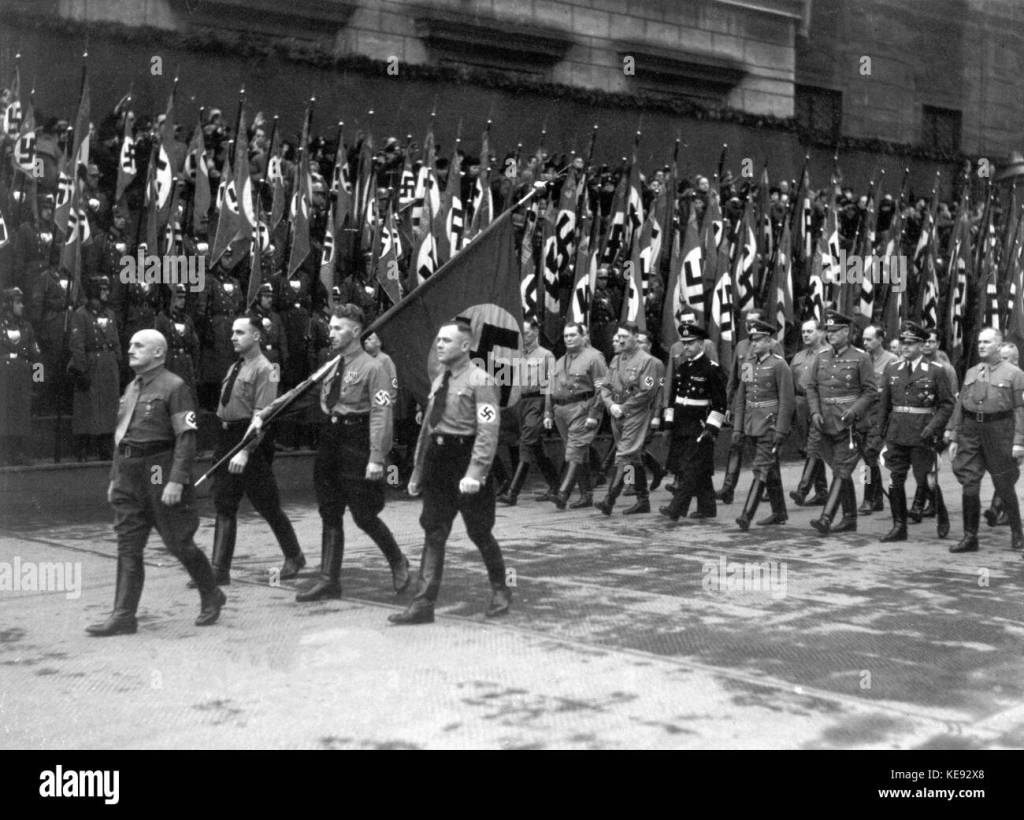
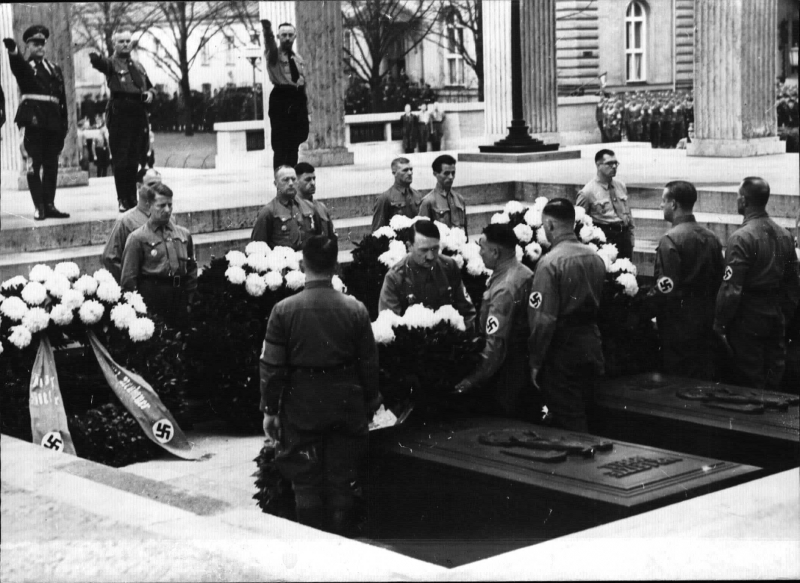
Swiss citizen Maurice Bavaud attended a parade in Munich celebrating the 15th anniversary of the Beer Hall Putsch with the intention of assassinating Adolf Hitler with a pistol. However, Hitler marched on the far side of the street relative to Bavaud’s position making the shot too difficult, so he abandoned his attempt.
Rudolf Höss was promoted to the rank of SS-Hauptsturmführer.
The Nazis are reportedly holding Cardinal Innitzer a virtual prisoner in Vienna.
Marshal Vasily Blyukher, Soviet military commander during the Changkufeng Hill crisis, is tortured and dies in prison.
France recognizes Italy’s conquest of Ethiopia.
British Prime Minister Neville Chamberlain tonight predicted a long era of peace for Europe as a result of the arrangement which he made with the dictators in the Munich conference. He spoke at the annual Guildhall banquet at which Sir Frank Bowater, the new lord mayor of London, was the host. Chamberlain’s speech was broadcast throughout the English speaking world. Joseph P. Kennedy, United States ambassador to London, was among the many foreign diplomats who attended the banquet.
Britain’s Cabinet decides that partitioning Palestine is not possible, and proposes a conference with Arabs and Jews. Meanwhile, two more British soldiers are killed by Arab insurgents.
There was no joy in the capital today. The mighty New Deal Santa Claus had struck out. From messenger to cabinet officer, the official family was stunned. Incredulity gave way to dismay on the faces of administration pay rollers as final returns turned the Democratic defeat in yesterday’s election to a rout. Work virtually was suspended in almost all government departments as employees measured the fall of one administration follower after another.
Federal building corridors buzzed with concern as to whether various units could be blanketed in under civil service in view of the Republican congressional gains. The fear was common that the administration’s scheme to control the government regardless of elections by giving permanent jobs to deserving Democrats would be blasted by a combination of Republicans and conservative Democrats. In official quarters there was nothing but silence. There was not a word of comment from high administration officialdom, which included seven cabinet officers.
President Roosevelt, who is at his estate in Hyde Park, New Year, refused to discuss the Democratic defeat. White House aides, unaccustomed to election setbacks after six years of vote prosperity, expressed irritation when correspondents pressed for a statement on the returns. In the last two congressional elections administration officials advanced claims that the elections vindicated the administration’s philosophy of the more abundant life from the AAA to the WPA. Today these same officials were invited — without result — to explain the rise in prices which occurred on the New York Stock exchange. More than 200 different shares reached 1938 highs and trading was the heaviest since October 21, 1937.
Over 3 million shares — a record — are traded in New York as stocks go up on the election news.
It looked, for the moment, as if Franklin Roosevelt’s third term aspirations were dead. However, the escalating crisis and war in Europe will give him a second chance to persuade the electorate.
Al Capp, cartoonist of Li’l Abner, creates Sadie Hawkins Day.
The Cole Porter stage musical “Leave It to Me!” opened at the Imperial Theatre on Broadway.
The Dionne Quintuplets, all five of them, have their tonsils removed in Ontario, Canada.
Japanese bombers flying north from Kwangtung province bomb cities in Hunan, killing 200 people.
Britain served notice today that she will not approve Japan’s reported plan to shut the western powers out of China by forming a Chinese-Japanese economic and political bloc. This stand was disclosed in the House of Commons by Richard Austen Butler, Undersecretary for Foreign Affairs, who stated the government’s attitude is the same as that of the United States as expressed in Secretary Hull’s statement of November 4. Britain’s position, Butler said, is governed by the Nine-Power Treaty of 1922 pledging respect for China’s territorial integrity and by other international agreements.
Dow Jones Industrial Average: 158.08 (+3.17).
Born:
Tom Thurlby, Canadian NHL defenseman (Oakland Seals), in Kingston, Ontario, Canada.
Ti-Grace Atkinson, American feminist author, in Baton Rouge, Louisiana.
Died:
Vasily Blyukher, 48, Soviet military commander (killed in the Great Purge).
Ernst vom Rath, 29, German diplomat (shot).
Edward Murray East, 59. American botanist and geneticist who developed hybrid corn.
Naval Construction:
The Royal Navy Net-class boom defence vessel HMS Burgonet (Z 33) is laid down by the Blyth Shipbuilding & Drydock Co. Ltd. (Blyth, U.K.).
The Royal Australian Navy Grimsby-class sloop HMAS Parramatta (L 44, later U 44) is laid down by the Cockatoo Docks and Engineering Co. Ltd. (Sydney, New South Wales, Australia).
The Royal Navy Dido-class light cruiser HMS Charybdis (88) is laid down by the Cammell Laird Shipyard (Birkenhead, U.K.).
The Royal Navy Brigand class rescue tug HMS Marauder (W 98) is launched by Fleming & Ferguson Ltd. (Paisley, Scotland).
The Kriegsmarine (German Navy) Type IX U-boat U-40 is launched by AG Weser, Bremen (werk 945).
The Regia Marina (Royal Italian Navy) Marcello-class submarine Morosini is commissioned.
The Royal Navy “T”-Class (First Group) submarine HMS Triton (N 15) is commissioned. Her first commanding officer is Lieutenant Commander Hugh Patrick de Crery Steel, RN.
The U.S. Navy Somers-class destroyer USS Davis (DD-395) is commissioned. Her first commanding officer is Commander Thomas Dewitt Carr, USN.
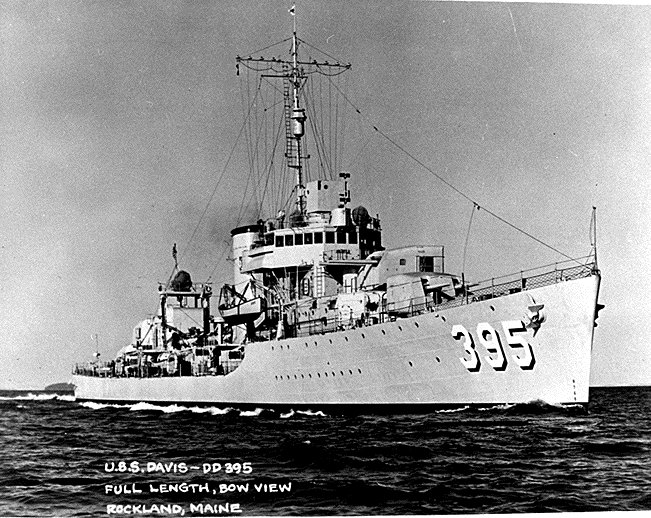
Davis served predominantly as a convoy escort in the Atlantic and Caribbean during the war, and received one battle star for World War II service. She was decommissioned after V-J Day and scrapped in 1947.
https://www.history.navy.mil/research/histories/ship-histories/danfs/d/davis-iii.html
 History Diaries