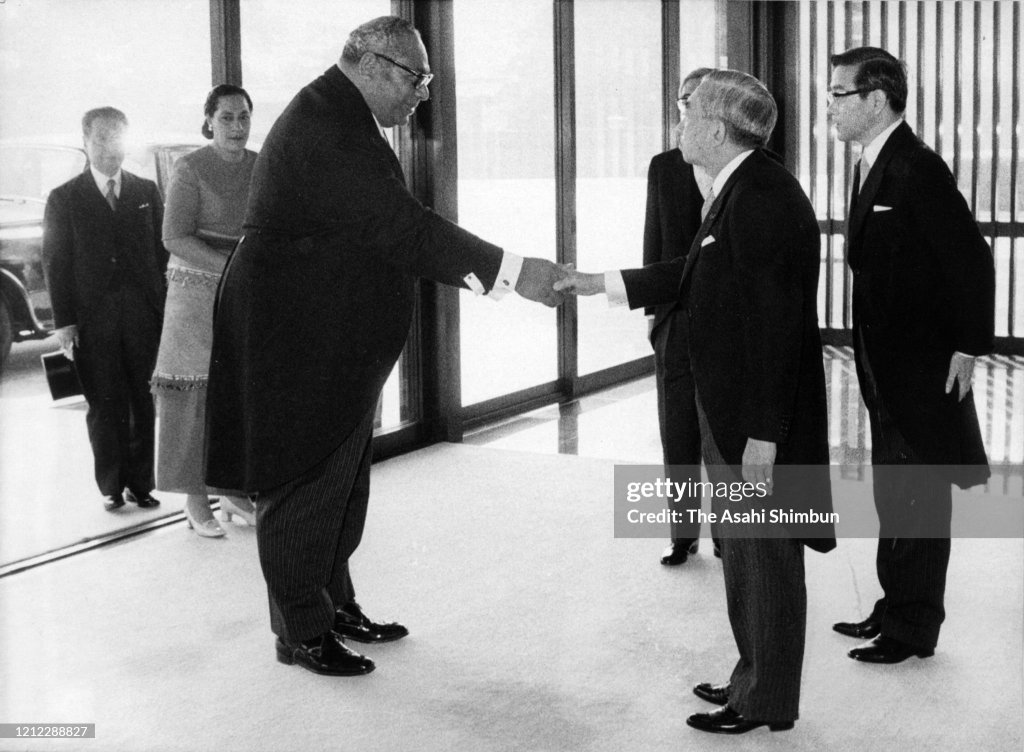
Photograph: King Taufa’ahau Tupou IV of Tonga shakes hands with Emperor Hirohito prior to their meeting at the Imperial Palace on November 9, 1973 in Tokyo, Japan.
Secretary of State Henry Kissinger is proud of the Mideast peace agreement he worked out with President Sadat of Egypt. The Secretary of State discussed peace plans with Saudi Arabia’s King Faisal today in hopes of restoring Arab oil supplies to the United States, but the proposal hit a snag.
Secretary of State Kissinger was unable to obtain a relaxation of Saudi Arabia’s oil embargo against the United States but he reportedly convinced King Faisal of his sincerity in the search for peace in the Middle East, Mr. Kissinger was told by the King and other Saudi officials that production cuts imposed since October 17 would not be relaxed until there was physical withdrawal of Israeli forces from Arab territory occupied during the 1967 war, according to Saudi spokesmen and American diplomats.
The Israeli Government announced that it had accepted “in principle” the American-sponsored cease‐fire agreement with Egypt, but said it would seek further clarification of the details from the United States. The long‐delayed announcement was made after a long Cabinet meeting in Tel Aviv.
Tel Aviv pulled back from immediate acceptance of Kissinger’s plan. Israel announced its approval of the agreement in principle but is seeking clarification from Washington. Premier Golda Meir cancelled her speech which was designed to explain acceptance of the proposal; last-minute disagreements caused the cancellation.
President Anwar el‐Sadat’s decision to drop Egypt’s insistence on an Israeli pullback to the October 22 cease‐fire line was a major factor in reaching a Middle East agreement, a senior American official said.
The strategic balance in the Middle East has tipped in favor of the Soviet Union and its Arab allies in the aftermath of the October war, according to United States military sources. While they welcomed the immediate benefits of Israel’s acceptance of the American peace proposal, these sources were pessimistic about the future. The salient influence in their gloomy analysis is the prospective withdrawal of the Navy’s Middle East fleet from the Persian Gulf within a year. The sheikdom of Bahrain on October 20 told the United States that the Navy had a year to get out of the Persian Gulf island. Bahrain’s action means that the United States will lose its only military foothold in the Persian Gulf, the source of much of the world’s oil, unless another base can be found, which appears unlikely in view of the present Arab hostility.
Meanwhile the Soviet Union is helping Iraq build a naval base at Umm Qasr, at the Iraqi end of the gulf. The American intelligence community believes the Soviet squadron in the Indian Ocean, now 20 ships strong, will be permitted to use the base. Military sources and civilian officials in the. Department of Defense take a generally pessimistic view of strategic developments in the eastern Mediterranean and Persian Gulf area. Assessing what they regard as a generally darkening situation, the sources asserted that the Soviet Union was making what one officer described as a “maximum effort” to restock Arab arsenals not only with combat essentials but with aircraft, missiles and tanks.
A United Nations force moved into Israeli-occupied lands to act as a buffer between Israel and Egypt. United Nations forces are now set up on both sides of the cease-fire line.
Communist forces have apparently cut all roads leading to the South Vietnamese provincial capital of Gia Nghĩa in the Central Highlands 105 miles northeast of Saigon. There was no panic here today, but military and civil officials have said they expect heavy fighting to break out in the area soon. The officials and ordinary citizens alike say that government reinforcements have been pouring into the area since the Communists overran two militia outposts about 20 miles north of here last Sunday. The only access to the city, which is the capital of Quảng Đức Province, is by air, and a black market in airline tickets between there and Saigon has sprung up almost overnight, the fare rising to seven or eight times the legal rate. The area’s lumber industry has virtually closed down. Officers are trying to get their wives and children flown, to safety by military helicopter. The man who represents the province in the National Assembly said in an interview, as he pointed to a map, that Communist troops were now within 4 miles of the city to the south, 10 miles to the west and 7 miles to the north.
Government reinforcements sent to stem North Vietnamese push along the Cambodian border northeast of Saigon ran into two stiff exchanges of fire, the Saigon command reported today. South Vietnamese armored and infantry units were said to have come under heavy fire three miles west of the road junction at Đắk Song, 125 miles northeast of the capital, the command reported, adding that 5 of its men were killed and 4 wounded before the government unit pulled back. About 15 miles farther along the border, another clash developed at dusk yesterday, near Bu Prăng, one of two government camps captured by North Vietnamese tanks and troops Sunday. Saigon said 12 North Vietnamese were killed and two government soldiers wounded. Military men say that the aim of the Communist campaign along the Cambodian frontier is to complete a supply corridor running down the frontier to Lộc Ninh, the Vietcong headquarters 75 miles north of Saigon.
The bulletins on Secretary of State Kissinger’s journey to Peking through the capitals of the Middle East have received the kind of careful attention here this week that is devoted to bulletins on an approaching typhoon. Typhoons are seasonal, sometimes disastrous but no cause for panic; officials, press commentators and intellectuals who openly discuss politics say much that sort of thing about visits by Mr. Kissinger to Peking. They speak of being “prepared for the worst” — meaning an agreement between Washington and Peking to move to full diplomatic relations — but they draw confidence from the fact that Taiwan has not just survived the five previous Kissinger visits to China but has flourished.
More South Korean university students joined today in a spreading boycott of classes to protest government policies. The boycotts now effect eight colleges in the Seoul area. The demonstrations began earlier this week, with students demanding an end to government repression, the release of students under arrest for previous demonstrations and disbandment of the South Korean Central Intelligence Agency. About 600 students of the College of Agriculture at Seoul National University began a strike this morning after a two-hour sit‐in on their campus at Suwon, 20 miles south of Seoul.
The government-owned Philippine National Oil Company was founded.
Fire at the Taiyo department store kills 101 and injures 84 in Kumamoto, Japan.
France, whose 10 percent inflation rate is becoming a big domestic political issue, asked her Common Market partners today to agree rapidly to emergency anti‐inflation measures. At a meeting of finance ministers, the nine members of the European Economic Community requested that the executive commission draw up a list of concrete actions, which members will examine and possibly adopt at a December 3–4 meeting. Officials stressed, however, that each member would be free to reject those measures that do not apply to its particular problems. The French Finance Minister, Valéry‐Giscard d’Estaing, said the actions should include budgetary and tax measures, limits on liquidity, incentives for saving, notifications of price rises, liberal import quotas and government incomes policies.
President Nixon met with top congressional Republicans to discuss Watergate; the meeting was designed to increase public confidence. Representative John Anderson reported that the President intends to cooperate fully with the courts and the special prosecutor regarding Watergate. The subjects of resignation and impeachment were not brought up. President Nixon is planning meetings with other party members to address Watergate, and he also hopes to clear up the White House tapes issue.
Judge John Sirica heard former White House chief of staff H.R. Haldeman testify about the White House tapes. Prosecutor Richard Ben-Veniste confronted Haldeman with a record of 31 White House tapes which were checked out by Haldeman. Haldeman insisted that only two tapes were used. White House attorney Fred Buzhardt testified that Rose Mary Woods, President Nixon’s personal secretary, was confused about the number of tapes and the dates they were recorded; he stated that no gaps exist on a tape which was reported to contain a gap.
A court agreed to rule on the legality of President Nixon’s firing of special Watergate prosecutor Archibald Cox. The judge specifically questioned the legality of Solicitor General Robert Bork delivering the message regarding the firing to Cox. The lawsuit was filed by consumer advocate Ralph Nader, Senator Frank Moss and Representatives Bella Abzug and Jerome Waldie.
Judge John Sirica sentenced six of the original Watergate defendants today. E. Howard Hunt received the stiffest sentence: 2½ years. James McCord received one year, and the four Cubans — Bernard Barker, Frank Sturgis, Virgilio Gonzales and Eugenio Martinez — were also sentenced after pleading for leniency, but their request was denied. Barker’s daughter Maria-Elena Moffett was bitter and stated that President Nixon is the one who should spend her father’s sentence behind bars. Unrepentant G. Gordon Liddy is serving 6-20 years for his Watergate activities.
The “Miami 4” (Martinez, Barker, Sturgis and Gonzales) were heavily influenced by the CIA. Cuban-Americans in Miami reacted to the Miami 4’s involvement in Watergate. Reverend William Arias said that those who were sentenced were not scandalized by Watergate as much as the American people generally. All-Spanish radio station WQBA in Miami reported that 75% of its talk show callers support President Nixon because he fights Communism. Radio announcer Emilio Melian stated that the Miami 4 believed they were helping the U.S. fight Communism. Bernard Barker’s wife Clara said that Judge Sirica was unfair to the Miami 4.
Cuban-Americans will be on guard in the future regarding matters of alleged national security.
The Alameda County coroner’s office in California said that bullets used in the ambush slaying of the Oakland school superintendent, Dr. Marcus Foster, were loaded with cyanide. A group calling itself the Symbionese Liberation Army, has claimed responsibility for the murder in letters to newspapers and radio stations, and said that Dr. Foster and his deputy, Robert Blackburn, had been found guilty by a people’s court and ordered executed.
Former United Mine Workers president Tony Boyle will appear in a Pittsburgh court to face charges of conspiracy to murder union rival Joseph Yablonski, who was killed in 1969.
Edmund Kemper of Santa Cruz, California, was sentenced to life imprisonment for the murders of his mother and seven other women.
The Senate Interior Committee continued its work on legislation to help President Nixon fight the nation’s fuel shortage. Committee chairman Henry Jackson thinks that a bill could be brought to the Senate floor next week. Warren Magnuson reported that the Senate Commerce Committee is working on legislation to extend daylight savings time. Administration energy czar John Love revealed that gasoline rationing may be necessary by next spring. The impact of rationing would be significant, particularly in areas which lack adequate public transportation.
A possible solution to the problem of blood clotting associated with the oral contraceptive pill was reported today to the American Heart Association. The clotting — a “slight risk” to the 14 million American women on the pill — can be set off by physical stress, such as minor surgery or a bone broken while skiing, a scientist said. That combination of the pill and physical stress, the scientist said, lowers the level in the blood of a normal anti-clotting agent, a protein called Factor 10, The simple administration of a very small amount of a substance called heparin, the body’s natural anticoagulant, apparently can elevate the level of Factor 10 back to normal, according to Dr. Stanford Wessler, a blood clotting specialist at Washington University in St. Louis. Wessler said there was “firm statistical evidence” of a very slight risk of blood clotting that can occasionally lead to death in women taking the pill. The risk, he said, apparently is less than 2%.
A new urine test that reportedly can detect a heart attack moments after onset has been developed by a Hartford physician, Dr. Stanley H. Bernstein. He reported favorable results in a study using the urine test to cardiologists attending the annual scientific meeting of the American Heart Association in Atlantic City.
A further delay in the launching of Skylab 3 seemed likely today as crews replacing eight cracked fins on the Saturn rocket ran into additional problems. The crew had originally been scheduled to blast off today to board the orbiting space laboratory, but discovery of cracks in the stabilization fins postponed the launch date until next Thursday. Engineers are driving hard to keep the Thursday launch date for Gerald Carr, Dr. Edward Gibson and William Pogue but are a day behind schedule in replacing the fins. Space agency officials also said Friday that “pitting and roughness” were discovered on the rocket itself when the first fin was removed Thursday. They also said the surfaces of the eight “new” fins, which have been in storage since 1968, showed roughness and uneven paint.
Musician Billy Joel released the album that would make him a star, “Piano Man”. The album was his second, after the poor-selling “Cold Spring Harbor.”
Apple Records releases “Ringo”, Ringo Starr’s third studio album, in the UK; his biggest commercial and critical success, featuring the singles “Photograph”, “You’re Sixteen”, and “Oh My My”.
The Reds trade Bobby Tolan and Dave Tomlin to the Padres for pitcher Clay Kirby. All 3 will have decent years with their new teams.
Dow Jones Industrial Average: 908.41 (-24.24, -2.60%).
Born:
Nick Lachey, American singer for the band 98 Degrees and TV personality; in Harlan, Kentucky.
Jason Bowen, Canadian NHL defenseman (Philadelphia Flyers, Edmonton Oilers), in Port Alice, British Columbia, Canada.
Jason Kaiser, NFL defensive back (Kansas City Chiefs, Dallas Cowboys), in Denver, Colorado.
Alyson Court, Canadian voice actress; in Toronto, Ontario, Canada.
Gabrielle Miller, Canadian actress, in Coffs Harbour, Australia.
Died:
Pradyumansinhji Lakhajirajsinhji, 60, the Thakore Saheb 60, India’s princely state of Rajkot from 1940 until the abolition of the title in 1971, as well as a first-class cricketer.



 History Diaries