Photograph: Miner Hermann Luebke is supported by a Red Cross rescue team as he waves to a cheering crowd on his way to an ambulance, at the Lengede iron ore mine November 7, 1963. It seemed a miracle but the rescue operations managed to save 11 miners who had been trapped for 336 hours (14 days) at a depth of 60 meters.
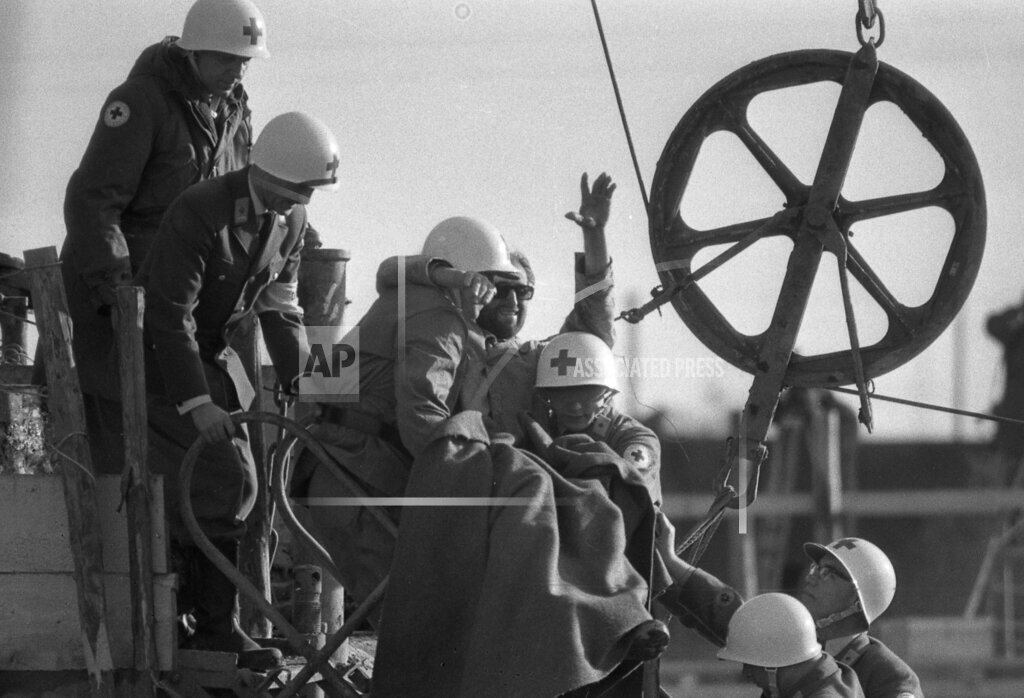
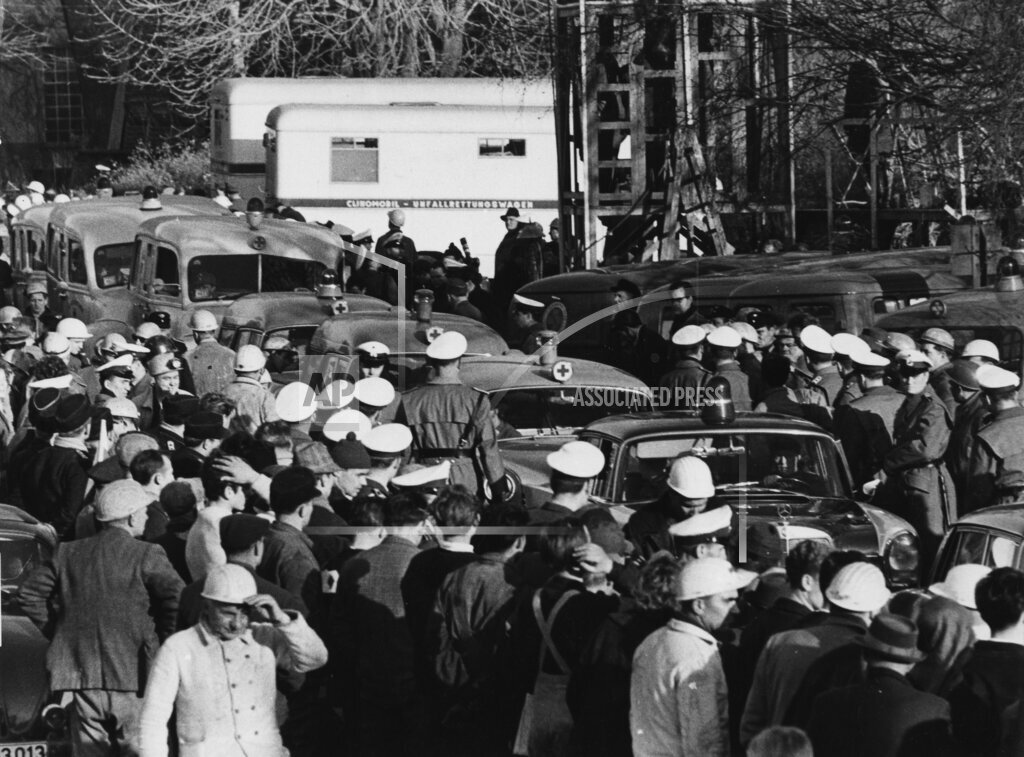
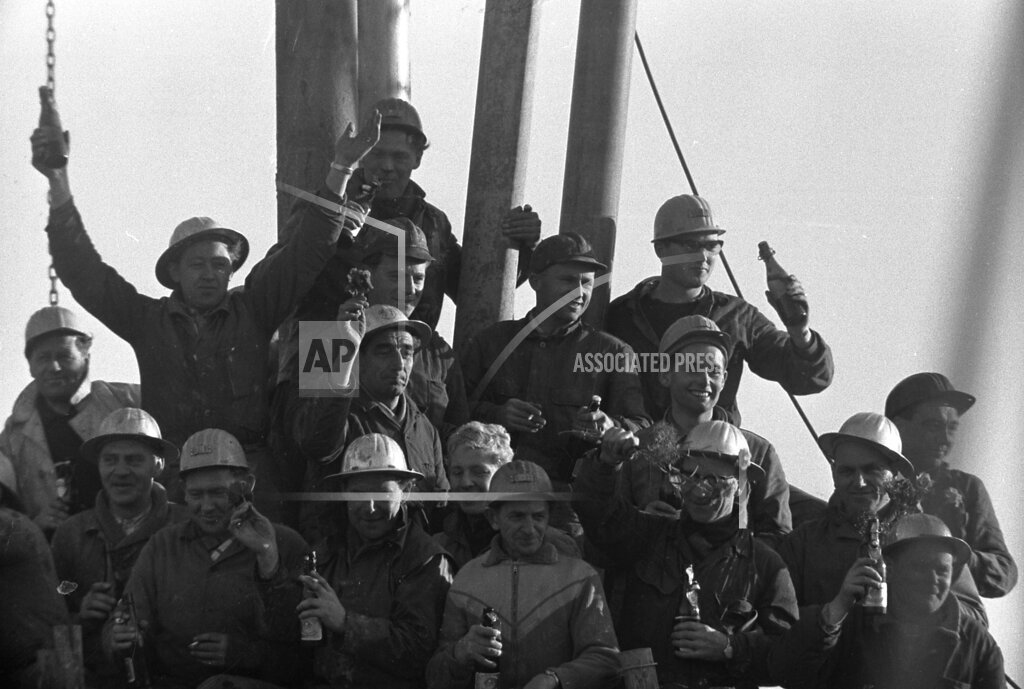
The Wunder von Lengede (“Miracle of Lengede”) saw 11 underground miners rescued two weeks after they had been feared drowned in a deep iron mine near Lengede, West Germany. They had been among 129 men who were working underground when a sludge pond had given way, flooding the mines. Stuck nearly 200 feet below the surface of the buttock, 21 people in their group had been able to find air in an unsupported section of the mine, but rockfalls killed ten of the survivors over the days that followed. By November 2, the forty people still entombed had all been given up for dead, but tapping was picked up by sound equipment, and drilling commenced. After five days, the drilled hole was large enough to lower a bomb-shaped cylinder (known as the Dahlbuschbombe) into the cavity. The first person to climb inside and to be brought to the surface was 51-year-old Heinz Kull, and over the next hour, the other ten came out. Last of the group was Bernhard Wolter, credited by his comrades with having kept up their hopes during the ordeal.
The United States tonight formally recognized the revolutionary government of South Vietnam. American Ambassador Henry Cabot Lodge was instructed to tell the new government the United States is satisfied with the junta’s assurances it would guarantee fundamental liberties in the southeast Asian country. The action came less than a week after a group of generals had deposed the government of President Ngô Đình Diệm. In the bloody revolt, Diệm and his brother Ngô Đình Nhu, his chief adviser, were slain.
Recognition of the new government opened the way for resumption of the 100-million-dollar American economic aid program in South Vietnam. Parts of the program had been suspended when the Diệm government’s repression of Buddhists threatened the stability of the country. American officials hoped that recognition of the new regime, in which Diệm’s vice president, Nguyễn Ngọc Thơ, was named premier, will lead to more efficient Vietnamese prosecution of the war against communist guerrillas. The United States is spending an estimated 1.5 million dollars a day to help fight the war and has 16,500 military advisers and large air contingents in South Vietnam.
Among the hoped for steps was the restoration of friendly relations with neighboring Cambodia, now a supply route for the Communists. American officials also want the South Vietnamese to wipe out by-passed guerrilla pockets and reorganize the strategic hamlet-armed village program. Lodge delivered the American note to the Saigon government at 7:30 a. m. Friday, Saigon time. Britain also recognized the South Vietnamese government today. Its note stated that the British government noted “with satisfaction that the new government confirms its intention to carry on the national struggle for freedom and independence.”
Madame Ngô Đình Nhu, 38, of South Vietnam, whose gibes and thrusts against American policy have won her such titles as the Dragon Lady and Lucrezia Borgia, made news of a different sort here today. She wasn’t talking at all. The widow of the head of South Vietnam’s secret police chief and sister-in-law of the late President Ngô Đình Diệm, was described as a weary, spent, and grieving woman under mild sedation in a magnificent hilltop mansion in Bel Air. Madame Nhu spoke by telephone to her three youngest children who were flown out of Vietnam to their uncle, Archbishop Ngô Đình Thục, in Rome, a member of the Allen Chase family said. The children, Ngô Đình Trác, 15, Ngô Đình Quỳnh, 11, and Ngô Đình Lệ Quyên, 4, had arrived in Rome by airliner from Saigon on Tuesday, accompanied by an American official. The archbishop, in tears, met them and took them away to safety. Madame Nhu had moved to the Chase home late yesterday from a $90 a day suite in a Beverly Hills hotel.
Communist Viet Cong guerrillas, less active than usual during the recent coup in Vietnam which overthrew the Diệm regime, moved belatedly to take advantage of any governmental disruption.
Soviet Premier Nikita Khrushchev gibed so often at the United States in toasts at a Kremlin reception tonight that American Ambassador Foy D. Kohler questioned him about it. “Where is the spirit of Moscow?” Kohler asked. “I don’t hear any of it. I haven’t heard any toasts I could drink to.” Khrushchev looked somewhat startled. He turned to Kohler and asked him to offer a toast. Kohler declined the invitation, saying it was Khrushchev’s party. Khrushchev, who was drinking champagne toasts, took it from there. “The American ambassador refuses to make a toast,” he said. “The spirit of Moscow is the spirit of peace with all countries who want to live with us. I drink a toast to the spirit of Moscow, peace for all the world.” The exchange came at a gathering of about 2,000 in the congress hall celebrating the 46th anniversary of the Bolshevik revolution. Among the guests were 20 American industrial and business leaders, who are visiting Moscow.
The Russians trundle four 50-foot rockets thru Red Square in the annual revolutionary day parade and represent them as anti-missile missiles that can hit any modern space attack weapons. Western military experts, however, believe that while the rockets might be capable of zeroing in on short range or intermediate range missiles in flight, they could not stop intercontinental ballistic missiles.
British military experts from the Institute for Strategic Studies accept with a large grain of salt Premier Nikita Khrushchev’s boast that Russia possesses an anti-missile missile that “can hit a fly in space.” They believe that the Kremlin is trying to reassure the soviet people that the recently signed nuclear test ban treaty has not impaired their country’s security.
A subcommittee of the House Republican Policy Committee has charged that the Kennedy administration has swept “Cuban affairs under the rug.”
Western sources interpreted the latest Berlin autobahn crisis as evidence that Russia is paving the way for a reconciliation with Peking.
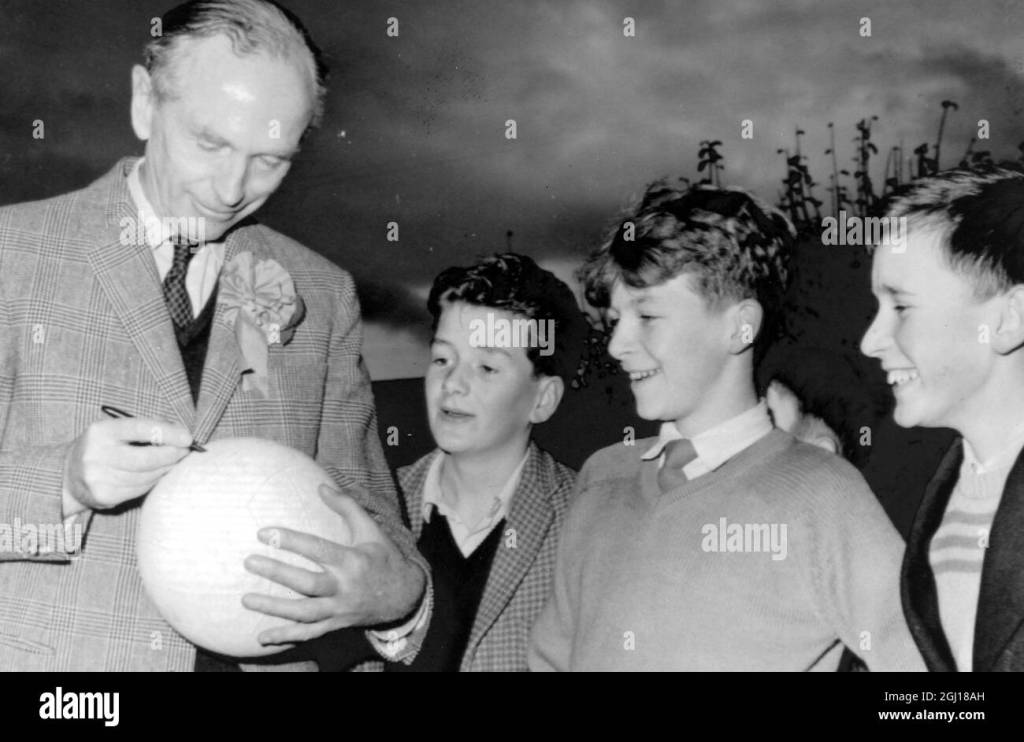
Prime Minister Sir Alec Douglas-Home’s Conservative government lost a seat in Parliament in a special election that boosted the opposition Labor Party’s political prospects.
Fifteen hundred students who massed before the Sorbonne in Paris to protest government education policies were dispersed today by policemen using their clubs. The students shouted demands for Christian Fouchet, minister of education, to resign and threw mud at the police. The students have long protested what they call insufficient government efforts to provide classrooms, laboratories, and housing.
A Cholera epidemic in the Bogra district of East Pakistan has killed 230 persons — 87 of them in the last three days — the Pakistan news agency APP reported today.
The U.S. Senate overrides Kennedy Administration opposition to write into the 3.7-billion-dollar foreign aid bill an amendment aimed at banning any American assistance to Egypt. The lawmakers also vote to prohibit any further military or economic assistance to Yugoslavia and Indonesia.
The House votes, for the sixth time since President Kennedy took office, to raise the ceiling on the national debt to a record high to accommodate ever-increasing spending. The fear that the United States might be forced into bankruptcy on December 1 haunts the Democratic leadership during the roll call on passage of the bill, which was approved by a slim, eight-vote margin. The House, voting for the third time during the session on raising the limit, adopts an elastic ceiling which can fluctuate during the next seven months.
Stung by a charge of weak leadership, Senator Everett Dirksen (R-Illinois) engages in a shouting altercation with Senator Thomas J. Dodd (D-Connecticut) on the Senate floor. Dirksen blasts as “cerebral incoherence” Dodd’s charge that Dirksen, Republican minority leader, cooperated with the Kennedy Administration instead of opposing its programs. Dodd’s remarks were voiced in a night session when Dirksen and Senator Mike Mansfield (D-Montana), another target of Dodd’s attacks, had left the floor.
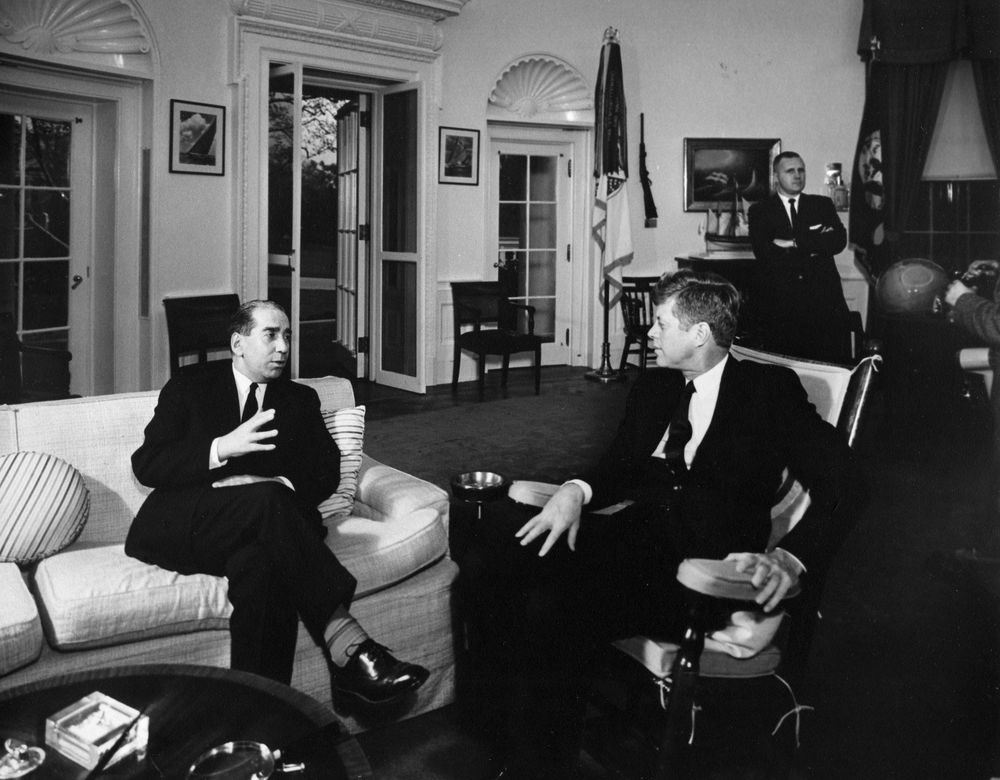
President Kennedy had a 45-minute meeting on the subject of U.S. wheat sales to the USSR. Present at the meeting were Undersecretary of State George Ball, Under Secretary of Commerce Franklin D. Roosevelt Jr., Secretary of Commerce Luther Hodges, Under Secretary of Agriculture Charles S. Murphy, and Secretary of Agriculture Orville Freeman. The group discussed talks with the Soviet Union regarding terms and conditions of the delivery system of U.S. wheat to the Soviet Union, the effect on U.S. shipping, and the basis for Soviet action.
Nelson Rockefeller, the Governor of New York, entered the 1964 U.S. presidential campaign by announcing on NBC’s Today news show that he would be a candidate for the Republican Party nomination. Following that appearance from a studio in Albany, he flew to Nashua, New Hampshire to address a crowd of supporters. U.S. Senator Barry Goldwater of Arizona, the front-runner for the Republican nomination in polls of voters, made no comment but was expected to enter the race. President John F. Kennedy was not expected to have any opposition in his nomination as the Democratic Party candidate for 1964.
The decision of Governor Nelson A. Rockefeller of New York to seek the Republican Presidential nomination is not expected to change the time table of Senator Barry Goldwater (Arizona) in announcing whether he also will run. Goldwater, the front runner for the nomination, had no comment on Rockefeller’s announcement. The senator’s decision is expected next January. His supporters were vocal however. Senator Carl T. Curtis (R-Nebraska), an avowed Goldwater backer, teamed up with Senator Karl Mundt (R-South Dakota) to demand that Rockefeller clarify the differences between his platform and that of the Kennedy administration. Mundt said Rockefeller had a lot of work to do to make these differences clear.
Senator Margaret Chase Smith (R-Maine) is seriously considering entering some Republican Presidential primaries to offer the GOP a “third choice.”
Paul H. Nitze, nominated for secretary of the Navy, spent three hours assuring apprehensive senators that he has always advocated military strength and never favored appeasement.
Atomic Energy Commissioners and some other federal officials get more money but less status under the new government pay bill as it now stands in Congress.
AFL-CIO president George Meany said “1964 will be a very, very crucial year” and urged American labor to elect to the nation’s law-making bodies people who think more of human problems than they do of dividends.
The state scores a victory in the T. Eugene Thompson “murder-for-hire” trial in Minneapolis when the prosecuting attorney is upheld in his contention that he should not be required to turn over to the defense a statement made by a state witness to St. Paul police. Thompson is accused of arranging the slaying of his wife, whom he had insured for more than one million dollars.
President Kennedy has named Dr. Donald F. Hornig, chairman of Princeton University’s department of chemistry, as his new science aide.
A coastal storm broke the extended drought in large areas of the Northeast, with record rain in New York City.
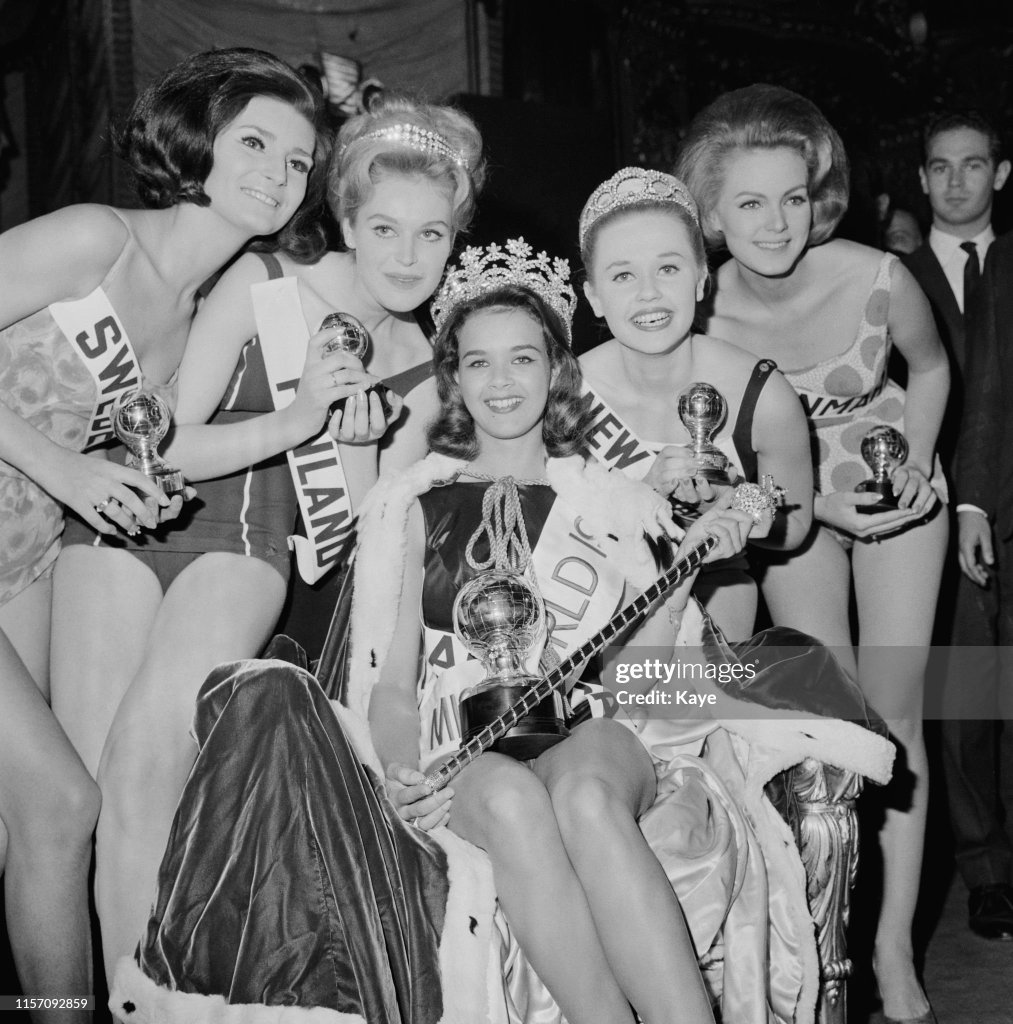
Carole Joan Crawford, 20, of Jamaica wins the Miss World title.
New York Yankees catcher Elston Howard becomes the first black ever voted American League MVP. New York’s Howard tops Detroit’s Al Kaline 248 to 148.
Dow Jones Industrial Average: 745.66 (+1.63).
Born:
Elizabeth “Liz” Mikel, American actress and jazz singer (“Friday Night Lights”), in Dallas, Texas.
Todd McKee, American actor (Ted-“Santa Barbara”, “The Bold & The Beautiful”), in Kentfield, California.
Keith McDonald, NFL wide receiver (Houston Oilers, Detroit Lions), in Los Angeles, California.
 History Diaries