Photograph: U.S. Secretary of State Henry Kissinger (L) meets with Egypt’s President Anwar Sadat, on November 7, 1973 during his visit to Cairo.
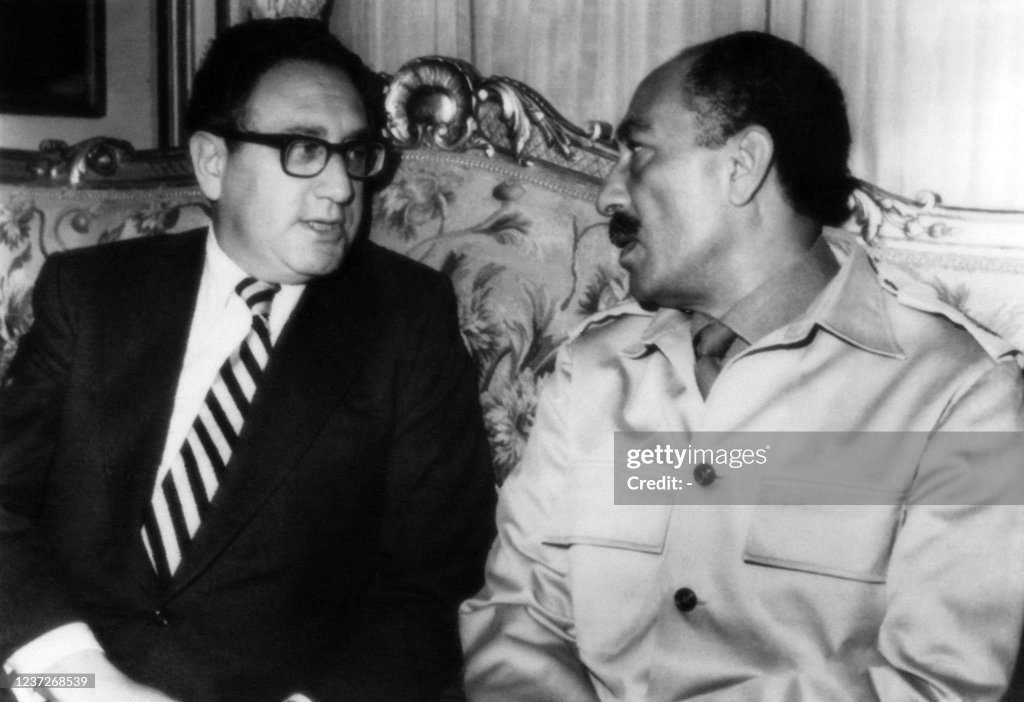
Egypt renewed diplomatic relations with the United States. Israel stated that Egypt is preparing for a new outbreak of fighting. Secretary of State Henry Kissinger met today in Cairo with Egyptian President Anwar Sadat regarding the Mideast situation; diplomatic relations were then restored, but the Egyptian military is on alert. Sadat and Kissinger drew up a proposal for a cease-fire and peace. Assistant Secretary of State Joseph Sisco presented the proposal to Israel, but there was no immediate word on Israel’s reaction. Sisco will meet Kissinger in Jordan tomorrow to relay Israel’s position.
Israel began three days of national mourning for soldiers killed during the war.
The South Vietnamese military command said yesterday that its planes had bombed two Communist-held areas north of Saigon in what the command described as its largest air strike since the signing of the cease‐fire agreement in January. The command spokesman, Lieutenant Colonel Lê Trung Hiền, said that South Vietnamese bombers had flown “more than 50 sorties” in the vicinity of Lộc Ninh and Bó Ducc, two towns that are about 15 miles from each other and 75 to 85 miles north of Saigon, near the Cambodian border. Colonel Hiền noted that a sortie is one mission by one plane and said that in yesterday’s attack a single plane could have made several sorties. He declined to give the number of planes involved in the attack. Colonel Hiền also said that all of the planes had returned safely. But he declined to say from which base the attack had been launched, or how much damage the raids had caused. He did say that the attack was a “punishing action” for Communist violations of the ceasefire, particularly for the Communist attack Tuesday on the Biên Hòa air base, near Saigon, in which two persons were killed, 22 injured and three South Vietnamese F-5 fighter-bombers were destroyed on the ground.
The Viet Cong declared Tuesday that they had attacked Biên Hòa in reprisal for air strikes against Communist positions originating from the air base. Whether the South Vietnamese attack on Lộc Ninh and Bó Duc was actually Saigon’s largest air strike since the cease‐fire could not be confirmed. In recent months, the air force has bombed several Communist‐held sectors on the coast, in the Central Highlands, near the Cambodian border and in other areas around Saigon. The Viet Cong’s Provisional Revolutionary Government asserts that as of last Saturday it has shot down 39 South Vietnamese planes since the ceasefire. A Viet Cong spokesman in Saigon called the air attack a “grave violation” or the Paris accord. The spokesman, Captain Phoung Nam, said that the Communists would respond to “violations” with “appropriate measures.”
The opposition party in South Korea submitted to the National Assembly today a draft resolution urging the Cabinet to resign in acceptance of responsibility for the abduction of a prominent opposition politician in Tokyo in August. The resolution was submitted by the New Democratic party after a two‐day Assembly debate on the controversial kidnapping of Kim Dae Jung, a political opponent of President Park Chung Hee, who was in self‐imposed exile in Japan. Mr. Kim was taken from a Tokyo hotel by a group of unidentified South Koreans and was brought to Seoul. The Governments of South Korea and Japan reached a political settlement on the case last week to end, their diplomatic conflict over the incident.
Iceland plunged into a government crisis over last month’s “cod war” peace terms with Britain and the resignation of Prime Minister Olafur Johannesson was thought likely. The Communist Party, one of the three coalition partners, asked for postponement of a cabinet meeting until today while its Central Committee discussed the fishing dispute settlement terms. The party has already said it would completely reject the accord.
At President Nixon’s personal request, the House again is postponing action on the trade bill, Speaker Carl Albert said. The bill, already put off once at the Administration’s request, had been scheduled for a vote next week. It contains a provision to grant the Soviet Union trade advantages available to other countries but only if the President is satisfied that the Soviet Union is not placing undue restrictions on emigration.
Soviet historian Roy Medvedev, known in the West for his outspoken account of Josef Stalin’s rule, has strongly criticized methods of fellow Russian dissidents in their campaign for wider human rights. Medvedev, the twin brother of exiled geneticist Zhores Medvedev, I warned that while pressures from other countries could change Soviet policies, they also could have a negative effect on the “democratization of Soviet society.”
A Jewish historian accused Israel of “seducing” Jewish scientists to leave the Soviet Union and said their departure caused serious damage. Prof. I. I. Mints, 77, outlined his views in an article in the Moscow weekly Literaturnya Gazeta. The subject of Jewish emigration is rarely mentioned in the Soviet press, and observers said publication of the Mints article may reflect official concern over the number of well-educated Jews seeking to leave the country.
The Soviet Union today displayed what Western military specialists believe to be a new intercontinental ballistic missile — the first major new military hardware to be shown off in a Soviet parade since 1967. Observers were caught off guard by the sudden appearance of the missiles near the end of the military display celebrating the 56th anniversary of the Bolshevik Revolution. There was uncertainty about the identification and performance of the missiles, a pair of which were trucked through Red Square in long, cylindrical green jackets. But the first estimate of Western specialists was that the new weapon did not appear to violate the interim agreement reached in 1972 between the United States and Soviet Union on offensive strategic missiles. The agreement limits the number of strategic missile launchers without restricting qualitative improvements in the missiles themselves. A light tank for tactical use by the Soviet Union’s seven airborne divisions also attracted Western, attention at the parade.
The Soviet press charged today that China had forcibly suppressed minority uprisings in six regions in recent years and killed more than 12,000 people in Tibet last year. In one of the most pointed attacks of what has been a flood of Soviet accusations against Peking this fall, a Soviet newspaper accused China of having “wiped off the face of the earth” several dozen minority tribes and peoples. The Soviet commentary, appearing in the Writers Union weekly Literaturnaya Gazeta, asserted that China’s leaders had violated their pledge to respect the autonomy and identity of the Tibetan people by “cruelly suppressing the national liberation movement of the Tibetan people.” It also accused the Chinese leadership of having used tanks and artillery in Inner Mongolia to put down an uprising there. Other revolts, the newspaper said, broke out between 1967 and 1972 in Sinkiang, Yunnan and Kwangsi and on the island of Hainan off China’s southern coast and were put down “with cruel ferocity.”
British Prime Minister Edward Heath’s new anti-inflation policy, setting a basic 7% limit for wage increases during the next 12 months, was approved 270 to 231 by the House of Commons. The new rates take effect immediately. Wages and prices will be controlled by the government under this third stage of Heath’s program, first introduced a year ago.
An 18-year-old Catholic died after being shot at close range by four teen-agers as he stood at a bus stop on Belfast’s Springfield Road. Security men said four youths ran out of a Protestant housing project and fired at him. Earlier, gunmen sprayed a truck with automatic gunfire in the Protestant Woodvale area of Belfast, hitting the driver five times and leaving him in serious condition. A large bomb planted outside government offices near a packed girls’ high school in Armagh failed to go off properly, averting what could have been a major disaster.
Chile’s military government said Swedish Ambassador Harold Edelstam might be asked to leave the country. The trouble involved the arrests of four persons-including the wife of a Swedish journalist and a heavy military guard at the former Cuban Embassy, now under Swedish control. A spokesman said Edelstam used the press instead of diplomatic channels to protest the arrests. The vigilance came, he said, after shots were fired at guards outside the embassy. Edelstam said a number of Uruguayan and Chilean citizens were inside the building and he sleeps there to protect them.
Congress overrides President Nixon’s veto of the War Powers bill. In an upset, the House voted to override President Nixon’s veto of the bill which limits the power of the President to make war. Both Houses of the U.S. Congress voted overwhelmingly to override President Richard Nixon’s veto of the War Powers Resolution, and passed into law. The vote was 284 to 135 in the House of Representatives and 75 to 18 in the U.S. Senate. Representative Louis Wyman (R, New Hampshire) said that he hopes the media won’t interpret Republican votes to override as a rejection of President Nixon’s foreign policy. Representative William Dickinson (R, Alabama) insisted that such Republican votes could not be interpreted as a vote of “no confidence” for the President, but Representative William Mailliard (R, California) conceded that Watergate and the off-year election results moved votes. Press Secretary Ron Ziegler stated that Congress’ veto will cause grave consequences in terms of world stability.
The off-year elections were closely watched to determine the effect of Watergate. Democrats seem to have a slight advantage after yesterday’s elections.
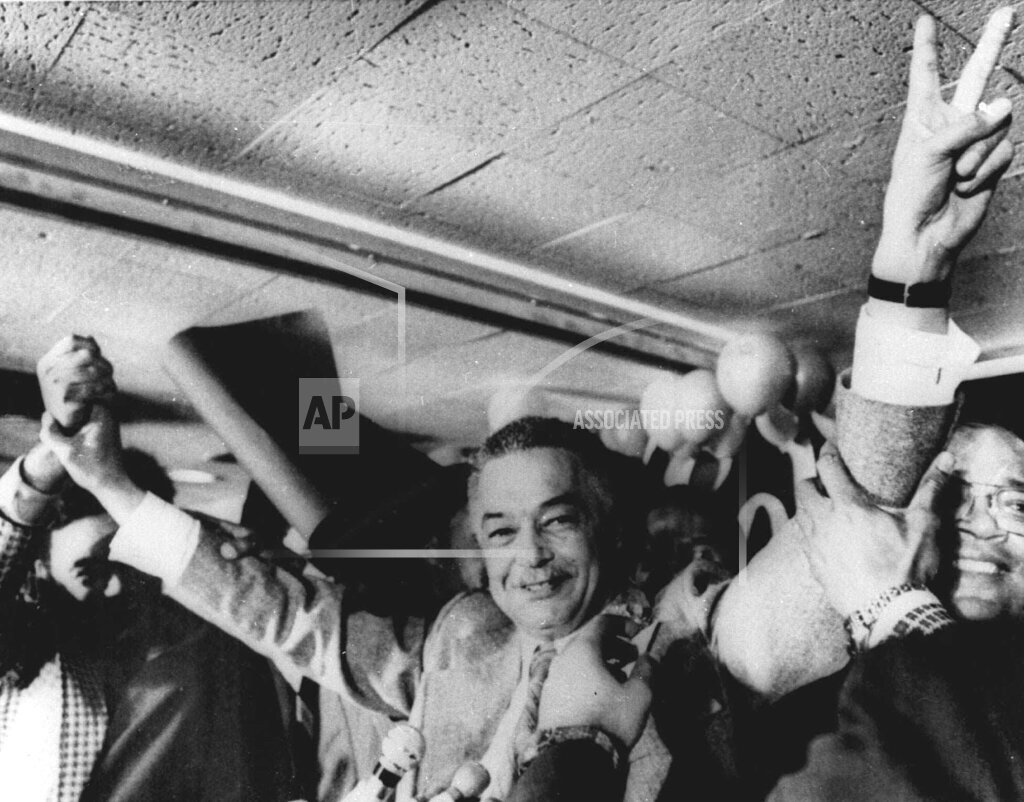
In the Virginia gubernatorial race, Democrat-turned-Republican Mills Godwin won over independent candidate Henry Howell. In New Jersey, Democrat Brendan Byrne, a novice to politics, beat Republican Charles Sandman. Democratic national chairman Robert Strauss declared that the election returns show Democrats are on the right track. Republican party chairman George Bush insisted that Watergate wasn’t the determining factor in the races, but Republican Senator Richard Schweiker stated that the Watergate scandal was obviously a disaster to the Republican party and its effects were clearly seen.
In California, voters rejected Governor Ronald Reagan’s Proposition 1, which would have reduced property and income taxes and set spending limits. Reagan’s future in politics has been dealt a setback as a result of that defeat. In New York, voters turned down Governor Rockefeller’s transit bond issue, and voters in Washington decided to cut back raises for legislators and state officials.
Presidential aide John Bennett testified today before the Watergate grand jury. Bennett admitted discussing his testimony with President Nixon’s secretary Rose Mary Woods. Miss Woods apparently confided in Bennett that a new gap in the tape recordings exists. The White House refused to comment on Miss Woods’ possible testimony, but revealed that its legal staff is being expanded to deal with Watergate.
Judge John Sirica rejected the appeals for a retrial from E. Howard Hunt, James McCord and the four other Watergate burglars. Final sentencing of the defendants will take place Friday.
Charles Allen Wright, President Nixon’s’ lawyer, returned to the University of Texas. Wright revealed that he never listened to the White House tapes and didn’t know that two of the tapes were missing.
George Aiken, the Senate’s senior Republican, challenged Congress to impeach President Nixon or stop badgering him. Aiken insisted that the President shouldn’t resign. Democrats Mike Mansfield, Hubert Humphrey and George McGovern praised Aiken.
Senate Rules Committee chairman Howard Cannon reported that Robert Winter-Berger’s allegations against Vice President designate Gerald Ford have been disproved.
The Senate Watergate Committee heard testimony from Florida building contractor John Priestes. He alleged that Nixon campaign fundraisers offered to help him get a contract in return for a $100,000 contribution. Priestes claims he took their advice, but campaign finance director Maurice Stans refused to follow through with assistance. Stans admitted seeing Priestes, but insisted that no favors were granted.
Near Lodi, California, at the U.S. community of Victor, serial killers Willie Steelman and Douglas Gretzler murdered nine people (including three children) in one household, the home of Walter and Joanne Parkin. The homicides followed eight other killings that had taken place in the preceding three weeks. After having killed 17 people starting on October 18, Steelman and Gretzler were arrested the day after the Parkin household massacre, after having committed the first of 17 murders over a 22-day period.
President Nixon will speak to the nation tonight regarding his proposals to combat the energy crisis. CBS will broadcast the President’s message at 7:30 p.m. Leaders of Congress are expected to give the President everything he requests to cope with the energy crisis. Senator Henry Jackson sponsored a national energy emergency bill which includes gasoline rationing and the rationing of fuel oil. The House and Senate are apparently ready to provide final approval for construction of the trans-Alaskan pipeline.
In Victor, California, nine persons were found dead in a mass murder case. The murder victims included the entire family of Walter Parkin, neighbor Richard Earle and his family, and Mark Lang, a family friend. San Joaquin County sheriff Mike Canlis stated that all victims were killed in the same manner. Later, Parkin’s grocery store was found to have been burglarized.
Police in Oakland, California, are searching for suspects in the ambush shooting of the city’s school superintendent and his attendant. The motive remains unknown. The world has not yet heard of the “Symbionese Liberation Army” and the circus that will transpire in coming months.
Local and federal law officers surrounded a farmhouse in Wadena, Minnesota, where two escaped convicts held a family hostage. The standoff continued as a snowstorm began. Later, three children were released but the other hostages remain with the gunmen.
The launch of Skylab 3 has been postponed until next Thursday. Fourteen tiny cracks at the base of the rocket today forced a five‐day postponement of the launching of the Skylab 3 astronauts. Officials of the National Aeronautics and Space Administration attributed the cracks, which developed in all eight tail fins, to “stress corrosion” brought on by the Saturn 1B rocket’s long exposure to the salt air. They discounted the rocket’s advanced age — eight years — as an important factor. The new launching time is set at 9:27 A.M. next Thursday, November 15. The mission had seen scheduled to begin Saturday. To meet the new launching date, officials said in a news conference, all eight fins would have to be replaced and inspected by this Sunday. The replacement parts are being shipped here overnight from the factory where the rocket was built near New Orleans.
Wholesale prices dropped 0.5% for October; the price of farm products dropped 3.9%. A further drop in farm and food prices brought a second consecutive monthly decline in the wholesale price index, but the rest of the economy continued to display strong inflation in October, the Labor Department reported today. Refined petroleum products, including gasoline and home heating oil, were prominent in the large increase for all industrial commodities of 1.1 percent, adjusted for normal seasonal price changes. The index for refined petroleum products last month was 40.4 percent higher than the year earlier, level after a rise of 7.2 percent in October alone.
On trial in Los Angeles for charges related to the break-in of Daniel Ellsberg’s psychiatrist’s office, former White House aide Egil Krogh requested that President Nixon be subpoenaed to testify regarding conversations he had with Krogh. Co-defendant John Ehrlichman and Krogh also requested pertinent White House tapes.
New Jersey becomes the first state to allow girls into little league. “The institution of Little League is as American as the hot dog and apple pie. There is no reason why that part of Americana should be withheld from girls” – Sylvia Pressler, explaining her ruling in favor of girls being allowed to play Little League. Sylvia Pressler was a hearing examiner for the New Jersey Civil Rights Division as New Jersey became the first state to allow girls to play on Little League baseball teams. Prior to the decision, regulations had prohibited girls from participating with boys in the program. The regulation had been challenged by Maria Pepe from Hoboken, New Jersey. Ultimately the New Jersey Superior Court decided that Little League must allow girls to try out. As a result, the Little League organization began a program specifically for girls starting in 1974. Pepe became a minor celebrity and drew media attention to various women’s causes at the time. The New York Yankees made her an honorary “Yankee for a day”.
The Cubs trade second baseman Glenn Beckert and a minor league player to the Padres for outfielder Jerry Morales.
Dow Jones Industrial Average: 920.08 (+7.00, +0.77%).
Born:
Yunjin Kim, South Korean-American actress (Sun-“Lost”), in Seoul, South Korea.
Sean DePaula, MLB pitcher (Cleveland Indians), in Newton, Massachusetts.


 History Diaries