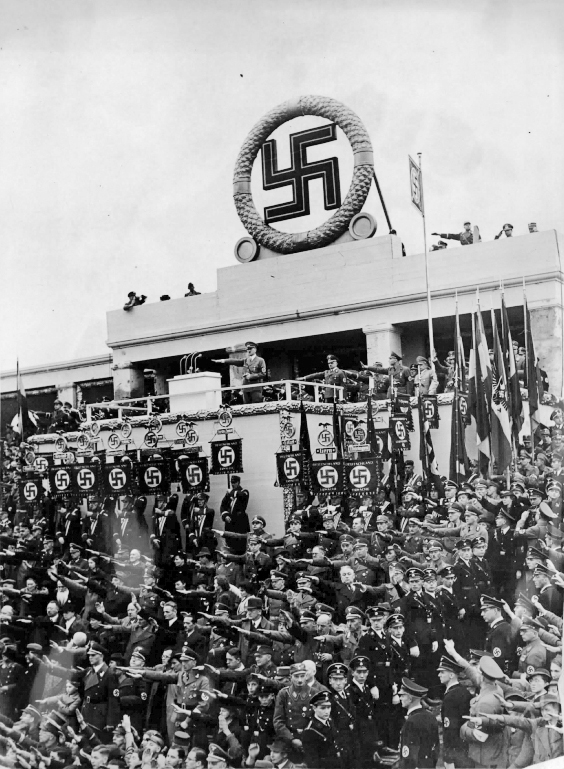
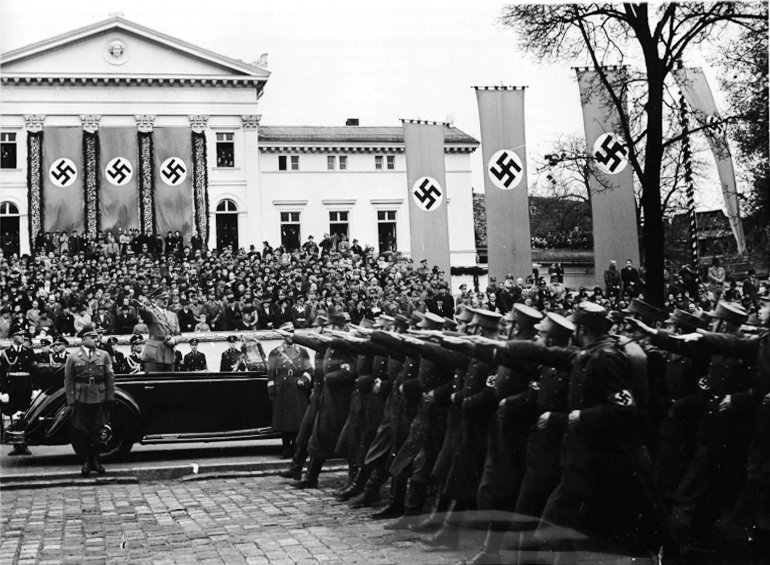
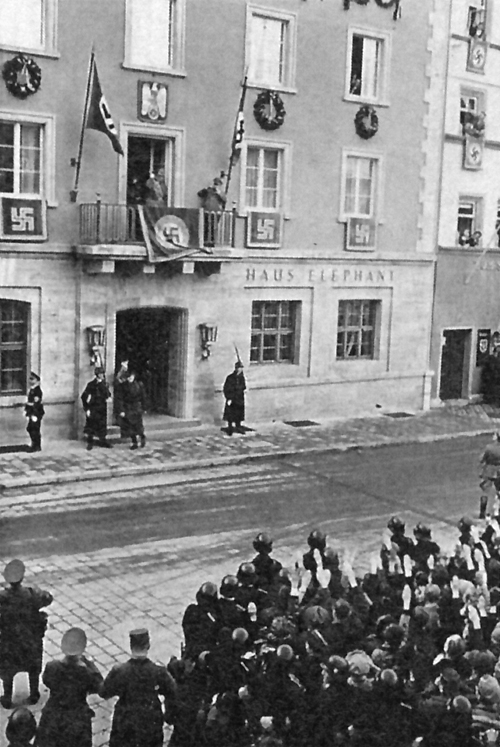
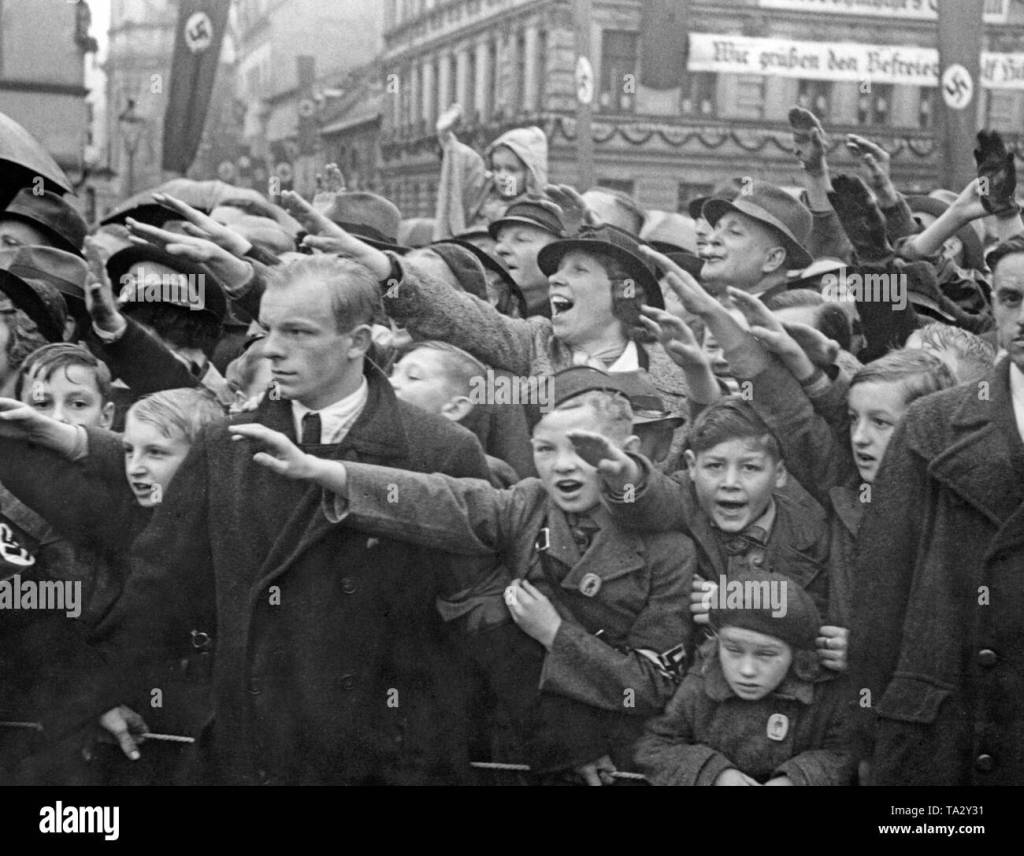
Photograph: Adolf Hitler makes a speech in front of 100,000 persons at the Gauparteitag in Weimar, Germany, 6 November 1938.
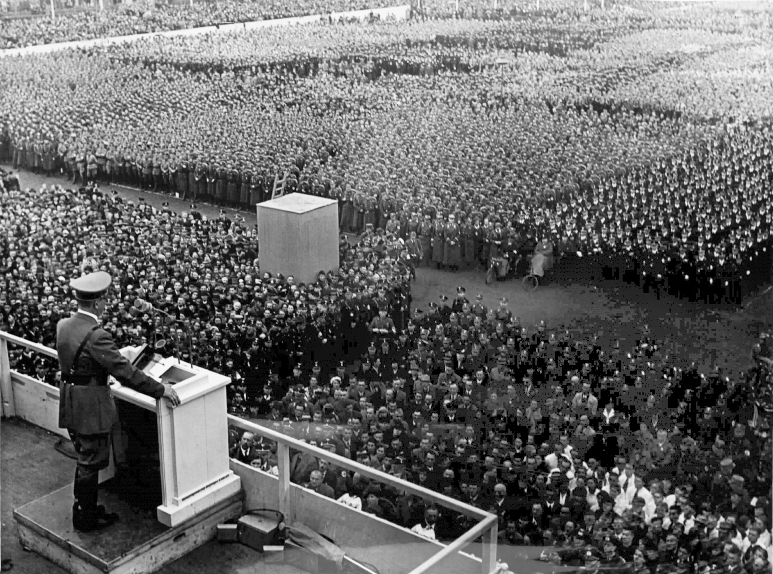
Chancellor Hitler denounces “war agitators” such as Britain, calling the words of Winston Churchill “complete stupidity.” Reichsführer Hitler today defined the status which Germany insists must be fulfilled before she can consider the question of disarmament. In a speech at Weimar he declared that “when the rest of the world speaks of the reduction of armaments we are ready for it, but under one condition: there must first be a reduction of war agitation.” “So long as there is talk of disarmament, though war agitation is permitted, we assume they wish to steal our weapons in order to prepare for us the fate we suffered in 1918,” Hitler said. “That happens once, but never again.”
The Führer spoke before a great Nazi demonstration in the Thuringian stadium. Part of his speech was devoted to slashing the democratic system of government and certain foreign politicians whom he described as “war agitators.” “A certain custom has developed in the world,” Hitler said. “There are so-called authoritarian, disciplined states and democratic states. In the former it is a matter of course that other countries are not blackguarded and slandered and that there is no war agitation. That may happen in the democratic states just because they are democratic. It is the duty of democratic governments to maintain freedom even for agitation for war.” Citing the wish for Germany’s and Italy’s destruction, which Hitler said was expressed by Arthur Greenwood, Laborite, in the British parliament, he exclaimed: “Naturally I cannot prevent it if this man may, under the democratic system, come to govern in two years. But I can guarantee this: I shall prevent him from destroying Germany.”
Spanish government counter-attacks of unexpected strength were reported today to have held back a rebel offensive aimed at wiping out the government’s salient on the west bank of the Ebro River. The advancing rebels clashed in a battle with a reorganized government army near the confluence of the Ebro River and Benisanet Creek — the outer defense of Mora de Ebro, the government’s last stronghold in the zone on the west bank of the Ebro. The government counter-attack was unleashed in the morning just after two rebel columns had joined forces, one moving west between Venta de los Camposines and the Caballos mountains and the other driving north toward Benisanet Creek.
Before the merged columns could organize into a single fighting unit, government troops struck. Waves of tanks led their attack while squadrons of warplanes bombed and machine-gunned the rebel rear guard. Rebel dispatches, however, said Generalissimo Francisco Franco’s troops quickly took cover in hills, rushed up light field guns, and held against the government attacks. Rebel capture of Mora de Ebro, which is about fifteen miles east of Gandesa, the starting point of Franco’s drive, would eliminate virtually the last gains made by the government’s surprise July offensive. Dispatches from both sides indicated combined casualties for the two armies in eight days of sanguinary fighting had mounted to more than 5,000 men.
Rebel reports said 700 government prisoners were captured yesterday alone, raising to 3,600 the number of captives sent behind Franco’s lines at the end of six days of the offensive. Franco’s troops, which had advanced steadily, were said also to have captured large quantities of arms and munitions, including twelve tanks. Stretched out on a fifteen-mile semicircle, rebel forces menaced Mora de Ebro from Benisanet and Venta de los Camposines. The northern column of Franco’s army apparently was held back by strongly entrenched government troops in that hilly sector.
Three persons were killed and eight injured today as two rebel warplane squadrons raided Cartagena. Other Mediterranean coast points also were bombed in a series of raids which began early in the morning.
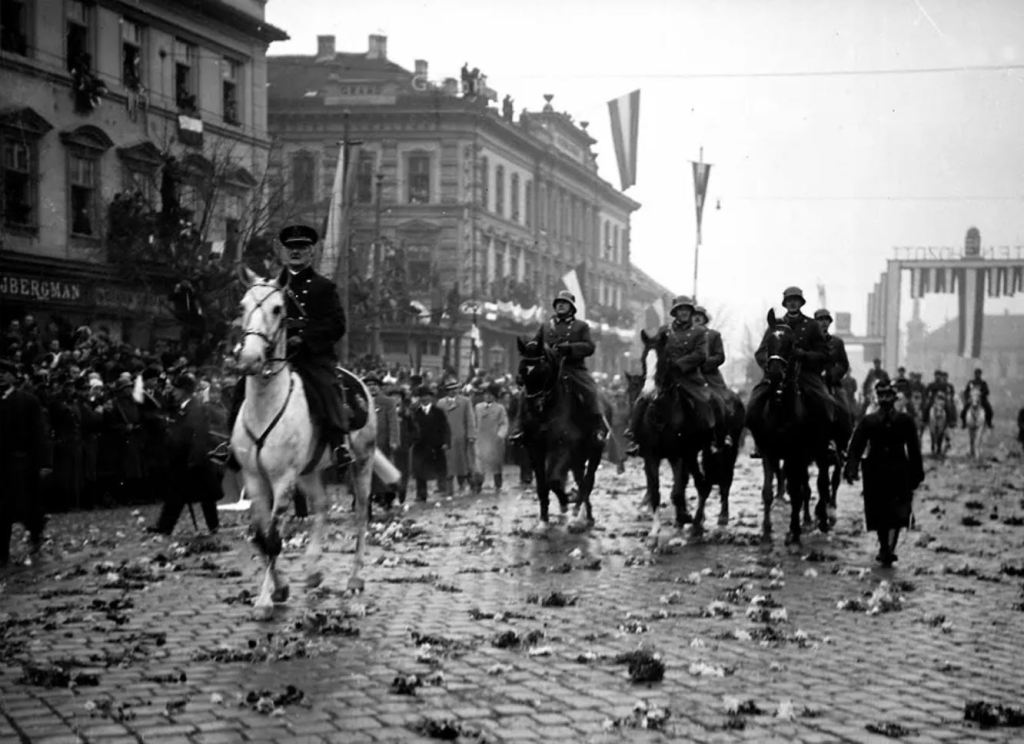
Hungary’s regent, Admiral Nicholas Horthy, today formally took possession of Hungary’s share of dismembered Czechoslovakia. Riding a white horse through a cold drizzle, he crossed the Danube by bridge into Komarom at the head of infantry, artillery, and cavalry regiments and tank units. Today was the second day in the progressive occupation of 4,875 square miles of former Hungarian territory which went to Czechoslovakia at the end of the world war and now goes back to Hungary by a decision of German and Italian arbitrators. Occupation of the zone, which amounts to one-fifth of the land Czechoslovakia acquired from Hungary twenty years ago, is to be completed by Thursday.
Soviet Premier Molotov says that a second world war has begun, and accuses Germany of being behind the Japanese “invasion” of Siberia last summer.
Defying the British police who search the city, Arab bands rob a Haifa post office, shoot at army trucks, and set fire to a warehouse holding government goods.
Twenty years after the first armistice finds Washington watching a new world war in Europe. In this war Great Britain and France are in full retreat before Germany and Italy as the latter win one bloodless battle after another. In the last week Britain and France suffered two defeats. Under steady pressure from Rome, England recognized the conquest of Ethiopia, and both Britain and France stood by as the partition of Czechoslovakia was completed, with the award of Czech territory to Hungary, an ally of Germany. Washington expects more defeats. Germany and Italy are not satisfied, but are hungry for more, observers are convinced.
It is expected that the “peace” of Munich, which ended with the partition of Czechoslovakia, will last a year or two, or perhaps five. It is believed it will last only because France and Britain are not ready to fight. In the meantime, observers here expect that the two nations will continue to retreat in the bloodless war being waged by Hitler. Whether the retreat will go so far as to bring a return of the colonies taken from Germany is a question. Hitler has declared that Germany never will rest until the colonies are returned. It is felt here that he may raise the demand for their restoration as soon as Sudetenland is assimilated. Premier Mussolini is muttering about the return to Italy of Italian populated districts under the French flag along the Franco-Italian border.
Sumner Welles, American undersecretary of state, gave the world fresh notice tonight that the United States is preparing not only to defend itself but also to aid in keeping the western hemisphere safe from threatened attack. In an address broadcast to South America, he appealed for inter-American solidarity at a time when “the doctrine of hatred is threatening civilization.”
The United States protests violations of the “Open Door” policy to Japan.
The Western comic strip “Red Ryder” first appeared.
The three DiMaggio brothers play together for the first time, making up an outfield for an all-star team in a West Coast charity game.
The St. Louis Cardinals hire Ray Blades to manage the team in 1939. Blades, manager of Rochester this past season, will be replaced by Billy Southworth.
Tokyo newspapers imply that retaliation may follow if the United States takes economic measures to enforce the Nine-Powers treaty.
The Japanese command reported today that airmen had bombed and sunk 25 junks carrying Chinese troops up the Siang River in retreat from the Japanese offensive fanning out from fallen Hankow. The Siang empties into the Yangtse through Tungting Lake at Yochow, gateway to unconquered Hunan Province, 122 miles upstream from Hankow. Yochow is in the middle of a semicircular front ranging from Hankow’s northwest to southeast. The Japanese also reported capture of Tsaoshih, 60 miles from Hankow near the northwestern extreme of the curving line of hostilities.
This announcement followed reports last night that the offensive southwest of Hankow was within 60 miles of Yochow, a point on the Yangtse-Tunting Lake and the Canton-Hankow railway. A number of American missionaries stationed in the path of the Japanese advance westward and south from Hankow were imperiled by the approaching combat and the daily bombardments along the railway and the Siang River. An army spokesman said the column which occupied Tungshan on Friday had pressed westward, taking Nanmuchiao, and was threatening Tsungyang, 55 miles east-northeast of Yochow.
The Japanese said the last remaining Chinese warships were cornered in Tungtung Lake, southwest of Yochow. Capture of Yochow would carry land warfare into Hunan Province and, if this report were true, would bottle up the remnants of the Chinese Yangtse fleet. Of the war in South China, Kuomin, a Chinese news agency, reported the counteroffensive toward Canton had brought the Chinese back into control of Samshui, within 25 miles of the Kwangtung Province metropolis which the Japanese took October 21, five days before the fall of Hankow. This report said the Chinese took Samshui by storm and engaged in vicious hand-to-hand fighting to defeat the Japanese. The same agency reported from South China that since the beginning of the war, just 16 months ago, Japanese warships had sunk or burned 628 Chinese junks in South China waters, causing a loss of 1092 lives.
Chinese military leaders were reported completing groundwork today for a counter attack against Japanese invaders in South China. Both Japanese and Chinese sources here agreed the Chinese would make a concerted effort to retake Canton, South China’s most important city, which fell to the Japanese on October 21. Domei, the Japanese news agency, said Chinese Generalissimo Chiang Kai-shek had ordered commanders of his South China forces to lay plans for an immediate offensive. The Chinese-owned Hong Kong Daily Press reported Chiang Kai-shek himself was believed to be directing wide scale operations designed to recapture the southern metropolis.
The whereabouts of the generalissimo have been unreported since the fall of Hankow and mystery similarly surrounds the location of large Cantonese forces withdrawn before the fall of Canton. Japanese troops apparently were spread thinly throughout Kwangtung province, with their main drives westward toward Wuchow and northward along the Canton-Hankow Railway. The Japanese meanwhile continued aerial strafing of Kwangtung province towns where many civilians were said to have been killed. Japanese marines were reported to have captured Haitan Island, south of coastal Fukien province’s capital, Foochow, but to have been repulsed in an attempt to reach the mainland.
Japanese troops capture Tsungyang, a major step en route to Changsha. Japanese troops driving southwest-ward from Hankow reported today they had broken the outer defenses of Changsha, capital of unconquered Hunan province. Japanese commanders said a major obstacle to this immediate objective was cleared with the capture of Tsungyang, 125 miles northeast of Changsha and midway between the provincial capital and Hankow. The capture of the town was said to have been accomplished following a stiff engagement with the Chinese 75th army, which the Japanese reported was “virtually annihilated.” A second Japanese column pressed closer to Yochow, gateway to Hunan province, and fifty-five miles southwest of Tsungyang. Yochow is 122 miles from Hankow on the Canton-Hankow Railway, the Yangtze River, and Lake Tungting. A raid by Japanese naval planes on the Chinese airdrome at Liangshan, in Szechwan province, was said to have resulted in the destruction of thirteen Chinese planes.
The Tokyo newspaper Kokumin, considered to be the organ of the army and ultra-nationalistic elements, warned today that Japan would “take retaliatory measures” if the United States attempted to force her to continue recognizing the nine-power treaty. The newspaper scoffed at the declaration of Cordell Hull, United States secretary of state, last Friday in Washington, D.C., that the United States’ attitude in the Far East was based on existing treaties and remained unchanged. Kokumin belittled Hull’s declaration as designed for home consumption only and declared that British machinations were working behind the scenes.
The newspaper asserted that any American economic reprisals against Japan’s assertion of economic and political sway in the orient would bring disaster to the “Roosevelt regime.” Such a step, it said, would draw the United States into the center of the China problem, and American public opinion would not tolerate being involved.
President Quezon puts the provinces of Cebu and Bulacan under military rule due to pre-election political riots in the Philippines.
Born:
Mack Jones, MLB outfielder (Milwaukee-Atlanta Braves, Cincinnati Reds, Montreal Expos), in Atlanta, Georgia (d. 2004).
Jim Pike, American singer (The Lettermen), in Missouri (d. 2019)
Branko Mikasinovich, scholar, in Belišće, Yugoslavia.
Michael Schultz, film and television director, in Milwaukee, Wisconsin.
Naval Construction:
The Вое́нно-морско́й флот СССР (ВМФ) (Soviet Navy) “L” (Leninec)-class (3rd group, Type XIII) submarine L-15 is commissioned.
The Вое́нно-морско́й флот СССР (ВМФ) (Soviet Navy) Project 7-class (Gnevny-class) destroyer Bodry (Бодрый, “Sprightly”) is commissioned.
The Вое́нно-морско́й флот СССР (ВМФ) (Soviet Navy) Project 7-class (Gnevny-class) destroyer Smetlivy (Сметливый, “Sly”) is commissioned.
 History Diaries