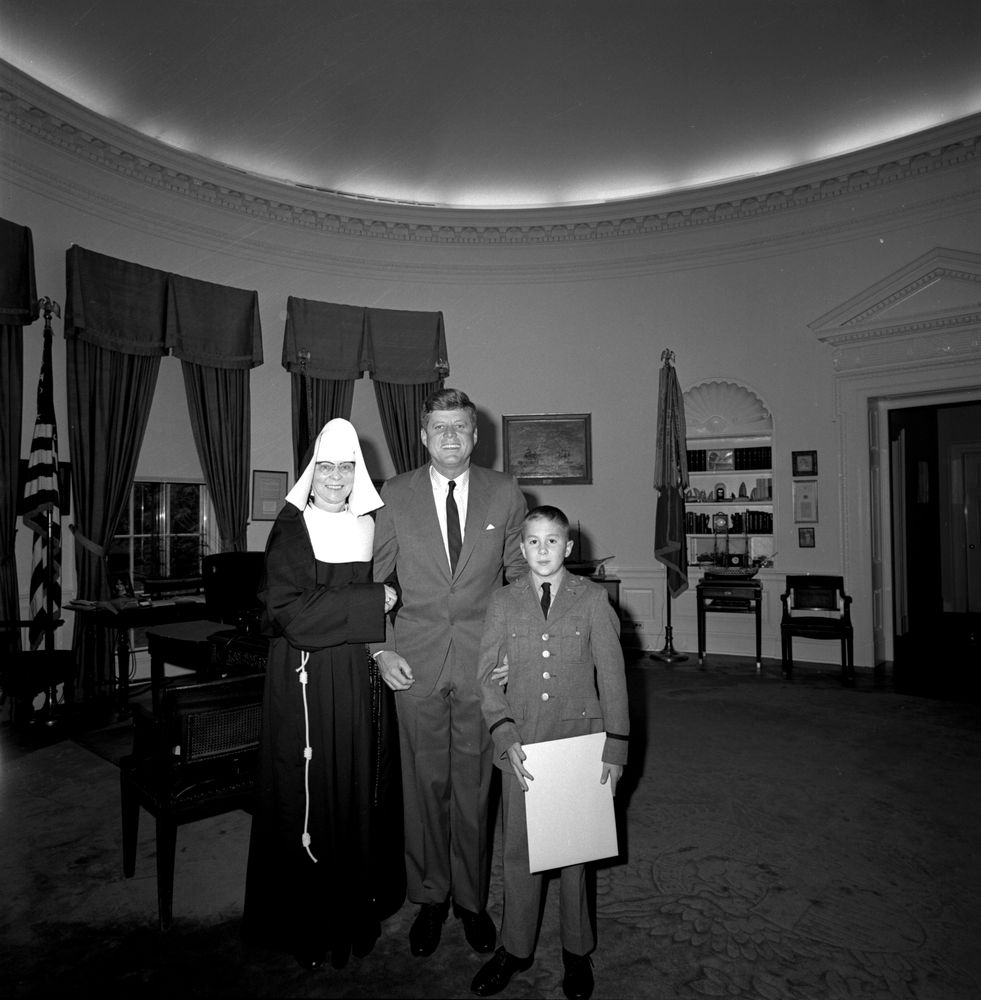
Photograph: President John F. Kennedy visits with Sister Domenica, of Stafford, England (native of County Galway, Ireland), and an unidentified boy in the Oval Office. White House, Washington, D.C., 6 November 1963.
Coup leader Major General Dương Văn Minh formally took office as the new head of state of South Vietnam, with civilian Nguyễn Ngọc Thơ as the prime minister.
Ambassador Lodge cables President Kennedy, “we could neither manage nor stop [the South Vietnamese coup] once it got started… It is equally certain that the ground in which the coup seed grew into a robust plant was prepared by us, and that the coup would not have happened [as] it did without our preparation.”
Major General Tôn Thất Đính, the new security minister in Saigon’s revolutionary government, warns that the Viet Cong Communists are trying to stir up strife between the Buddhists and Roman Catholics in South Vietnam. His statement echoes similar charges made by President Ngô Đình Diệm during the Buddhist crisis which led to Diệm’s overthrow and death.
The U.S. State Department announces that the American embassy in Saigon has received a note from the new revolutionary South Vietnam government requesting recognition as the successor to the Diệm regime and hoping for continued good relations between the two countries. The United States is expected to reply favorably to the request.
Madame Ngô Đình Nhu, tightlipped and pale, left her Los Angeles hotel suite this afternoon through a surging crowd of newsmen and spectators and took up residence in a luxurious Bel-Air villa to await the arrival of her three younger children from Rome. Dressed in a rust-colored sheath with mandarin collar, Madame Nhu stepped from an elevator into the lobby of the Beverly Wilshire shortly after 4 p.m. As the elevator doors slid open, pandemonium broke out. Newsmen and spectators surged around the diminutive former first lady of South Vietnam. An elderly woman, who kept asking what it was all about, was knocked down in the crush as two uniformed and two plainclothes Beverly Hills police officers fought to keep a lane clear to the hotel’s front door.
Soviet Premier Nikita Khrushchev told 21 leading American businessmen in Moscow today that the dispute over the United States convoy on the East German autobahn was ended when the United States yielded. In a three-hour interview, the text of which was released by the visiting group, Khrushchev also:
- Said that Soviet plans to buy American wheat may be canceled because of higher American rates for shipping the grain.
- Denied that the Soviet Union had given up plans to put a man on the moon. “We have never said we are giving up on our lunar project — you’re the ones who said that,” he said.
- Said that Russia was trying its best to solve friction with communist China and warned Americans to keep their noses out of eventual Sino-Soviet discussions.
Khrushchev said that if the convoy dispute on the Berlin superhighway had continued “it is possible that you and I would not be here today.” An American army convoy was detained 41 hours before it was released by the Russians early today.
Major General James H. Polk, American commandant in Berlin, says that his troops are “ready for any type of incident and are prepared for it.” His comment answers Premier Nikita Khrushchev’s warning in Moscow that more trouble may be coming on the superhighway to Berlin. “They are trying to make the point,” Polk says, “that they call the shots on the autobahn and we are determined that they will not make it.”
The “Big Three” western powers accused the Soviet Union of trying to hinder allied access to Berlin in the halting of a U.S. convoy for 41 hours, and demanded that such provocations by Soviet forces on the autobahn be ended at once.
With the Russians’ permission for the U.S. convoy to go forward on the East German autobahn, the allies in West Berlin won an important round in the international war of nerves.
A giant rescue drill is pushed into an air pocket in which 11 men have been trapped since October 24 in an iron mine at Peine, Germany. It is hoped that the men can be brought to the surface in a rescue capsule tomorrow. West German Chancellor Ludwig Erhard visits the mine to encourage the trapped men.
A Canadian jet airliner with 90 passengers and crew of 7 aboard crashed on take-off from fog-bound London airport tonight with one engine in flames. All escaped with their lives but were lost for a time in the fog in a muddy cabbage patch while rescue teams searched for them. It was reported the plane carried three containers of radioactive materials. One official insisted they could not have affected the plane’s instruments. An air lines spokesman said the only casualty was a stewardess who suffered a cut on one arm. An earlier report had said a man was injured. The Montreal-bound TransCanada DC8-F sped through swirling fog on its take-off run and ended up over the end of the runway. Passengers and crew escaped through emergency chutes within 90 seconds. Visibility was about 500 yards, airport officials said. The airport had been closed because of fog earlier in the day.
Cuban exiles will try to elect nonpartisan leaders next month to liberate their homeland from communism. The election will be world-wide by mail ballot. The announcement is made by Jose M. Bosch, president of the Bacardi company, who apparently is financing the election.
The U.S. Senate tonight continued its assault on the Kennedy administration’s foreign aid program, lowering the level of authorized spending to 3 billion, 742 million dollars in the fiscal year which began July 1. After a day of cloakroom huddles, in which Senate leaders of both parties conferred on strategy to defeat wholesale reductions in spending abroad, a compromise amendment was produced. It carried cuts totaling $460 million in the 4 billion- and 202-million-dollar measure. It was promptly approved by a unanimous vote of 89 to 0. On an earlier vote, the Senate had approved, 86 to 3, a 50-million-dollar reduction which was then included in the package proposal.
The House of Representatives approved a three-year, 1 billion- and 195-million-dollar college construction program designed to help colleges meet increased enrollments. The bill, a compromise drawn up by a Senate-House conference, authorizes $230 million annually in grants, loans of $120 million a year, and grants for the construction of graduate school facilities totaling $145 million. The bill allots $50,600,000 annually of the grant total to the states for the construction of public community junior colleges and public technical schools.
The House Rules Committee cleared the way for the third partisan squabble over the national debt that would raise the ceiling from $309 to $315 billion.
The Senate Rules Committee votes to hire an outside counsel to direct its investigation of Robert G. Baker, who resigned under fire last month as secretary for the Senate Democratic majority. Senator Everett B. Jordan (D-North Carolina) says the move, originally opposed by Democrats, was made to keep the inquiry above question.
A quiet move is under way in Washington to force a broadening of the Senate’s investigation of Robert G. Baker to include senators.
Returns from Tuesday’s off-year elections suggest that President Kennedy’s prospective try for re-election next year could be as close as the cliff-hanging 1960 campaign.
James R. Hoffa, Teamsters Union president, hit the trucking industry with a demand for $600 million a year in new wage and fringe benefits.
All signs indicate that New York Governor Nelson Rockefeller will formally announce tomorrow morning that he is a candidate for the GOP Presidential nomination.
In Midland, Texas, 17-year-old Laura Welch, who would later marry George W. Bush and become the First Lady upon his inauguration as President of the United States, ran a stop sign at the intersection of Farm Road 868 and Big Spring Street, and crashed into the side of a car driven by one of her classmates at Robert E. Lee High School, 17-year-old Michael Dutton Douglas. Laura Bush would finally write about the accident after her husband left office, in her 2010 memoir, “Spoken from the Heart,” recounting that she and her friend were hurrying to a drive-in movie. Douglas, whose neck was broken, died at the local hospital.
New, heavy concentration of cyanide contamination is found in a Mattoon, Illinois, sewer as a coordinated probe of cyanide pollution is launched by city, county, and state authorities. The Coles County state’s attorney says he is prepared to recall the county grand jury for consideration of any evidence of criminal responsibility which may be uncovered. As of yet, the source of the poison is unknown.
Dr. George E. Mueller, associate administrator of NASA, said the United States can assume leadership in space “in the next few years” despite the present lag behind Russia’s new maneuverable satellite.
Dow Jones Industrial Average: 744.03 (-5.19).
Born:
Laurene Powell Jobs, American businesswoman and philanthropist (Emerson Collective, widow of Steve Jobs), in West Milford, New Jersey.
Paul Brindley, British rock bassist (The Sundays), in Bristol, England, United Kingdom.
Steve Rehage, NFL defensive back (New York Giants), in New Orleans, Louisiana.
Brian Carey, NFL wide receiver (New England Patriots), in Woburn, Massachusetts.
Joe Stepanek, NFL defensive tackle (Minnesota Vikings), in Tama, Iowa.
Died:
Daniel Mannix, 99, Irish-born Australian clergyman who served as the Roman Catholic Archbishop of Melbourne for 46 years.

16 Days to Dallas.
 History Diaries